
The true role of AI in sales: boost performance in 2026
TL;DR:
- AI adoption in sales reached 99% among BDRs in 2026, transforming core sales tasks.
- AI enhances prospecting, lead scoring, personalized outreach, and pipeline forecasting, boosting efficiency.
- Human judgment and empathy remain essential for closing complex deals and building customer trust.
Here’s a number that should stop you cold: 99% of BDRs now use AI in some part of their sales workflow, up from 62% just one year ago. Yet most sales leaders at mid-sized IT companies in Europe are still wrestling with a fundamental question: does AI replace your sellers, or does it make them unstoppable? The confusion is understandable, and the stakes are real. This guide cuts through the noise. We’ll break down exactly how AI reshapes the sales process, which tools deliver the highest ROI for tech sales teams, how to build a human-AI collaboration model that actually works, and how to implement AI without derailing your team.
| Point | Details |
|---|---|
| AI supercharges efficiency | AI now handles critical tasks across the sales funnel, freeing up time for reps to focus on value-added work. |
| Collaboration is key | The most effective sales teams combine AI tools with human judgment and empathy for the best outcomes. |
| Adoption is nearly universal | In 2026, almost all sales teams use AI in some capacity, making it essential for staying competitive. |
| Start with clear strategy | To implement AI successfully, pilot in a high-impact area and keep improving with feedback from real sales use. |
With adoption rates skyrocketing, let’s break down exactly how AI is transforming the steps of sales. The shift has been dramatic and fast. AI adoption in sales reached 99% among BDRs in 2026, up from 62% in 2025. That’s not incremental growth. That’s a full market shift happening in twelve months.
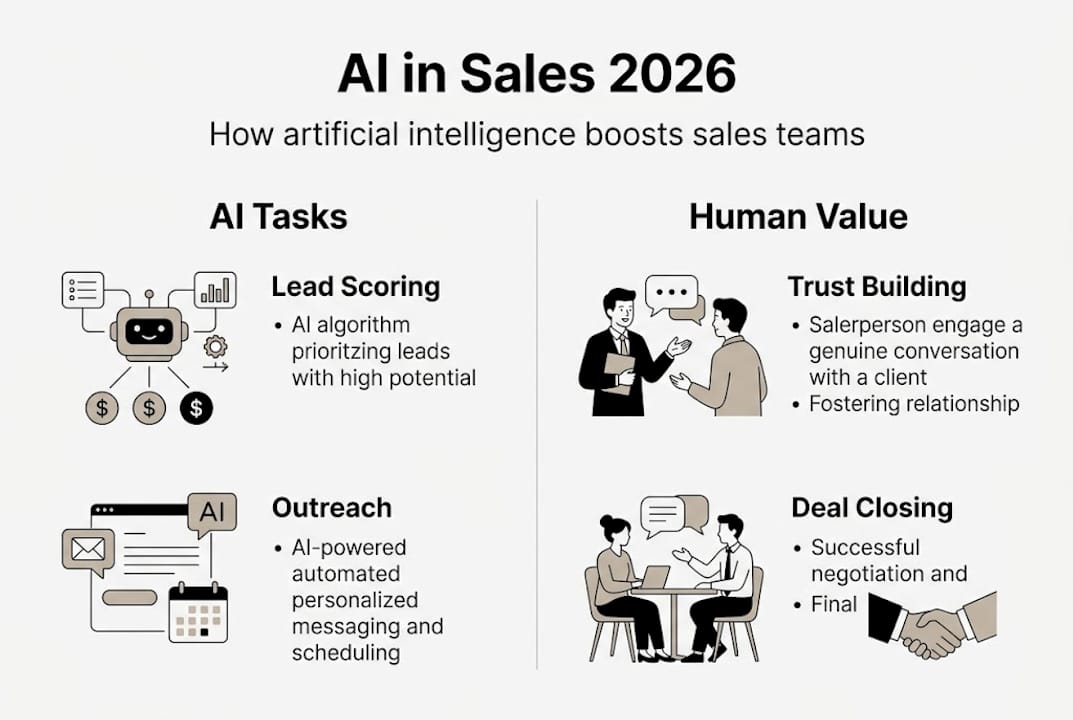
What’s driving it? Simple. AI is solving the most painful, time-consuming parts of the sales job. Prospecting used to eat up hours every day. Sorting through leads, researching prospects, personalizing outreach at scale: these were manual tasks that drained reps before they even got to their first meaningful conversation. AI changes all of that.
Here’s where AI is making the biggest impact across the sales process:
Let’s look at some concrete numbers to show the scale of these improvements:
| Sales stage | Without AI | With AI |
|---|---|---|
| Prospecting time per week | 10+ hours | 3-4 hours |
| Lead scoring accuracy | ~55-60% | ~80-85% |
| Email open rates (personalized) | 18-22% | 32-38% |
| Follow-up consistency | Varies by rep | Near 100% automated |
| Forecast accuracy | ~60% | ~80%+ |
Key stat: Sales teams using AI-powered outreach tools report up to a 50% improvement in response rates compared to manual sequences. That’s not a marginal gain. That’s a structural shift in what’s possible.
The AI reshaping sales tech story is also one of competitive pressure. If your team is still doing manual research and batch-and-blast emails while competitors run AI-powered sequences with real-time intent data, you’re already behind. The B2B sales tech trends for 2026 are clear: AI is no longer a nice-to-have layer. It’s the operating foundation. And AI in business operations more broadly confirms that companies integrating AI into core workflows see measurable efficiency gains across the board, not just in sales.
Now that you see the end-to-end impact, let’s zoom into specific high-value AI applications for your team. For mid-sized IT companies, the challenge is rarely “should we use AI?” It’s “which tools solve our actual problems, and how do we configure them properly?”
Here are the top five AI functions ranked by impact for tech sales teams:
Here’s a quick comparison of the manual versus AI-powered approach for the most common tasks:
| Task | Manual approach | AI-powered approach |
|---|---|---|
| Lead research | 30-45 min per prospect | 2-5 min with AI enrichment |
| Outreach personalization | Rep-written, inconsistent | Dynamic, data-driven at scale |
| Knowledge retrieval | Search docs, ask colleagues | Instant AI query response |
| Pipeline reporting | Manual CRM updates | Auto-logged, real-time dashboards |
| Proposal drafting | 2-4 hours per proposal | AI first draft in minutes |
A strong real-world example of AI in action: SNP, a German IT firm with over 1,500 employees, deployed an AI bot called Snappy to manage sales knowledge across scattered internal sources. Instead of reps digging through multiple systems to find the right answer for a prospect question, Snappy delivers the relevant information instantly. The result is faster responses, fewer errors, and reps spending more time actually selling.
You can explore proven AI sales workflows that replicate this kind of efficiency across your team. The AI sales strategy trends for 2026 point consistently toward knowledge management and intent data as the two highest-ROI starting points for mid-sized tech companies.
Pro Tip: AI tools only perform as well as the instructions you give them. Schedule a monthly prompt review session where your team tests and refines AI prompts based on what’s working in live conversations. This ongoing tuning is what separates teams that plateau from teams that keep improving.
As you adopt more AI, it’s crucial to understand the balance between technology and the irreplaceable human factor in sales. This is where most guides get it wrong. They either hype AI as a magic replacement for human effort, or they dismiss it as overhyped. The real picture is more nuanced and more actionable.
Let’s be direct about what AI cannot do:
“AI raises the floor but humans win deals via judgment and empathy. The teams that build operating models with clear escalations and continuous prompt tuning will hold a sustainable edge in 2026 and beyond.”
The smartest framing we use with our clients: think of AI as raising the floor, not the ceiling. Every rep becomes more consistent, better prepared, and faster at routine tasks. But the ceiling, those career-defining deals and the deepest customer relationships, is still set by human skill, judgment, and persistence.
This debate is worth digging into further. We’ve covered it from multiple angles in our piece on the AI and human sales debate, and explored practical strategies for surviving AI disruption in sales without losing what makes your team great.
Pro Tip: Define explicit handoff rules in your sales playbook. Spell out which interactions are AI-handled (initial outreach, FAQ responses, meeting scheduling) and which require a human (discovery calls, negotiation, executive relationships). Ambiguity here leads to poor customer experiences and missed deals.
Equipped with a realistic view of collaboration, here’s how to practically implement AI in your sales organization for immediate impact. Don’t try to boil the ocean. The companies that successfully integrate AI start focused and expand deliberately.
Here’s a practical four-phase implementation approach:
Before adopting any AI tool, make sure your team can answer these questions:
The most common pitfall we see? Teams buy the tool, skip proper onboarding, and then blame the technology when adoption stalls. Optimizing sales outreach at scale requires both the right tool and the right process wrapped around it. Similarly, automation for efficiency only pays off when it’s connected to a clear workflow, not bolted on as an afterthought.

For companies looking to scale sustainably, business automation for growth frameworks show that the organizations with the highest ROI from AI are those that treat implementation as an ongoing capability, not a one-time project.
Here’s what most AI playbooks skip: adoption and implementation are table stakes now. The real advantage is cultural, and it compounds over time.
The teams chasing the latest AI tools without building adaptive habits will always be one product cycle behind. The teams that win are the ones building a learning culture around AI, reviewing what works monthly, updating prompts, refining escalation rules, and treating their AI setup as a living system rather than a finished product.
As experts consistently confirm, AI raises the floor for the whole team, but the ceiling is still set by human judgment, empathy, and the ability to navigate complex commercial moments. Those critical junctures, a stalled negotiation, a skeptical economic buyer, a relationship under pressure, are where your people still make or break the deal.
The sales organizations growing most sustainably in 2026 are the ones blending AI efficiency with human excellence, and updating their 2026 sales strategy insights as both the technology and the market evolve. Structure beats heroics. And a well-calibrated human-AI system beats either one working alone.
Moving from theory to action is where most teams get stuck. You know AI matters. You’ve seen the data. Now comes the hard part: building the framework, choosing the right tools, and actually getting your team to adopt them.
At Sales Label Consulting, we work directly with RevOps leaders, Heads of Sales, and VPs at mid-sized IT companies to design AI-powered sales systems that get used and deliver results. Whether you’re starting from scratch or scaling an existing pilot, our step-by-step sales enablement frameworks give you a clear path forward. Explore our enablement best practices to see what strong foundations look like, and check out the 2026 sales enablement trends shaping the field right now. Let’s build something that actually works.
AI excels at lead scoring and outreach, managing sales data, and responding instantly to routine queries, freeing your reps to focus their energy on the complex conversations that close deals.
No. AI supports reps by handling repetitive tasks, but complex negotiations, relationship building, and final deal closure still require human judgment and empathy that no algorithm can replicate.
Begin with a focused pilot in one high-impact area, such as lead scoring or outreach automation. Choose tools that fit your existing workflow, train your team thoroughly, and refine based on the results from your pilot before expanding further.
In 2026, 99% of BDRs use AI in some part of their sales workflow, a dramatic jump from 62% just one year earlier.
Subscribe to our Insights: Expert productivity tips in your inbox
You'll receive 1-3 emails per month. Your data stays private, always.

CRO & Co-Founder with Sales Label Consulting

Watch our Sales Mates Podcast
Available
April 28, 2026 - 10 min read
Read article Read articleApril 28, 2026 - 10 min read
Read article Read articleApril 28, 2026 - 10 min read
Read article Read articleApril 28, 2026 - 10 min read
Read article Read articleDrop us a line to talk
about your project