
How leadership drives sales success in tech companies
TL;DR:
- Effective leadership accounts for 35% of salesperson engagement and significantly impacts sales results.
- Transformational leadership styles that inspire and enable teams outperform transactional approaches in tech sales.
- Leveraging AI and data is essential for modern sales leaders to improve forecasting, coaching, and pipeline management.
Most sales leaders believe results come down to rep talent. Hire better people, close more deals. It sounds logical, but it’s not the whole picture. Leadership practices account for 35% of variance in salesperson engagement, meaning the person at the top shapes outcomes far more than most organizations admit. For European tech companies running complex, multi-stakeholder B2B sales cycles, that gap between strong and weak leadership isn’t just noticeable. It’s measurable in ARR, win rates, and pipeline health. This article breaks down what effective sales leadership actually looks like, why it matters right now, and what you can do about it.
| Point | Details |
|---|---|
| Leadership shapes performance | Sales leadership influences results more than individual talent alone. |
| Blend leadership styles | Transformational and enablement practices outperform numbers-only management. |
| Adapt for European markets | EU sales demand cultural fluency, pipeline discipline, and longer-term strategy. |
| Leverage data and AI | Top leaders use AI and analytics for precise forecasting and rep enablement. |
| Leadership at every level | Cultivating leadership beyond titles accelerates team-wide sales success. |
Let’s look at the numbers first. Only 31% of sales reps exceed quota globally, with win rates sitting between 19% and 21% for average performers. Those aren’t typos. That’s the real baseline most orgs are working with. Now compare that to value-led deals, which win at 68%. The difference isn’t just methodology. It’s leadership setting the standard.
| Metric | Strong Leadership Teams | Weak Leadership Teams |
|---|---|---|
| Quota attainment rate | 45%+ | Below 25% |
| Pipeline win rate | 30%+ | 15% or below |
| Rep engagement score | High | Low to moderate |
| Deal cycle length | Managed and predictable | Unpredictable and extended |
Leadership shapes these numbers through a handful of core behaviors. It’s not magic. It’s consistency and structure.
“Value-led deals win at 68%, nearly triple the rate of average deal approaches. The differentiator isn’t the product. It’s how leaders train teams to sell value.”
Here’s how strong leaders move the needle:
The real talk here is this: if your team’s numbers are lagging, start by auditing the leadership behaviors, not just the reps’ scorecards.
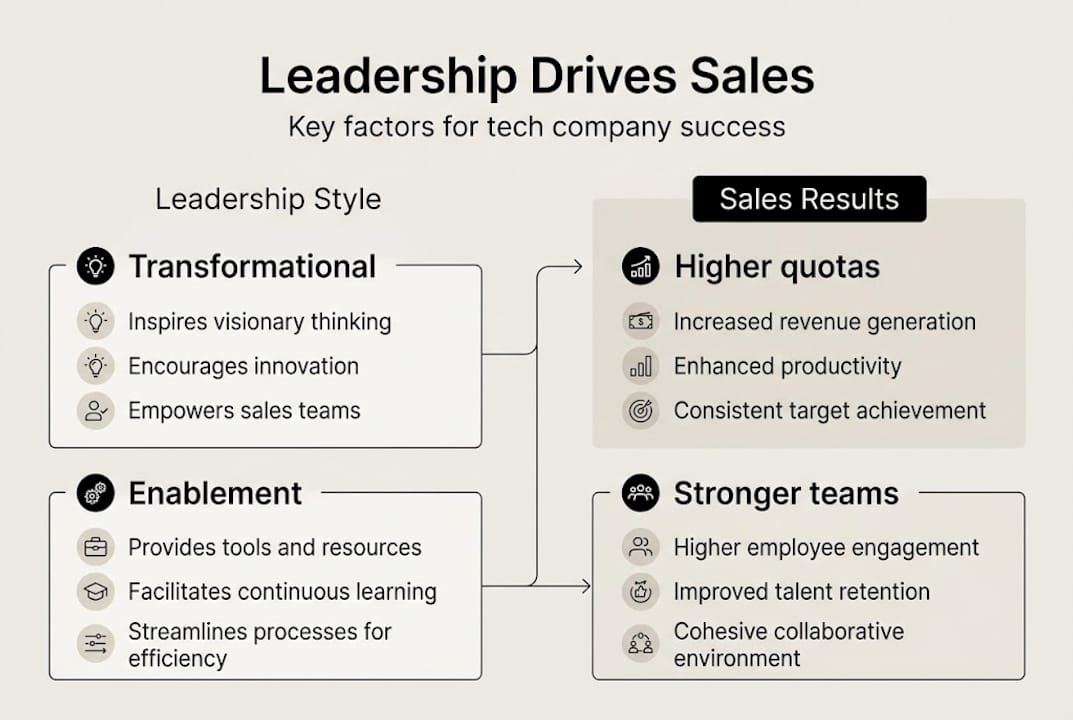
Not all leadership approaches are created equal. Research on sales leadership styles shows that transformational leadership consistently outperforms transactional models in motivation, performance, and team culture. The most frequently practiced high-impact behavior is “Enable Others to Act,” meaning top leaders build capability, not dependency.

| Leadership type | Focus | Effect on motivation | Effect on performance | Culture impact |
|---|---|---|---|---|
| Transactional | Targets and compliance | Moderate | Short-term | Rigid and hierarchical |
| Transformational | Inspiration and enablement | High | Sustained | Collaborative and innovative |
So what does this look like in practice? Here are the four leadership behaviors that consistently drive results in tech sales environments:
Pro Tip: Don’t pick one leadership style and stick to it religiously. Complex enterprise sales cycles in Europe demand a blend. Use transformational leadership to inspire and build culture, and shift to more transactional precision when managing quarterly targets or tight sprint cycles.
People-first, enablement-driven leadership isn’t soft. It’s the most commercially effective approach for tech orgs running long, relationship-heavy B2B cycles.
European tech sales is its own beast. If you’ve ever managed a deal across three countries, two languages, and a procurement committee with six stakeholders, you know what we mean. EU sales cycles run 15-20% longer than their US counterparts, and multi-stakeholder buying processes require a level of cultural awareness that many global playbooks simply ignore.
Here are the top challenges leaders face in the European tech market:
Stat callout: European B2B tech sales require up to 4x pipeline coverage to achieve predictable revenue. Build that into your planning from day one.
Pro Tip: Cross-cultural fluency is a leadership skill, not just a soft skill. Invest in training your managers and senior reps to navigate cultural nuance in decision-making, communication styles, and trust-building timelines. Use the EU sales process checklist to identify where your pipeline discipline may be breaking down.
The leaders who thrive in Europe aren’t the loudest or the most aggressive. They’re the most disciplined and culturally intelligent. That combination is rare. Build it deliberately.
If you want to stay current on what’s shifting in the European B2B landscape, B2B sales tech trends in 2026 are reshaping how top orgs plan and execute.
AI isn’t replacing sales leaders. It’s separating the ones who adapt from the ones who don’t. The top-performing heads of sales in European tech are already using AI not just for automation, but as a leadership tool. Top leaders leverage AI for opportunity identification, talent development, and more accurate pipeline management. That’s a fundamentally different use case than just automating email sequences.
Here’s where AI-empowered leadership is creating real separation:
The intersection of AI and sales strategy in 2026 means leaders need to be comfortable reading dashboards, questioning data models, and making calls based on signals, not just instinct. That’s a skill shift, and it’s non-negotiable.
The teams pulling ahead right now are those where leadership is fluent in both human motivation and machine-generated insight. Those aren’t competing skills. They’re complementary.
Here’s the uncomfortable truth most leadership content won’t say out loud: treating leadership as a static skill set is one of the fastest ways to fall behind in European tech sales. The market shifts. Buyer behavior shifts. AI shifts. Your leadership approach needs to shift with it.
Conventional wisdom frames leadership as something you learn once and apply consistently. We’d argue the opposite. The best sales leaders we’ve worked with are constantly recalibrating, reading their team’s energy, adjusting their coaching style based on individual rep needs, and integrating new tools into how they manage pipelines.
And here’s the contrarian view worth sitting with: leadership doesn’t belong only to people with titles. Some of the most impactful leadership behaviors in high-performing sales orgs come from senior reps, deal coaches, and RevOps analysts, not just the Head of Sales or VP. When you build leadership capacity at every level, you stop relying on heroics at the top.
For tech executives in Europe, the priority is clear: blend AI and data capabilities with EU-specific leadership adaptations. That combination is what separates predictable revenue from the roller coaster. Data and behavioral skills are not opposites. They’re your two strongest levers. Use both.
Reading about leadership impact is one thing. Turning it into repeatable performance is another. If you’re a Head of Sales, VP of Sales, or RevOps leader in a European tech company, you don’t need more theory. You need a structured path forward.
At Sales Label Consulting, we work directly with sales leaders to build the enablement frameworks, audit the gaps, and create the conditions for predictable, scalable revenue. Explore our step-by-step enablement guide to see how structured programs drive results. Check out sales enablement best practices adapted for tech orgs, and stay sharp with enablement trends shaping 2026. Let’s move from insight to impact.
Transformational and enablement-focused leadership consistently drives higher motivation and quota attainment among tech sales teams, outperforming compliance-driven, transactional approaches.
Transactional leaders manage by targets and compliance, while transformational leaders inspire, enable, and foster innovation, resulting in stronger long-term performance and team culture.
EU sales cycles run 15-20% longer due to multi-stakeholder processes and compliance demands. Leaders must build extended pipeline models and develop culture-savvy teams to navigate this successfully.
AI empowers leaders to identify at-risk opportunities early, personalize rep coaching, and manage pipelines with far greater precision than manual methods allow.
Absolutely. Distributed leadership across all levels, not just titled managers, consistently outperforms top-heavy structures where results depend on one or two individuals.
Subscribe to our Insights: Expert productivity tips in your inbox
You'll receive 1-3 emails per month. Your data stays private, always.

CRO & Co-Founder with Sales Label Consulting

Watch our Sales Mates Podcast
October 15, 2026 - 9 min read
Read article Read articleOctober 14, 2026 - 7 min read
Read article Read articleOctober 13, 2026 - 10 min read
Read article Read articleOctober 12, 2026 - 11 min read
Read article Read article