
How to Optimize RevOps: A 90-Day Playbook
Optimize RevOps by aligning your people, processes, data, and tech, then executing a phased 90-day program that starts with a hard audit and ends with a self-correcting revenue system. That’s the short version. Gartner frames RevOps as a strategic function requiring cross-functional alignment and enabling practices before you can scale, and Forrester’s research links RevOps investment directly to measurable revenue outcomes. The leaders who get this right don’t buy their way out of chaos. They build structure first.
Start this week with these six actions:
90-day roadmap at a glance:
The first metric every leader should track after launch: pipeline velocity (deals × win rate × average deal size ÷ sales cycle length). If it moves, your RevOps changes are working.
Optimizing RevOps requires a sequenced 90-day program: audit and align in Days 1–30, build and integrate in Days 31–60, and optimize and scale in Days 61–90, with pipeline velocity as your first tracking metric.
| Point | Details |
|---|---|
| Audit before everything | Map processes, tech, data quality, and handoff SLAs before changing anything. |
| Charter and sponsor first | A signed one-page charter and a named executive sponsor prevent scope creep and stalled decisions. |
| Data governance is not optional | Without field ownership and hygiene rules, CRM data degrades 30–40% annually. |
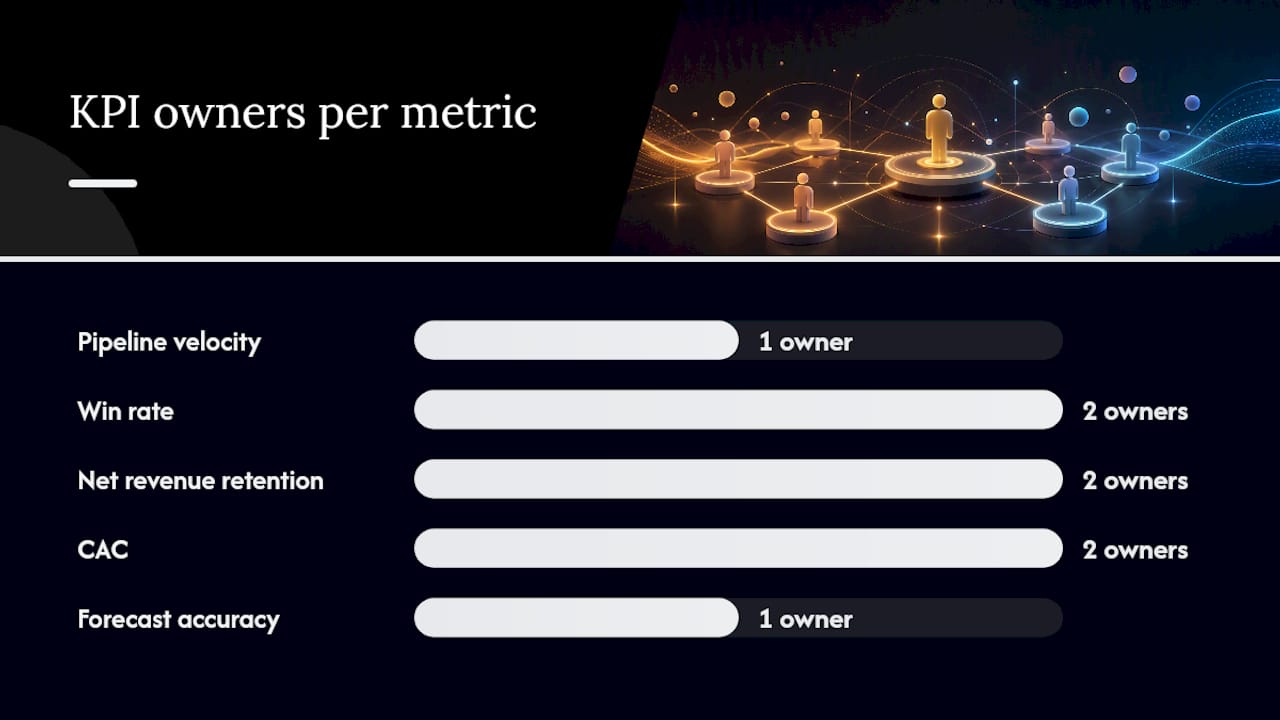
| Own five core KPIs | Pipeline velocity, win rate, NRR, CAC, and forecast accuracy cover the full revenue engine. |
| Saleslabelconsulting accelerates the work | Fixed-scope 60–90 day engagements deliver the audit, SSoT, SLAs, and KPI framework you need to run independently. |
You can’t fix what you haven’t mapped. Before you touch a single process or buy a new tool, you need a clear picture of where revenue breaks down today. Skipping this step is the single most common reason RevOps programs stall at Day 45.
Run a structured diagnostic across four areas:
Pro Tip: Run a five-step sales audit before your first stakeholder meeting. Walking in with data beats walking in with opinions every time.
RevOps touches every revenue-generating function, so the people you involve at the start determine whether the program survives past Day 60. You need a CEO or CRO as executive sponsor, plus working-level representatives from sales, marketing, customer success, and finance. Each person should understand the problem you’re solving, their role in the solution, and what success looks like for their team.
Produce four artifacts during preparation: a RevOps charter (one page, problem statement, scope, decision rights, and one primary success metric), a stakeholder RACI, a process map, and a data dictionary that defines minimum required fields for leads, contacts, accounts, and opportunities.
Your audit findings should directly shape your 90-day priorities. If handoff SLAs are undefined across the board, process standardization becomes your first build sprint. Let the diagnostic drive the sequence, not a template someone downloaded.
Salesforce recommends a four-pillar approach to RevOps: people and alignment, process, data, and technology. The sequence matters. Most teams get this backwards, buying tools before fixing process and wondering why adoption is low. Here’s the order that works.
Write and ratify the RevOps charter. One page. Problem statement, scope boundaries, decision rights, and one primary KPI. Get sign-off from your executive sponsor before anything else moves.
Complete the audit. Use the four-area diagnostic above. Set a hard deadline of Day 30. The output is a prioritized list of gaps, not a wish list of new tools.
Standardize processes and define handoff SLAs. Document every stage transition with a clear trigger, owner, and time-bound SLA. Example: “Marketing passes an MQL to sales within 4 business hours of hitting lead score threshold X.” Write it down. Put it in the CRM as a required field.
Establish a single source of truth. Your CRM is the authoritative record for pipeline and customer data. Every other tool reads from or writes to it. No spreadsheet pipelines, no shadow CRMs. This is non-negotiable at any company stage.
Integrate your tech stack. Prioritize CRM sync, lead routing, data enrichment, forecasting, and CS handoff in that order. Fix integrations before buying new tools.
Automate high-volume manual tasks. Lead assignment, stage-change notifications, renewal alerts, and data enrichment are the first candidates. Automate what’s repetitive and measurable. Don’t automate a broken process.
Run an enablement sprint. Train every revenue-facing team on the new process, the new SLAs, and how to use the CRM correctly. Enablement is not a one-time event. Build a feedback loop.
Launch your measurement cadence. Weekly pipeline standup, monthly process health review, quarterly forecast calibration. Tie each meeting to a specific metric threshold that triggers an action.
Pro Tip: Resist the urge to rip and replace your CRM in the first 90 days. Instrument what you have, measure the gaps, and only then decide if a platform change is warranted. Most teams need better governance, not a new tool.
Structure beats heroics at every stage. The playbook scales; the ad-hoc approach doesn’t.
The average company runs a significant number of SaaS applications across its revenue functions, and tool sprawl creates real integration and governance problems for RevOps teams. More tools don’t mean better data. They usually mean more places for data to break.
Good data governance is where most RevOps programs under-invest. Without it, CRM data degrades by 30–40% annually, and your forecasts become fiction. Run through this checklist quarterly:
What the authoritative source is for each revenue object:
| Revenue Object | Authoritative Source | Sync Target |
|---|---|---|
| Lead / Contact | CRM (e.g., Salesforce) | Marketing automation |
| Account | CRM | Data enrichment tool |
| Opportunity / Pipeline | CRM | Forecasting platform |
| Customer health score | CS platform | CRM (read-only field) |
| Product usage data | Product analytics | CRM (enrichment) |
RevOps should own the metrics that connect activity to revenue, not vanity counts. The goal is a small set of KPIs that every revenue team agrees on, measured consistently, and reviewed on a cadence that triggers real decisions.
| KPI | Why It Matters | Data Source | Owner | Review Frequency |
|---|---|---|---|---|
| Pipeline velocity | Measures revenue throughput | CRM | RevOps | Weekly |
| Win rate | Signals process and qualification health | CRM | Sales + RevOps | Monthly |
| Net revenue retention | Tracks expansion and churn | CS platform + CRM | CS + RevOps | Monthly |
| CAC | Measures efficiency of growth spend | Finance + CRM | Finance + RevOps | Quarterly |
| Forecast accuracy | Validates pipeline quality | CRM + forecasting tool | RevOps | Weekly + Quarterly |
Three meetings drive RevOps health:
New processes fail when people don’t use them. Governance and training aren’t administrative overhead. They’re the difference between a RevOps program that lasts and one that quietly dies by Day 75.
A charter prevents scope creep and clarifies who decides what. Keep it to one page with five elements: (1) the problem you’re solving, (2) the scope (what RevOps owns and what it doesn’t), (3) decision rights (who approves process changes, tool purchases, and KPI definitions), (4) the primary success metric for the first 90 days, and (5) the executive sponsor’s name and sign-off date. Post it somewhere every revenue team can see it.
RevOps should own process design, data governance, tech stack decisions, and KPI definitions. RevOps should support campaign execution, deal strategy, and customer success delivery. Sales, marketing, and CS each own their team’s execution within the defined process. Finance consults on CAC, NRR, and budget decisions. No one should be surprised by who decides what.
Pro Tip: Map your RACI before your first process change goes live. A handoff SLA that no one agreed to own is just a suggestion.
For training, run a pilot cohort of 3–5 reps before a full rollout. Collect structured feedback after two weeks. Fix the friction points before scaling. Incentivize correct CRM usage by tying it to pipeline reviews, not just compliance reminders. Reps who see their own data improve tend to maintain the behavior.
Most RevOps programs don’t fail because of bad strategy. They fail because of predictable, avoidable execution mistakes. Here’s the field guide.
Skipping the audit. You can’t prioritize fixes without knowing what’s broken. Mitigation: complete a full process, tech, data, and metrics audit before Day 30. Use a structured sales audit process to make it systematic.
Fixing tools before fixing process. A new CRM on top of a broken process is still a broken process. Mitigation: document and standardize your process first. Only then evaluate whether your current tools can support it.
Under-investing in data governance. Without field standards and ownership rules, data quality degrades fast. Mitigation: assign field-level ownership in Week 1 and run a deduplication pass before any new integrations go live.
No executive sponsor. RevOps crosses every revenue function. Without a CRO or CEO actively backing the program, cross-functional decisions stall. Mitigation: secure a named executive sponsor before the charter is written, not after.
Fragmented KPIs. When sales measures pipeline by stage count and marketing measures it by MQL volume, you’re not running one revenue engine. Mitigation: define shared KPI definitions in the charter and get sign-off from all three revenue functions before Day 30.
If you see two or more of these, run a triage audit immediately. Don’t wait for the quarterly review.
This is the phased plan. Each phase has deliverables, owners, and a clear readiness gate before you move forward.
Days 1–30: Audit and align. Complete the four-area diagnostic. Produce the RevOps charter, stakeholder RACI, process map, and data dictionary. Get executive sponsor sign-off. Readiness gate: all four artifacts exist and are approved.
Days 31–60: Build and integrate. Standardize all handoff SLAs. Establish the SSoT in your CRM. Complete priority integrations (CRM sync, lead routing, enrichment). Define KPI targets. Readiness gate: zero undefined handoff SLAs, CRM adoption above 80%, and all priority integrations live.
Days 61–90: Optimize and scale. Automate top three manual tasks. Launch enablement sprint. Run first full pipeline standup cadence. Measure forecast accuracy for the first time. Readiness gate: forecast variance measured, pipeline velocity baseline set, and enablement pilot complete.
| Phase | Days | Key Deliverables | Owner | Success Criteria |
|---|---|---|---|---|
| Audit & Align | 1–30 | Charter, RACI, process map, data dictionary | RevOps lead + exec sponsor | All artifacts approved |
| Build & Integrate | 31–60 | Handoff SLAs, SSoT, CRM integrations, KPI targets | RevOps + IT + sales ops | 80%+ CRM adoption, zero undefined SLAs |
| Optimize & Scale | 61–90 | Automation, enablement, pipeline cadence, forecast baseline | RevOps + enablement lead | Forecast variance measured, velocity baseline set |
The most common mistake is treating Day 90 as the finish line. It’s the starting line for continuous improvement. After Day 90, your job is to run the operating cadence, track the KPIs, and iterate on the process every quarter.
RevOps is not a title. It’s a function with specific accountability zones. Getting the roles right prevents the most common failure mode: everyone owns revenue, so no one owns it.

Head of RevOps (or VP of RevOps): Owns the charter, the KPI framework, the tech stack strategy, and the operating cadence. This person is the connective tissue between sales, marketing, and CS. They report to the CRO or CEO and have decision rights over process and tooling.
RevOps Analyst: Owns data quality, reporting, and dashboard maintenance. Runs the weekly pipeline standup data pull and the monthly health review. This role is the early warning system for the whole revenue engine.
Sales Operations Manager: Owns CRM configuration, territory management, quota setting, and comp plan administration. Works within the RevOps framework but focuses on the sales motion specifically.
Marketing Operations Manager: Owns the marketing automation platform, lead scoring, campaign attribution, and MQL-to-SQL handoff SLAs. Accountable for data quality on the top of the funnel.
CS Operations Manager: Owns the CS platform, renewal tracking, health score definitions, and the closed-won-to-CS handoff. Accountable for NRR data accuracy.
The accountability map is simple: RevOps owns the system. Each function owns execution within the system. Disputes about process go to the Head of RevOps. Disputes about strategy go to the executive sponsor. No gray zones. You can explore how sales team structure connects to RevOps success when designing your org chart.
RevOps budgets fail when they’re treated as a tech line item rather than a people-and-process investment. The real talk: most of the value in a RevOps program comes from the first 60 days of process work, which costs almost nothing except time and focus.
People before tools. A skilled RevOps analyst with a well-configured CRM outperforms a team with a bloated tech stack and no governance. Hire or designate a RevOps owner before purchasing any new platform.
Audit before spend. Run the 30-day audit before committing budget to new tools. The audit almost always reveals that existing tools are underused, not insufficient. Consolidating two redundant tools often frees up budget for the headcount you actually need.
Prioritize integrations over new platforms. A $500/month integration middleware (Zapier, Make, or a native connector) that connects your existing CRM to your marketing automation platform delivers more value than a $50,000 new platform that requires a 6-month implementation.
For a growth-stage B2B tech company, a practical RevOps budget splits roughly into three buckets: people (the largest share, covering a RevOps lead and one analyst), tools and integrations (existing stack optimization plus one or two new integrations), and enablement and training (documentation, onboarding, and ongoing coaching). The exact split depends on your audit findings, but the principle holds: people and process first, tools second.
When evaluating new tool purchases, require a documented business case tied to a specific audit gap, a named owner, and a 90-day adoption target. Tools without owners become shelfware within six months. For AI-driven content and reporting augmentation, an AI content optimization audit can help identify where automation adds real value versus where it creates noise.
Real talk: the clients who get the most out of RevOps optimization aren’t the ones with the biggest budgets or the most sophisticated tools. They’re the ones who commit to the audit, get an executive sponsor in the room on Day 1, and resist the urge to buy their way out of a process problem.
The most common gap we see? Teams that have invested heavily in CRM and marketing automation but have never documented a single handoff SLA. The tools are live. The data is there. But no one agrees on what “qualified” means, so the pipeline is full of noise and the forecast is a guess.
The highest-leverage fix, consistently, is a shared KPI definition session. Get sales, marketing, and CS in a room for two hours. Define pipeline, qualified lead, and churn together. Write it down. Put it in the charter. That one session often unlocks more forecast accuracy than six months of tool configuration.
In 90 days, we completed a full process audit, standardized five handoff SLAs, consolidated three redundant tools into one integration layer, and launched a weekly pipeline standup. The tools didn’t change. The process and accountability did.
Consulting accelerates this work because an outside perspective cuts through the internal politics that stall process decisions. When the Head of Sales and the VP of Marketing can’t agree on MQL definition, a neutral third party with a structured framework moves the conversation faster than another internal meeting.
If you’ve read this far, you know what good RevOps looks like. The harder question is whether you have the bandwidth to build it while running a live revenue engine.
Saleslabelconsulting works with B2B tech companies to design and implement exactly the systems this guide covers: 90-day RevOps audits, charter development, tech-stack consolidation, KPI frameworks, and sales enablement programs built for predictable revenue. Engagements are fixed-scope, typically 60–90 days, with clear deliverables at each phase gate. You get a process map, a working SSoT, defined SLAs, and a measurement cadence you can run independently after the engagement ends.

No retainer lock-in. No six-month discovery phase. Just a structured program that gets your revenue teams aligned and your pipeline data trustworthy. If you want to start with a diagnostic, our sales audit is the fastest way to identify your highest-leverage gaps before committing to a full engagement. Book a discovery call at Saleslabelconsulting to get started.
Subscribe to our Insights: Expert productivity tips in your inbox
You'll receive 1-3 emails per month. Your data stays private, always.

CRO & Co-Founder with Sales Label Consulting

Watch our Sales Mates Podcast
August 11, 2026 - 9 min read
Read article Read articleAugust 10, 2026 - 10 min read
Read article Read articleAugust 9, 2026 - 14 min read
Read article Read articleAugust 8, 2026 - 12 min read
Read article Read article