
Why Improve Pipeline Visibility: A RevOps Guide for Sales Leaders
Improving pipeline visibility is the single fastest way to move from gut-feel forecasts to defensible, board-ready numbers. When your team has real visibility, deals stop dying in silence, managers coach on evidence instead of instinct, and quarter-end surprises become rare.
Immediate business outcomes you get:
Organizations with mature sales analytics catch problems earlier and course-correct faster, translating directly into higher revenue growth. That’s the real case for pipeline visibility.
Improving pipeline visibility is the foundation of forecast accuracy, faster deal cycles, and smarter GTM investment — and it starts with data quality, not dashboards.
| Point | Details |
|---|---|
| Data quality comes first | Audit activity coverage and field completeness before buying any new tool or dashboard. |
| Redefine stages around buyers | Stages tied to buyer commitments, not seller tasks, produce reliable forecast signals. |
| Automate activity capture early | Automated logging removes rep friction and gives managers real deal signals to coach from. |
| Track six core KPIs | Pipeline coverage, velocity, stage conversion, deal aging, engagement score, and forecast accuracy give a complete health picture. |
| Saleslabelconsulting accelerates the fix | A sales audit engagement delivers a data-quality baseline and 90-day plan within the first month. |
Most teams confuse a dashboard with visibility. A dashboard is just a display. True visibility means your pipeline data is complete, accurate, and timely, and that it reflects actual buyer behavior, not rep optimism.
A truly visible pipeline shows you:
The distinction matters because redefining stages around buyer commitments rather than seller tasks is what separates a reliable pipeline from a wishful one. A stage that says “Proposal Sent” tells you what the rep did. A stage that says “Proposal Reviewed by Economic Buyer” tells you where the deal actually stands.
Poor visibility doesn’t just make forecasting harder. It makes every downstream decision worse: headcount planning, marketing spend, capacity modeling, and board guidance all run on pipeline data. When that data is stale or incomplete, the whole revenue machine runs on guesswork.
HBR research confirms that companies with a formal, standardized sales process generate more revenue than those without one. Process standardization is the foundation of visibility, and visibility is what makes forecasts credible.
The benefits break down by role:
There’s a cross-functional dimension too. Gartner research finds that 74% of B2B buyer teams demonstrate unhealthy conflict during the decision process. If you can’t see which stakeholders are engaged and which are resistant, you’re flying blind into the most dangerous part of the deal. Visibility that includes multi-stakeholder engagement signals is what lets your team navigate that conflict proactively.
When finance, marketing, and sales share a single source of truth, decisions shift from subjective debate to data-driven tradeoffs. That’s when quarterly reviews stop being surprises and start being confirmations.
Real talk: most visibility failures aren’t dashboard problems. They’re data problems. The root cause is almost always upstream, in capture and quality, not in the reporting layer.
Here’s what actually breaks visibility in most B2B sales orgs:
The sequencing matters here. The proven path is audit → standardize → automate → dashboard → review → AI signals. Don’t buy a new tool before you’ve fixed the process it’s supposed to support.
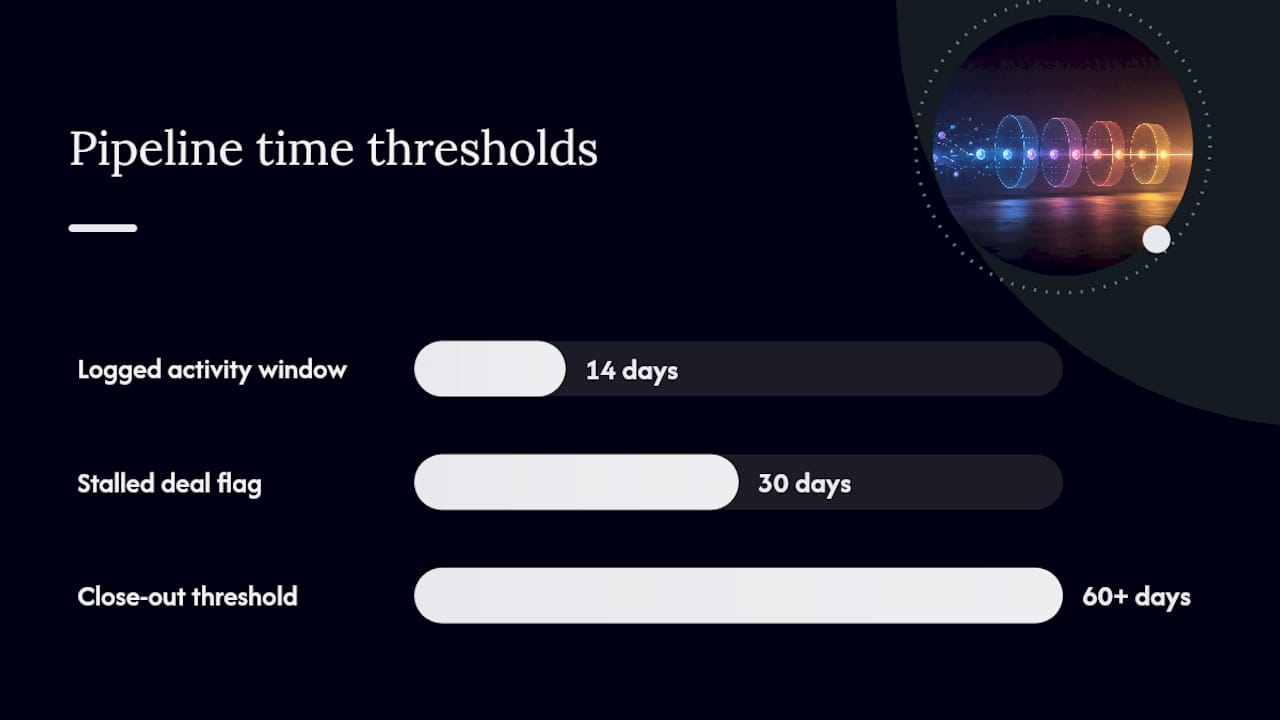
Start with a data-quality audit. Measure your baseline: what percentage of opportunities have a logged activity in the last 14 days? What percentage have a close date in the past? How many are missing a contact role? Those three numbers tell you more about your pipeline health than any dashboard.
Redefine stages around buyer commitments. Each stage should represent something the buyer did, not something the rep did. Add explicit entry criteria (“Economic buyer confirmed budget”) and exit criteria (“Mutual action plan signed”). This is the single highest-leverage process change you can make. For a deeper look at pipeline stage definitions, the terminology matters more than most teams realize.
Make activity capture non-negotiable, then automate it. Manual logging is a tax on reps. Automated activity capture that maps emails, calls, and meetings to the correct opportunity removes the friction and gives you reliable signal data. This is the highest-leverage technical fix available.
Instrument proposal and content engagement. Tools like GetAccept and DealHub let you see when a proposal was opened, how long a stakeholder spent on each section, and whether it was forwarded internally. That’s not a nice-to-have; it’s a direct window into late-stage buyer behavior.
Build role-specific dashboards and signal-based alerts. A rep doesn’t need the same view as a CRO. Configure alerts for deal-specific triggers (no activity in 10 days, stage age exceeding threshold, new stakeholder added) rather than relying on weekly meetings to surface problems.
Enforce stage time limits and a stalled-deal policy. Any deal that hasn’t moved in 30 days gets flagged. After 60 days with no activity, it moves to “Stalled” or gets closed out. A clean active pipeline is worth more than a padded one.
Quick wins vs. next-layer investments:
| Action | Effort | Impact | Owner |
|---|---|---|---|
| Required fields + validation rules | Low | High | RevOps |
| Close out stale deals (60+ days no activity) | Low | High | Sales Manager |
| Rewrite stage definitions with exit criteria | Medium | High | RevOps + Sales Leadership |
| Deploy automated activity capture | Medium | Very High | RevOps |
| Enable proposal engagement tracking | Medium | High | RevOps |
| Configure AI-based deal risk signals | High | Very High | RevOps |
Pro Tip: Flip the value proposition for reps. Instead of “log your activity so management can see it,” make it “log your activity and we’ll give you your next-best-action and coaching based on what’s actually happening in your deals.” Adoption follows value, not mandates.
For a full playbook on pipeline optimization tactics, the sequencing of quick wins versus longer investments is where most teams save months of wasted effort.
Six KPIs give you a complete picture of pipeline health and forecast reliability. Here’s how to calculate each one and why it matters.

| KPI | How to Calculate | Benchmark Target | Owner | Cadence |
|---|---|---|---|---|
| Pipeline coverage ratio | Total pipeline value / quota | 3x–4x for most B2B | RevOps | Weekly |
| Deal velocity | (# of deals × avg deal value × win rate) / avg sales cycle length | Improve quarter-over-quarter | RevOps | Monthly |
| Stage conversion rate | Deals advancing from stage N / deals entering stage N | Track trend, not absolute | Sales Manager | Weekly |
| Deal aging (stage time) | Average days a deal spends in each stage | Set per-stage SLAs | Sales Manager | Weekly |
| Engagement score | Composite of activity recency, proposal opens, stakeholder touches | Custom per org | RevOps | Daily/Weekly |
| Forecast accuracy | (Actual closed / forecasted closed) × 100 | Within 10% of commit | RevOps | Monthly |
Dashboard roles in practice:
Tracking these metrics consistently is what separates a team that reacts to missed quarters from one that prevents them. Connecting analytics to growth decisions is the same discipline applied to revenue operations.
Ownership without accountability is just org-chart decoration. Here’s the model that works:
Tiered cadence:
Weekly pipeline review agenda (30–45 min):
Escalation rules:
HBR’s research on formal sales processes supports exactly this kind of structured governance. Structure beats heroics every time.
This is the roadmap a VP of RevOps can present to the CRO on Monday and start executing immediately.
Days 0–30: Audit and baseline
Days 31–60: Quick fixes and process enforcement
Days 61–90: Automation and signals
Success metrics at 90 days:
This is the same sequencing Saleslabelconsulting uses in sales audit engagements for B2B tech teams. The 90-day window is tight enough to show results before the next board review.
The pattern we see across client work is consistent: teams that try to fix visibility by buying a new tool first almost always fail. The tool surfaces the mess rather than cleaning it up.
The sequence that works is data first, then process, then technology. You can’t automate your way out of a stage-definition problem. You can’t dashboard your way out of missing activity data. Fix the foundation, then add the tooling.
One concrete action you can take this week: run a 7-field completeness audit on your open pipeline. Check close date, primary contact, last activity date, deal value, stage, next step, and opportunity source. Any deal missing three or more of those fields is not a real forecast input. Close it out or flag it for immediate rep action.
The other pattern worth naming: visibility initiatives that frame data entry as surveillance die in 90 days. The ones that survive frame it as coaching infrastructure. When reps see that logging an activity triggers a useful next-best-action recommendation rather than a manager interrogation, behavior changes fast.
Pipeline visibility is a cross-functional discipline, as Executive Edge Magazine notes, requiring people, process, data, and technology to align. No single tool solves it. No single team owns it. But someone has to lead the initiative, and in most orgs, that’s RevOps.
If your forecast still depends on rep confidence rather than deal evidence, a sales audit is the fastest way to find out exactly where the gaps are and what to fix first.
Saleslabelconsulting works with B2B tech and IT companies to design the systems, processes, and governance that turn pipeline data into reliable revenue predictions. A typical engagement delivers a data-quality baseline, a prioritized 90-day fix plan, and manager coaching templates within the first month. No long retainer required to get started. The sales enablement framework we build around your pipeline becomes the operating system your RevOps and sales managers run on every week. Book a discovery call to see where your pipeline stands today.
Subscribe to our Insights: Expert productivity tips in your inbox
You'll receive 1-3 emails per month. Your data stays private, always.

CRO & Co-Founder with Sales Label Consulting

Watch our Sales Mates Podcast
August 9, 2026 - 14 min read
Read article Read articleAugust 8, 2026 - 12 min read
Read article Read articleAugust 7, 2026 - 13 min read
Read article Read articleAugust 6, 2026 - 10 min read
Read article Read article