
Head of Sales: 5 strategies for effective leadership
TL;DR:
- The Head of Sales role is focused on developing strategies, not just closing deals.
- Successful sales leadership balances strategic planning, team management, and revenue ownership.
- EU market complexities require longer sales cycles, multi-stakeholder engagement, and cultural awareness.
Most people assume the Head of Sales is just the team’s top closer. That’s the misconception that quietly kills revenue. The real job is developing and executing sales strategies aligned with company goals, not just pushing deals across the finish line. The difference between a tactically focused sales leader and a strategically grounded one can be 30% or more in annual revenue outcomes. In this guide, we break down exactly what it takes to lead a high-performing sales function in the EU, from building the right playbook to managing pipeline across complex, multi-country markets. No fluff. Just what works.
| Point | Details |
|---|---|
| Strategic leadership focus | A Head of Sales drives results by prioritizing strategy and aligning sales with company goals. |
| Enablement and methodology | Blending sales methodologies and disciplined enablement sets top teams apart from the rest. |
| EU-specific challenges | Longer sales cycles and cross-market complexity demand robust pipeline management and qualification. |
| From coaching to consulting | Lasting impact requires shifting from tactical deal help to strategic, team-wide enablement. |
| Outcomes over outputs | Success comes from focusing on qualification rigor and outcomes—not just activity volume. |
With the stage set, let’s get specific: what does a Head of Sales actually do, and why does it matter?
Strategic planning, team management, and revenue generation are the three pillars of the role. But here’s what most job descriptions miss: the balance between these three shifts dramatically depending on your company’s growth stage. Early-stage? You’re closer to the ground, running deals yourself. Scaling? Your job is to build systems that make heroics unnecessary.
The core responsibilities break down like this:
According to Sales Managers data from O*NET, the role demands a rare combination of analytical rigor and people leadership. You need to read numbers and read people. Both skills matter equally.
The must-have skills for EU Heads of Sales include structured thinking, cross-cultural communication, data fluency, and the ability to coach without micromanaging. If you’re excelling as a Head of Sales, you’re spending most of your time on strategic leverage points, not individual deals.
“Only disciplined strategic leadership consistently scales sales results. Activity without architecture is just noise.”
Pro Tip: Block two hours every week for strategic work only. No deal reviews, no Slack. If you don’t protect that time, firefighting will consume it. Structure beats heroics every single time.
The trap most Heads of Sales fall into is staying too close to the ground. It feels productive. It isn’t. Your highest-leverage move is building the system that makes your team better, not being the best rep in the room. Check out sales strategy examples to see how high-performing teams translate strategy into execution.
Understanding the ‘what’ is only part of the equation; let’s tackle the ‘how,’ and what sets high-performing Heads of Sales apart.
The best sales leaders don’t pick one methodology and enforce it religiously. They mix and match based on deal complexity, buyer sophistication, and team maturity. Hybrid methodologies and pipeline discipline consistently drive team performance in the 2024 B2B Sales Benchmark Report. Here’s a quick comparison to help you choose:

| Methodology | Best for | Core focus | Watch out for |
|---|---|---|---|
| MEDDIC | Complex enterprise deals | Qualification rigor | Overcomplicating SMB cycles |
| Challenger | Competitive, insight-led selling | Teaching and tailoring | Requires strong coaching culture |
| Activity Metrics | High-volume transactional sales | Volume and velocity | Mistaking activity for outcomes |
To implement a real enablement framework, follow these steps:
On the tech side, AI in sales enablement is a genuine accelerator, but only when your fundamentals are solid. AI surfaces insights; your team still needs to act on them intelligently. Don’t automate a broken process.
For sales talent management, HBR research confirms that what reps need from leaders changes at each career stage. Your enablement approach should reflect that reality.
Pro Tip: Enforce strict data hygiene and structured deal reviews. Teams that do this consistently show up to 11x improvement in pipeline velocity. It sounds tedious. It pays off enormously. Check sales leadership tips for more on building this discipline.
Choosing the right strategy only works if you match it to your market, so what should EU Heads of Sales prioritize?
The EU is not one market. It’s a collection of markets with different buyer behaviors, decision-making timelines, and cultural expectations. Ignoring that costs you deals. Here’s a snapshot of compensation benchmarks across key EU regions, based on EU salary benchmarks from Nobel Recruitment:
| Region | Base salary range | OTE range |
|---|---|---|
| DACH | €90,000 to €130,000 | €150,000 to €220,000 |
| Benelux | €85,000 to €120,000 | €140,000 to €200,000 |
| Nordics | €80,000 to €115,000 | €130,000 to €190,000 |
These numbers matter for attracting and retaining top talent. Underpaying your Head of Sales is one of the most expensive mistakes a company can make.
The unique challenges EU Heads of Sales face include:
For long B2B sales cycles, momentum maintenance is the skill that separates average from great. Use sales benchmarks 2026 to calibrate your quota-setting and pipeline targets against current market data.
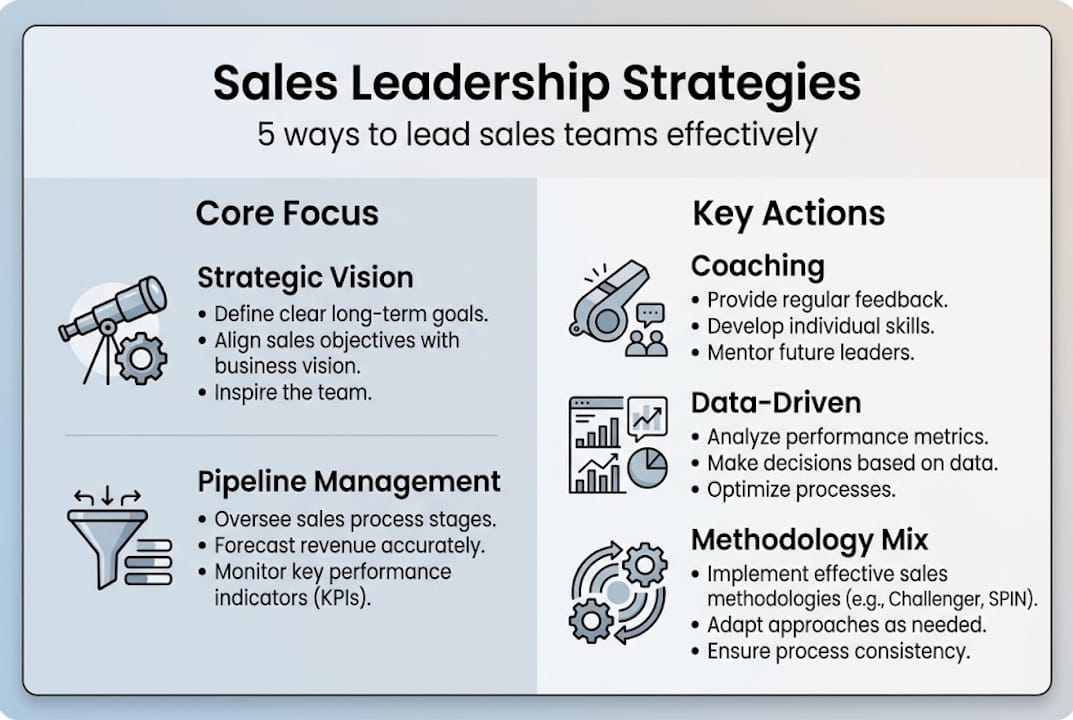
Data-driven decision-making isn’t optional in this environment. A well-structured RevOps team structure gives you the visibility you need to manage pipeline across multiple countries without losing control.
Having mastered operational execution, great Heads of Sales elevate their teams through strategic guidance. Here’s how the best do it.
There’s a meaningful difference between tactical coaching and strategic enablement. Tactical coaching is deal-level: helping a rep handle a specific objection or navigate a tricky stakeholder. Strategic enablement is systemic: building the processes, skills, and culture that make the whole team better over time.
Both matter. But most Heads of Sales spend 80% of their time on tactical and 20% on strategic. The ratio should be closer to 50/50 as your team scales.
Here’s how to shift from ad hoc advice to team-wide strategic process:
“Leaders who tailor their approach to where each salesperson is in their career see significantly better retention and performance outcomes than those who apply generic metrics uniformly.” — HBR, 2025
Pro Tip: Align your coaching moments with career stages. A junior rep needs confidence and process. A senior rep needs strategic challenge and autonomy. Mixing these up wastes everyone’s time and quietly damages morale.
For teams building a high-performance sales team from the ground up, the transition from tactical to strategic leadership is the single biggest growth lever available. Pair that with enablement best practices and you’re building something that compounds over time.
These practical frameworks are powerful, but there’s a hard lesson most executives discover too late.
High call counts and email volumes feel like momentum. They’re not. The 2024 B2B Sales Benchmark Report is clear: activity metrics alone are insufficient without a strong qualification focus. Top performers win because they qualify better, not because they dial more.
The cost of misaligned metrics is real. Teams chasing activity targets fill pipelines with junk. Forecasts become unreliable. Reps burn out running in circles. Leadership loses confidence in the data. It’s a slow-motion disaster that looks fine on the dashboard until it isn’t.
The fix isn’t complicated, but it requires discipline. Reframe your team’s focus from outputs (calls made, emails sent) to outcomes (qualified opportunities created, deals advanced, revenue closed). Track sales strategy trends to stay ahead of where the market is moving. The leaders who make this shift consistently outperform those who don’t. It’s not a theory. It’s what the data shows, year after year.
Ready to move from theory to results? Here’s how you can apply these principles.
Strategic consulting and modern enablement aren’t luxuries for large enterprises. They’re the fastest path to predictable, scalable revenue for any sales team serious about growth. If you’ve recognized gaps in your current approach, whether it’s methodology, pipeline discipline, or coaching structure, the next move is to get structured support.
At Sales Label Consulting, we work directly with Heads of Sales, VP of Sales, and RevOps leaders across the EU to build systems that produce consistent results. Explore our step-by-step enablement framework, review enablement best practices to benchmark your current state, or learn how consulting for sales growth can accelerate your team’s performance. Let’s build something that lasts.
The top KPIs are revenue growth, pipeline coverage of 3 to 4x, quota attainment, and deal qualification ratios. Pipeline discipline and qualification focus consistently separate top-performing teams from average ones.
EU Heads of Sales face 15 to 20% longer sales cycles and a heavier emphasis on multi-stakeholder qualification and champion development compared to their US counterparts.
Hybrid approaches combining MEDDIC and Challenger, paired with structured deal reviews and pipeline rigor, work best. Top performers use hybrid methodologies for consistently superior results across complex EU markets.
Compensation varies by region, but salary benchmarks for EU Heads of Sales show OTE ranges of €130,000 to €220,000 across DACH, Benelux, and the Nordics depending on company size and scope.
Activity volume must be paired with robust qualification and deal management. Outcomes over outputs is the principle that drives sustainable performance, not raw activity counts.
Subscribe to our Insights: Expert productivity tips in your inbox
You'll receive 1-3 emails per month. Your data stays private, always.

CRO & Co-Founder with Sales Label Consulting

Watch our Sales Mates Podcast
October 15, 2026 - 9 min read
Read article Read articleOctober 14, 2026 - 7 min read
Read article Read articleOctober 13, 2026 - 10 min read
Read article Read articleOctober 12, 2026 - 11 min read
Read article Read article