
Role of sales coaching: Drive tech team success in 2026
Many tech sales leaders believe informal mentoring suffices for team development. This assumption costs companies millions in unrealized revenue. Structured sales coaching transforms average performers into quota crushers by delivering personalized, ongoing skill development that directly impacts pipeline growth and close rates. For EU tech companies navigating complex B2B sales cycles in 2026, understanding sales coaching’s precise role separates thriving teams from struggling ones. This article reveals how effective coaching strategies boost performance, integrate with sales enablement, and deliver measurable ROI that RevOps and sales leaders can track and optimize.
| Point | Details |
|---|---|
| Sales coaching drives revenue | Personalized coaching directly improves close rates, pipeline velocity, and quota attainment through targeted skill development. |
| Coaching differs from training | While training provides broad knowledge, coaching focuses on applying skills to real deals with ongoing feedback. |
| Integration amplifies results | Coaching works best when embedded within comprehensive sales enablement strategies that align team behaviors with business goals. |
| Measurement enables optimization | Tracking metrics like win rate improvement and behavioral changes helps leaders refine coaching programs for maximum impact. |
| 2026 trends favor data-driven approaches | AI analytics and RevOps integration are reshaping how tech companies deliver scalable, personalized coaching. |
Sales coaching represents ongoing, personalized development that helps individual reps master skills needed to close complex deals. Unlike sales training topics that deliver standardized curriculum to entire teams, coaching adapts to each seller’s unique strengths, weaknesses, and learning pace. This distinction matters enormously in tech sales where products require deep technical knowledge and consultative selling approaches.
The core purpose of coaching centers on driving revenue-generating behaviors through real-time feedback and skill application. When a rep struggles with discovery calls, a coach observes actual conversations, identifies specific improvement areas, and guides practice until mastery develops. This targeted approach accelerates skill acquisition far beyond classroom training alone.
Tech companies face unique coaching challenges due to product complexity and lengthy sales cycles. Your reps must articulate technical value propositions, navigate multiple stakeholders, and handle sophisticated objections. Generic coaching frameworks fail here. Effective tech sales coaching addresses these specific scenarios, helping reps translate features into business outcomes that resonate with technical buyers and economic decision makers.
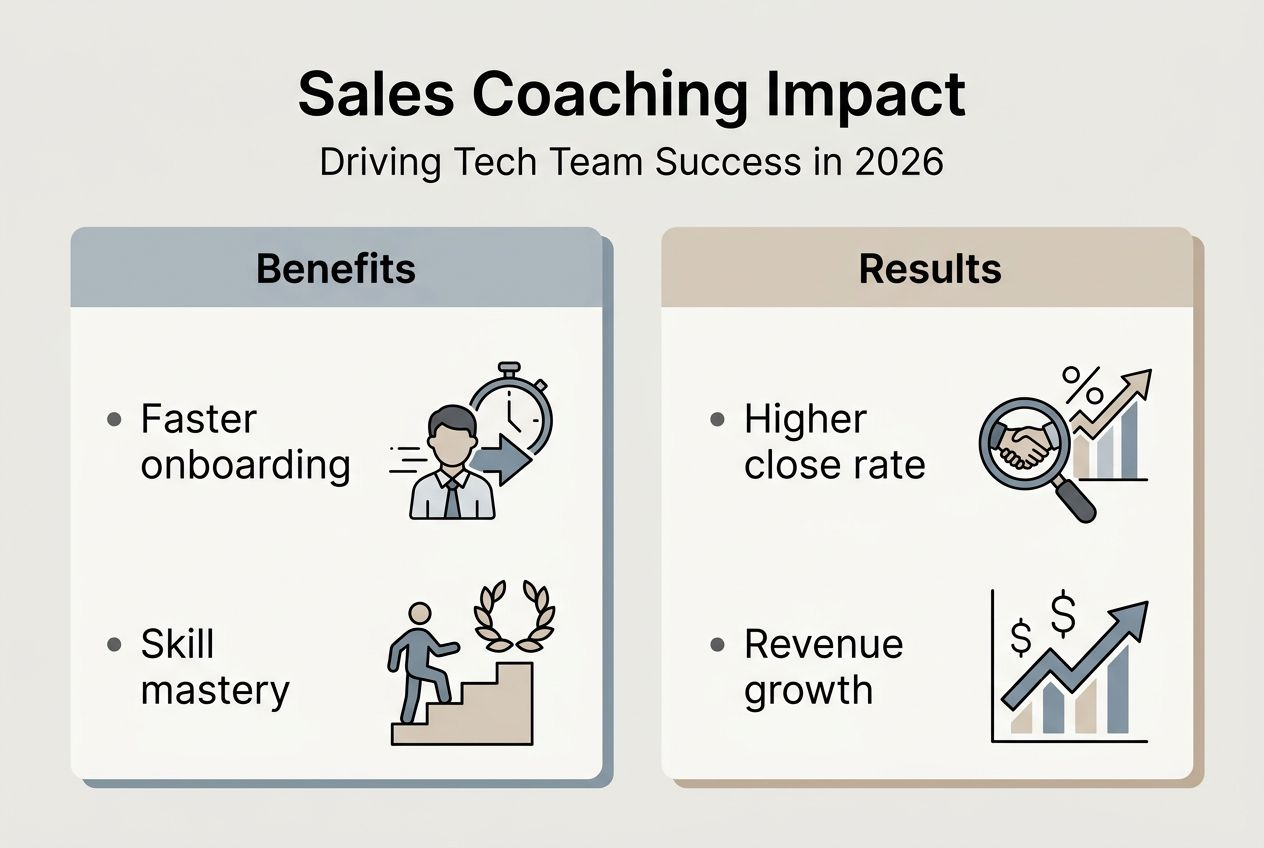
The benefits manifest quickly when coaching becomes systematic:
Pro Tip: Schedule weekly 30-minute coaching sessions focused on one skill area rather than monthly hour-long reviews covering everything. Concentrated practice builds muscle memory faster than sporadic broad feedback.
Implementing sales coaching techniques can boost sales pipelines by 28%, but only when leaders apply proven frameworks systematically. The most effective approach follows five sequential steps that transform coaching from occasional feedback into continuous development.
First, observe your reps in action. Listen to recorded calls, shadow live demos, or review email sequences. Collect specific examples of what works and what needs refinement. Second, deliver personalized feedback immediately after observation. Point to exact moments where different approaches would improve outcomes. Third, collaboratively set measurable goals tied to observed behaviors. Instead of vague targets like improve discovery, specify ask three business impact questions per call.

Fourth, conduct role-playing sessions where reps practice new techniques in safe environments. This builds confidence before high-stakes customer interactions. Fifth, review performance data weekly to track progress and adjust coaching focus. This cycle repeats continuously, creating compounding skill improvements over time.
The numbered approach looks like this:
Tailoring coaching to individual learning styles multiplies effectiveness. Some reps absorb concepts through reading and analysis. Others need hands-on practice and repetition. Visual learners benefit from frameworks and diagrams. Discover each rep’s preference early and adapt your coaching delivery accordingly.
Sales coaching that focuses on personalized skill gaps rather than generic best practices delivers 3x higher performance improvements, with coached reps exceeding quota at significantly higher rates than uncoached peers.
Integrate coaching moments into daily routines rather than treating them as separate events. Quick five-minute debriefs after calls, shared screen reviews of email drafts, and brief pipeline reviews all create coaching opportunities. This approach normalizes feedback and accelerates skill development without overwhelming calendars. Check out sales team coaching tips for additional frameworks that drive predictable results.
Sales enablement encompasses all resources, tools, content, and processes that help sales teams sell more effectively. Coaching represents one critical component within this broader ecosystem. When you align coaching with sales enablement best practices, the synergies multiply impact across your entire revenue organization.
The relationship between coaching and enablement works like this: enablement provides the playbooks, content, and tools while coaching ensures reps actually use these resources effectively in real selling situations. Without coaching, even the best enablement materials gather digital dust. Without enablement infrastructure, coaching lacks the frameworks and content needed to scale impact.
| Aspect | Sales Coaching | Other Enablement Types |
| — | — |
| Focus | Individual skill application and behavior change | Broad knowledge transfer and resource provision |
| Delivery | One-on-one or small group, ongoing | Classroom training, self-service content, tools |
| Measurement | Behavioral changes, skill mastery, deal outcomes | Content usage, training completion, tool adoption |
| Timeframe | Continuous, iterative development cycles | Episodic training events, always-on resource access |
| Personalization | Highly tailored to individual rep needs | Standardized for efficiency and consistency |
Data-driven coaching creates the bridge between enablement strategy and execution. When you track which content reps use in successful deals, you identify coaching opportunities around underutilized high-value assets. When call analytics reveal common objection handling gaps, you focus coaching sessions on those specific scenarios. This feedback loop continuously improves both coaching effectiveness and enablement resources.
Pro Tip: Build a coaching scorecard that tracks both activity metrics like sessions completed and outcome metrics like skill assessment scores. This dual measurement reveals whether coaching volume translates into actual capability improvements.
Buyer behavior constantly evolves, especially in tech markets where new competitors, technologies, and economic conditions shift dynamics rapidly. Coaching helps teams adapt faster than training alone because it addresses real-time challenges reps face today, not hypothetical scenarios from last quarter’s curriculum. The role of consulting in sales often includes this adaptive coaching element, helping teams navigate unprecedented situations with expert guidance.
Without measurement, coaching remains an act of faith rather than a strategic investment. Sales leaders and RevOps professionals need concrete frameworks to evaluate coaching effectiveness and optimize programs for maximum revenue impact. The right metrics reveal not just whether coaching happens, but whether it drives the behaviors and outcomes that matter.
Quantitative metrics provide objective performance indicators. Track quota attainment rates before and after coaching programs launch. Measure average deal size, sales cycle length, and win rates across coached versus uncoached cohorts. Monitor pipeline generation and velocity improvements. Calculate revenue per rep and compare coached teams to baseline performance. These numbers tell the financial story that justifies coaching investments.
Qualitative metrics capture the human elements that predict long-term success. Assess rep confidence through surveys and manager observations. Gather customer feedback about sales interactions. Evaluate skill mastery through recorded call reviews and certification assessments. Track rep engagement and retention rates. These softer measures often predict quantitative improvements before they appear in revenue reports.
| Metric Category | Specific Measure | Example Benchmark |
| — | — |
| Revenue Impact | Quota attainment rate | 75% to 85% post-coaching |
| Pipeline Health | Qualified opportunity creation | 25% increase quarter over quarter |
| Deal Execution | Win rate improvement | 18% to 24% within six months |
| Skill Development | Certification pass rate | 90% mastery on key competencies |
| Engagement | Coaching session attendance | 95% participation rate |
Collecting and analyzing coaching data requires systematic processes. Record all coaching sessions with permission and tag them by skill focus area. Use conversation intelligence platforms to track specific behaviors like question ratios, talk time, and objection handling approaches. Integrate coaching activity data with CRM systems to correlate coaching inputs with deal outcomes. Review trends monthly to identify which coaching interventions drive the strongest results.
Best practices for ongoing assessment include:
Pro Tip: Link coaching achievements to compensation and recognition programs. When reps see that skill development directly influences earnings and career progression, engagement with coaching programs skyrockets.
Understanding sales enablement metrics provides the broader context for evaluating coaching within your overall go-to-market strategy. The sales performance review process should incorporate coaching metrics to create accountability and continuous improvement loops.
You’ve learned how structured sales coaching drives measurable revenue growth for tech teams. Now comes the crucial question: how do you implement these strategies effectively within your organization? Sales Label Consulting specializes in helping EU tech companies build and scale coaching programs that deliver predictable results. Our expertise spans sales enablement, sales audits, and demand generation, all grounded in extensive entrepreneurial tech experience.
We work directly with RevOps, Heads of Sales, and VPs of Sales to design coaching frameworks tailored to your specific market challenges and team dynamics. Whether you need help establishing your first formal coaching program or optimizing existing initiatives, our proven methodologies accelerate time to results. Explore our comprehensive guide on sales enablement step by step to understand how coaching integrates with broader enablement strategies. Review sales enablement best practices for additional frameworks that complement coaching programs. Discover the types of sales enablement that work together to boost team performance and drive sustainable growth.
Sales coaching focuses on personalized, ongoing skill development tailored to individual rep needs and real deal situations. It involves observation, feedback, and iterative practice cycles that address specific performance gaps. Sales training topics typically cover broad curriculum delivered to groups, providing foundational knowledge rather than personalized skill application. Coaching happens continuously while training occurs in discrete events.
Pipeline growth, win rate improvements, and quota attainment increases provide the strongest quantitative signals of coaching effectiveness. These metrics directly connect coaching activities to revenue outcomes. Qualitative indicators like rep confidence scores, skill assessment results, and behavioral change observations predict future performance improvements before they appear in closed deals. Using sales enablement metrics to boost ROI helps evaluate coaching success within your broader go-to-market strategy.
Leverage technology platforms that track coaching activities, record sessions, and provide analytics on skill development patterns across your organization. Implement peer coaching programs where top performers mentor colleagues, multiplying coaching capacity without adding headcount. Establish standardized coaching frameworks and playbooks that ensure consistency while allowing personalization. Group coaching sessions for common skill gaps complement individual coaching for maximum efficiency. Review sales team coaching tips for additional scaling strategies.
Artificial intelligence and conversation analytics are transforming how coaches identify skill gaps and track improvement, making coaching more data-driven and objective. Growing integration between sales coaching and RevOps functions creates tighter alignment between coaching priorities and revenue goals. The shift toward continuous, personalized coaching modalities replaces traditional quarterly reviews with ongoing micro-coaching moments embedded in daily workflows. Sales enablement trends 2026 emphasize these data-driven growth strategies that position coaching as a competitive advantage.
Subscribe to our Insights: Expert productivity tips in your inbox
You'll receive 1-3 emails per month. Your data stays private, always.

CRO & Co-Founder with Sales Label Consulting

Watch our Sales Mates Podcast
October 15, 2026 - 9 min read
Read article Read articleOctober 14, 2026 - 7 min read
Read article Read articleOctober 13, 2026 - 10 min read
Read article Read articleOctober 12, 2026 - 11 min read
Read article Read article