
Sales Training Topics Explained: Elevate Team Performance
Leading a sales team at a mid-sized IT company in Western Europe often means facing mounting performance expectations and unpredictable market shifts. The pressure to master complex selling techniques and drive measurable results makes strategic sales training more than just a routine task. This guide breaks down the fundamental sales training concepts and advanced methods proven to optimize team performance and empower professionals to tackle intricate challenges with confidence.
| Point | Details |
|---|---|
| Sales Training Essentials | Effective sales training encompasses product knowledge, communication skills, and relationship management to enhance team performance. |
| Ongoing Learning is Vital | Continuous training is necessary for adapting to market changes and improving sales strategies over time. |
| Customized Approaches Matter | Tailoring training methods to specific organizational needs leads to better engagement and retention among sales professionals. |
| Avoid Common Pitfalls | Address mistakes like neglecting digital skills and inadequate personalization in training to maintain a high-performing sales team. |
Sales training represents a strategic approach to developing the knowledge, skills, and behaviors necessary for sales professionals to perform effectively in their roles. Sales training fundamentals encompass critical components designed to enhance individual and team performance across various industries.
At its core, sales training involves several key dimensions that organizations must address:
Successful sales training programs recognize that professional development is not a one-time event, but a continuous journey of improvement. Sales operations and management courses highlight the importance of ongoing learning, which includes territory management, forecasting techniques, and adaptive selling strategies.
Performance Optimization Framework
Effective sales training transforms individual contributors into strategic revenue generators who can consistently deliver exceptional results.
Pro tip: Design your sales training curriculum with modularity and flexibility, allowing for personalized learning paths that address individual skill gaps and organizational objectives.
Sales training methodologies are not one-size-fits-all, but rather dynamic approaches that adapt to specific organizational needs and learning contexts. Effective training principles demonstrate that successful programs must be flexible, learner-centered, and strategically designed to address unique industry challenges.
Organizations typically leverage several distinct training approach variations:
The landscape of sales training has evolved significantly, recognizing that different industries and sales teams require customized learning strategies. Sales education programs increasingly emphasize adaptive methodologies that can be tailored to specific organizational contexts, skill levels, and performance objectives.
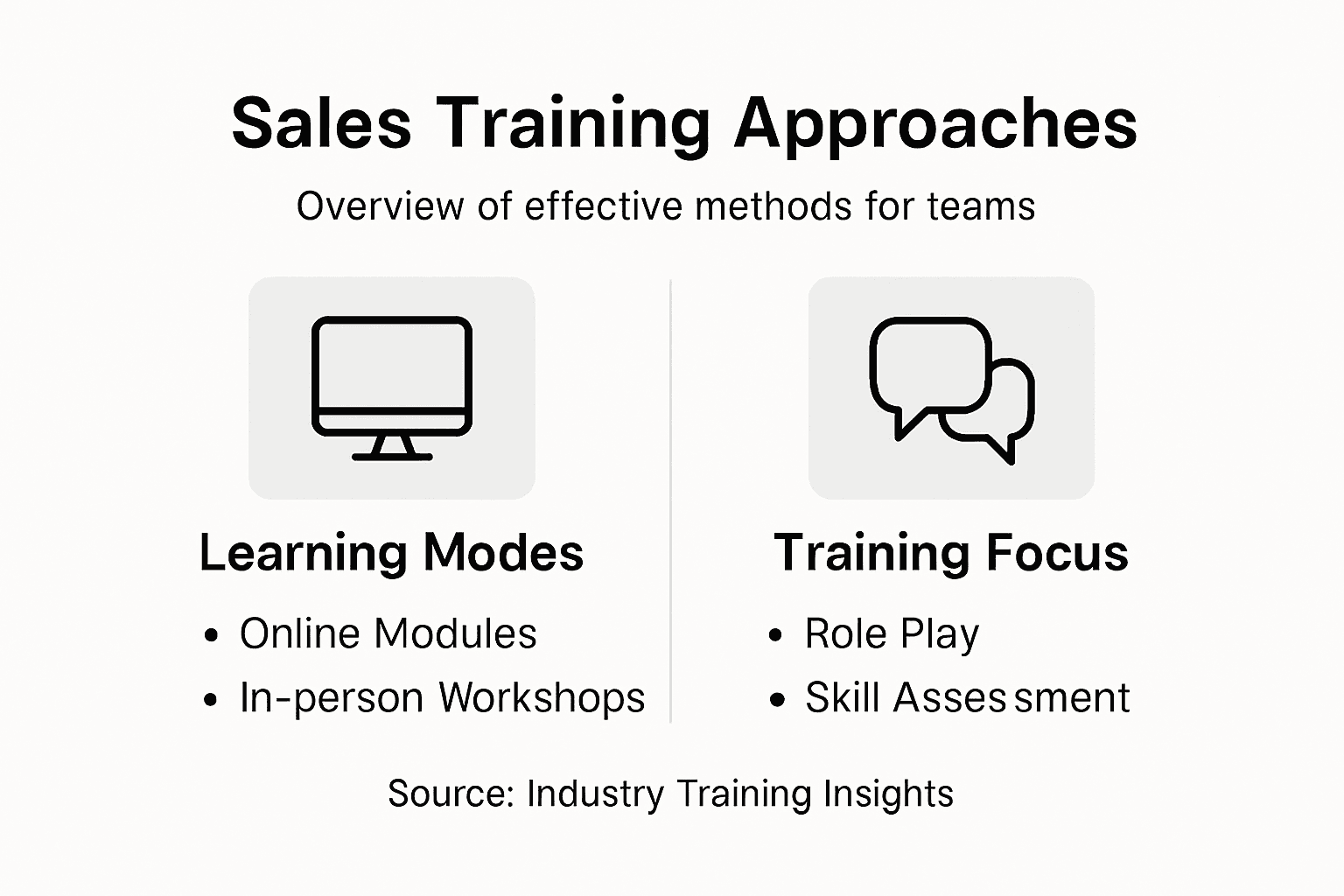
Here is a comparison of popular sales training methods and when they are most effective:
| Training Method | Best Use Case | Potential Drawback |
|---|---|---|
| Classroom Sessions | Deep skill building for new teams | Limited scalability for large teams |
| Online Learning | Flexible upskilling at scale | Lower engagement without oversight |
| Simulation/Role-Play | Practicing real scenarios | Resource-intensive to design |
| Mentorship Programs | Rapid onboarding for new hires | Results vary with mentor quality |
| Microlearning Modules | Fast skill refreshers and updates | May lack strategic context |
Training Approach Comparison
Successful sales training transcends traditional teaching models, creating immersive learning experiences that transform potential into measurable performance.
Pro tip: Develop a multi-modal training approach that combines different learning methods to accommodate diverse learning styles and maximize knowledge retention.
Successful sales professionals must develop a comprehensive set of skills that go beyond traditional selling techniques. Core sales skills encompass a dynamic blend of interpersonal, strategic, and technical competencies that enable consistent high-performance in competitive business environments.
The most critical skills for modern sales professionals include:
Sales job market research reveals that top-performing sales professionals distinguish themselves through their ability to anticipate customer needs and collaborate effectively across complex organizational landscapes. These skills require continuous learning and strategic personal development.

This summary outlines the impact of core sales skills on professional effectiveness:
| Skill Area | Direct Benefit | Example Application |
|---|---|---|
| Communication | Builds client trust | Negotiating with stakeholders |
| Problem Solving | Accelerates deal closure | Resolving objections |
| Technology Fluency | Boosts productivity | Using CRM analytics |
| Emotional Intelligence | Enhances relationship quality | Adapting to buyer signals |
| Adaptability | Responds to market shifts | Revising pitch strategies |
Skill Development Progression
Exceptional sales performance emerges from a deliberate commitment to mastering both technical competencies and nuanced interpersonal skills.
Pro tip: Develop a quarterly self-assessment routine that objectively measures your skill progression and identifies emerging areas for professional growth.
Navigating complex sales environments requires sophisticated strategies that transcend traditional selling approaches. Advanced sales techniques demand a nuanced understanding of customer dynamics, emphasizing adaptability and strategic resource deployment in increasingly competitive markets.
Key advanced techniques for addressing complex sales challenges include:
Challenger Sales Model represents a sophisticated approach to navigating complex B2B sales landscapes, where sales professionals challenge customer assumptions and guide them toward innovative solutions. This method requires deep market understanding, exceptional communication skills, and the ability to reframe customer perspectives.
Advanced Sales Strategy Framework
Exceptional sales performance emerges from the ability to transform transactional interactions into strategic partnerships.
Pro tip: Cultivate a continuous learning mindset by dedicating at least 5 hours weekly to understanding emerging market trends and advanced sales methodologies.
Sales training is fraught with potential pitfalls that can derail team performance and organizational growth. Common sales training errors often stem from outdated methodologies, misaligned incentives, and a failure to adapt to rapidly changing business landscapes.
The most critical mistakes sales organizations consistently make include:
Training program design requires a strategic approach that addresses systemic weaknesses in traditional sales training methodologies. Organizations must move beyond generic workshops to create adaptive, personalized learning experiences that genuinely transform sales team capabilities.
Mistake Prevention Strategy
Effective sales training is not about avoiding mistakes entirely, but about creating a culture of continuous improvement and adaptive learning.
Pro tip: Implement a quarterly skills audit that objectively measures individual and team performance gaps, enabling targeted and precise training interventions.
The article highlights the critical challenge of designing personalized, ongoing sales training programs that address key skills like communication mastery, adaptability, and advanced selling techniques. Many sales departments struggle to turn learning into measurable results while avoiding common pitfalls such as generic training and neglecting digital skill development. Sales Label Consulting understands these pain points and offers tailored solutions including sales enablement, comprehensive sales audits, and demand generation strategies that empower RevOps, Heads of Sales, and VP of Sales to confidently navigate complex challenges.

Are you ready to overcome training roadblocks and transform your sales department into a high-performance revenue engine Today at Sales Label Consulting, we harness our extensive entrepreneurial tech experience to deliver precise, error-free sales strategies. Explore how our Sales Enablement services and Sales Audit solutions can create continuous learning ecosystems tailored to your team’s specific gaps and goals. Take the first step towards predictable and scalable success by contacting us now and elevating your sales training to the next level.
An effective sales training program includes product knowledge, sales process mapping, communication skills, customer relationship management, and performance metrics to enhance individual and team performance.
Organizations can assess current team skills and implement targeted training interventions, using various methods like online learning, role-playing, and mentorship to accommodate diverse learning styles and performance goals.
Advanced techniques such as insight-driven selling, dynamic resource allocation, proactive customer mapping, and consultative problem solving help sales professionals address complex challenges and position themselves as strategic partners.
Common mistakes include neglecting digital skill development, creating ineffective performance incentives, applying generic training approaches, and treating training as a one-time event rather than an ongoing process.
Subscribe to our Insights: Expert productivity tips in your inbox
You'll receive 1-3 emails per month. Your data stays private, always.

CRO & Co-Founder with Sales Label Consulting

Book a free consultation
October 15, 2026 - 9 min read
Read article Read articleOctober 14, 2026 - 7 min read
Read article Read articleOctober 13, 2026 - 10 min read
Read article Read articleOctober 12, 2026 - 11 min read
Read article Read article