
Unlock predictable revenue with smarter sales competency frameworks
TL;DR:
- Sales competency frameworks should address sales DNA, coaching, and real-world team dynamics.
- Building tailored frameworks and maintaining ongoing coaching are key to sales success.
- Overemphasis on training volume or perfect frameworks often fails without cultural and behavioral reinforcement.
Most sales leaders in IT believe the fix is simple: run more training, add another workshop, bring in a new vendor. But training volume alone does not equate to improved sales outcomes. The real differentiators are Sales DNA, coaching quality, and how well your framework maps to your team’s actual reality. If you’re running a complex B2B tech sales motion across European markets, the stakes are even higher. This guide cuts through the noise and gives you a clear, actionable picture of what sales competency frameworks actually are, what makes them work, and how to build one that drives predictable, measurable revenue.
| Point | Details |
|---|---|
| Sales DNA matters most | Developing beliefs and mindsets drives more sales growth than skills training alone. |
| Multiple success pathways | Top performers thrive through diverse combinations of competencies, not one rigid mold. |
| Tiered metrics boost predictability | Tracking leading and mid-stage indicators improves forecast accuracy and coaching. |
| AI is a tool, not a crutch | Data and automation amplify frameworks but require a foundation of proven methods. |
| Coaching sustains gains | Ongoing leadership support turns competency models into reliable results. |
A sales competency framework is a structured model that defines the critical knowledge, skills, behaviors, and underlying beliefs your salespeople need to perform consistently. Think of it as the operating system for your sales team. Without it, you’re relying on individual heroics instead of repeatable process. Structure beats heroics every time.
For IT sales teams, the core components typically include:
That last point is where most frameworks fall short. Sales DNA gaps, not tactical skill deficiencies, are the largest limitation in IT sales force effectiveness. Research shows that 37% of sales reps lack a consultative approach at the DNA level, meaning no amount of skills training will fix it without addressing underlying beliefs.
When you build a framework that covers all these dimensions, you align your hiring criteria, onboarding, development plans, and coaching conversations around the same north star. That alignment is what creates outcome predictability.
For a deeper look at how this plays out in practice, optimizing IT sales teams requires exactly this kind of structural clarity.
“Assessment scores predict performance, but coaching and leadership environment moderate outcomes.” The framework sets the ceiling. Your culture and coaching determine how close you get to it.
With clarity on purpose and structure, sales leaders must decide between building a tailored framework or adapting an existing one. This is a real decision with real tradeoffs, and getting it wrong costs you months.
Here’s an honest comparison:
| Factor | Build (custom) | Buy (off-the-shelf) |
|---|---|---|
| Customization | High | Low to medium |
| Cost | Higher upfront | Lower upfront |
| Speed to deploy | Slower | Faster |
| Team engagement | Higher buy-in | Risk of rejection |
| Adaptability | Built-in | Requires workarounds |
| Tech integration | Designed to fit | May need retrofitting |
Off-the-shelf frameworks are tempting because they feel safe and fast. But importing a generic model into an IT sales context without adaptation is one of the most common mistakes we see. Your reps sell six-figure SaaS contracts or complex infrastructure solutions. A framework designed for transactional retail sales will not resonate, and it will not stick.

AI in sales frameworks has changed the assessment game significantly. AI tools can analyze call recordings, CRM data, and behavioral signals to surface competency gaps faster than any manual review. But here’s the catch: AI improves framework analysis only when a strong underlying sales methodology is already in place. AI amplifies what’s there. If the methodology is weak, AI just surfaces weak patterns faster.
Keeping an eye on sales tech trends 2026 will help you stay ahead of which tools are actually delivering ROI versus which ones are just noise.
Pro Tip: Before finalizing any framework, run it by three or four frontline managers and cross-reference it against six months of actual sales data. If the competencies don’t map to what’s actually winning or losing deals, you’ve built a beautiful document that nobody will use.
After deciding on your foundational approach, the real power comes from embedding advanced elements that reflect the complexity of your team and the modern sales environment.
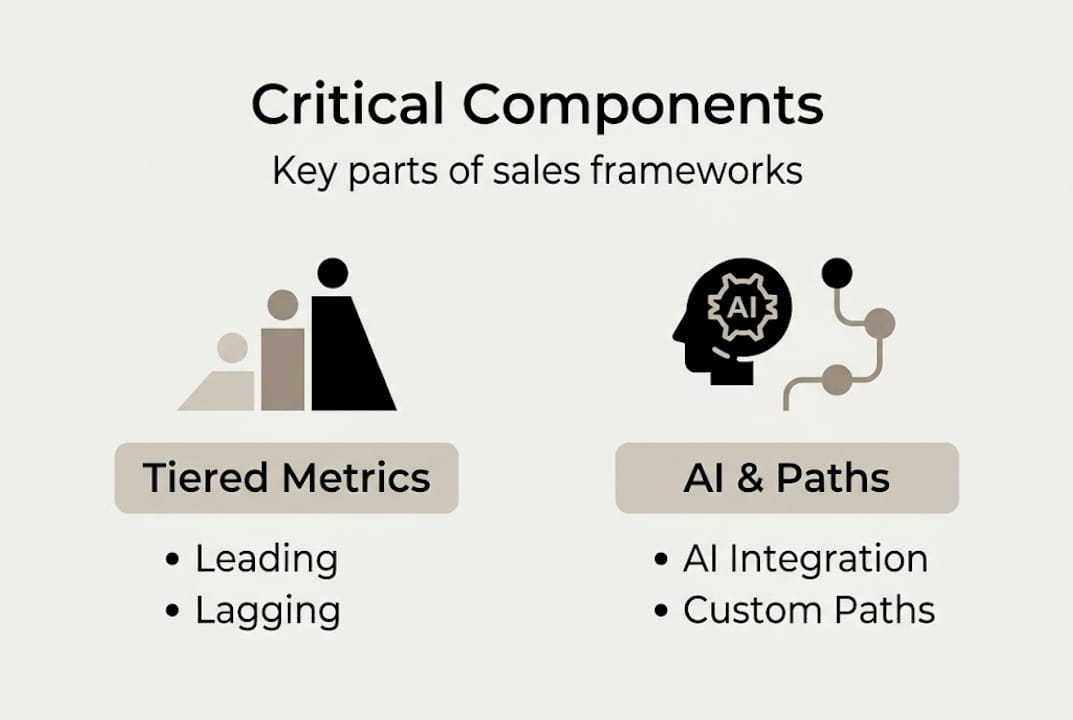
Tiered metrics are non-negotiable. Most leaders only track lagging indicators like closed/won revenue. That’s like driving by looking in the rearview mirror. You need all three tiers:
| Metric tier | Examples | What it tells you |
|---|---|---|
| Leading | Calls made, proposals sent | Activity and pipeline input |
| Mid-stage | Demos completed, opportunities created | Conversion momentum |
| Lagging | Closed/won, ARR, churn rate | Actual revenue outcomes |
When you track all three, you can intervene early. You spot the rep who’s making calls but not converting to demos. You catch the pipeline that looks healthy but has stalled mid-stage. Tiered leading indicators and AI amplifiers drive better performance prediction and management than lagging metrics alone.
Another insight that most frameworks ignore: configurational approaches with multiple competency pathways are statistically superior for heterogeneous sales teams. Translation: not every top performer looks the same. Some win on deep technical credibility. Others win on relationship and consultative depth. Your framework needs to accommodate both.
Here’s how to integrate AI and tiered metrics quickly:
For practical guidance on AI sales workflows and how to structure coaching sales teams around these signals, those resources will save you significant trial and error.
Pro Tip: Monitor for over-automation. AI should surface insights for your managers to act on, not replace the judgment call. The moment your managers stop questioning AI outputs is the moment the system starts drifting.
Even the best-designed competencies fall flat without the right ongoing support. Here’s how to make frameworks live in your sales organization.
A framework predicts potential. Coaching and leadership environment are what translate that potential into lasting competency. This is the part most organizations underinvest in after the initial framework rollout. The energy goes into design and launch, then coaching gets deprioritized when quota pressure kicks in. That’s a mistake.
Practical actions leaders can take right now:
Statistic callout: 37% of IT sales reps show weakness in consultative selling at the DNA level. That’s not a skills gap you close with a two-hour workshop. It requires sustained coaching, belief-level work, and a culture that rewards curiosity over pitching.
For specific techniques, tech sales coaching techniques and foundational sales teaching give you proven starting points. And if you want to build a more efficient rhythm, optimizing coaching workflow is worth your time.
“No matter how strong your framework, poor coaching turns potential into static.” The framework is the map. Coaching is what gets the team to actually move.
Here’s the uncomfortable truth we see repeatedly working with European IT sales organizations: leaders spend enormous energy selecting or building the “perfect” framework, then wonder why nothing changed six months later.
The research is clear. Overemphasizing the perfect framework distracts from the real work: DNA-building, coaching, and tailored competency paths. Most vendors won’t tell you this because they’re selling you the framework itself.
“It’s not the template, but the belief shifts and feedback loops that move the revenue needle.”
What actually works is investing as heavily in ongoing coaching and cultural practices as you do in framework selection. It’s running configurational analysis to understand your team’s unique pathways to success, not forcing everyone into one ideal profile. It’s resisting the checklist obsession where frameworks become compliance exercises rather than living performance tools.
If you want to see how a consultant’s role in sales improvement actually accelerates this, the difference is in how the work gets embedded, not just designed.
Real talk: the organizations that get the most from their frameworks are the ones that treat them as living systems, not documents. They review, adjust, and recommit to coaching every quarter. That’s what separates predictable revenue from wishful thinking.
If you’re ready to turn insight into action, these expert-curated resources and services will help operationalize and scale your improved competency framework.
At Sales Label Consulting, we work directly with RevOps leaders, Heads of Sales, and VPs across European IT companies to build frameworks that actually get used. Whether you need a step-by-step sales enablement roadmap, want to benchmark against best practices for scaling revenue, or need clarity on which metrics to boost sales ROI are worth tracking, we’ve got the playbooks. Let’s build something that actually moves your revenue needle.
Sales DNA refers to the underlying beliefs and mindset that drive behavior, while skills are the tactical actions a rep takes. DNA gaps like weak consultative selling beliefs hold back performance far more than skill deficiencies do.
AI helps detect leading indicators and calibrate frameworks in real time, but it only works when grounded in sound sales methodology. AI boosts but requires a strong underlying framework to deliver meaningful insight.
Because there is no single path to success in complex sales. Configurational research shows that multiple competency routes can lead to top performance, which is why rigid one-size-fits-all profiles miss the mark.
Focusing on template selection instead of ongoing coaching and cultural reinforcement. Overemphasis on training volume without DNA development and consistent coaching consistently fails to produce sustained gains.
Subscribe to our Insights: Expert productivity tips in your inbox
You'll receive 1-3 emails per month. Your data stays private, always.

CRO & Co-Founder with Sales Label Consulting

Watch our Sales Mates Podcast
Available
June 22, 2026 - 7 min read
Read article Read articleJune 21, 2026 - 8 min read
Read article Read articleJune 20, 2026 - 8 min read
Read article Read articleJune 19, 2026 - 8 min read
Read article Read articleFix the System
Not Symptoms