
Optimize your sales coaching workflow for 2026 results
Sales coaching remains one of the most powerful levers for improving team performance, yet many sales leaders struggle to balance frequency, methodology, and measurable impact. Without a structured workflow, coaching efforts become inconsistent, time-consuming, and difficult to scale across growing teams. This guide provides a practical framework to transform your sales coaching into a repeatable system that drives win rates, quota attainment, and revenue growth. You will learn the prerequisites, planning steps, execution tactics, and measurement strategies needed to optimize your coaching workflow for sustainable success in 2026.
| Point | Details |
|---|---|
| Coaching frequency drives results | Weekly coaching sessions deliver 353% ROI and 107% quota attainment compared to 88% without structured coaching. |
| Balance human and AI approaches | Combine human relationship-building with AI-powered data analysis to scale coaching without losing personalization. |
| Structure creates consistency | A step-by-step workflow with clear preparation, execution, and verification phases ensures repeatable coaching success. |
| Measurement enables iteration | Track win rates, quota attainment, and qualitative feedback to continuously refine your coaching approach. |
The business case for consistent sales coaching has never been stronger. Coached teams achieve 28% higher win rates, 19% higher revenue, 76% quota attainment with weekly coaching versus less frequent periods. These benchmarks reflect 2026 data showing that organizations prioritizing coaching see measurable performance improvements across their entire sales organization. In the EU market specifically, France leads in coaching time allocation, and top-performing sellers are 48% more likely to receive regular coaching than average performers.
Before designing your workflow, establish these critical prerequisites. Leadership must visibly support coaching as a strategic priority, not an optional activity. Your CRM and sales enablement platforms need to provide visibility into pipeline health, conversation quality, and individual rep performance. A coaching culture where feedback is welcomed and growth mindset is valued must exist at the team level. Finally, managers need protected time for coaching, typically 20-30% of their weekly schedule dedicated to development conversations.
“Weekly coaching drives 353% ROI and 107% quota attainment compared to organizations without structured coaching programs.”
Without these foundational elements, even the best-designed workflow will struggle to gain traction. Consider these required components before moving forward:
Once these prerequisites are in place, you can confidently move into workflow design knowing your organization is ready to support consistent coaching practices. For additional guidance on building coaching capabilities, explore these key sales coaching tips that complement workflow optimization.
Effective workflow design begins with choosing the right coaching methodology for your team and market context. Structured frameworks like MEDDIC provide repeatable qualification steps that coaches can reinforce consistently. Consultative approaches emphasize discovery and relationship-building, allowing reps to develop their own solutions. Most successful EU sales organizations blend both, using structure for pipeline rigor while maintaining flexibility for complex enterprise deals.

The directive versus non-directive coaching decision shapes your entire workflow. Directive coaching works well for skill gaps and urgent performance issues, where the coach provides specific guidance and solutions. Non-directive coaching builds long-term capability by asking questions that help reps discover insights themselves. Directive and non-directive coaching present contrasting strengths; AI support can scale coaching but requires human oversight to maintain relationship quality and contextual understanding.
| Coaching Style | Best Use Cases | Tools and Support |
| — | — |
| Directive | New hire onboarding, urgent skill gaps, process adherence | Call scripts, playbooks, recorded demos |
| Non-directive | Strategic thinking, deal strategy, career development | Open-ended questions, reflection exercises |
| AI-augmented | Data analysis, pattern recognition, administrative tasks | Conversation intelligence, pipeline analytics |
| Human-led | Relationship building, motivation, personalized guidance | One-on-one sessions, ride-alongs, role-plays |
Follow these preparation steps to build your coaching workflow:
Pro Tip: Blend AI tools for efficiency without losing human connection by using technology for prep work like reviewing call recordings and identifying patterns, then spending face-to-face time on relationship building and strategic guidance. This approach respects manager time while maintaining the personal touch that drives motivation. Learn more about implementing AI sales coaching workflows that complement human coaching efforts.
Execution determines whether your carefully designed workflow delivers actual results or becomes another initiative that fades after initial enthusiasm. Start each coaching session with focused preparation. Review the rep’s recent activities, pipeline changes, and performance metrics before the conversation. Identify 2-3 specific topics that will create the most value, whether that is deal strategy, skill development, or obstacle removal.
Follow this proven session structure for consistent coaching quality:
Authentic coaching boosts performance and motivation; data-driven practices predict coaching effectiveness when combined with genuine relationship investment. Apply these best practices during every session:
Pro Tip: Frame feedback for maximum motivation by starting with what the rep did well, then asking what they would do differently next time before offering your perspective. This sequence builds confidence while maintaining accountability. Consistency matters more than perfection in coaching. Even a shorter session held reliably beats sporadic deep dives. Track coaching activities in your CRM alongside deal data to measure correlation between coaching frequency and performance outcomes. For comprehensive performance management approaches, review this sales performance review process that integrates coaching with formal evaluations.
Measurement transforms coaching from a feel-good activity into a strategic performance driver. Track these key performance indicators before and after workflow implementation to quantify impact. Weekly coaching drives 353% ROI and 107% quota attainment compared to 88% without coaching, demonstrating the massive performance gap between coached and uncoached teams.
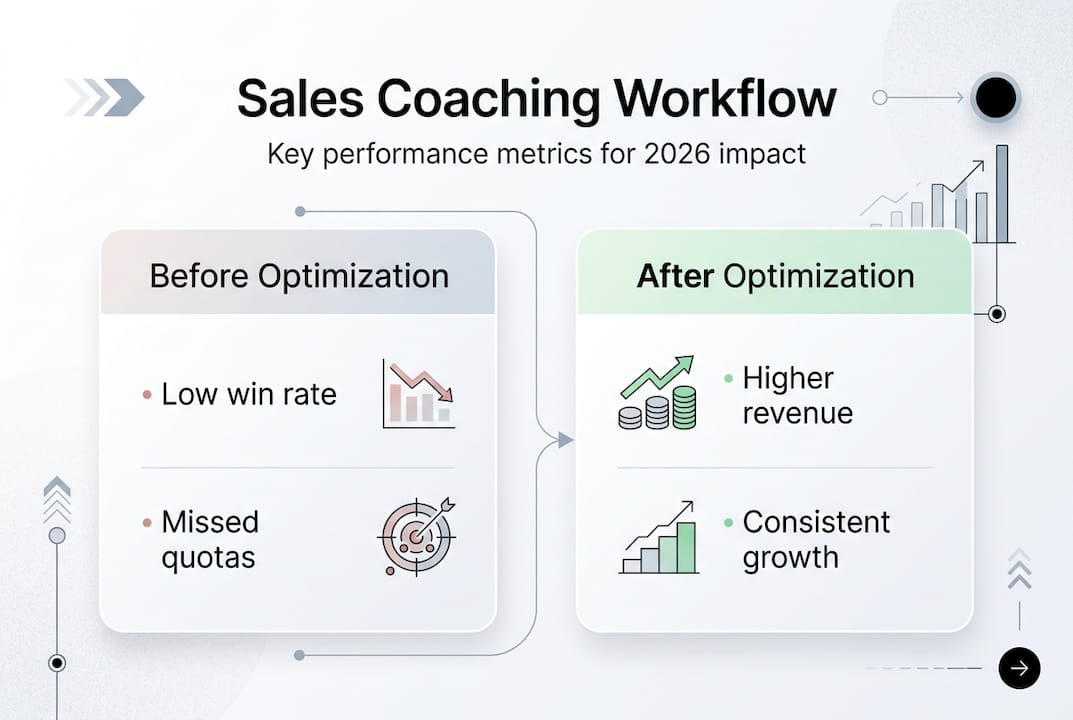
| Metric | Before Optimization | After Optimization | Target Improvement |
|---|---|---|---|
| Win Rate | 18% | 28% | +10 percentage points |
| Quota Attainment | 88% | 107% | +19 percentage points |
| Average Deal Size | €45,000 | €52,000 | +15% |
| Sales Cycle Length | 87 days | 76 days | -11 days |
| Coaching Session Completion | 45% | 92% | +47 percentage points |
Beyond quantitative metrics, collect qualitative feedback through quarterly surveys and informal conversations. Ask reps how coaching impacts their confidence, skill development, and job satisfaction. Gather manager input on workflow efficiency and time investment. This combination of hard data and soft insights reveals the full picture of coaching effectiveness.
Common obstacles threaten even well-designed workflows. Address these challenges proactively:
Continuous iteration separates good coaching programs from great ones. Review your workflow quarterly using performance data and team feedback. Test small changes like adjusting session length, trying new questioning techniques, or experimenting with group coaching formats. Successful organizations treat coaching as a living system that evolves with team needs and market conditions. Explore comprehensive sales enablement metrics that complement coaching measurement and drive overall sales effectiveness.
Optimizing your sales coaching workflow requires more than good intentions. It demands systematic approaches, proven frameworks, and expert guidance to navigate complex implementation challenges. Sales Label Consulting helps EU sales leaders transform coaching from ad hoc conversations into predictable performance drivers through our sales enablement expertise.
Our consulting services support every phase of coaching workflow optimization, from initial assessment through full implementation and ongoing refinement. We bring extensive entrepreneurial tech experience to help RevOps, Head of Sales, and VP of Sales managers achieve error-free, repeatable results. Whether you need help with sales enablement step by step implementation, want to explore sales enablement best practices for your market, or need insights on sales enablement trends 2026 shaping European sales organizations, our team provides practical guidance tailored to your specific challenges and growth objectives.
Weekly coaching sessions yield significantly higher quota attainment and ROI compared to quarterly coaching. Research shows that weekly coaching drives 107% quota attainment versus 88% for teams coached less frequently. The consistency of weekly touchpoints allows managers to address issues quickly, reinforce positive behaviors, and maintain momentum on development priorities. For high-performing teams, some organizations supplement weekly sessions with monthly deep dives on strategic skills.
Use AI for data analysis and administrative tasks, while human coaches focus on relationship, motivation, and personalized guidance. AI tools excel at analyzing call recordings, identifying patterns across deals, and surfacing insights that would take hours to find manually. Managers then use these insights as conversation starters in human-led sessions where empathy, strategic thinking, and relationship building happen. This division of labor scales coaching capacity without sacrificing the personal connection that drives performance.
Avoid dependency on single star managers by creating scalable systems that work across your entire leadership team. Many organizations design coaching around their best manager’s natural style, then struggle when that approach does not transfer to others. Ensure coaching is consistent, data-driven, and aligned with team goals rather than individual manager preferences. Document your workflow clearly, provide training for all managers, and build in quality checks to maintain standards as you scale.
Track KPIs like win rates, quota attainment, revenue uplift, and coaching session frequency to quantify workflow impact. Compare these metrics before and after workflow implementation, and segment data by coached versus uncoached reps to isolate coaching effects. Collect qualitative feedback to assess motivation and skill growth through quarterly surveys and informal conversations. The combination of hard performance data and soft feedback indicators provides a complete picture of coaching effectiveness and areas for continued improvement.
Subscribe to our Insights: Expert productivity tips in your inbox
You'll receive 1-3 emails per month. Your data stays private, always.

CRO & Co-Founder with Sales Label Consulting

Watch our Sales Mates Podcast
October 22, 2026 - 9 min read
Read article Read articleOctober 21, 2026 - 9 min read
Read article Read articleOctober 20, 2026 - 9 min read
Read article Read articleOctober 19, 2026 - 10 min read
Read article Read article