
Prioritize sales training: 30% lower turnover, 15% more revenue
More than half of tech sales reps miss their targets due to inadequate training, costing IT companies millions in lost revenue and stalled growth. For Heads of Sales and CEOs in the European IT sector, this reality underscores an urgent priority: investing strategically in sales training. The complexity of IT products, rapid innovation cycles, and demanding buyer expectations make continuous skill development non-negotiable. This article examines why prioritizing sales training transforms sales performance, reduces turnover, and drives sustainable revenue growth.
| Point | Details |
|---|---|
| Training reduces turnover significantly | Prioritized sales training programs cut turnover by up to 30% in IT sales departments. |
| Recurring training drives revenue growth | Tailored, ongoing training can boost revenue performance by 15% or more within a year. |
| IT sales demand continuous learning | Complex, evolving products require regular skill updates to maintain competitive edge. |
| Blended approaches maximize effectiveness | Combining online modules with mentoring ensures engagement and knowledge retention. |
| Measuring training impact is essential | Tracking quota attainment, pipeline metrics, and retention validates training ROI. |
IT sales differ fundamentally from traditional sales. Products often involve intricate technical specifications, integrations, and ongoing updates that demand deep understanding. Buyers expect consultative conversations addressing specific pain points, not generic pitches. Without robust training, sales teams struggle to articulate value, differentiate solutions, and close complex deals.
More than half of tech sales reps miss their targets due to inadequate training, reflecting how skill gaps directly erode quota attainment. Rapid product innovations further complicate matters. A feature launched last quarter may become outdated by next quarter, requiring constant learning. Sales teams without ongoing training face inconsistent results, frustrated buyers, and missed revenue opportunities.
Prioritizing training aligns skills with evolving buyer expectations and sales challenges. It builds confidence, sharpens messaging, and equips teams to navigate objections effectively. For IT companies targeting predictable revenue growth, sales training unlocks revenue growth by transforming raw talent into consistently high performers.
Key reasons training matters in IT sales:
IT sales teams confront obstacles rarely seen in other industries. Mastering evolving technical details while maintaining strong sales fundamentals creates a dual burden. Sales quotas are often missed because reps lack preparation on new offerings or struggle to communicate ROI to technical and business stakeholders.
High turnover compounds these challenges. When talented reps leave due to insufficient support or training, institutional knowledge vanishes. Replacing them costs time and money, disrupting pipeline momentum. Continuous training is critical to adapt to rapid product updates, ensuring teams stay current and confident.

Training mitigates these issues by improving knowledge retention and buyer engagement. Structured programs teach reps how to distill complex features into business outcomes, handle technical objections, and build trust with savvy buyers. This readiness translates into higher conversion rates and stronger customer relationships.
Common IT sales challenges training solves:
Pro Tip: Conduct quarterly product knowledge assessments to identify gaps early. Address them through targeted micro-learning sessions before they impact quota attainment.
For IT leaders seeking to address IT sales challenges through training, the path forward involves continuous investment in skill development aligned with real-world sales obstacles.
Many executives view training as a one-time expense with limited lasting impact. This mindset underestimates how recurring, well-designed programs compound over time. Myth 1: Training delivers short-term benefits only. Reality: Recurring training improves sales performance by up to 25% compared to one-time training, as reinforcement embeds skills and adapts to changing market conditions.
Myth 2: Generic training works equally well across all sales teams. Reality: IT sales require specialized content addressing technical complexity, long sales cycles, and multi-stakeholder decisions. Off-the-shelf programs rarely address these nuances. Myth 3: Training barely affects retention or revenue. Reality: Effective sales training programs reduce turnover by up to 30% and can increase revenue by 15% within a year, proving substantial ROI.
These misconceptions limit investment, leaving teams underprepared and vulnerable. Data proves recurring, customized training drives retention and revenue growth significantly. Leaders who recognize this prioritize training as a strategic lever, not a cost center.
“Sales training is not an event. It’s a continuous process that adapts to market shifts, product evolution, and team needs. Companies treating it as ongoing see exponential gains in performance and morale.”
For IT sales leaders, understanding crucial sales training insights transforms how they allocate budgets and measure success. Training becomes a competitive advantage, not an afterthought.
A structured approach ensures training delivers measurable results. The Buyer-Centric Skill Alignment framework provides a roadmap for designing, deploying, and optimizing sales training tailored to IT sales complexity.
Step 1: Assess sales challenges and knowledge gaps. Conduct skills audits, review call recordings, and gather feedback from reps and managers. Identify where breakdowns occur: product knowledge, objection handling, discovery, or closing.
Step 2: Design training based on buyer personas and product complexity. 92% of sales leaders state customized training aligned to buyer personas is markedly more effective, especially in IT. Build content addressing specific buyer pain points, decision-making processes, and technical concerns.
Step 3: Deploy hybrid delivery methods blending online and mentoring. Combine self-paced modules with live coaching, role-plays, and peer learning. This approach scales while maintaining personalization.
Step 4: Measure effectiveness via revenue and performance metrics. Track quota attainment, pipeline velocity, win rates, and retention. Correlate training participation with performance outcomes to validate impact.
Step 5: Continuously iterate training to keep pace with tech evolution. Schedule quarterly content updates, incorporate new product launches, and refine based on feedback and metrics.
| Training Component | Traditional Approach | Buyer-Centric Approach |
|---|---|---|
| Content Focus | Generic sales skills | Persona-specific, product-aligned scenarios |
| Delivery Method | One-time workshops | Blended learning with ongoing reinforcement |
| Measurement | Attendance, satisfaction scores | Quota attainment, pipeline metrics, retention |
| Iteration Frequency | Annually or less | Quarterly with real-time adjustments |
Pro Tip: Use real sales calls and lost deals as case studies in training sessions. This grounds learning in actual challenges reps face daily.
For leaders seeking to implement this framework, the IT sales team mastery framework offers detailed guidance on building scalable, effective training programs.
Data validates the business case for prioritizing sales training. Effective sales training programs reduce turnover by up to 30% and can increase revenue by 15% within a year, demonstrating substantial ROI. IT companies implementing structured training see quota attainment improve, pipeline quality strengthen, and retention rates stabilize.
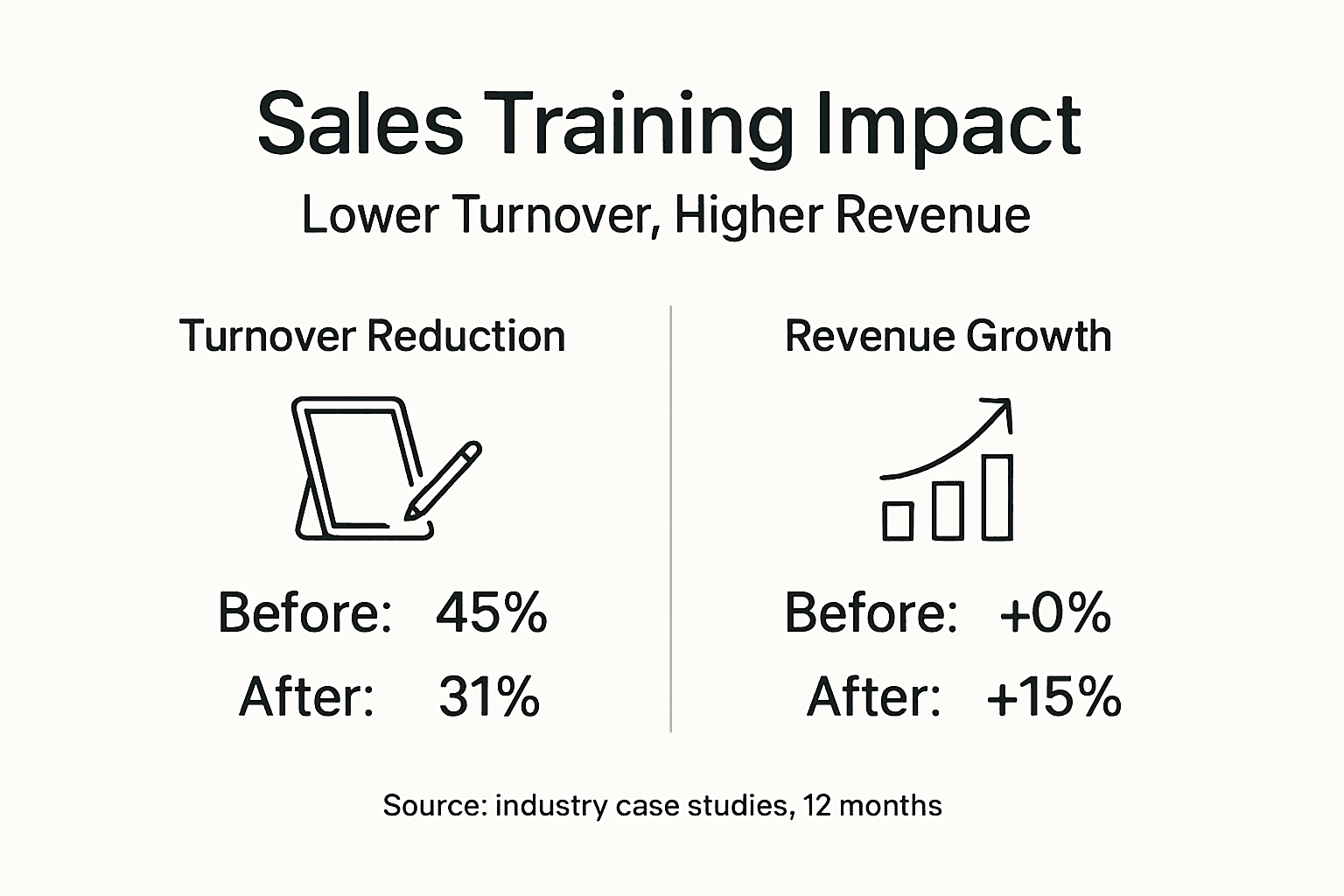
Consider a mid-sized EU IT company specializing in cloud infrastructure solutions. Before prioritizing training, only 58% of reps hit quota, and annual turnover exceeded 35%. After implementing a blended training program aligned with buyer personas, results shifted dramatically. Within 12 months, quota attainment rose to 83%, turnover dropped to 18%, and pipeline conversion rates improved by 22%.
Quantitative outcomes from prioritized training:
| Metric | Before Training | After 12 Months | Improvement |
|---|---|---|---|
| Quota Attainment | 58% | 83% | +25 percentage points |
| Annual Turnover | 35% | 18% | -17 percentage points |
| Pipeline Conversion | 19% | 23% | +4 percentage points |
| Average Deal Size | €47,000 | €54,000 | +15% |
These results stem from continuous learning, role-specific content, and leadership commitment. Reps felt supported, confident, and equipped to handle complex buyer conversations. Managers gained clarity on skill gaps and coaching opportunities.
For IT leaders evaluating training investments, reviewing step-by-step sales training results provides additional evidence and implementation insights.
Launching or optimizing sales training requires deliberate planning and execution. Follow these actionable strategies to maximize impact and sustain momentum.
1. Conduct sales skills audits to identify IT-specific gaps. Use assessments, call reviews, and manager feedback to pinpoint weaknesses. Focus on areas like technical fluency, consultative selling, objection handling, and closing.
2. Develop buyer persona-aligned, consultative selling content. Map training modules to the buyer journey. Address questions prospects ask at each stage, from awareness to decision. Teach reps how to position value, not features.
3. Choose a blended training format for scalability and engagement. Blended learning methods combining online modules and mentoring maximize engagement and retention in complex IT sales. Reps complete self-paced learning, then apply concepts in live coaching sessions.
4. Institute recurring refresher sessions for continuous skill development. Schedule quarterly workshops addressing new products, market trends, and emerging buyer concerns. Keep training dynamic and relevant.
5. Track key KPIs like quota attainment, pipeline status, and turnover. Establish baseline metrics before training launches. Monitor changes monthly and correlate training participation with performance improvements. Adjust content based on data.
Pro Tip: Involve top performers in training design. Their insights on what works in real deals ensure content resonates with the entire team.
Leaders looking to refine their approach can explore effective sales training topics to ensure comprehensive coverage of critical skills.
Ongoing training fosters durable sales competencies that translate into steady revenue. Strong training programs enable better forecasting and pipeline management by creating consistent rep performance. When teams operate with aligned skills and processes, revenue becomes predictable rather than volatile.
Leadership buy-in is critical to sustain training programs. Executives must champion learning, allocate budgets, and hold teams accountable for participation. Without this commitment, training initiatives lose momentum and fail to deliver ROI.
Key actions for IT leaders:
For those ready to elevate their sales enablement strategy, exploring best practices in sales enablement provides a roadmap for sustained success.
Transforming your sales team’s performance starts with the right partner. Sales Label Consulting offers customized sales training designed specifically for complex tech sales environments. Our programs align with buyer personas, evolving IT products, and the unique challenges your team faces daily.
We combine blended learning approaches with mentoring to maximize engagement and retention. Whether you need a complete training overhaul or targeted skill development, our expertise ensures your IT sales team achieves predictable revenue growth. Explore our step-by-step sales enablement methodology, review best practices in sales enablement, or discover our comprehensive IT sales team mastery program. Let us help you build a high-performing sales organization that consistently exceeds targets.
IT sales involve complex products and technical buyers requiring specialized skills. Prioritizing training equips teams to articulate value, handle objections, and close deals effectively. This reduces turnover and drives revenue growth consistently.
Most IT companies see measurable improvements within six to twelve months. Initial gains appear in pipeline quality and rep confidence, followed by quota attainment increases and revenue growth as skills solidify.
Blended learning combining online modules with live coaching and role-plays maximizes engagement and retention. This approach scales efficiently while addressing individual rep needs and complex sales scenarios.
Track quota attainment, pipeline conversion rates, win rates, average deal size, and turnover before and after training. Correlate participation with performance improvements to quantify impact and justify continued investment.
Yes. Effective training programs reduce turnover by up to 30% by building rep confidence, providing clear career development paths, and demonstrating company investment in employee success. This stability strengthens institutional knowledge and pipeline continuity.
Core topics include technical product knowledge, consultative selling, buyer persona understanding, objection handling, discovery techniques, value articulation, and closing strategies. Tailor content to your specific products and buyer challenges for maximum relevance.
Subscribe to our Insights: Expert productivity tips in your inbox
You'll receive 1-3 emails per month. Your data stays private, always.

CRO & Co-Founder with Sales Label Consulting

Book a call here
October 15, 2026 - 9 min read
Read article Read articleOctober 14, 2026 - 7 min read
Read article Read articleOctober 13, 2026 - 10 min read
Read article Read articleOctober 12, 2026 - 11 min read
Read article Read article