
Inbound vs Outbound Sales: A 2026 Strategy Guide
TL;DR:
- Inbound sales rely on prospects reaching out through content and referrals, which takes 6 to 18 months to build. Outbound sales involve seller-initiated outreach and can generate meetings in 30 to 60 days, often with larger deal sizes. Successful integration of both methods improves pipeline quality and alignment, with continuous auditing essential for optimal results.
Inbound vs outbound sales describes two fundamentally different processes defined by who initiates contact. In inbound sales, the buyer reaches out first, drawn by content, SEO, or referrals. In outbound sales, the seller initiates contact through cold outreach, sequences, or direct prospecting. Both motions drive revenue, but they operate on different timelines, cost structures, and skill sets. Choosing the wrong motion for your market is one of the most common and expensive mistakes sales leaders make. Saleslabelconsulting works with RevOps leaders and VPs of Sales to fix exactly this kind of misalignment before it drains pipeline.

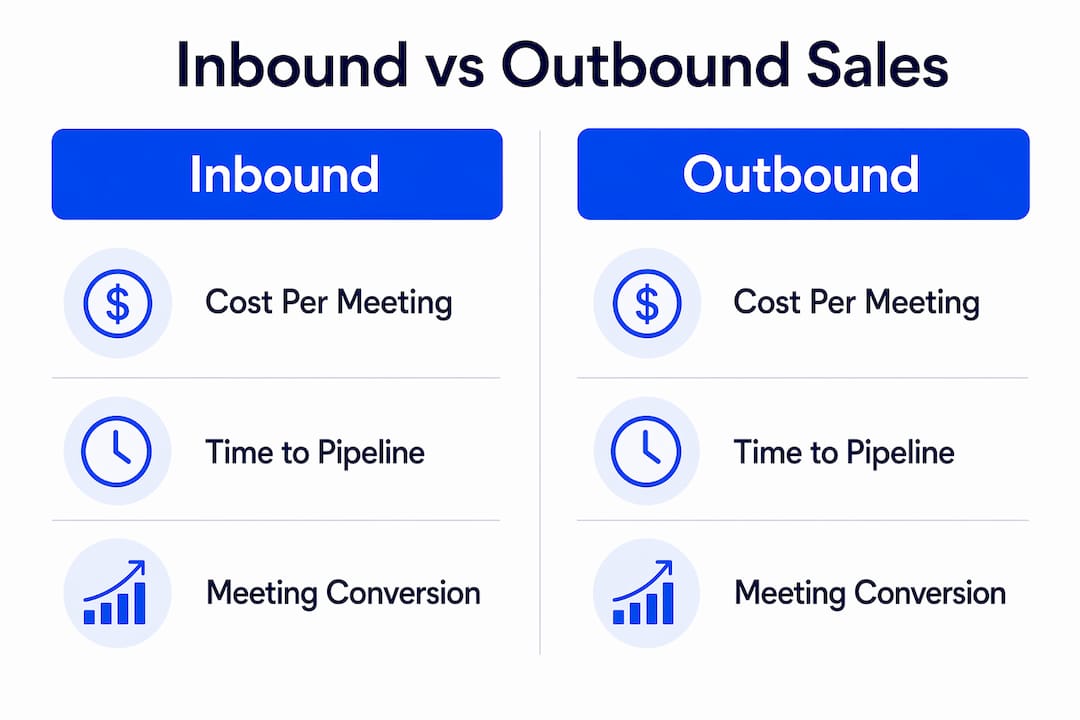
The difference between inbound and outbound is not just philosophical. It shows up directly in your cost per meeting, your time to pipeline, and your close rates.
Inbound cost per meeting runs $200–$800. Outbound runs $500–$1,200, driven by labor, tooling, and sequence management. That gap matters when you’re planning headcount and budget. Inbound is cheaper per meeting once the content engine is running, but it takes time to get there.
Inbound pipeline build time ranges 6–18 months. Outbound can generate initial meetings in 30–60 days. If your board wants pipeline this quarter, outbound is the only motion that delivers fast enough. Inbound is a compounding asset, not a quick fix.
On conversion, outbound meeting-to-opportunity rates run 25–40%. Inbound runs 35–55%, reflecting the higher intent of buyers who came to you first. Inbound leads close at higher rates, but outbound deals often carry a larger average contract value because reps are targeting specific accounts rather than waiting for whoever shows up.
Inbound marketing breaks even at 9–12 months. Outbound breaks even in 2–3 months. Outbound does not compound the way inbound does, but it addresses short-term growth expectations far better.
| Metric | Inbound | Outbound |
|---|---|---|
| Cost per meeting | $200–$800 | $500–$1,200 |
| Time to first pipeline | 6–18 months | 30–60 days |
| Meeting-to-opportunity rate | 35–55% | 25–40% |
| Break-even timeline | 9–12 months | 2–3 months |
| Deal size tendency | Smaller, higher volume | Larger, targeted accounts |
Pro Tip: If you’re pre-product-market-fit or entering a new segment, run outbound first to validate ICP and messaging. Use what you learn to build inbound content that actually converts.
The right motion depends on your deal size, buyer behavior, and market size. Getting this wrong wastes rep capacity and distorts your pipeline data.
Outbound excels in these conditions:
Inbound works best when:
The real talk: most B2B companies need both. Failing to audit which motion drives pipeline by segment leads to missed enterprise targets. A SaaS company selling to mid-market might run inbound for SMB and outbound for enterprise, with different reps, different messaging, and different success metrics for each.
Pro Tip: Map your ICP by ACV tier before choosing a motion. If your top 20% of accounts by revenue require outbound to reach, don’t let your inbound success metrics mask a gap in enterprise pipeline.
Inbound and outbound require fundamentally different rep profiles. Putting the wrong rep in the wrong motion is one of the fastest ways to underperform on both.
Inbound reps act as trusted advisors. They guide buyers who are already exploring a solution. The skill set centers on active listening, discovery, and consultative selling. These reps need to slow down a warm conversation and help the buyer articulate their problem clearly. Rushing a warm lead is as damaging as ignoring a cold one.
Outbound reps operate differently. They need high rejection tolerance, disciplined sequence execution, and the ability to create relevance from scratch. Misalignment of rep skills to sales type causes poor outbound outcomes. A rep who thrives on warm inbound calls will often struggle with the volume and rejection cadence of cold outbound. That’s not a character flaw. It’s a structural mismatch.
Key skill differences to hire and train for:
Sales teams often underperform outbound because reps are split between inbound and outbound duties simultaneously. Multitasking across both motions dilutes focus and reduces output quality in both. Where possible, dedicate reps to one motion or clearly time-block their day to protect execution quality.
The highest-performing sales teams don’t treat inbound and outbound as separate programs. They treat them as a single feedback loop where each motion makes the other sharper.
Here’s how to build that integration:
Use outbound signals to prioritize inbound leads. When a prospect you’ve been targeting with outbound sequences suddenly visits your pricing page, that’s a buying signal. Route that lead immediately. Responding within 5 minutes improves connection rates by 400% compared to a 30-minute wait. Speed is a competitive advantage most teams leave on the table.
Use inbound content to improve outbound messaging. The questions your inbound leads ask during discovery are the exact objections your outbound reps will face. Feed those insights back into your cold email copy, call scripts, and LinkedIn sequences. Your outbound messaging gets sharper every month if you build this feedback loop deliberately.
Dedicate or time-block reps by motion. Split SDR roles where volume justifies it. If you can’t fully split, assign morning blocks to outbound prospecting and afternoon blocks to inbound follow-up. Mixing both in real time creates context-switching costs that kill productivity.
Audit pipeline contribution by motion and segment. Top-performing sales teams integrate inbound and outbound as feedback loops, using cross-motion signals to prioritize leads. Run a monthly review of which motion is generating pipeline in each ICP segment. If outbound is generating 60% of enterprise pipeline but getting 30% of your SDR capacity, that’s a resource allocation problem.
Automate reply triage for speed. Revenue growth leaders use automated triage tools to flag high-intent replies and route them to the right rep within minutes. This applies to both inbound form fills and outbound reply threads. Automated triage is no longer optional for teams running at scale.
Pro Tip: Build a shared Slack channel or CRM tag system where inbound and outbound reps flag accounts showing cross-motion signals. It takes 30 minutes to set up and creates compounding pipeline intelligence over time.
Effective outbound is also signal-based, not interruption-heavy. Timing outreach around funding rounds, leadership changes, or product launches converts cold messages into relevant ones. That’s the difference between spam and a welcome conversation. Pair that timing precision with inbound content that educates, and you’ve built a motion that works at every stage of the buyer’s journey. You can also use video in your sales funnel to increase engagement across both inbound and outbound touchpoints.
Inbound and outbound sales require different timelines, skills, and cost structures, and the highest-performing teams integrate both motions as a feedback loop rather than running them in isolation.
| Point | Details |
|---|---|
| Cost and timeline differ sharply | Inbound costs less per meeting but takes 6–18 months to build; outbound delivers pipeline in 30–60 days. |
| Match motion to deal size | Use outbound for high-ACV enterprise accounts; use inbound for lower-ACV, high-volume buyer segments. |
| Rep skills must align to motion | Inbound reps need consultative skills; outbound reps need rejection tolerance and sequence discipline. |
| Integration creates compounding returns | Use outbound signals to prioritize inbound leads and inbound content to sharpen outbound messaging. |
| Speed closes the loop | Responding to high-intent leads within 5 minutes improves connection rates by 400%. |
Most sales leaders I work with come in believing they have an inbound problem or an outbound problem. After a proper audit, the real issue is almost always a motion-to-market mismatch. They’re running inbound for enterprise accounts that will never Google their way to a vendor. Or they’re burning SDR capacity on outbound for a $2,000 ACV product that needs volume, not precision targeting.
The fix isn’t always adding more budget or more reps. It’s auditing what’s actually generating pipeline in each segment and reallocating accordingly. I’ve seen companies double enterprise pipeline by shifting 20% of their SDR capacity from inbound follow-up to targeted outbound sequences, without hiring a single new person.
The other thing I see consistently: outbound teams underperforming because reps are multitasking. They’re handling inbound replies in the morning, doing cold outreach in the afternoon, and doing neither well. Structure beats heroics. Split the roles, or at minimum protect the time blocks. The revenue impact of sales alignment between motion, rep profile, and market segment is real and measurable.
One more thing worth saying plainly: outbound success in 2026 is not about volume. It’s about signal quality and message relevance. The teams winning with outbound are timing their outreach to real buying triggers and personalizing at the account level. The teams losing are still blasting generic sequences at 500 contacts a week and wondering why reply rates are flat.
— Antony
Getting the balance right between inbound and outbound is not a one-time decision. It requires ongoing auditing, rep alignment, and process design that matches your market and growth stage.
Saleslabelconsulting works with RevOps leaders, Heads of Sales, and VPs of Sales to build exactly this kind of structured, data-driven approach. From sales enablement step by step frameworks that create predictable revenue, to sales enablement best practices that scale both inbound and outbound motions, the work is grounded in real consulting experience across B2B tech companies. If your pipeline feels unpredictable or your motions feel misaligned, a structured sales audit is the fastest way to find the gap and fix it.
Inbound sales is buyer-initiated contact, where prospects come to you through content, SEO, or referrals. Outbound sales is seller-initiated, where reps proactively reach out to target accounts through cold email, calls, or sequences.
Neither is universally better. Outbound works best for high-ACV enterprise deals with a finite target market. Inbound works best for lower-ACV products with buyers who actively research before purchasing.
Inbound pipeline typically takes 6–18 months to build to a steady state. Outbound can generate initial meetings within 30–60 days, making it the faster option for short-term pipeline needs.
Yes, and the best teams integrate them as a feedback loop. Outbound signals help prioritize inbound leads, and inbound content improves outbound messaging quality over time.
Outbound teams most often underperform because of rep skill mismatch and multitasking between inbound and outbound duties simultaneously. Dedicating reps to a single motion, or protecting focused time blocks, significantly improves output quality.
Subscribe to our Insights: Expert productivity tips in your inbox
You'll receive 1-3 emails per month. Your data stays private, always.

CRO & Co-Founder with Sales Label Consulting

Watch our Sales Mates Podcast
Available
June 27, 2026 - 8 min read
Read article Read articleJune 25, 2026 - 7 min read
Read article Read articleFix the System
Not Symptoms