
What Is Sales Cadence? A Guide for Sales Teams
TL;DR:
- A sales cadence is a structured sequence of multi-channel outreach activities that engagement prospects and support pipeline build-up. Consistent, signal-based cadences improve forecast accuracy, prevent leads from falling through the cracks, and drive higher reply and conversion rates.
A sales cadence is a predefined sequence of outreach activities across multiple channels that sales professionals use to systematically engage prospects and move them through the pipeline. Without a structured cadence, reps follow up inconsistently, leads fall through the cracks, and pipeline forecasting becomes guesswork. The difference between a team that hits quota reliably and one that doesn’t often comes down to whether they have a disciplined cadence in place. Tools like Outreach, Apollo, and Salesloft exist precisely because this problem is universal.
A sales cadence is defined as a structured, multi-channel sequence of touches designed to engage a specific prospect over a set period. It tells your rep exactly what to do, on which channel, and when, removing the guesswork from follow-up.

The channel mix matters as much as the number of touches. Effective multi-channel cadences use 40–50% email, 20–30% phone, 15–25% LinkedIn, and 5–10% video touches. That distribution reflects how buyers actually consume outreach. Email is easy to ignore, so phone and LinkedIn create the pattern interrupts that get responses.
Timing between touches is equally critical. Spacing of 1–4 days between contacts keeps you present without feeling like a stalker. A cadence that stretches touches too far apart loses momentum. One that fires daily feels like spam.
Here is what a standard 10-touch cold outbound cadence looks like across three weeks:
| Day | Channel | Action |
|---|---|---|
| Day 1 | Personalized intro email with a specific trigger | |
| Day 3 | Connection request with a short note | |
| Day 5 | Phone | First call attempt, leave voicemail |
| Day 7 | Follow-up referencing voicemail | |
| Day 9 | Engage with prospect’s content | |
| Day 11 | Phone | Second call, no voicemail |
| Day 14 | Value-add email with a relevant resource | |
| Day 17 | Phone | Third call, leave voicemail |
| Day 19 | Direct message | |
| Day 21 | Break-up email |
This structure is not rigid. It’s a baseline. You adjust based on what the prospect does.
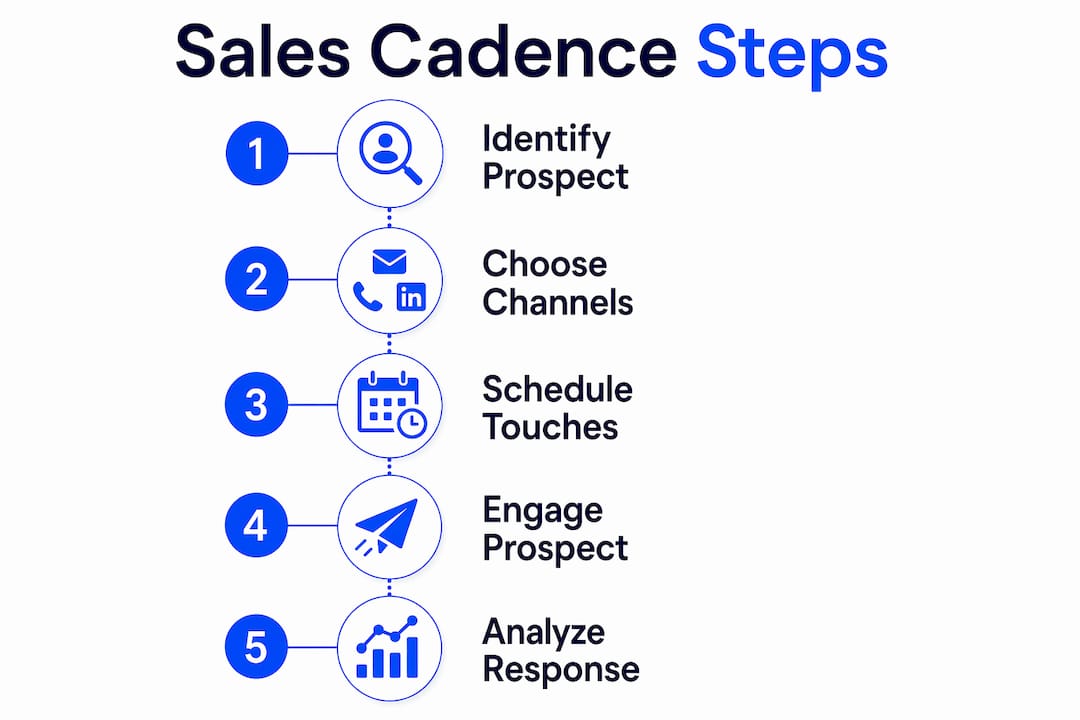
The persistence gap is the single biggest reason cadences fail when they don’t exist. 80% of B2B sales require at least five follow-up contacts after the initial outreach. Yet 44% of salespeople give up after just one attempt. That gap is where revenue disappears.
A structured cadence solves this by removing the decision from the rep. They don’t have to remember to follow up or decide whether it’s “too soon.” The sequence does that thinking for them.
“A disciplined cadence provides the structure to keep persistent, consistent follow-up so deals don’t fall through the cracks.” — Cognism
Beyond persistence, cadences drive pipeline and forecast reliability. When every rep runs the same structured process, your pipeline data becomes meaningful. You can predict how many touches it takes to book a meeting, how many sequences produce a qualified opportunity, and where the drop-off happens. That’s the data RevOps and VP of Sales need to make real decisions.
Personalization is the other side of this equation. 73% of B2B buyers avoid suppliers who send irrelevant or generic communications. A cadence that fires the same template to every prospect isn’t a cadence. It’s spam with a schedule.
The biggest shift in cadence strategy right now is the move from time-based drips to signal-based sequences. Instead of firing touch number four on day nine regardless of what the prospect did, you advance the sequence based on behavior. If a prospect opens your email three times and clicks a link, that’s a signal. Call them today, not in four days.
Here’s how to build a cadence that actually works in 2026:
Pro Tip: Cadences with 8–12 touches over 17–21 days consistently outperform the old 2-2-2 rule (contact at 2 days, 2 weeks, and 2 months). Compress your timeline and increase your touch count.
Content governance matters too. If your marketing team is running a nurture sequence while your rep runs a cold cadence, the prospect gets mixed messages. Align messaging across channels before you launch any sequence.
Most cadence failures come down to the same handful of errors. Recognizing them early saves you months of wasted outreach.
Pro Tip: Add a break-up email as your final touch. Break-up emails generate 14–22% reply rates, often outperforming the initial outreach. A simple “Is this still a priority for you?” can reopen a dead conversation.
Not every prospect deserves the same sequence. The cadence length and touch count vary significantly by prospect type and deal complexity.
| Scenario | Touches | Duration | Primary Channels |
|---|---|---|---|
| Cold outbound | 7–12 | 3–4 weeks | Email, phone, LinkedIn |
| Inbound leads | 5–8 | 2–3 weeks | Email, phone, LinkedIn |
| Enterprise / ABM | 10–15 | 6–8 weeks | Email, phone, LinkedIn, video |
Cold outbound requires more persistence because you’re starting from zero awareness. Inbound leads already know who you are, so shorter sequences with faster escalation to a call work better. Enterprise accounts involve multiple stakeholders and longer buying cycles, so your cadence needs to account for multi-threading across contacts.
A few principles that apply across all three scenarios:
For a deeper look at multi-channel outreach setup and how to structure your channel blend, the Saleslabelconsulting resource library covers the full approach.
A structured, multi-channel sales cadence is the single most reliable way to close the persistence gap, build pipeline predictability, and prevent qualified leads from going cold.
| Point | Details |
|---|---|
| Define the channel mix | Use 40–50% email, 20–30% phone, and 15–25% LinkedIn as your baseline distribution. |
| Compress your timeline | Cadences with 8–12 touches over 17–21 days outperform longer, spaced-out sequences. |
| Build in stopping rules | Exit prospects after non-engagement or opt-outs to protect sender reputation and focus effort. |
| Shift to signal-based triggers | Advance the sequence based on prospect behavior, not just the calendar date. |
| Personalize every touch | Reference specific triggers like job changes or funding rounds to avoid the 73% buyer avoidance rate. |
I’ve worked with sales teams across tech and B2B services, and the pattern is always the same. The reps who miss quota aren’t missing it because they lack product knowledge or closing skills. They’re missing it because they give up too soon and follow up inconsistently. Structure beats heroics every time.
The teams that shifted to signal-based cadences saw the most dramatic improvement. Not because the technology was magic, but because it forced them to pay attention to what prospects were actually doing. When a rep calls a prospect who just visited the pricing page three times, the conversation is completely different from a cold call on day nine of a drip sequence.
My honest caution: don’t let automation replace judgment. The best cadences I’ve seen use tools like Outreach or Apollo to handle timing and tracking, but the messaging is written by a human who understands the prospect’s context. The moment your cadence becomes fully automated with zero personalization, you’ve built a spam machine with a fancy dashboard.
One more thing. Cadence without a sales process framework underneath it is just activity. Make sure your cadence connects to a defined qualification stage, a clear value proposition, and a handoff process. Otherwise you’re generating meetings that go nowhere.
— Antony
If you’ve read this far and you’re thinking “we don’t have this in place,” you’re not alone. Most sales teams we audit at Saleslabelconsulting are running informal, inconsistent outreach with no defined channel mix, no stopping rules, and no signal-based triggers.
Saleslabelconsulting works directly with RevOps leaders, Heads of Sales, and VPs of Sales to design and implement cadence systems that produce measurable, repeatable results. Our sales enablement approach covers cadence architecture, messaging frameworks, and the tooling setup that makes it all run. If you want pipeline you can actually forecast, the work starts with getting your cadence right.
A sales cadence is a structured sequence of outreach touches across email, phone, and LinkedIn designed to engage a prospect over a defined period. It tells reps what to do, on which channel, and when.
Most effective cadences use 8–12 touches over 17–21 days for cold outbound. Enterprise accounts may require 10–15 touches over 6–8 weeks depending on deal complexity.
A sales process defines the stages a deal moves through from prospecting to close. A sales cadence is the specific outreach sequence a rep executes within the prospecting and engagement stages of that process.
The most common reasons are giving up too early, using generic messaging, ignoring prospect behavior signals, and running sequences without stopping rules. 44% of salespeople quit after just one follow-up attempt, which is the root cause of most cadence failures.
Start by segmenting your prospects (cold, inbound, enterprise), define a channel mix using the 40–50% email baseline, write personalized touch templates referencing specific triggers, and set clear stopping rules before you launch. Review sales rhythm best practices to build a sequence your team will actually run consistently.
Subscribe to our Insights: Expert productivity tips in your inbox
You'll receive 1-3 emails per month. Your data stays private, always.

CRO & Co-Founder with Sales Label Consulting

Watch our Sales Mates Podcast
July 26, 2026 - 13 min read
Read article Read articleJuly 25, 2026 - 8 min read
Read article Read articleJuly 24, 2026 - 11 min read
Read article Read articleJuly 23, 2026 - 17 min read
Read article Read article