
How to Design Sales Compensation That Drives Results
TL;DR:
- Effective sales compensation aligns behaviors with revenue goals and uses clear, simple structures.
- Plans should limit KPIs to 2-3 metrics and include meaningful accelerators to motivate top performers.
Sales compensation design is the process of building a pay structure that directs rep behavior toward your most important revenue outcomes. Done right, it’s the single most powerful management tool you have. Done wrong, it creates confusion, kills motivation, and sends your best reps to competitors. Knowing how to design sales compensation means understanding quota-to-OTE ratios, base-variable splits, commission accelerators, and KPI selection. These aren’t abstract concepts. They’re the levers that determine whether your team hits plan or misses it quarter after quarter.
Sales compensation design, formally called incentive compensation management, starts with two numbers: base pay and variable pay. The base-variable split shapes how much risk a rep carries and how aggressively they sell. A 50/50 split suits a complex enterprise sale with long cycles. A 30/70 split fits a high-velocity transactional role. The base-variable split directly influences rep behavior, so choose it based on your sales motion, not industry habit.

Commission structures sit at the heart of variable pay. The most common models include flat-rate commission (a fixed percentage on every deal), tiered commission (rates that increase as reps hit thresholds), and revenue-based commission tied to ARR or MRR. Each model rewards different behaviors. Tiered structures push reps to close more volume. ARR-based models reward deal quality and contract length. You can explore the full range of commission structure options to find the right fit for your team.
Accelerators are the mechanism that separates good plans from great ones. A 1.1x accelerator above quota is effectively invisible to most reps. A 2x accelerator is the threshold where top performers actually change their behavior and push harder. Build your accelerator to be meaningful, or don’t bother including one.
KPI selection is where most plans fall apart. Variable pay KPIs should be limited to 2–3 metrics, with each metric representing at least 20% of variable pay. More than three metrics splits a rep’s attention and dilutes the incentive signal. Pick the metrics that matter most to your current business stage and weight them accordingly.
Here’s what a clean compensation structure looks like in practice:
Pro Tip: Write your plan document with concrete payout examples. A rep should be able to read one scenario and immediately calculate what they’d earn. If they can’t, the plan is too complex.
The biggest mistake sales leaders make is designing compensation around outcomes instead of behaviors. Closing a deal is an outcome. Running a structured discovery call, advancing a multi-stakeholder opportunity, and maintaining pipeline hygiene are behaviors. Rewarding end-of-quarter outcomes instead of repeatable selling behaviors is the leading cause of incentive program failure. Behavior-led plans improve ramp time, forecast accuracy, and deal quality.
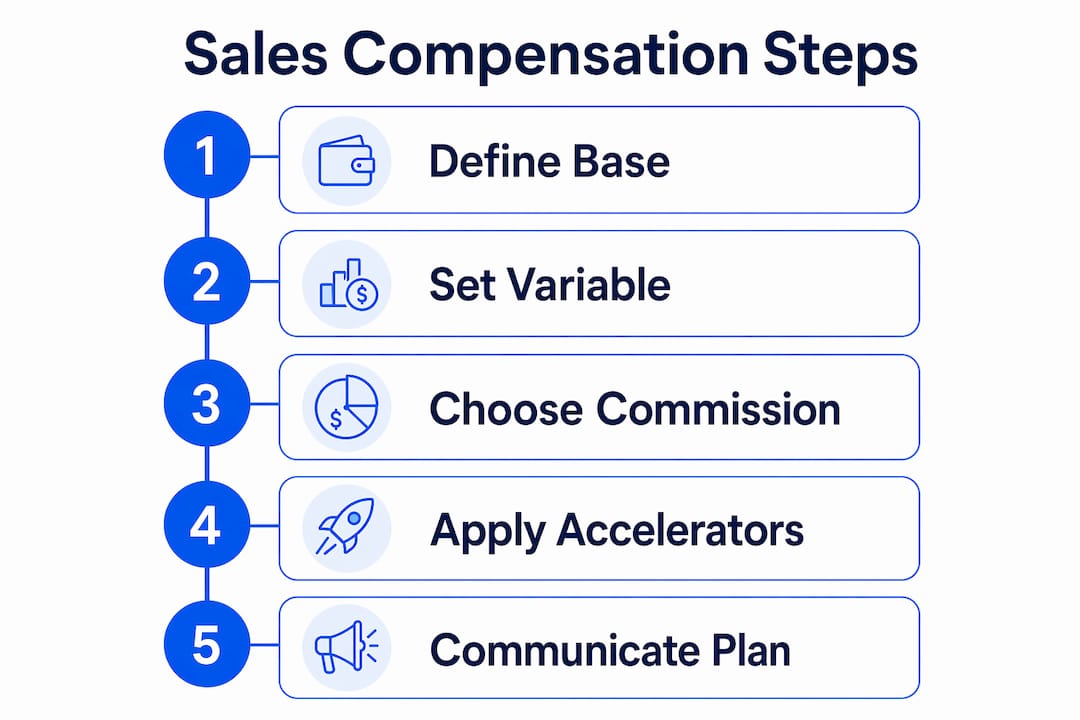
Start your design process by answering one question: what specific selling motions do you want reps to repeat every week? Then build the compensation structure to reward those motions. If you want reps to prioritize enterprise accounts, weight enterprise ARR more heavily in the commission formula. If pipeline coverage is your constraint, add a SPIF for qualified opportunities created. The plan should read like a map of your sales strategy.
Follow these four steps to align compensation with strategy:
Pro Tip: Run a “rep math” test before launching any plan. Have three reps with different deal sizes and attainment levels calculate their own pay from the document. If any of them get a different number than your model, the plan language needs work.
Sales leaders who want to go deeper on aligning incentives to revenue goals will find that compensation is only one part of a broader alignment system.
The infrastructure behind your compensation plan matters as much as the plan itself. Reps should be able to calculate their commission in under 30 seconds. If they can’t, you have a trust problem. Manual spreadsheet calculations introduce errors, create disputes, and signal to reps that the company doesn’t take their pay seriously.
Automation is the baseline requirement for any team above ten reps. Compensation management platforms connect to your CRM, pull closed-won data automatically, and generate rep-level statements on a defined schedule. The result is fewer disputes, faster payouts, and more time for managers to coach instead of reconcile spreadsheets.
Documentation is equally critical. Ambiguous plan language creates legal risk and destroys the shared understanding between reps and management. Every plan document should include a plain-language summary, a worked payout example for each commission tier, and a clear definition of every term used in the calculation.
| Infrastructure element | Purpose | Common failure mode |
|---|---|---|
| CRM integration | Pulls deal data automatically for commission calculation | Manual data entry creates errors and delays |
| Compensation statements | Shows reps their earnings in real time | Delayed or opaque statements reduce trust |
| Plan documentation | Defines terms, rates, and examples in plain language | Vague language leads to disputes and legal risk |
| Payout schedule | Sets clear expectations for when commissions are paid | Irregular payouts damage rep confidence |
Pro Tip: Send reps a one-page plan summary alongside the full document. The summary should fit on a single screen and answer three questions: what am I measured on, how do I calculate my pay, and when do I get paid.
Most compensation plans fail for predictable reasons. Knowing the traps before you build saves you a painful mid-year redesign.
The fix for most of these pitfalls is the same: start with strategy, limit complexity, and test the plan with real rep scenarios before you launch. If you’re seeing classic sales performance issues across your team, compensation design is often the root cause.
Effective sales compensation design requires behavioral alignment, quota validation, meaningful accelerators, and plan clarity to produce predictable revenue performance.
| Point | Details |
|---|---|
| Limit KPIs to 2–3 metrics | Each metric must represent at least 20% of variable pay to drive focused rep behavior. |
| Validate quota at territory level | The 4–5x quota-to-OTE ratio must reflect actual market potential, not a company-wide average. |
| Make accelerators meaningful | A 2x accelerator above quota is the threshold that changes top-performer behavior. |
| Prioritize plan clarity | Reps who can’t calculate their pay in under 30 seconds lose trust in the compensation system. |
| Reward behaviors, not just outcomes | Behavior-led incentives improve ramp time, forecast accuracy, and deal quality over time. |
Real talk: most compensation plans I’ve reviewed are built backwards. Leaders start with a budget number, divide it by headcount, and reverse-engineer a commission rate. That’s not compensation design. That’s math dressed up as strategy.
The plans that actually work start with a question: what do I want reps to do differently next quarter? Every structural decision flows from that answer. I’ve seen teams cut their ramp time significantly just by shifting from a pure revenue commission to a behavior-weighted model that rewarded pipeline creation and discovery call quality alongside closed ARR.
The transparency piece is underrated. Clarity and transparency outweigh commission model choice every time. I’ve watched reps on a simple flat-rate plan outperform reps on a sophisticated tiered model, purely because the first group understood exactly what they were working toward. Confusion is a performance killer.
One more thing on accelerators: don’t be timid. A 1.1x multiplier above quota is an insult to your top performers. They know it’s not worth the extra push. A genuine 2x accelerator tells your best reps that you see them and you’re willing to pay for exceptional output. That’s how you keep your A-players from taking calls from recruiters.
The best compensation plans I’ve worked on share three traits. They’re simple enough for a rep to explain to their spouse. They’re directly connected to the company’s top two or three strategic priorities. And they’re reviewed at least once a year against actual territory data. If yours doesn’t meet all three, it’s time to rebuild.
— Antony
Saleslabelconsulting works with RevOps leaders, Heads of Sales, and VPs of Sales who need compensation plans that produce predictable results, not quarterly surprises. The team brings hands-on experience across sales enablement, sales audits, and demand generation to help you build structures that actually motivate your team and align with your revenue goals.
If you’re ready to move from a plan that confuses reps to one that drives consistent performance, the sales enablement step-by-step guide is the right starting point. It walks through the full framework for building predictable revenue, including compensation design, pipeline management, and team structure. You can also review sales enablement best practices to see how leading teams are scaling with the right incentive infrastructure in place.
The standard quota-to-OTE ratio for B2B Account Executives is 4–5x, meaning a rep earning $100,000 OTE should carry a $400,000 to $500,000 quota. This ratio must be validated at the territory level to reflect actual market potential.
Variable compensation plans should include no more than 2–3 KPIs, with each metric representing at least 20% of variable pay. More metrics split rep attention and reduce the motivating power of each individual incentive.
Reps who can’t easily understand how they earn lose trust and motivation regardless of how well-designed the underlying model is. Transparency in compensation consistently outperforms model sophistication as a driver of sales performance.
An accelerator must be significant enough to change rep behavior. A 2x accelerator above quota is the benchmark that motivates top performers to push beyond their target. A 1.1x multiplier is typically ignored.
Concrete payout examples in the plan document create shared understanding between reps and management. Pairing clear documentation with automated commission calculations eliminates most disputes before they start.
Subscribe to our Insights: Expert productivity tips in your inbox
You'll receive 1-3 emails per month. Your data stays private, always.

CRO & Co-Founder with Sales Label Consulting

Watch our Sales Mates Podcast
July 27, 2026 - 9 min read
Read article Read articleJuly 26, 2026 - 13 min read
Read article Read articleJuly 25, 2026 - 8 min read
Read article Read articleJuly 24, 2026 - 11 min read
Read article Read article