
How to Reduce Sales Errors for Sales Leaders
TL;DR:
- Reducing sales errors involves implementing data validation, structured qualification, and standardized playbooks. These measures prevent mistakes at the source, saving time and improving deal accuracy. Leadership plays a key role in fostering a culture that values precision alongside speed.
Sales errors are defined as preventable mistakes in data entry, qualification, pricing, or process execution that directly reduce revenue and slow deal velocity. Knowing how to reduce sales errors is the difference between a predictable pipeline and a team constantly firefighting avoidable problems. Tools like Dynamics 365, QuoteWerks, and structured CRM workflows address the most common sales pitfalls at the source, not after the damage is done. Point-of-entry validation and automated field-filling can save reps about 35 minutes daily while cutting data-related errors. That’s not a minor efficiency gain. That’s time your team gets back to close deals.
Data accuracy starts at the moment of entry, not during a quarterly CRM cleanup. True data accuracy is best achieved by validating data points at entry, such as email format checks and instant alerts for missing fields, rather than cleaning data after the fact. Retrospective cleanup costs far more time and introduces secondary errors when reps try to reconstruct context they’ve already forgotten.

The mechanics matter here. Point-of-entry validation means your CRM rejects bad data before it enters the pipeline. Automated field-filling pulls known data from connected sources, so reps aren’t manually copying company names, job titles, or deal sizes from one system to another. Standardization rules enforce consistent formatting across the team, which makes reporting accurate and forecasting reliable.
Here’s what to prioritize when building your validation setup:
Pro Tip: Toggle-based automation features drive higher adoption than complex rule sets. If your reps need a training session to use a validation feature, it will get ignored under pressure. Keep it simple and it will stick.
Simple toggle-based automation increases user adoption and accuracy because complex setups discourage consistent use. That’s the real talk: the best validation system is the one your team actually uses every day. You can also automate sales processes further by connecting your CRM to quoting and reporting tools, which compounds the accuracy gains across the full cycle.
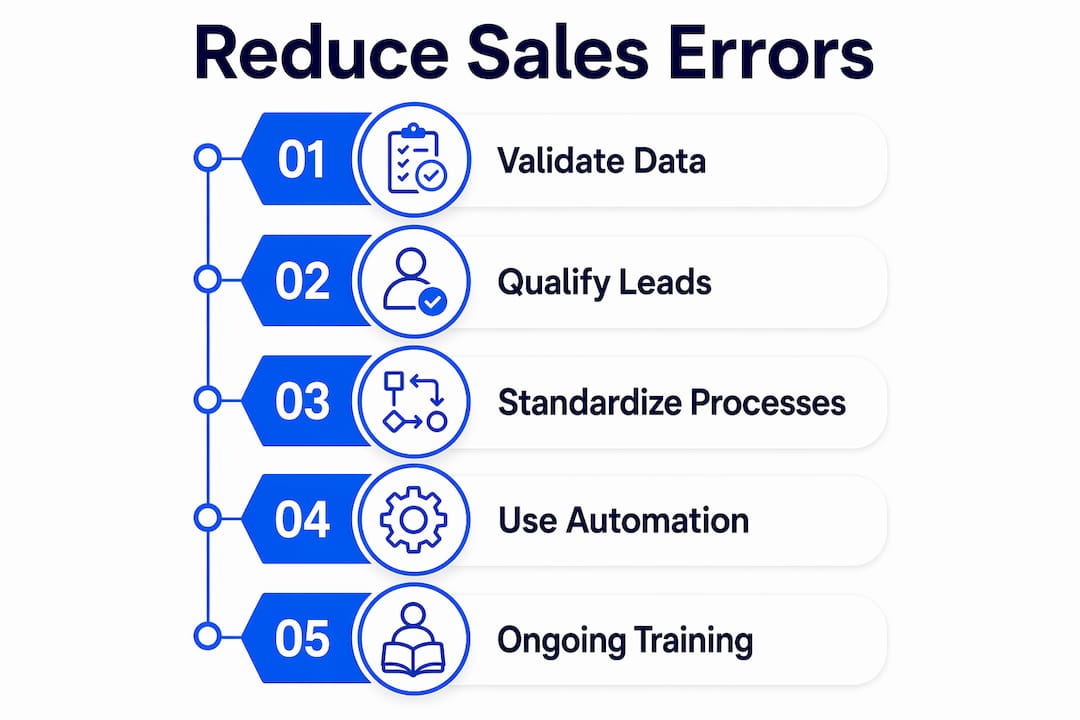
Unqualified leads are one of the most expensive and least discussed sources of sales errors. When reps pitch the wrong prospects, they waste preparation time, misalign messaging, and generate pipeline data that distorts your forecast. The fix is structural, not motivational.
Spending 10–15 minutes researching a prospect’s industry and pain points before calls allows reps to outperform 90% of competitors who skip preparation. That’s a significant competitive edge built from a small time investment. The insight here is that most sales errors in the qualification stage aren’t about skill. They’re about skipping steps that feel optional but aren’t.
A structured lead qualification process removes that ambiguity. Here’s how to build one that prevents errors from the start:
Sales playbooks formalize these steps so they don’t depend on individual rep memory or motivation. A well-built playbook turns qualification from a judgment call into a repeatable process. That’s where fixing classic sales mistakes starts: not with better reps, but with better structure.
Closing errors are almost always process failures, not people failures. When pricing is wrong, when a deal advances without a signed NDA, or when a rep quotes a discontinued product, the root cause is usually a missing guardrail, not a bad rep. Structure beats heroics every time.
Defining objective exit criteria for each sales stage and automating pipeline gating in your CRM improves deal quality and reduces errors in progression. This means a deal cannot move from “Proposal Sent” to “Negotiation” unless specific conditions are met and logged. The CRM enforces it, not the manager.
Here’s a before-and-after view of what standardized playbooks actually change:
| Error type | Without a playbook | With a playbook |
|---|---|---|
| Pricing mistakes | Reps quote from memory or outdated sheets | Centralized pricing database enforced at quote creation |
| Stage progression errors | Manager approval required case by case | Automated exit criteria block premature advancement |
| Onboarding inconsistency | New reps learn from senior reps unevenly | Documented process with examples and scripts |
| Handoff failures | Verbal summaries, missing context | Standardized handoff template logged in CRM |
| Approval delays | Ad hoc email chains | Built-in approval workflows with defined SLAs |
Systematized handoff processes across sales and customer success teams reduce error friction and revenue leakage in B2B sales. This is where a lot of revenue quietly disappears: in the gap between “closed won” and “onboarded.” A playbook closes that gap.
QuoteWerks prevents pricing errors not by reviewing quotes after creation but by enforcing product and pricing rules and mandatory fields at the moment of quote generation. That’s the key distinction. Reactive quote reviews are less effective and more time-consuming than embedding error prevention directly in the creation workflow. You can’t review your way to accuracy. You have to build accuracy into the process.
Pro Tip: Centralize your product and pricing database in one system that your quoting tool pulls from directly. If reps can access pricing from multiple sources, they will, and errors will follow.
A well-built sales playbook checklist covers not just what to do at each stage but what must be true before moving forward. That’s the difference between a playbook that sits in a Google Drive folder and one that actually reduces errors.
Reducing errors once is a project. Sustaining low error rates over time is a system. The difference is whether your tools and training reinforce each other or operate in silos.
Many common sales mistakes require structural interventions like documented playbooks and data-driven CRM processes for true remediation. Behavioral coaching alone doesn’t fix a broken quoting workflow. And a great CRM setup doesn’t compensate for reps who don’t understand why the process exists. You need both.
When selecting tools and building training programs, focus on these priorities:
Pro Tip: Use your CRM’s reporting to build a monthly “error rate dashboard” that tracks data completeness, stage skip rates, and quote revision frequency. Show it to the team. Visibility creates accountability without blame.
You cannot reduce errors by reviewing more quotes. Errors must be prevented at the source through centralized and enforced pricing and product data. That principle applies to training too. Don’t train reps to catch their own mistakes after the fact. Train them to build habits that prevent mistakes from happening.
Reducing sales errors requires prevention at the source, not correction after the fact. The most effective approach combines point-of-entry data validation, structured qualification, enforced playbooks, and integrated technology.
| Point | Details |
|---|---|
| Validate data at entry | Use CRM validation rules and automated field-filling to stop errors before they enter the pipeline. |
| Qualify with structure | Define objective criteria and require pre-call research to eliminate wasted effort on bad-fit prospects. |
| Enforce process with playbooks | Use exit criteria and approval workflows so deal progression depends on facts, not judgment calls. |
| Prevent pricing errors at creation | Centralize product and pricing data so quoting tools enforce rules, not reps. |
| Sustain accuracy with analytics | Track error hotspots monthly and coach to patterns, not individual incidents. |
I’ve worked with sales teams that had excellent CRM setups, solid playbooks, and still produced consistent errors. The missing piece was almost always cultural. Leadership set the expectation that speed mattered more than accuracy, and the team delivered exactly that.
The uncomfortable truth is that error reduction requires leaders to model the behavior they want. If you skip the qualification checklist when you’re in a rush, your reps will too. If you approve a deal that doesn’t meet exit criteria because the quarter is ending, you’ve just told the team that the process is optional. Structure only works when leadership enforces it consistently, especially under pressure.
What I’ve found actually works is making accuracy visible without making it punitive. Share the error rate dashboard in your weekly team meeting. Celebrate the rep who caught a pricing mistake before it went to the client. Treat a disqualified deal as a win, not a loss, when the criteria were applied correctly. That’s how you build a culture where accuracy and speed coexist instead of compete.
The other thing I’d push back on is the idea that better tools solve the problem. Tools create the conditions for accuracy. People create the culture. Your job as a sales leader is to do both: build the system and set the standard.
— Antony
Sales leaders who want predictable, error-free results need more than a checklist. They need a system that holds under pressure, scales with the team, and gets adopted by reps who are already stretched thin.
Saleslabelconsulting works directly with Heads of Sales, VP of Sales, and RevOps leaders to build that system. Our sales enablement approach covers the full cycle: from auditing your current error points to building playbooks, validation workflows, and training programs that stick. We also offer sales audit services that identify exactly where your team’s errors are costing you revenue. If your pipeline has accuracy problems, we’ll find them and fix them at the source.
Implement point-of-entry validation in your CRM, including mandatory fields, format checks, and duplicate detection. Automated field-filling removes manual transfer entirely, which is where most data errors originate.
Playbooks define objective exit criteria for each pipeline stage and automate gating so deals cannot advance without required conditions being met. This removes judgment calls and enforces consistency across the team.
Pricing errors happen when reps access pricing from multiple or outdated sources. Enforcing product and pricing rules at the point of quote creation, through a centralized database, eliminates this regardless of rep experience level.
Point-of-entry validation and automation saves reps approximately 35 minutes per day. That time compounds across a full team and a full quarter into a significant gain in selling capacity.
Correction happens after a mistake reaches the pipeline or the client. Prevention happens at the moment of data entry, qualification, or quote creation. Prevention is faster, cheaper, and more reliable than any review process.
Subscribe to our Insights: Expert productivity tips in your inbox
You'll receive 1-3 emails per month. Your data stays private, always.

CRO & Co-Founder with Sales Label Consulting

Watch our Sales Mates Podcast
July 28, 2026 - 17 min read
Read article Read articleJuly 27, 2026 - 9 min read
Read article Read articleJuly 26, 2026 - 13 min read
Read article Read articleJuly 25, 2026 - 8 min read
Read article Read article