
How to use data to transform your sales strategy
TL;DR:
- Many EU tech sales teams lack a structured framework to turn abundant data into actionable decisions that drive revenue. Implementing focused objectives, prioritizing key metrics, and establishing consistent review routines enable teams to leverage data effectively. Strategic data utilization enhances forecasting, coaching, resource allocation, and overall sales predictability.
You’ve got the dashboards, the CRM reports, the weekly pipeline reviews, and still something feels off. Your team is swimming in numbers but somehow flying blind. You’re not alone: 62% of sales leaders report feeling under-informed on execution despite having access to more data than ever before. The real problem isn’t a lack of data. It’s the absence of a practical system to turn that data into decisions that actually move revenue. This guide gives you that system.
| Point | Details |
|---|---|
| Focus on actionable data | Target data that directly links to your most important sales outcomes for maximum impact. |
| Frameworks conquer chaos | Structured approaches and digital tools turn overwhelming data into intelligence that drives revenue. |
| Reduce, then refine | Cut out irrelevant metrics and double down on what moves your sales strategy forward. |
| Consistent training matters | Ongoing skill development is essential for a sales team to harness and apply data insights. |
The opportunity in front of mid-sized EU tech companies right now is real. Data, when used correctly, gives you the ability to target smarter, forecast more accurately, and build a sales motion that scales without heroics.
Think about what’s changed in the last five years. Your buyers are more informed. Your competitors are more aggressive. And the tools available to your sales and RevOps teams have become genuinely powerful. The challenge isn’t access anymore. It’s judgment.
Here’s what structured data use looks like in practice for teams that get it right:
Research confirms this shift is already happening across European B2B firms. Sales enablement platforms are measurably improving collaboration, efficiency, and cost outcomes for organizations willing to invest in structure.
“The question is no longer whether to use data in sales. It’s whether your team has the right framework to act on it.”
The volume and complexity of available data is only going up. CRM activity data, intent signals, product usage analytics, marketing attribution, customer health scores — all of it feeds into a picture that’s increasingly rich and increasingly noisy. Staying current on the latest sales enablement trends is one way to keep your strategy sharp as the landscape shifts. And understanding the full sales analytics value for EU enterprises will help you make the case internally for the right investments.
The bottom line: data isn’t just a reporting tool anymore. It’s a strategic asset. But only if you treat it like one.
Understanding why data matters is just the start — but for many, the benefits get buried in complexity. Let’s address the real barriers first.
Here’s the uncomfortable truth. Most sales leaders aren’t struggling because they lack data. They’re struggling because they have too much of it, spread across too many tools, with no clear owner and no agreed definition of what “good” looks like.
“More dashboards don’t mean better decisions. They just mean more meetings arguing about which number to trust.”
That 62% of sales leaders feeling under-informed on execution? They’re not missing reports. They’re missing a framework that connects data to day-to-day sales behavior. The gap is execution, not information.
The most common failure patterns we see with EU tech sales teams:
Pro Tip: Before adding any new metric to your sales review, ask one question: “What decision does this number help us make?” If you can’t answer that immediately, don’t track it yet.
The fix isn’t simpler tools. It’s a structured decision-making framework. You need to know which questions matter, which metrics answer those questions, and who owns the action when the data signals a problem. We’ve seen how fixing classic sales mistakes often starts with cleaning up data practices before anything else.
Having covered the main challenges, it’s time to shift toward how successful sales teams tackle data complexity — and what steps you can immediately apply.
Structure beats heroics. Every time. Here’s how to build a sales process that puts data to work systematically rather than sporadically.
Step 1: Start with objectives, not metrics.
Don’t open your CRM and start reporting. Start with a clear business question. Are you trying to reduce churn? Increase average contract value? Shorten sales cycles in a specific segment? Your objective defines which data matters. Everything else is noise.
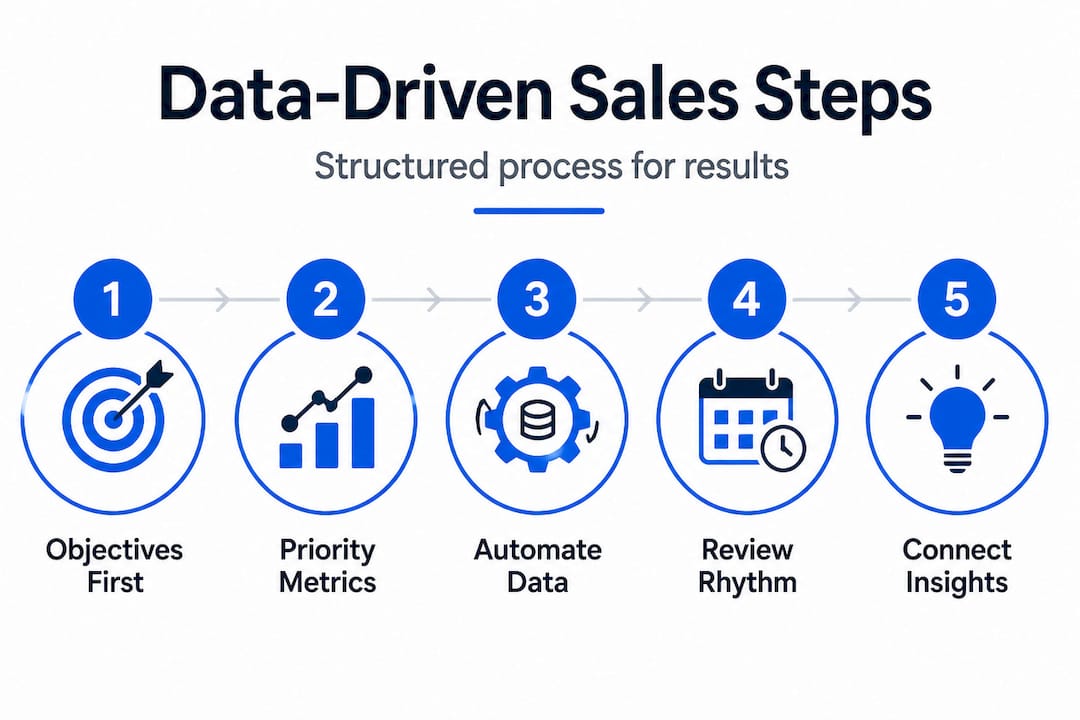
Step 2: Identify your three to five priority metrics.
Less is more here. The most effective sales organizations we work with track a short, focused set of indicators. Consider these as your starting point:
| Metric | What it tells you | Why it matters |
|---|---|---|
| Pipeline velocity | How fast deals move through your funnel | Predicts revenue timing and bottlenecks |
| Quota attainment rate | % of reps hitting target | Signals coaching needs and goal accuracy |
| Cost per acquisition (CPA) | Spend required to close one deal | Measures efficiency of your go-to-market |
| Win rate by segment | Close rate across verticals or deal sizes | Identifies your best-fit customer profile |
| Average sales cycle length | Time from first touch to closed-won | Flags process friction and forecasting risk |
Step 3: Automate data capture and distribution.
Reps shouldn’t be manually logging every activity. Your CRM and sales enablement platform should capture the right signals automatically, then surface them in a format that drives action. Research shows that platforms driving digital data foster stronger marketing ownership and value creation across the sales process.

Step 4: Build a review rhythm that creates accountability.
Data without a review cadence is just storage. Set a weekly or biweekly rhythm where pipeline metrics are reviewed, anomalies are flagged, and owners are named for follow-up actions. Keep it tight. Thirty minutes max. The goal is decisions, not presentations.
Step 5: Connect insights to coaching.
When your data shows that deals stall at proposal stage in a specific vertical, that’s a coaching signal. Your front-line managers need to know how to use that information in their 1:1 conversations with reps. Check the sales enablement best practices that operationalize this kind of insight effectively.
Pro Tip: Build a one-page “sales intelligence brief” for each weekly review. Top metric, biggest anomaly, and one action owner. Simple, repeatable, high-impact. Our guide to data-driven decisions walks through exactly how to structure this kind of brief.
With a framework in hand, let’s compare the impact of structured versus unstructured data use in tech sales teams.
This is where it gets concrete. The difference between a team that grows predictably and one that lurches from quarter to quarter often comes down to one thing: how systematically they use data.
| Factor | Structured approach | Ad-hoc approach |
|---|---|---|
| Forecasting accuracy | High, based on pipeline velocity trends | Low, relies on rep gut-feel |
| Coaching effectiveness | Targeted, data-informed, consistent | Reactive, based on anecdotes |
| Resource allocation | Driven by segment and conversion data | Based on manager instinct or politics |
| Onboarding speed | Faster, supported by documented playbooks | Slower, depends on tribal knowledge |
| Risk management | Proactive, early warning signals in place | Reactive, problems spotted late |
| Team alignment | Marketing, sales, and CS share one view | Siloed, conflicting data sources |
The results speak for themselves. Teams with systematic frameworks create repeatable revenue. They spend less time debating numbers and more time acting on them.
Here’s what ad-hoc data use actually costs you:
Sales enablement platforms change this equation. They bring flexibility and systemic digital skills to sales teams that previously relied on individual heroics to hit number. The step-by-step sales enablement approach turns scattered effort into a structured, scalable engine.
It’s also worth understanding the types of sales enablement available to your team, because the right mix depends on where your biggest friction points actually live in the process.
Comparing approaches makes the path forward clearer — but how do you make a meaningful shift? Here’s how to put your data to work for measurable sales growth.
Three things consistently separate teams that make data-driven strategy work from those that talk about it endlessly without results.
Establish clear data governance. Someone needs to own this. Not “everyone is responsible,” which means nobody is. Assign a Revenue Operations lead or a data champion who owns metric definitions, reviews data quality, and ensures dashboards reflect what’s actually happening in the field. Research confirms that operational efficiency follows directly from this kind of structural clarity.
Invest in continuous skill-building. Your CRM is only as smart as the people entering and interpreting its data. Run quarterly sessions on how to read pipeline dashboards, how to interpret win/loss data, and how to use account signals for better timing and messaging. This isn’t a one-time onboarding task. It’s an ongoing investment.
Build experimentation loops. The best sales teams treat their process like a product. They form a hypothesis (“If we add a proof-of-value step at Stage 3, our win rate will improve by 15%”), run it as a controlled test, measure outcomes, and roll out what works. This is how content-driven sales enablement becomes genuinely dynamic instead of a static library nobody uses.
Here’s what a results-focused rhythm looks like in practice:
Pro Tip: Start every monthly review with your three worst losses from the previous month. What did the data show before those deals died? That backward-looking habit is how you prevent the same mistakes at scale.
The culture shift here is subtle but critical. You’re moving from “data as reporting” to “data as coaching.” That transition takes time. But the teams that make it stop firefighting and start compounding their wins.
Having equipped you with frameworks and best practices, let’s pause for a crucial reality check about what separates leaders from laggards in the data-driven sales game.
Here’s the unpopular opinion: the companies with the biggest data infrastructure aren’t always the ones winning. We’ve worked with mid-sized tech firms in the EU that track 40 KPIs religiously and still can’t call their quarter accurately. And we’ve seen scrappy 30-person sales teams with five metrics and a clear owner outperform them consistently.
The difference isn’t the data. It’s the decisiveness.
The real value of data isn’t in what it tells you. It’s in the permission it gives your team to act with confidence. When a rep can see that a specific segment has a 40% higher win rate with a specific use-case, they stop second-guessing their pitch. When a manager can see that deals stalling past day 45 rarely close, they stop hoping and start intervening. Data removes the politics from decisions. That’s where the real ROI lives.
But here’s the other side of this: you have to be willing to edit. Most organizations are far too reluctant to stop tracking metrics that no longer serve a decision. The courage to simplify, to say “we’re removing these five dashboards because they’re not connected to anything actionable,” is actually a competitive advantage. Less noise means faster signal.
The organizations that invest in sales enablement strategically understand this. They don’t buy tools to have more data. They invest in structure to make fewer, better decisions faster. That’s the mindset shift that actually changes outcomes.
Real change also requires blending analytics with empathy. Data tells you what is happening. Your sales team tells you why. The leaders who listen to both — who run the numbers and then sit with their top reps to understand the story behind them — build strategies that actually stick in the field.
Structure beats heroics. Always. But only when leaders are brave enough to act on what the data is telling them, even when it’s inconvenient.
You’ve got the framework. You know the pitfalls. You understand the difference between structured and scattered data use. The question now is whether you want to navigate this alone or with a team that’s done this before.
At Sales Label Consulting, we help EU-based tech sales teams turn data complexity into revenue clarity. From predictable sales enablement frameworks tailored to your growth stage, to a full sales audit that shows you exactly where your pipeline is leaking and why, we work alongside your RevOps, Head of Sales, and VP of Sales to build systems that deliver consistent, measurable results. No generic playbooks. No theory. Just hands-on expertise from people who’ve built and scaled tech sales operations themselves. Let’s make your next quarter the one where data actually drives the outcome.
Most sales leaders struggle with turning abundant data into clear, actionable strategies that actually impact execution. In fact, 62% feel under-informed on execution decisions despite having access to extensive data resources.
Begin with clearly defined business objectives, focus on three to five priority metrics, and adopt sales enablement platforms to bring structure to your data. Research confirms that these platforms directly foster marketing ownership and value creation across the sales process.
Key metrics include pipeline velocity, quota attainment rate, and cost per acquisition, each tailored to your firm’s specific growth objectives and target segments.
Yes. Research shows that sales enablement platforms measurably increase collaboration, operational efficiency, and cut costs in European B2B sales organizations.
Limit your data focus to a small set of metrics tied to specific business questions, assign clear ownership for each metric, and build a consistent weekly review rhythm that converts insights into action.
Subscribe to our Insights: Expert productivity tips in your inbox
You'll receive 1-3 emails per month. Your data stays private, always.

CRO & Co-Founder with Sales Label Consulting

Watch our Sales Mates Podcast
September 17, 2026 - 16 min read
Read article Read articleSeptember 16, 2026 - 14 min read
Read article Read articleSeptember 15, 2026 - 10 min read
Read article Read articleSeptember 14, 2026 - 10 min read
Read article Read article