
Boost IT sales with strategic content enablement
Sales teams that leverage strategic enablement content see 32% higher quota attainment than those relying on scattered resources. For IT sales leaders facing fragmented content libraries and inconsistent messaging, building a content-driven enablement strategy transforms reps from frustrated hunters into confident closers. This guide reveals how to structure, manage, and optimize sales content that shortens ramp time, lifts win rates, and delivers predictable revenue growth.
| Point | Details |
|---|---|
| Strategic content drives quota success | Teams using organized, relevant enablement content achieve 32% higher quota attainment and improved win rates. |
| Role-aligned materials accelerate ramp | Structured onboarding content cuts new rep ramp time by 4 to 6 weeks, boosting productivity faster. |
| AI personalizes delivery at scale | AI-powered platforms automate content recommendations and updates, increasing lead conversion by over 30%. |
| Governance sustains content value | Clear ownership and update schedules prevent outdated materials from eroding rep confidence and buyer trust. |
Sales enablement differs from training and operations in crucial ways. Training develops skills through workshops and coaching sessions. Operations manages CRM systems, territories, and compensation plans. Enablement bridges these functions by equipping reps with the right resources at the right moment to execute effectively.
Sales enablement content acts as connective tissue integrating product knowledge, marketing insights, and sales execution. When product teams launch new features, enablement translates technical specs into buyer-facing value propositions. When marketing creates thought leadership pieces, enablement curates them into battle cards reps actually use. This integration accelerates product launch cycles and ensures consistent messaging across every customer touchpoint.
Accessible, relevant content directly impacts rep efficiency. Reps spend an average of 440 hours annually searching for or creating materials from scratch. Centralized, tagged content libraries eliminate this waste, giving reps more time for prospecting and closing. Buyers also benefit when reps present cohesive, evidence-backed narratives instead of improvised pitches.
For IT sales leaders navigating complex solution sales, content relevance determines whether reps can articulate technical differentiation and ROI effectively. Strong content availability correlates with higher quota attainment because reps confidently address objections, share proof points, and tailor conversations to buyer needs. Exploring sales enablement best practices and IT sales team mastery provides deeper insight into building foundational strategies that sustain long-term performance gains.
Effective content use delivers measurable improvements across critical sales metrics. Organizations with mature enablement programs report 32% higher quota attainment compared to teams relying on ad hoc resources. This gap stems from reps having immediate access to materials that answer buyer questions, counter competitive claims, and demonstrate ROI in real time.

Ramp time shrinks dramatically when new hires receive structured, role-specific content. Sales reps ramp 4 to 6 weeks faster with targeted onboarding materials that clarify value propositions, buyer personas, and common objection handling. Faster ramp means new reps contribute to pipeline sooner, reducing time to productivity and increasing overall team capacity.
Win rates climb when reps deploy relevant proof points during critical deal stages. Teams using case studies, competitive analyses, and technical whitepapers see up to 50% improvement in win rates. Buyers facing complex IT purchasing decisions demand evidence that solutions work. Reps armed with customer success stories and third-party validation close deals competitors cannot.
Consistent messaging across sales teams becomes achievable when everyone references the same authoritative content. Fragmented materials cause reps to deliver conflicting information, eroding buyer trust and internal alignment. Shared battle cards, pitch decks, and objection scripts ensure uniform positioning whether prospects engage with SDRs, AEs, or solution engineers. For actionable frameworks, review sales enablement step by step predictable revenue to understand how structured content governance supports repeatable sales motions.
Pro Tip: Track content engagement metrics like download rates and usage frequency to identify which materials truly drive deals forward, then prioritize updates and creation efforts accordingly.
Internal content supports reps behind the scenes, while external content engages buyers directly. Understanding both categories helps IT sales leaders build comprehensive libraries that address every selling scenario.
Internal content includes:
External content engages buyers throughout their journey:
Training materials ensure reps deliver consistent, compelling conversations. Scripts for discovery calls, demo flows, and objection handling provide structure without sounding robotic. Role-play scenarios and recorded call reviews reinforce best practices and accelerate skill development.
Buyer personas guide content creation and messaging alignment. Detailed personas capturing IT buyer roles, priorities, pain points, and decision criteria enable reps to personalize outreach and select materials that resonate. For deeper exploration of content types and their strategic applications, visit types of sales enablement boost team performance and why invest in sales enablement.
Many organizations assume more content automatically improves sales results. In reality, volume without relevance creates noise. Reps overwhelmed by hundreds of outdated documents ignore most materials and revert to improvised pitches. Quality and accessibility matter far more than quantity.
Relevance and trustworthiness trump sheer volume every time. Reps need confidence that materials reflect current product capabilities, accurate competitive intelligence, and genuine customer outcomes. A single outdated case study or incorrect pricing sheet destroys credibility with buyers and erodes rep trust in the entire content library.
Outdated content poses serious risks beyond wasted effort. When reps unknowingly share obsolete information, deals stall or collapse. Buyers lose confidence in vendor expertise. Internal teams waste time correcting misinformation. Clear governance prevents these failures by assigning ownership and establishing update schedules.
Continuous content ownership ensures sustained impact. Marketing cannot maintain sales materials in isolation. Product teams must flag feature changes. Sales leaders must surface objections and competitive shifts. Enablement coordinates these inputs, updates content proactively, and archives irrelevant materials before they cause damage.
Pro Tip: Conduct quarterly content audits where reps rate material usefulness and relevance, then retire the bottom 20% and refresh the top performers with updated data and examples.
Mapping content to buyer journey stages ensures reps have appropriate materials for every interaction. Awareness stage content educates prospects on industry challenges and trends through blogs, whitepapers, and webinars. Consideration stage content compares solutions and demonstrates differentiation via competitive guides, feature sheets, and analyst reports. Decision stage content validates choices and mitigates risk through case studies, ROI calculators, and security documentation.
Assigning clear owners and defining update frequency maintains content health. Product marketing owns battle cards and product sheets, updating them with each major release. Customer success manages case studies, refreshing them annually or when metrics change. Sales operations maintains playbooks and scripts, revising them quarterly based on win/loss analysis. This distributed ownership with centralized coordination prevents bottlenecks while ensuring accountability.
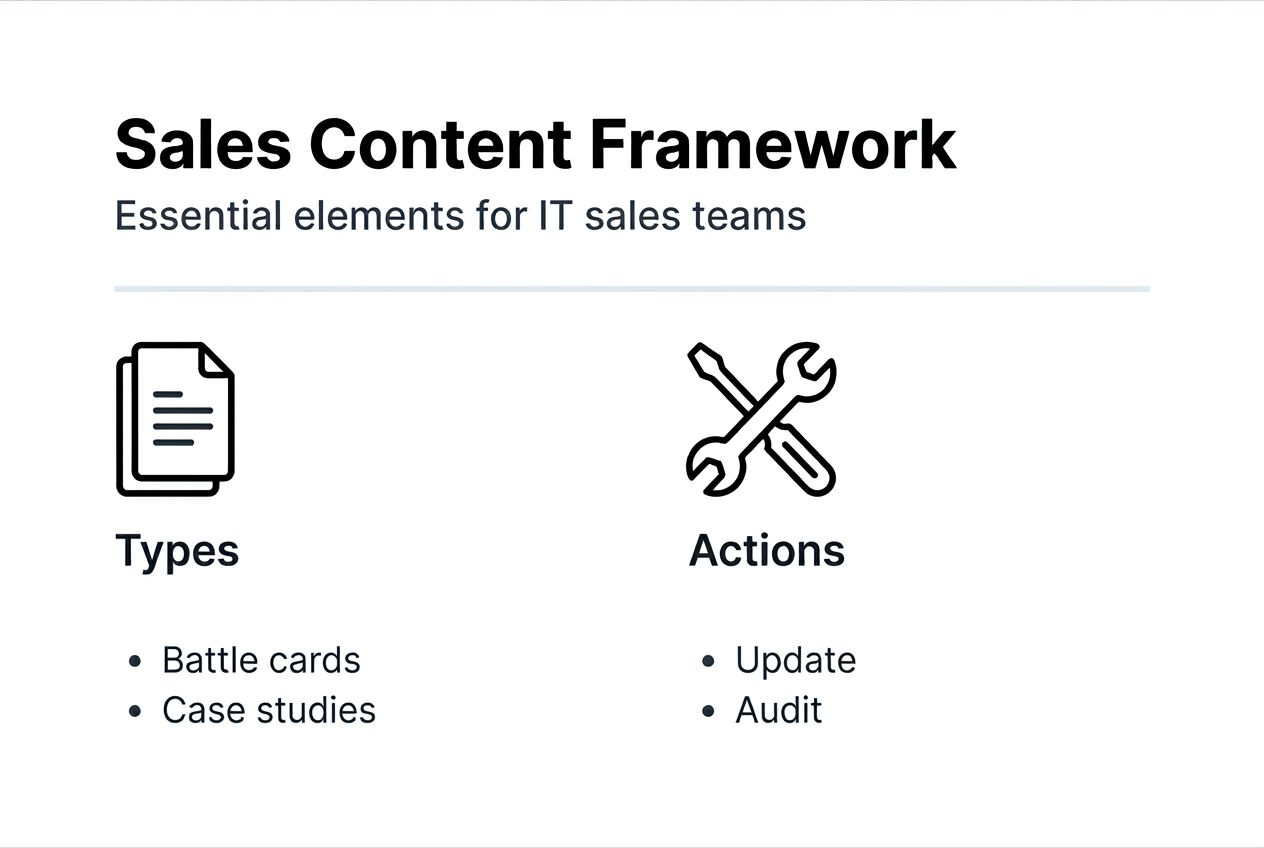
Integrating continuous sales feedback loops improves content relevance over time. Monthly rep surveys identify missing materials and outdated assets. Win/loss interviews reveal which content influenced decisions and where gaps exist. CRM analytics show which documents get shared most during successful deals. This data drives prioritization for creation and retirement decisions.
The table below compares common content types across key management dimensions:
| Content Type | Primary Owner | Update Frequency | Buyer Journey Stage |
|---|---|---|---|
| Battle Cards | Product Marketing | Quarterly | Consideration |
| Case Studies | Customer Success | Annually | Decision |
| Product Sheets | Product Marketing | Per Release | Consideration |
| Whitepapers | Marketing | Annually | Awareness |
| ROI Calculators | Sales Operations | Semi-Annually | Decision |
| Demo Scripts | Sales Enablement | Quarterly | Consideration |
For comprehensive best practices on building sustainable content governance models, explore sales enablement best practices.
AI-powered platforms personalize content recommendations based on deal stage, buyer persona, and engagement history. Machine learning algorithms analyze successful deal patterns and suggest materials that historically correlate with wins. Real-time updates push new content to reps automatically when products launch or competitive landscapes shift, eliminating manual distribution lag.
Automated content distribution embedded in CRM and communication tools reduces friction. When reps update deal stages in Salesforce, AI surfaces relevant battle cards, case studies, and objection responses within the interface. Email plugins recommend attachments based on recipient role and previous interactions. This contextual delivery increases content usage because reps access materials exactly when needed without searching.
Organizations implementing AI-driven enablement report significant productivity gains:
Technology adoption challenges include integration complexity and user resistance. Legacy systems may not support modern enablement platforms. Reps accustomed to existing workflows resist new tools unless benefits become immediately obvious. Ensuring user-friendly interfaces and providing hands-on training mitigates these barriers.
Pro Tip: Start with AI-powered content search and recommendation features before expanding to automated distribution, allowing teams to experience quick wins that build confidence in broader platform adoption.
For practical applications and case studies demonstrating AI’s sales impact, review AI reshaping sales tech, AI workflows saving time, and IT sales strategy trends 2026.
Implementing strategic content-driven enablement empowers sales teams and improves quota attainment and win rates. IT sales leaders can build high-impact programs by following a structured approach:
For detailed implementation frameworks and measurement strategies, explore step by step sales enablement, sales enablement best practices, and sales enablement metrics boost ROI.
Building content-driven sales enablement programs requires strategic expertise and operational discipline. Sales Label Consulting partners with IT sales leaders to design, implement, and optimize enablement initiatives that deliver measurable revenue growth.
Our tailored programs address your specific challenges, from content audits and governance frameworks to AI platform selection and rep adoption strategies. Whether you need to accelerate new hire ramp, improve win rates, or establish scalable content operations, our team brings proven methodologies refined through extensive tech industry experience. Explore how we help organizations achieve predictable results through sales enablement step by step predictable revenue, sales enablement best practices, and comprehensive Sales Label IT Consulting services designed for European IT sales teams.
Track content engagement rates, quota attainment by content usage levels, win rates correlated with specific materials, and ramp time reductions for new hires. These metrics directly link content performance to revenue outcomes and identify which assets drive actual deals.
Update frequency depends on content type and business dynamics. Battle cards and product sheets require quarterly reviews or updates with major releases. Case studies need annual refreshes or when customer metrics change significantly. Whitepapers remain relevant for 12 to 18 months unless industry shifts demand earlier revisions.
Buyer personas guide content topics, messaging tone, and material formats that resonate with specific decision makers. IT directors prioritize ROI and integration concerns, while technical evaluators focus on architecture and security. Persona-aligned content increases relevance, engagement, and conversion rates throughout the sales cycle.
Absolutely. Small teams gain disproportionate advantages from structured content because limited headcount magnifies efficiency gains. A five-person team saving eight hours weekly per rep through better content access reclaims 2,080 hours annually for revenue-generating activities, dramatically impacting pipeline and closed deals.
Demonstrate immediate value through quick wins like faster objection responses or higher meeting conversion rates. Integrate content delivery into existing workflows rather than requiring separate logins. Gather rep feedback continuously and prioritize materials addressing their most pressing pain points to build trust and sustained engagement.
Subscribe to our Insights: Expert productivity tips in your inbox
You'll receive 1-3 emails per month. Your data stays private, always.

CEO & Co-Founder with Sales Label Consulting
Lets book a free call
October 15, 2026 - 9 min read
Read article Read articleOctober 14, 2026 - 7 min read
Read article Read articleOctober 13, 2026 - 10 min read
Read article Read articleOctober 12, 2026 - 11 min read
Read article Read article