
How to Improve Sales Meetings and Drive Team Performance
TL;DR:
- Most sales meetings suffer from lack of structure, clear objectives, and follow-up systems.
- Effective preparation includes defining goals, agendas, roles, and pre-read materials 24 hours in advance.
- Strong facilitation, accountability, and feedback loops are essential for measurable improvement and culture change.
Most sales teams run too many meetings that accomplish too little. Reps leave the room unclear on next steps, leaders wonder why performance isn’t shifting, and the cycle repeats every week. The business cost is real: wasted selling time, confused pipelines, and disengaged teams. According to HubSpot Research, improving alignment between reps and leadership and supporting reps through coaching are top priorities for sales leaders today. This guide gives you a practical, no-nonsense framework to diagnose what’s broken, fix how you prepare and run meetings, and track whether any of it is actually working.
| Point | Details |
|---|---|
| Alignment is critical | Meetings are most effective when leadership and reps are strategically aligned. |
| Preparation drives outcomes | Clear agendas, role assignments, and pre-work set the stage for productive meetings. |
| Coaching boosts engagement | Focusing on rep development increases participation and results. |
| Measure and adapt | Improvement comes from regularly tracking meeting outcomes and iterating based on feedback. |
Before you can fix your meetings, you need to call out what’s actually wrong. Most leaders sense the dysfunction but can’t name it precisely. Let’s be direct: vague meetings are a leadership problem, not a rep problem.
Common symptoms to watch for:
These aren’t personality issues. They’re structural ones.
Root causes behind ineffective meetings:
| Symptom | Root cause | Impact |
|---|---|---|
| Disengaged reps | No clear agenda or purpose | Wasted time, low morale |
| Missed follow-ups | No accountability system | Stalled pipeline |
| Misaligned outcomes | Poor leadership prep | Team confusion |
| Weak coaching moments | No structured coaching space | Stunted rep growth |
| Recurring issues | No feedback loop | No improvement |
The real talk here? Most sales meetings fail because of two compounding problems. First, there’s no structure that holds people accountable. Second, leadership hasn’t modeled what a productive meeting actually looks like.
HubSpot Research confirms it: improving alignment between reps and leadership (27%) and supporting reps through coaching (30%) are the top levers sales leaders say they need to pull. Yet in practice, most meetings do neither.
The fix starts with recognizing that misalignment isn’t just a communication issue. It’s a meeting design issue. When your meeting has no clear owner, no defined outcome, and no follow-up system, confusion fills the vacuum. We’ve seen this pattern across dozens of B2B sales teams, and the good news is it’s very fixable once you address the underlying mistakes at the structural level.
With the need for more effective sales meetings made clear, the next step is to examine the foundations of preparation.
Here’s a truth most meeting advice skips: the meeting starts before anyone enters the room. What you do in the 24 to 48 hours before determines whether the hour together is productive or performative.
The five must-have elements of strong pre-meeting prep:
Role clarity is often the missing piece. When everyone assumes someone else is leading a segment, gaps appear and meetings drift. A structured effective sales training process includes meeting facilitation as a real skill, not an afterthought.
Meeting prep effectiveness by element:
| Prep element | Teams that use it | Reported meeting quality |
|---|---|---|
| Written agenda | 61% | High |
| Pre-read materials | 38% | Very High |
| Defined role assignments | 29% | High |
| Post-meeting action log | 44% | Medium-High |
Sending pre-reads without context doesn’t work. When you distribute materials, include a short note explaining what you want people to think about before they arrive. This is exactly how reps and leadership build productive alignment ahead of the session itself.
For heads of sales, the guide to excelling as a head of sales reinforces that your meeting discipline sets the cultural tone for your entire team. Your prep level signals your expectations.
A great reference for agenda structure also comes from service-based industries. The principles in this client engagement workflow guide translate well to B2B sales contexts, particularly around structured check-ins and outcome documentation.
Pro Tip: Send pre-read materials at least 24 hours before the meeting. Include two or three focused questions you want attendees to come prepared to answer. It shifts the dynamic from passive listening to active participation before anyone shows up.
Once your meeting preparation is solid, it’s time to focus on the execution that makes meetings productive.
You’ve prepped well. Now the room is full. How you run the next 45 to 60 minutes determines whether all that prep translates into real momentum.

Strong facilitation isn’t about being entertaining. It’s about being intentional. Here’s the execution framework we recommend:
Five steps for high-engagement sales meeting facilitation:
Supporting reps through coaching is one of the highest-impact changes you can make to meeting culture. It’s not a soft skill. It’s a performance multiplier. Our work on sales coaching techniques shows that brief, focused coaching moments inside meetings yield faster rep development than standalone training sessions.
Engagement tactics that actually work:
Building teamwork in sales meetings isn’t accidental. It’s engineered through how you facilitate, who you involve, and what behaviors you reward in the room.
Pro Tip: Pull up your actual CRM data during the meeting. Not a polished slide deck, real numbers. When reps see their own performance metrics in real time, the conversation becomes honest fast. Combine this with sales team coaching tips to structure those conversations so they motivate rather than embarrass.
After strong meeting execution, it’s crucial to ensure that effort translates into measurable change.
A great meeting that produces no follow-through is just a good conversation. Verification is where most teams fall apart. They run better meetings but forget to check whether anything actually changed.
Post-meeting actions that create accountability:
“Improvement is driven by feedback loops and ongoing coaching support. Without both, even the best-structured meetings stagnate.”
Key metrics to track for meeting effectiveness:
| KPI | What it tells you | How to measure |
|---|---|---|
| Action completion rate | Follow-through culture | % of items completed before next meeting |
| Participation rate | Engagement level | Number of reps who spoke or contributed |
| Pipeline progression | Business impact | Deal movement week over week |
| Rep confidence score | Coaching effectiveness | Brief weekly self-assessment |
| Meeting duration vs. plan | Facilitation discipline | Planned vs. actual time used |
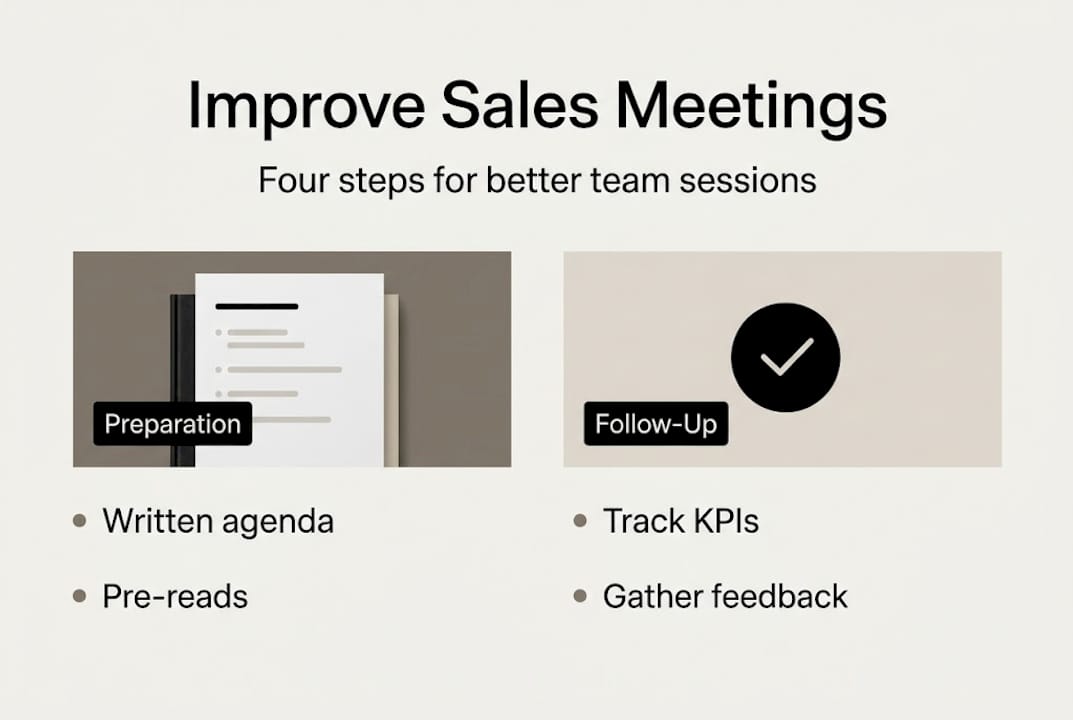
Feedback loops are non-negotiable. Run a quick pulse survey after each meeting (three questions max). Monthly, go deeper: what’s working, what’s frustrating, what should stop. This data feeds your next iteration.
The sales performance review checklist is a practical tool to tie meeting outcomes to actual rep performance reviews, closing the loop between what you discuss and what you measure.
Iteration isn’t weakness. It’s how you build a meeting culture that teams actually respect and show up for. Structure beats heroics every time.
With effective meetings verified and scaled, consider what standard advice often overlooks in sales meeting transformation.
Here’s our honest take, earned through working with dozens of B2B sales teams: templates don’t fix culture.
You can copy the best agenda format on the internet and still run a terrible meeting if leadership is conflict-averse, reps don’t trust the room, or feedback is treated as a performance threat rather than a growth tool.
The uncomfortable truth is that the most productive sales meetings we’ve ever observed include real tension. Reps push back on forecasts. Leaders admit they got the messaging wrong. Someone says the thing no one wanted to say. That’s not dysfunction. That’s trust.
Tech tools amplify whatever dynamic already exists. Better video conferencing won’t fix a meeting where no one feels safe speaking honestly. AI note-takers won’t solve misalignment between what leadership thinks the team needs and what reps actually experience.
The deeper work is cultural. And that’s exactly where consulting’s role in sales becomes most valuable: helping you see the patterns you’re too close to recognize yourself.
If you’ve recognized your team in any of this, you’re already ahead. Knowing the problem is step one. Building the system to fix it is step two.
At Sales Label Consulting, we work directly with RevOps leaders, Heads of Sales, and VPs to redesign meeting structures, build coaching cultures, and create accountability systems that stick. Our step-by-step sales enablement framework gives your team a clear operating model, not just advice. Explore our enablement best practices to see what high-performing teams do differently. And if demand generation is your gap, start with our lead generation checklist 2026 to make sure your pipeline supports your meeting goals.
Improving alignment between sales reps and leadership is the most critical factor, with 27% of sales leaders citing it as their top priority, according to HubSpot Research.
Effective meetings follow a clear agenda with defined roles, pre-work distributed 24 hours in advance, and dedicated time for coaching and results-sharing. Supporting reps via coaching (30%) is a key practice for improving meeting outcomes.
Avoid unclear objectives, poor facilitation, and skipping follow-up or metric tracking. Lack of structure and weak leadership alignment are proven drivers of ineffective meetings.
Track KPIs like participation rates, action completion percentages, and pipeline progression week over week. Pair this with brief rep feedback surveys to capture both quantitative and qualitative signals.
Subscribe to our Insights: Expert productivity tips in your inbox
You'll receive 1-3 emails per month. Your data stays private, always.

CRO & Co-Founder with Sales Label Consulting

Watch our Sales Mates Podcast
Available
April 18, 2026 - 8 min read
Read article Read articleApril 18, 2026 - 9 min read
Read article Read articleApril 17, 2026 - 7 min read
Read article Read articleApril 17, 2026 - 8 min read
Read article Read articleDrop us a line to talk
about your project