
Explaining Revenue Leakage: A Guide for Business Leaders
TL;DR:
- Revenue leakage results from failures in billing, contracts, or sales processes that cause revenue loss. Most companies lose 1–5% of ARR annually, with higher rates indicating systemic issues. Fixing leakage requires cross-functional ownership, automation, and continuous reconciliation to recover lost revenue effectively.
Revenue leakage is defined as the unintentional loss of contractually earned revenue caused by failures in billing, contract execution, or sales process gaps. It is not churn, and it is not intentional discounting. B2B SaaS companies typically lose 1–5% of ARR to this problem annually, and rates above 5% signal systemic failure. At $5M ARR, a 3% leakage rate means $150,000 in lost revenue that requires zero new customer acquisition cost to recover. For executives focused on profit margins and operational efficiency, explaining revenue leakage accurately is the first step toward stopping it.
Broken handoffs between sales, contracts, and billing cause most revenue leakage. The problem is structural, not intentional. When a signed contract never fully translates into a correctly configured invoice, money disappears quietly and permanently.

Finance leakage is the most visible category. It includes billing errors, pricing misalignments, missed renewal invoices, and incorrect manual adjustments. Manual invoicing errors, metering failures in usage-based billing, and discount misapplications are the most common vectors. Each error is small. Across thousands of contracts, the cumulative damage is severe.
Upstream leakage is harder to see and often larger in scale. Sales teams frequently miss expansion signals, stall on renewal opportunities, and fail to act on buying signals before they expire. A deal that stalls for 30 days without follow-up is not just a pipeline problem. It is a revenue problem that never shows up on an invoice.
CRM-to-billing reconciliation gaps create a third category of loss. Contract amendments get tracked in a CRM but never reach the billing system. Usage-based pricing models fail when metering data does not feed accurately into the invoicing workflow. Government contractors face a parallel version of this risk, where contract compliance gaps can trigger chargebacks and deductions that erode net revenue months after delivery.
The core causes break down into four buckets:
Pro Tip: Run a monthly reconciliation between your CRM deal data and your billing system. Any contract amendment not reflected in the next invoice is a confirmed leakage point.
Measuring revenue leakage requires comparing what contracts say against what invoices show and what payments confirm. Most companies skip this three-way check. They rely on a single system, usually the ERP or billing platform, and miss what the other systems reveal.
A practical measurement process follows four steps:
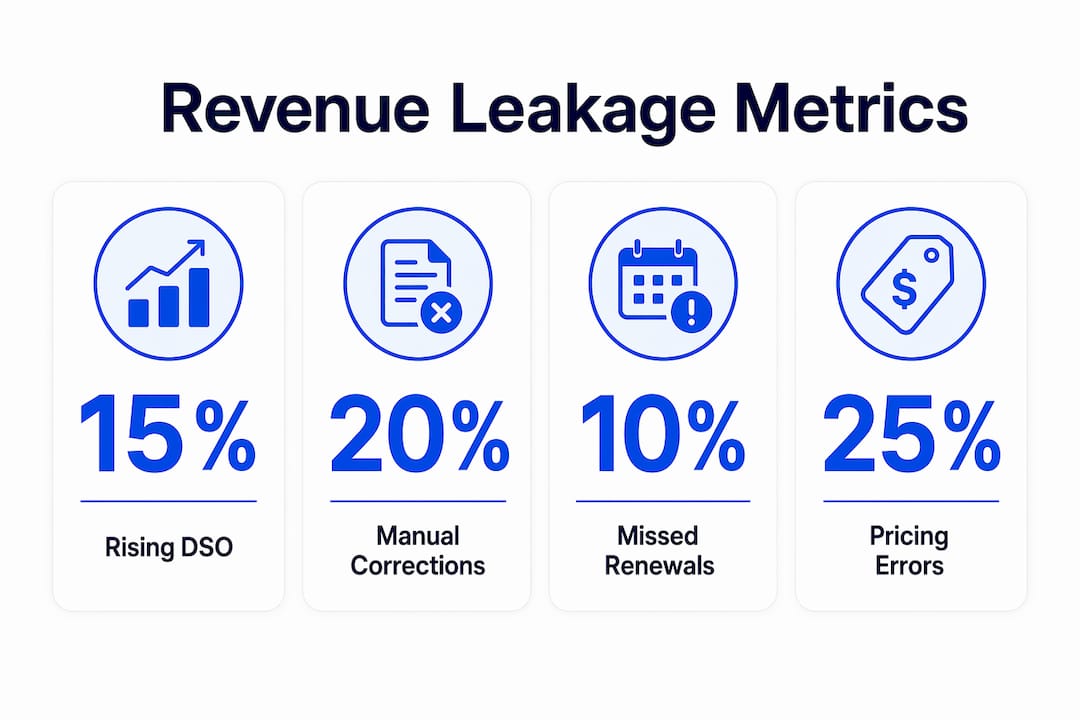
Key metrics to track in your revenue leakage analysis include Days Sales Outstanding trends, the frequency of manual invoice corrections, the volume of billing disputes, and the ratio of aged receivables to total AR. Each metric points to a specific process failure.
| Metric | What it signals |
|---|---|
| Rising DSO | Collections process is breaking down |
| High manual correction rate | Billing configuration errors are frequent |
| Billing dispute volume | Contract-to-invoice misalignment |
| Aged receivables ratio | Dunning and escalation workflows are failing |
Segmenting revenue by channel, product, and customer cohort is equally critical. Decomposing revenue by channel reveals hidden leakage that aggregate top-line numbers conceal. A product line growing 10% in gross revenue may be shrinking in net revenue once deductions, returns, and chargebacks are factored in. That gap is the revenue mirage effect, and it misleads financial planning.
Pro Tip: Never rely on a single system for leakage detection. Cross-reference your CRM, ERP, and billing platform monthly. Discrepancies between systems are where leakage hides.
Revenue leakage is invisible by design. It accumulates gradually across large contract portfolios, and no single transaction is large enough to trigger an alert. Most leakage is never recognized as missing because the revenue was never formally invoiced in the first place. You cannot chase what you never billed.
The revenue mirage effect compounds this problem. Retail trade spend deductions, compliance chargebacks, and returns cause net sales leakage 60–90 days post-shipment, obscuring true profitability. A company reporting strong top-line growth may be experiencing margin erosion that only appears in net revenue figures weeks later. By then, the financial planning cycle has already moved on.
Revenue leakage is not a finance problem. It is a structural process problem that finance happens to measure last. By the time it shows up in the numbers, the operational failure that caused it is already weeks or months old. Fixing the symptom without fixing the process guarantees the loss repeats.
Organizational blind spots in sales execution make upstream leakage especially persistent. Sales teams focused on new logo acquisition rarely monitor expansion signals in existing accounts. Renewal dates slip past without proactive outreach. Scope creep goes unbilled because no one owns the contract amendment process. Small process gaps like missed renewals and unbilled scope creep cumulatively erode profits in ways that no single quarter’s review will catch.
The long-term effect is a double hit. Profit margins shrink, and financial forecasts become unreliable because they are built on revenue figures that do not reflect actual collections.
Prevention requires fixing the structural failures that cause leakage, not just auditing for it after the fact. Continuous reconciliation between contracts, CRM data, billing, and finance systems is a process discipline, not a month-end fire drill. Companies that treat it as a periodic audit will always be chasing losses they could have prevented.
The most effective prevention strategies are:
The financial case for prevention is clear. Companies implementing automation report leakage rates below 1%, and recovered revenue carries zero customer acquisition cost. The ROI on leakage prevention is faster and more certain than the ROI on new customer acquisition.
| Prevention approach | Best for |
|---|---|
| Contract-to-billing automation | Companies with high contract volume |
| Real-time usage metering | Usage-based or consumption pricing models |
| Automated dunning workflows | Businesses with recurring invoice cycles |
| CRM-based renewal alerts | Subscription and SaaS revenue models |
| Cross-system reconciliation | Enterprises with separate CRM, ERP, and billing |
Pro Tip: Recovered revenue is pure margin. Before you invest in demand generation, calculate your current leakage rate. Fixing a 3% leakage problem often delivers faster ROI than acquiring new customers.
Revenue leakage is a leadership problem before it is a finance problem. Executives often focus on finance leakage but the larger problem is upstream sales execution failures that are harder to detect and cause more total loss. Fixing it requires cross-functional ownership, not just a finance team audit.
Leaders who successfully reduce leakage do four things consistently:
Culture matters as much as process. Sales teams need to understand that missed expansion signals and late renewal outreach are revenue failures, not just pipeline misses. Sales enablement best practices that include contract awareness and expansion signal training reduce upstream leakage at the source.
The goal is a culture where continuous reconciliation and proactive sales follow-up are standard operating procedure, not heroic exceptions.
Revenue leakage is a structural process failure that erodes profit margins silently, and fixing it requires cross-functional ownership, automation, and continuous reconciliation across contracts, CRM, billing, and finance systems.
| Point | Details |
|---|---|
| Define leakage precisely | Revenue leakage is earned but uncollected revenue, distinct from churn or intentional discounting. |
| Audit all three systems | Cross-reference contracts, invoices, and payments monthly to find discrepancies. |
| Upstream leakage is larger | Sales execution failures like missed renewals cause more loss than billing errors alone. |
| Automation cuts leakage below 1% | Companies using contract-to-billing automation report leakage rates under 1% of ARR. |
| Recovered revenue costs nothing | Fixing leakage carries zero customer acquisition cost and delivers immediate margin improvement. |
Most executives I work with treat revenue leakage as a finance department problem. They ask their CFO to run a report, find a few billing errors, fix them, and move on. That approach misses the point entirely.
The real damage is upstream. It happens when a sales rep closes a deal and hands it off without documenting the contract terms clearly. It happens when a renewal date passes without a single outreach attempt. It happens when a customer expands usage and no one notices because the metering system is not connected to billing. None of these failures show up in a standard finance audit.
Here is what I have seen work. The companies that get leakage below 1% treat it as an operational discipline, not a cleanup exercise. They build reconciliation into weekly workflows. They give sales teams visibility into contract terms and renewal dates. They automate the handoff from signed contract to billing configuration so no human can accidentally skip a step.
The other thing worth saying plainly: recovered revenue is the most profitable revenue you will ever generate. It costs zero to acquire. It lands directly on the bottom line. Before you approve the next demand generation budget, run a leakage audit. You may find that the fastest path to margin improvement is already inside your existing customer base.
Structure beats heroics here. You do not need a bigger sales team. You need a tighter process.
— Antony
Revenue leakage does not fix itself. It compounds until someone builds the process to stop it. Saleslabelconsulting works directly with RevOps leaders, Heads of Sales, and VPs of Sales to identify where contracts, billing, and sales execution are breaking down and costing you money.
Our sales enablement process closes the upstream gaps that finance audits miss, from renewal management to expansion signal training. Our sales audit methodology maps your contract-to-cash workflow and surfaces the exact points where revenue is leaking. If your leakage rate is above 2%, the fix is faster than you think. Contact Saleslabelconsulting to find out where your revenue is going.
Revenue leakage is earned revenue a company should have collected but did not, due to billing errors, missed renewals, or sales process gaps. It differs from churn because the customer did not leave. The money was simply never invoiced or collected.
Divide total unrecovered revenue by total billed or reported ARR, then multiply by 100. A rate of 1–5% is common in B2B SaaS. Anything above 5% signals a systemic process failure requiring immediate attention.
The most common causes are broken contract-to-billing handoffs, manual invoicing errors, missed renewal outreach, unbilled usage in variable pricing models, and sales teams failing to act on expansion signals in existing accounts.
Companies that implement contract-to-billing automation and continuous reconciliation typically see leakage rates drop below 1% within 30–60 days of deployment. The fastest wins come from fixing billing configuration errors and automating dunning workflows.
No. Bad debt is revenue that was invoiced but cannot be collected because the customer cannot or will not pay. Revenue leakage is revenue that was never invoiced at all, or was invoiced incorrectly, due to internal process failures.
Subscribe to our Insights: Expert productivity tips in your inbox
You'll receive 1-3 emails per month. Your data stays private, always.

CRO & Co-Founder with Sales Label Consulting

Watch our Sales Mates Podcast
September 22, 2026 - 11 min read
Read article Read articleSeptember 21, 2026 - 8 min read
Read article Read articleSeptember 20, 2026 - 13 min read
Read article Read articleSeptember 19, 2026 - 13 min read
Read article Read article