
Why Demand Generation Matters for Revenue Teams
Demand generation matters because it builds the predictable, high-quality pipeline that capture tactics alone cannot create. If your sales team is chasing low-intent leads, closing rates are weak, and CAC keeps climbing, the root cause is almost always a demand problem, not a sales problem. Here’s the real talk on what a demand-first approach actually delivers:
This guide covers the metrics that prove it, the timeline to expect, and a practical checklist to get your first pilot off the ground.
Demand generation matters because it builds the educated, high-intent pipeline that capture tactics alone cannot produce, and the teams that invest in it consistently outperform on win rate, CAC, and revenue predictability.
| Point | Details |
|---|---|
| Pipeline quality over volume | Demand gen produces SQLs that close faster and churn less than capture-only leads. |
| 83% pipeline visibility | Integrated demand gen gives marketers clear line-of-sight into pipeline impact, per Salesforce. |
| 6–24 month timeline | Expect significant pipeline signals at 6–12 months; full maturity can take up to 24 months. |
| Multi-stakeholder reality | B2B purchases involve 5–11 stakeholders, requiring multi-persona, omnichannel programs. |
| Saleslabelconsulting audit path | Saleslabelconsulting’s audit → pilot → scale model proves SQL conversion before full investment. |
Demand generation is a long-term, education-first, multi-channel approach that creates awareness and preference before you ask for contact information. It’s not a campaign. It’s the full system that makes buyers want to find you. Adobe’s primer on demand generation frames it as the coordinated mix of awareness, buyer education, and pipeline acceleration that turns a cold market into a pipeline of qualified opportunities.
Lead generation, by contrast, is the capture layer. It converts existing interest into a name and an email. Both matter, but confusing them is where most B2B teams go wrong.
| Dimension | Demand Generation | Lead Generation |
|---|---|---|
| Primary goal | Build awareness and preference | Capture contact information |
| Typical tactics | Ungated content, SEO, ABM, thought leadership, webinars | Gated assets, paid forms, demo requests |
| Timeframe | 6–24 months to full maturity | Immediate to 90 days |
| Key KPIs | Brand affinity, branded search growth, SQL quality | CPL, MQL volume, form conversion rate |
| Buyer state | Pre-aware to actively researching | Actively researching or ready to buy |
Here’s a concrete example. A B2B SaaS company publishes a weekly ungated newsletter on RevOps benchmarks (demand creation). When a subscriber visits the pricing page three times in a week, Leadfeeder identifies the company by IP, and the sales team triggers a personalized outreach sequence (demand capture). One motion creates the interest; the other converts it. Platforms like Bombora layer in third-party intent signals to tell you which accounts are researching your category right now, even before they hit your site.
Mailchimp’s demand generation guide puts it plainly: demand gen is a long-game approach that builds trust through value-first, ungated content across multiple channels, not a single-channel capture play.
The business case is concrete. When you run a real demand-first program, here’s what moves:
The pipeline visibility stat is striking: 83% of marketers report a clear view into their impact on the sales pipeline as a result of integrated demand generation efforts. That’s not just a feel-good metric. It means marketing can defend budget with data, and sales can forecast with confidence.
One more structural reality worth naming: B2B purchases now routinely involve 5–11 stakeholders. A single-channel, single-persona capture approach misses most of the buying committee entirely. Demand generation, done right, puts your content in front of every relevant stakeholder across the channels they actually use, so by the time sales reaches out, the committee is already warmed. For a deeper look at why demand generation drives B2B growth, the revenue mechanics are worth reading in full.
The metrics that matter are revenue-facing, not activity-based. Here’s the dashboard that connects demand gen effort to business outcomes:
| Metric | Why it matters | Suggested cadence | Example target |
|---|---|---|---|
| SQLs by channel | Shows which demand sources produce sales-ready pipeline | Monthly | 20% MoM growth in organic SQLs |
| Pipeline value created | Ties demand gen directly to ARR potential | Monthly | $X pipeline per $1 spent on content |
| Cost per opportunity | Tracks efficiency vs. paid capture | Quarterly | Below blended CAC benchmark |
| Win rate by source | Reveals which demand channels produce closeable deals | Quarterly | Organic/content-sourced win rate vs. paid |
| CAC payback period | Measures how fast you recover acquisition spend | Quarterly | Under 12 months for SMB |
| Branded search growth | Proxy for unaided awareness and dark-funnel influence | Monthly | Strong QoQ growth |
| Content consumption depth | Signals buyer education progress | Monthly | Avg. pages per session, return visits |
Pro Tip: Skip last-click attribution for demand gen reporting. It systematically undercredits content and brand channels that influenced the deal weeks or months earlier. Use multi-touch attribution or, at minimum, add a “how did you hear about us?” field to every demo request form. Branded search growth is your best proxy for dark-funnel impact: if it’s rising, your demand creation is working even when the CRM can’t prove it. Report pipeline metrics to leadership monthly; CAC payback and win-rate trends quarterly.
Sales and marketing alignment is the operational prerequisite for any of these metrics to be trustworthy. Without shared definitions of SQL and opportunity, the dashboard is noise.
The fundamental split is demand creation versus demand capture. Most B2B teams overinvest in capture and underinvest in creation, which is why their pipeline is thin and their CAC is high.
AI-driven content personalization is increasingly central to scaling these creation tactics. Personalizing content at scale improves engagement and keeps buyers moving through longer nurture cycles without requiring proportional headcount growth.
For a full demand generation tactics playbook, the channel-by-channel breakdown goes deeper on sequencing and budget allocation.
The honest answer: sooner than most teams think, and with more patience than most leaders want to give it.
Salesforce’s B2B demand generation research puts the time-to-impact window at 6–12 months for significant pipeline signals, with some programs taking up to 24 months to fully mature. That’s not a reason to delay. It’s a reason to start now and set the right expectations with leadership.
Prioritize demand generation when:
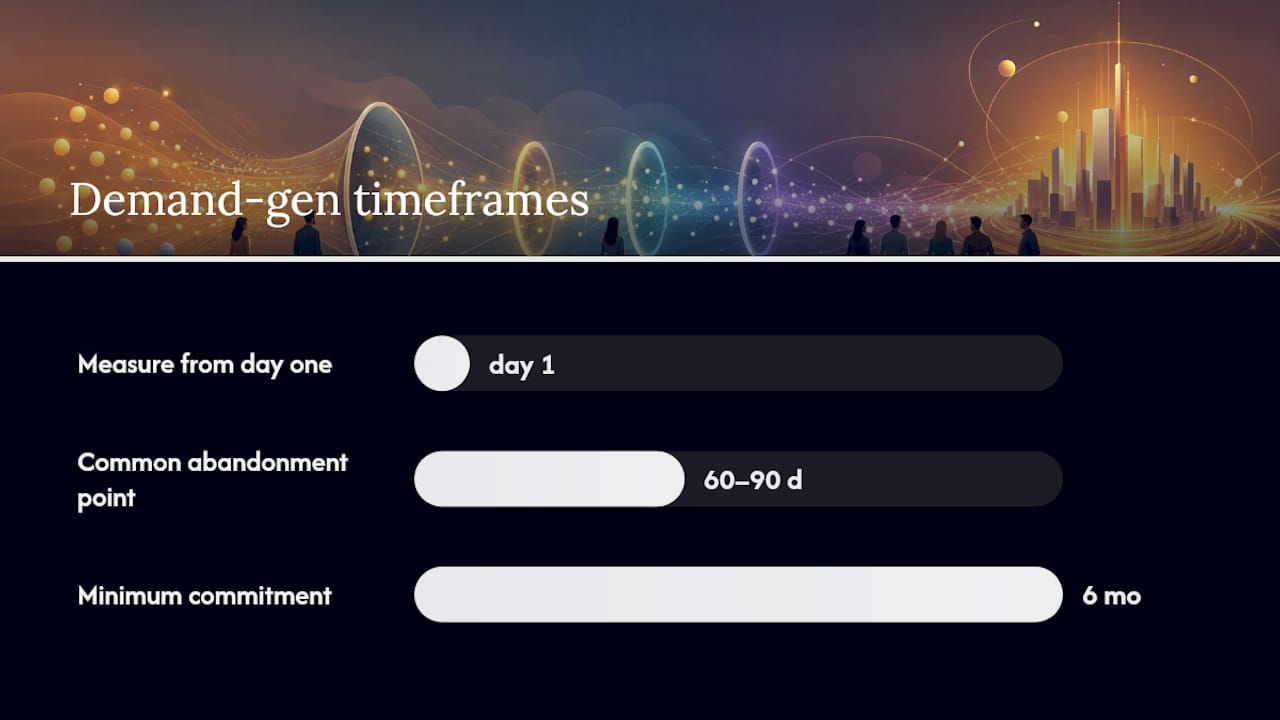
On budget shape: don’t try to run a full demand gen engine on day one. A practical starting point is a 90-day pilot focused on one ICP segment, one content format, and one intent signal. Prove SQL-to-opportunity conversion in that segment, then scale the model. Most teams that abandon demand gen do so because they ran it for 60 days, saw no MQL spike, and called it a failure. That’s the wrong metric and the wrong timeline.
Structure beats heroics. The best content strategy in the world stalls if the signal-to-handoff process is broken. Here’s the operational playbook:
Pro Tip: Automate routing for clear-signal accounts (high Bombora intent + three or more site visits + ICP match). Require human review for ambiguous signals. A rep spending 20 minutes researching a low-fit account is waste; a rep missing a high-intent ICP account because routing failed is a pipeline leak. The demand generation workflow guide covers the full CRM integration and automation setup in detail.
Most demand gen programs don’t fail because the strategy is wrong. They fail because of execution traps that are entirely avoidable.
The corrective step for that last one is straightforward: set a 6-month minimum commitment with leadership before the pilot starts, agree on leading indicators (branded search growth, content engagement, intent signal volume) that show the engine is building, and save the revenue metrics conversation for month six.
The evidence base is solid and growing.
Salesforce reports that 83% of marketers using integrated demand generation programs have clear visibility into their pipeline impact, a figure that reflects how much the discipline has matured beyond vanity metrics. The same source confirms the 6–12 month typical time-to-impact window, with full maturity sometimes requiring up to 24 months.
Monday.com’s research on buying committee dynamics is equally important: with 5–11 stakeholders now involved in a typical B2B purchase, single-persona, single-channel programs miss most of the decision-making unit. Omnichannel, multi-persona demand generation isn’t a nice-to-have for complex sales; it’s the minimum viable approach.
Leadfeeder’s B2B demand generation research supports pairing ungated organic content with IP-based identification as a scalable way to surface in-market accounts without requiring a form fill. In practice, teams using this approach identify a meaningful share of their pipeline from companies that would never have filled out a form, but were actively consuming content and showing intent signals.
On measurement: the research consistently points to multi-touch attribution and branded search growth as the most reliable proxies for demand gen impact. Last-click models systematically undercount content and brand channels, which leads finance teams to cut the programs that are actually building pipeline.
Most B2B teams treat demand generation as a marketing project. The ones that win treat it as a revenue architecture decision.
Here’s what’s genuinely underappreciated: the gap between a team that does demand gen and a team that has a demand gen engine is enormous. The first runs campaigns. The second has built a system where buyers arrive educated, sales conversations start at a higher level, and pipeline is predictable quarter over quarter. That system takes 6–12 months to build and longer to fully compound, which is exactly why most leadership teams don’t invest in it properly. The ROI is real, but it’s not immediate, and that’s uncomfortable in a world of quarterly targets.
The other thing most articles won’t say: demand generation without sales-marketing alignment is just expensive content production. The content creates the demand. The alignment is what converts it. If your sales team isn’t using the content, isn’t following up on intent signals, and isn’t capturing attribution data, you’re running half a program. Structure beats heroics here, too.
The practical next step isn’t a full-scale rebrand or a six-figure content budget. It’s a 90-day pilot: one ICP segment, one content format, one intent signal, and a clear SQL-to-opportunity conversion target. Prove the model small, then scale it with confidence.
Saleslabelconsulting works with B2B tech companies that are tired of unpredictable pipeline and want a demand-first revenue system that actually closes. The engagement path is straightforward: a sales and revenue audit to identify where demand is leaking, a 90-day pilot focused on your highest-fit ICP segment, and a scale phase once SQL-to-opportunity conversion is proven. The audit alone typically surfaces three to five pipeline gaps that no amount of outbound volume can fix.
Services span demand generation design, sales enablement frameworks, RevOps integration, and outbound system builds, all mapped to the metrics that matter to your CFO and board. If you’re a Head of Sales, VP of Revenue, or RevOps leader at a B2B tech firm ready to move from activity metrics to pipeline metrics, book a discovery call with Saleslabelconsulting to scope your audit.
Subscribe to our Insights: Expert productivity tips in your inbox
You'll receive 1-3 emails per month. Your data stays private, always.

CRO & Co-Founder with Sales Label Consulting

Watch our Sales Mates Podcast
August 10, 2026 - 10 min read
Read article Read articleAugust 9, 2026 - 14 min read
Read article Read articleAugust 7, 2026 - 13 min read
Read article Read articleAugust 6, 2026 - 10 min read
Read article Read article