
Why IT Firms Need Sales Enablement to Win More Deals
TL;DR:
- Sales enablement helps IT firms increase win rates and shorten ramp times by providing targeted content and tools. AI-powered support during calls enables reps to handle technical questions independently, accelerating deal progress. Effective enablement aligns buyer experience with revenue goals, fostering consistent messaging and measurable improvements.
Sales enablement is defined as the strategic process of equipping sales teams with the content, training, and tools they need to engage buyers effectively and close more deals. For IT firms, this process is not optional. Organizations investing in sales enablement see up to 49% higher win rates, and firms using unified enablement platforms are 42% more likely to improve those rates. That gap between firms that invest and those that don’t is widening fast. Understanding why IT firms need sales enablement starts with recognizing that technical complexity, long sales cycles, and multi-stakeholder deals make structured enablement a competitive necessity, not a nice-to-have.
The direct impact of sales enablement on win rates in IT firms is measurable and significant. AI-enabled enablement strategies improve win rates by 20–30% and reduce new hire ramp time by up to 40%. That ramp time reduction alone changes the math on hiring. A new account executive (AE) who reaches full productivity in three months instead of five generates revenue that would otherwise be lost.

Consistent messaging is the other half of the equation. When every AE tells the same story with the same supporting content, buyers gain confidence faster. In IT sales, where a single deal can involve a procurement team, a CTO, and a security officer, that consistency is what keeps a deal from stalling at the evaluation stage.
Here is what effective sales enablement delivers for IT sales teams:
Pro Tip: Prioritize enablement tools that support both SEs and AEs equally. SEs are often the bottleneck in technical deals, and giving AEs the tools to handle tier-one technical questions independently doubles your effective sales capacity without adding headcount.
The importance of sales enablement compounds over time. Firms that treat it as a system rather than a one-time training event see compounding improvements in both win rates and rep retention.
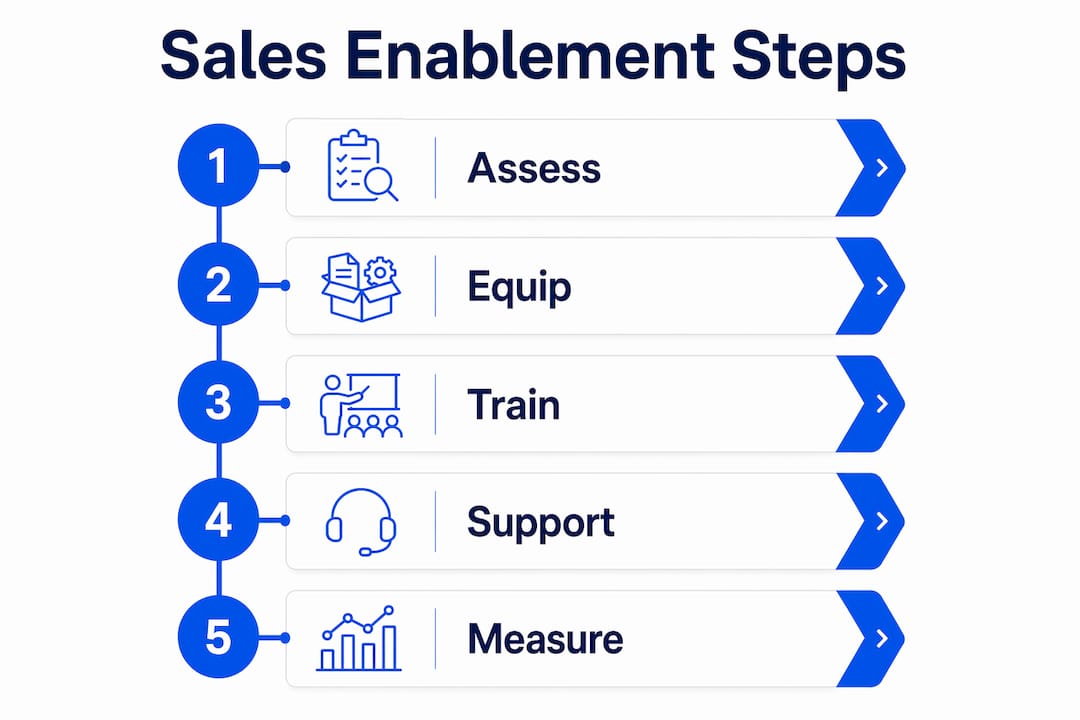
IT sales is not the same as SaaS sales or retail sales. The deals are more complex, the buyers are more technical, and the sales cycle is longer. Without structured enablement, these factors create specific, costly problems.
The most common failure point is content that does not match what technical buyers actually need. Marketing decks built for awareness do not help an SE explain a microservices architecture to a skeptical CTO. Technical sales require specific assets like battlecards, architecture diagrams, integration guides, and security documentation. Without these, SEs spend hours creating content from scratch for every deal, which kills velocity and morale.
The second major problem is the AE-to-SE bottleneck. Most IT firms run a 2:1 or 3:1 AE-to-SE ratio. Every time an AE hits a technical question they can’t answer, they schedule another call with an SE. That delay costs days. Multiply it across a full pipeline and you lose weeks of deal velocity every quarter.
Here is how to fix these problems systematically:
Pro Tip: Write a one-page enablement charter before your next planning cycle. Define your goals, assign RACI ownership, and list three KPIs tied directly to revenue. That single document prevents the “content dump” problem that kills most enablement programs.
Real-time AI assistance is the single biggest shift in sales enablement since the CRM. Traditional enablement prepared reps before the call. AI-powered enablement supports them during the call, in the moment when it matters most.
Sales enablement bridges marketing insights and product knowledge to reps exactly when they need it in live conversations, closing the intelligence gap that costs IT firms deals every week. When a buyer asks a complex integration question mid-demo, an AE without AI support either guesses, deflects, or schedules a follow-up. All three options slow the deal. An AE with real-time AI support pulls the right answer in seconds and keeps the conversation moving.
The AE-to-SE bottleneck shrinks significantly when AEs can answer complex technical questions without SE attendance. This effectively scales your sales capacity without adding headcount.
| Approach | Response to technical questions | SE involvement | Deal velocity |
|---|---|---|---|
| Traditional enablement | Schedule follow-up call | Required for most technical questions | Slow; days lost per deal |
| AI-powered enablement | Answer in real time during the call | Reserved for complex architecture decisions | Fast; deals progress in the same meeting |
Traditional sales training follows a “dump and forget” model where reps memorize content once and apply it imperfectly. Modern AI-powered enablement replaces memorization with live retrieval, AI roleplay for practice, and continuous learning loops. The result is a rep who improves with every call rather than plateauing after onboarding. For IT firms running AI in sales workflows, this is where the productivity gains become real and measurable.
80% of buyers say the buying experience is as important as the product itself. That statistic reframes the entire sales enablement conversation. You are not just training reps. You are designing an experience that either builds or destroys buyer trust at every touchpoint.
Disjointed handoffs between marketing, sales, and customer success are the most common trust-breaker in IT sales. A buyer who hears one message from a marketing campaign, a different message from an AE, and a third message from a post-sale success team concludes that the vendor doesn’t have its act together. Revenue enablement aligns all three functions with shared visibility, shared messaging, and shared accountability for the buyer’s experience.
The KPIs that matter for this alignment are specific:
Leadership alignment is the non-negotiable foundation. Enablement programs that report to marketing but are measured by sales outcomes fail because the incentives don’t match. The most effective programs sit at the intersection of RevOps, sales leadership, and marketing, with a shared dashboard that everyone reads from. Saleslabelconsulting works with IT firms to build exactly this kind of cross-functional alignment, connecting sales enablement metrics directly to ARR and pipeline velocity.
Sales enablement is the most direct lever IT firms have for improving win rates, reducing ramp time, and creating a consistent buyer experience that drives predictable revenue.
| Point | Details |
|---|---|
| Win rate impact | Firms with effective enablement see up to 49% higher win rates than those without it. |
| Ramp time reduction | AI-enabled programs cut new hire ramp time by up to 40%, accelerating revenue contribution. |
| Technical content gap | IT sales requires battlecards, architecture diagrams, and integration guides, not just marketing decks. |
| AI in live calls | Real-time AI assistance reduces AE-to-SE dependency and keeps deals moving in the same meeting. |
| Buyer experience | 80% of buyers weigh the buying experience equally to the product, making consistency a revenue driver. |
Here’s my honest take after working with IT sales teams across different growth stages: most enablement programs fail not because of bad content, but because of bad ownership. Someone builds a SharePoint folder, fills it with decks, and calls it enablement. Six months later, reps aren’t using any of it, and leadership wonders why win rates haven’t moved.
The firms that get this right treat enablement like a product. They assign a product owner, they run quarterly reviews, and they kill content that doesn’t show up in won deals. That discipline is rare. But it’s the difference between a program that costs money and one that makes money.
The other thing I see consistently: IT firms under-invest in SE enablement. All the attention goes to AEs, and SEs are left to figure it out on their own. That’s backwards. SEs are often the deciding factor in a technical deal. When you give them pre-built architecture summaries, security FAQ documents, and competitive battlecards, they close faster and with less stress.
The shift toward revenue enablement, where marketing, sales, and customer success share one view of the buyer, is the right direction. But don’t let the concept outpace your execution. Start with a one-page charter, three measurable goals, and a RACI. Ship that before you buy any technology. Structure beats heroics every time.
— Antony
IT sales is a different game. The buyers are technical, the deals are complex, and the margin for error is thin. Saleslabelconsulting works with RevOps leaders, Heads of Sales, and VPs of Sales at IT firms to build enablement programs that are tied to revenue outcomes from day one.
We start with a sales audit to identify where deals stall and what content or training gaps are causing it. From there, we build a structured enablement system with clear ownership, technical content libraries, and KPIs that your leadership team can actually act on. If you’re ready to move from scattered training to a program that drives predictable ARR, our step-by-step enablement framework is the place to start. You can also explore our enablement best practices guide to see how leading IT firms are structuring their programs in 2026.
Sales enablement in IT firms is the process of equipping AEs and SEs with the content, training, and tools they need to win complex technical deals. It includes battlecards, architecture guides, AI-assisted call support, and structured onboarding programs.
Yes. Firms with effective enablement report up to 49% higher win rates, and AI-enabled programs improve win rates by an additional 20–30% while cutting ramp time by up to 40%.
Technical buyers expect precise answers in real time. Sales training gives AEs the confidence and knowledge to handle tier-one technical questions independently, reducing SE dependency and keeping deals on track.
The most useful KPIs are win rate by deal stage, AE-to-SE call ratio, ramp time to first deal, and content-to-close correlation. These metrics connect enablement activity directly to revenue outcomes.
Real-time AI assistance gives AEs instant access to technical answers during live calls, reducing the need to escalate to SEs and eliminating the “get back to you” delays that slow deal velocity.
Subscribe to our Insights: Expert productivity tips in your inbox
You'll receive 1-3 emails per month. Your data stays private, always.

CRO & Co-Founder with Sales Label Consulting

Watch our Sales Mates Podcast
August 25, 2026 - 8 min read
Read article Read articleAugust 24, 2026 - 8 min read
Read article Read articleAugust 23, 2026 - 11 min read
Read article Read articleAugust 22, 2026 - 8 min read
Read article Read article