
B2B SaaS Sales Model: A 2026 Guide for Sales Leaders
TL;DR:
- A B2B SaaS sales model involves selling subscription-based, cloud-hosted applications to other businesses. It emphasizes recurring revenue, multi-tenancy, and matching sales motions to customer segments. Proper pricing strategy and integration between sales and customer success are key to maximizing growth and margins.
A B2B SaaS sales model is defined as the structured method by which software companies sell cloud-hosted, subscription-based applications to other businesses. It generates recurring revenue streams measured in MRR or ARR, replacing the one-time license fees that dominated software sales for decades. Three characteristics define every B2B SaaS model: cloud delivery, multi-tenancy, and subscription pricing. Understanding what is a b2b saas sales model is the foundation for any sales leader who wants predictable revenue, not just a pipeline full of hope. This guide breaks down the models, the pricing mechanics, and the operational realities that separate high-growth SaaS companies from the ones stuck chasing one-time deals.
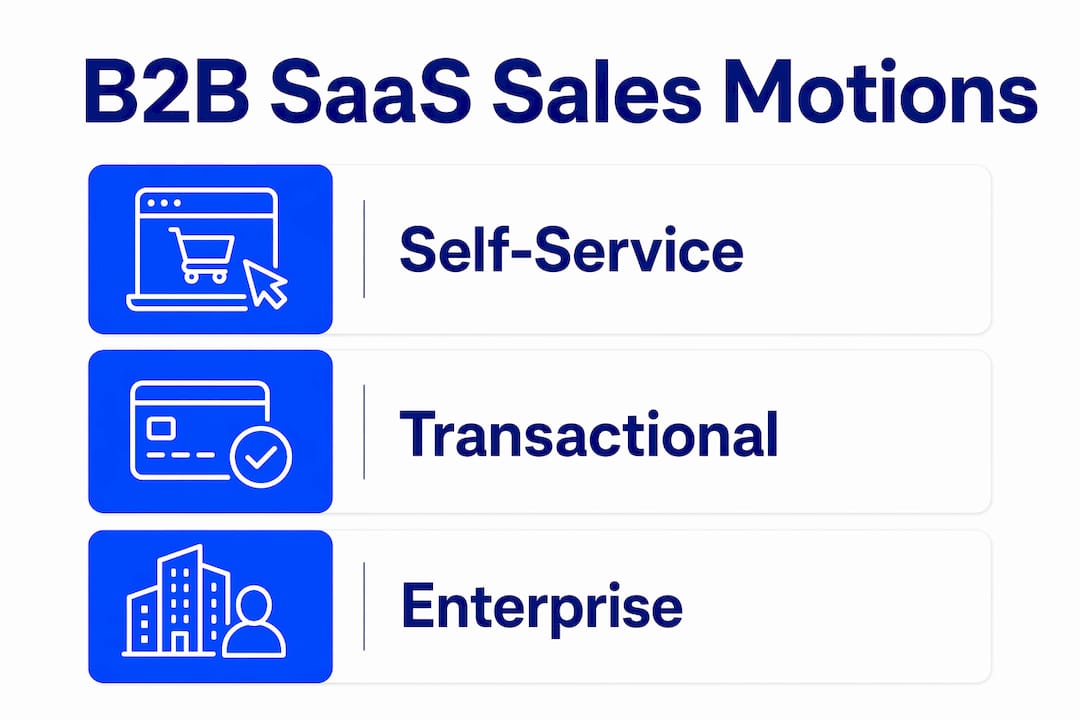
A B2B SaaS sales model is the go-to-market structure that determines how a software company acquires, prices, and retains business customers at scale. The model is not just a pricing decision. It shapes your entire sales motion, team structure, and customer success approach. Three primary motions exist: self-service, transactional, and enterprise sales. Each serves a different customer profile and product complexity level.

Self-service models require minimal human sales involvement. The product sells itself through free trials, freemium tiers, or low-friction sign-up flows. This motion works best for simple, low-cost tools where the buyer can evaluate and purchase without a sales rep. Think project management tools or lightweight CRMs priced under $50 per seat per month. Volume is the game here, not deal size.
Transactional models blend automation with light sales support. A prospect may start a trial but needs a short discovery call or a demo before committing. Pricing is typically tiered, and the average contract value sits in the $5,000 to $50,000 annual range. Your inside sales team owns this motion. Speed and repeatability matter more than deep relationship building.
Enterprise deals involve longer sales cycles, complex negotiations, and contract values ranging from $50,000 to several million annually. Multiple stakeholders, security reviews, legal teams, and procurement processes all enter the picture. Your reps need deep account research skills and the patience to run a six to twelve month sales cycle. Direct sales teams own the entire process from discovery through onboarding, with no intermediaries cutting into margin or relationship quality.
Pro Tip: Match your sales motion to your ACV before you hire. A $3,000 ACV product cannot support a field sales team. A $500,000 ACV deal cannot close through a self-service checkout page.
Pricing is the highest-leverage growth lever in any B2B SaaS business. Companies that optimize their pricing architecture see revenue growth of 25–50% without acquiring a single new customer. That number should stop you cold. Most sales leaders chase pipeline when the answer is already inside their existing customer base.
The most effective B2B SaaS pricing strategy blends three inputs: cost sets the floor, market rates provide a reference point, and customer value sets the ceiling. Targeting 10–25% of the quantified value delivered is the benchmark for sustainable, defensible pricing. Solely cost-plus pricing misses this entirely and leaves serious revenue on the table.
Five pricing models dominate the B2B SaaS market:
| Pricing Model | Best For | Key Trade-off |
|---|---|---|
| Flat-rate | Simple products, single use case | Easy to sell, hard to upsell |
| Per-seat | Team-based tools | Scales with headcount, not value |
| Usage-based | API products, infrastructure | Aligns cost to value, unpredictable MRR |
| Tiered | Multi-segment products | Captures willingness to pay across segments |
| Hybrid | Complex enterprise products | Maximum flexibility, harder to explain |
Tiered pricing captures different customer willingness to pay by separating features and usage limits across subscription levels. It is the most common model for mid-market SaaS products because it lets you serve SMBs on a starter plan while moving enterprise buyers toward a premium tier. The key is making the upgrade path obvious and the value gap between tiers real, not cosmetic.
For enterprise segments, packaging strategies matter as much as the price itself. Showing a “Contact Sales” option when a buyer hits a threshold, such as 100 seats or a compliance requirement like SSO, signals that you have a product built for their scale. It also moves the conversation from price to value.
Pro Tip: Run a pricing audit before your next planning cycle. Map what each customer segment actually pays versus what they could pay based on the value they receive. The gap is your growth opportunity.
The financial strength of B2B SaaS comes from multi-tenancy. One hosted application instance serves thousands of customers simultaneously, isolated by permissions and encryption. You write the software once and sell it indefinitely. That is a fundamentally different cost structure than traditional on-premise software, which required separate deployments, on-site installations, and dedicated support for each customer.
“B2B SaaS companies decouple delivery costs from revenue, writing software once and serving multiple customers simultaneously. This creates high gross margins that traditional software models cannot replicate.”
Decoupling delivery cost from revenue is what drives the valuation multiples SaaS companies command. A traditional software company might gross 40–50% margins. A well-run SaaS business targets 70–80% gross margins because the marginal cost of serving one more customer is near zero. That efficiency funds sales, marketing, and product development without proportional headcount growth.
The operational table below shows how SaaS compares to traditional software on the dimensions that matter most to a sales leader:
| Dimension | B2B SaaS | Traditional On-Premise |
|---|---|---|
| Deployment | Cloud, instant | On-site, weeks to months |
| Updates | Automatic, continuous | Manual, customer-managed |
| Revenue type | Recurring (MRR/ARR) | One-time license |
| Gross margin potential | 70–80% | 40–50% |
| Customer success integration | Built-in, ongoing | Post-sale, optional |
Customer success is not a nice-to-have in SaaS. It is a revenue function. Retention directly determines ARR growth. A product that updates automatically and improves continuously gives your customer success team a real story to tell at renewal. That story is impossible to tell when the customer is running a version you shipped three years ago.
Customer segmentation drives every good sales model decision. SMBs want fast time-to-value, simple pricing, and self-serve onboarding. Mid-market buyers want a consultative rep who understands their workflow and can show ROI within 30 days. Enterprise buyers want references, security documentation, and a named account executive who will still be there in year two.
Your B2B sales methodology must match the buying cycle of your target segment. Pushing a complex enterprise sales process onto an SMB buyer kills deals. Running a self-service motion against a Fortune 500 procurement team loses to competitors who show up in person.
Here is how to align your model by segment:
Sales enablement is the connective tissue between your model and your results. Reps need playbooks, objection handling guides, and competitive positioning documents tailored to each segment. Without that infrastructure, even the right sales motion produces inconsistent results. The 2026 B2B sales tech trends show that AI-assisted prospecting and conversation intelligence tools are becoming standard equipment for mid-market and enterprise teams. Adopting them is no longer optional if you want to compete at scale.
Customer success integration into the sales model is the final piece most teams get wrong. Churn is a sales problem, not just a CS problem. When your sales team sells the right customer into the right tier with accurate expectations, retention follows. Structure your handoff process so CS has full context on what was promised, what the customer’s success metrics are, and when the first check-in happens.
The B2B SaaS sales model generates predictable revenue through subscription pricing, multi-tenancy, and sales motions matched precisely to customer segment and product complexity.
| Point | Details |
|---|---|
| Match motion to ACV | Self-service, transactional, and enterprise motions each require different team structures and deal economics. |
| Pricing is a growth lever | Optimizing pricing architecture can grow revenue 25–50% without adding new customers. |
| Multi-tenancy drives margins | Serving thousands of customers from one software instance creates gross margins traditional software cannot match. |
| Segment before you sell | SMB, mid-market, and enterprise buyers have different cycles, expectations, and success metrics. |
| Sales enablement closes the gap | Reps need playbooks and tools aligned to each segment or even the right model produces inconsistent results. |
Here’s the real talk: most sales leaders I work with know their product cold but have never stress-tested their sales model against their actual customer data. They picked a motion early, hired around it, and never revisited it as the product and market evolved. That is where revenue stalls.
The single biggest unlock I see is pricing. Teams treat it as a finance decision and hand it off to the CFO. Pricing is a sales strategy decision. When you price at 10–25% of the value you deliver, you have a defensible number you can walk a customer through. When you price based on what feels comfortable or what a competitor charges, you are guessing.
The second thing I push hard on is the integration between sales and customer success. Structure beats heroics. A clean handoff process, shared success metrics, and a CS team that flags expansion signals back to sales creates a compounding revenue engine. Without it, you are filling a leaky bucket.
Data-driven decisions matter here too. Track MRR, ARR, churn rate, net revenue retention, and average contract value by segment. If you don’t know which segment churns most, you can’t fix the model. If you don’t know your average sales cycle by motion, you can’t forecast accurately. The metrics tell you where the model is working and where it isn’t.
— Antony
Knowing the model is one thing. Executing it with a real team, real pipeline, and real revenue targets is another challenge entirely.
Saleslabelconsulting works with RevOps leaders, Heads of Sales, and VPs of Sales to audit existing sales processes, identify where the model breaks down, and build the enablement infrastructure that makes results repeatable. From pricing alignment to segment-specific playbooks, the work is grounded in what actually moves ARR. If you want a structured path to predictable revenue, the sales enablement framework Saleslabelconsulting uses is a practical starting point. You can also explore the full range of consulting services to see where the fit is strongest for your team.
A B2B SaaS sales model is the method a software company uses to sell cloud-based applications to business customers through recurring subscriptions. It generates predictable MRR or ARR instead of one-time license fees.
The three main motions are self-service, transactional, and enterprise sales. Each suits a different product complexity level, customer size, and average contract value.
Companies that optimize their pricing architecture see revenue growth of 25–50% without acquiring new customers. Pricing at 10–25% of the value delivered is the benchmark for sustainable B2B SaaS pricing.
Multi-tenancy means one software instance serves thousands of customers simultaneously. It decouples delivery cost from revenue, enabling gross margins of 70–80% that traditional on-premise software cannot achieve.
Match your sales motion to your average contract value and product complexity. Low-cost, simple products suit self-service. Mid-range products with moderate complexity fit transactional sales. High-value, complex products require an enterprise motion with dedicated account executives.
Subscribe to our Insights: Expert productivity tips in your inbox
You'll receive 1-3 emails per month. Your data stays private, always.

CRO & Co-Founder with Sales Label Consulting

Watch our Sales Mates Podcast
Available
July 7, 2026 - 8 min read
Read article Read articleJuly 6, 2026 - 8 min read
Read article Read article