
What Is Demand Generation? A 2026 B2B Guide
TL;DR:
- Demand generation is a strategic marketing approach that builds brand awareness and shapes buyer preferences before prospects enter an active purchasing cycle. It targets the 95% of buyers not yet in-market, complementing lead generation efforts that focus on active shoppers, and requires long-term content and brand-building efforts. Measuring success involves pipeline quality, sales velocity, and revenue contribution, with strong sales alignment essential for converting demand into revenue.
Demand generation is defined as a strategic marketing discipline that builds brand awareness, trust, and buyer interest before prospects enter an active purchasing cycle. Unlike a quick lead capture campaign, it works on the 95% of buyers not currently in-market, shaping their preferences long before they talk to sales. Research shows 70–80% of B2B buyers form brand preferences before contacting a vendor. That single fact rewrites the entire playbook for marketing leaders. Tools like HubSpot, Salesforce, and Leadfeeder exist precisely to support this kind of long-cycle influence. If your program only chases in-market leads, you’re competing for a fraction of the available revenue.
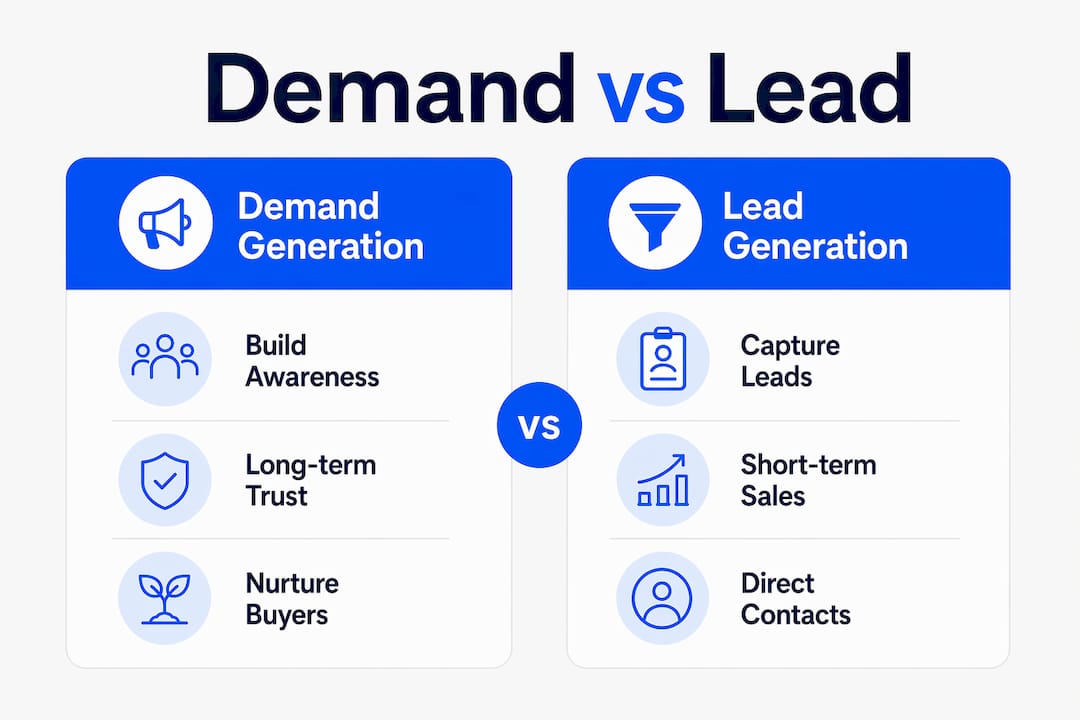
The core distinction is buyer intent. Demand generation nurtures potential buyers before they show intent, while lead generation targets those actively shopping. Both matter. Neither works well without the other.

Think of demand generation as farming and lead generation as fishing. Farming takes longer, but it feeds you all year. Fishing gets you dinner tonight, but only if the fish are biting.
Here’s how the two strategies compare across the dimensions that matter most to marketing and revenue leaders:
| Attribute | Demand Generation | Lead Generation |
|---|---|---|
| Primary goal | Build awareness and trust over time | Capture contact data from in-market buyers |
| Buyer stage | Pre-intent, out-of-market (95% of buyers) | Active consideration, in-market |
| Time horizon | Long-term, ongoing | Short-term, campaign-driven |
| Content approach | Ungated, educational, brand-building | Gated, offer-driven, conversion-focused |
| Success metrics | Pipeline quality, brand authority, sales velocity | MQL volume, cost per lead, conversion rate |
| Sales alignment | Warms pipeline for future handoffs | Delivers immediate leads for follow-up |
Neglecting demand generation creates a lead quality crisis. You get volume without intent, which means your sales team wastes time on prospects who were never ready to buy. That’s pipeline stagnation dressed up as activity. A balanced program uses demand generation to build the pool and lead generation to convert from it. If you want to understand where leads fit into the broader pipeline picture, the lead vs. prospect breakdown at Saleslabelconsulting is worth reading.
Demand generation encompasses content marketing, social media, events, thought leadership, and paid campaigns. Leadfeeder splits this into two distinct modes: demand creation and demand capture. Both are necessary, and confusing them is one of the most common mistakes we see.
Demand creation targets buyers who don’t know they have a problem yet. It includes:
Demand capture targets buyers who are already in-market but haven’t found you yet. It includes:
The five-stage demand generation engine from IvrisTech frames this well: Foundation, Create, Capture, Convert, and Compound. Each stage builds on the last. Most companies skip Foundation (brand positioning, ICP clarity) and wonder why their content doesn’t convert. Structure beats heroics every time.
Pro Tip: Don’t gate your best content. Ungated thought leadership builds the brand authority that makes your gated offers worth downloading later. Flip the sequence: give first, ask second.
The most underused demand generation tactic in B2B tech is original research. Publishing a proprietary data report gives you something no competitor can copy. It generates backlinks, earns media coverage, and positions your brand as the authority in the category. That’s compounding demand creation at its best.
Salesforce defines demand generation success through pipeline quality, sales velocity, and revenue contribution, not MQL counts alone. MQLs are a vanity metric when used in isolation. A thousand MQLs that never close tell you nothing useful about marketing’s real impact.
Marketing leaders who measure sales effectiveness through multi-metric frameworks get a far more accurate picture of what demand generation is actually doing for revenue. The table below shows the KPIs that matter and how to use them:
| KPI | Definition | How to Use It |
|---|---|---|
| Pipeline contribution | % of pipeline sourced or influenced by marketing | Tracks marketing’s direct impact on revenue potential |
| Sales velocity | Speed at which deals move through the pipeline | Reveals whether demand gen is attracting high-intent buyers |
| Revenue contribution | Closed revenue attributed to marketing-sourced deals | Connects marketing spend directly to ARR growth |
| Brand authority score | Share of voice, branded search volume, media mentions | Measures long-term demand creation effectiveness |
| Win rate by source | % of deals won, segmented by lead source | Identifies which demand gen channels produce the best buyers |
Attribution is the hardest part. Multi-touch attribution models (linear, time-decay, W-shaped) each tell a different story. The right model depends on your sales cycle length and the number of touchpoints before a deal closes. For most B2B tech companies with cycles longer than 60 days, a W-shaped model gives the most honest view of marketing’s influence.
Pro Tip: Align on a shared pipeline dashboard with your sales team before launching any demand generation program. If marketing and sales aren’t looking at the same numbers, you’ll spend more time arguing about credit than closing deals.
Knowing how well your brand is known online is a practical starting point for benchmarking brand authority before you invest in demand creation. You can’t improve what you haven’t measured.
Demand generation supports sales enablement by delivering marketing collateral, data insights, and nurtured prospects that make sales conversations more productive. This is where most companies leave serious money on the table. Marketing generates interest, then hands off a name and a company. Sales gets no context, no content, and no clue why the prospect should care. That’s not a handoff. That’s a fumble.
A well-integrated demand generation program does the following for your sales team:
The 95% of future buyers who aren’t in-market today will be in-market eventually. Demand generation keeps your brand in their consideration set during that waiting period. When they’re ready to buy, you’re not starting from zero. That’s the compounding effect that makes demand generation worth the investment.
Practical alignment between marketing and sales requires three things: a shared definition of a qualified opportunity, a documented handoff process, and a regular pipeline review meeting where both teams look at the same data. Without those three, even the best demand generation program leaks revenue at the handoff point. The sales enablement best practices guide from Saleslabelconsulting covers the handoff process in detail.
Demand generation is increasingly viewed as a core engine of B2B growth in 2026, not an optional marketing add-on. Salesforce frames it as building authority and trust that turns fleeting interest into revenue. That framing is exactly right. It’s not a campaign. It’s an operating system for sustainable growth.
Demand generation works because it builds brand preference among the 95% of buyers not yet in-market, creating a pipeline that compounds over time rather than resetting with every campaign.
| Point | Details |
|---|---|
| Demand gen targets future buyers | Focus on the 70–80% of B2B buyers who form preferences before contacting sales. |
| It differs from lead generation | Demand gen builds long-term awareness; lead gen converts buyers already in-market. |
| Measure beyond MQLs | Track pipeline quality, sales velocity, and revenue contribution for real impact. |
| Sales alignment is non-negotiable | Shared dashboards and documented handoffs prevent revenue leaking at the transition point. |
| Structure beats scattered tactics | A five-stage framework (Foundation, Create, Capture, Convert, Compound) produces repeatable results. |
Here’s what I’ve learned after working with dozens of B2B tech companies on their go-to-market programs: most teams understand demand generation conceptually and execute it poorly in practice. They publish content without a distribution plan. They run webinars without following up. They measure MQLs and call it a win while their sales team quietly starves for quality pipeline.
The companies that get it right treat demand generation as infrastructure, not a campaign. They invest in brand before they need it. They publish research that makes them the most credible voice in their category. They build nurture sequences that run for 12 months, not 12 days.
The other thing I see consistently is impatience. Demand generation has a lag. You will not see the results in Q1 from content you published in Q1. The compounding effect takes six to twelve months to show up in pipeline data. Leaders who kill the program at month four because “it’s not generating leads” are making a category error. They’re judging a farming strategy by fishing metrics.
My honest advice: pick two or three demand creation channels and go deep rather than spreading thin across six. Publish original data. Show up consistently on LinkedIn. Run quarterly webinars with real practitioners, not product demos. Then build the capture layer on top of that foundation. That sequence works. Reversing it doesn’t.
— Antony
Demand generation builds the pipeline. Sales enablement closes it. The gap between those two functions is where most B2B revenue gets lost.
Saleslabelconsulting works directly with RevOps leaders, Heads of Sales, and VPs of Sales to connect demand generation programs with the sales enablement systems that convert interest into signed contracts. From defining your ICP and building your nurture architecture to equipping your sales team with the right content at the right deal stage, we cover the full revenue cycle. Start with the sales enablement step-by-step guide to see exactly how the handoff from marketing to sales should work. If you want to go deeper on 2026 trends, the sales enablement trends guide is the next read.
Demand generation is a strategic marketing approach that builds brand awareness and buyer interest among prospects before they enter an active buying cycle. It targets the majority of potential buyers who are not yet in-market, shaping preferences that influence future purchasing decisions.
Demand generation nurtures out-of-market buyers over the long term, while lead generation captures contact information from buyers actively shopping. Both strategies serve different stages of the revenue cycle and work best when used together.
The most effective tactics include ungated thought leadership content, original research reports, LinkedIn campaigns, webinars, and retargeting programs. Leadfeeder’s framework splits these into demand creation (brand building) and demand capture (converting in-market buyers).
Salesforce recommends measuring pipeline quality, sales velocity, and revenue contribution rather than relying on MQL counts alone. Multi-touch attribution models help connect marketing activity to closed revenue across longer B2B sales cycles.
Demand generation equips sales teams with nurtured prospects, intent data, and marketing collateral that make conversations more productive. It shortens sales cycles by ensuring prospects arrive already educated on the brand and its value, reducing the time sales spends on early-stage education.
Subscribe to our Insights: Expert productivity tips in your inbox
You'll receive 1-3 emails per month. Your data stays private, always.

CRO & Co-Founder with Sales Label Consulting

Watch our Sales Mates Podcast
October 15, 2026 - 9 min read
Read article Read articleOctober 14, 2026 - 7 min read
Read article Read articleOctober 13, 2026 - 10 min read
Read article Read articleOctober 12, 2026 - 11 min read
Read article Read article