
The Role of RevOps in Sales: 2026 Growth Guide
TL;DR:
- Revenue Operations (RevOps) aligns marketing, sales, and customer success under shared processes and metrics to drive predictable revenue. It reduces non-selling activities, boosts sales productivity by up to 30%, and shortens sales cycles through automation and data consolidation. Effective RevOps implementation depends on governance, early adoption, and integrating it into daily workflows to outperform traditional sales operations.
Revenue Operations, or RevOps, is defined as the integrated function that aligns marketing, sales, and customer success under shared processes, data, and accountability to drive predictable revenue growth. The role of RevOps in sales goes far beyond administrative support. It acts as the operational backbone that removes friction, unifies data, and gives sales teams the structure they need to perform at their ceiling. According to the Salesforce State of Sales research, companies with a formal RevOps function report 36% higher revenue growth and up to 30% lower go-to-market costs. That’s not a marginal improvement. That’s a structural advantage. Platforms like Unify and frameworks like the Four Pillars of RevOps (people, process, data, technology) are now central to how high-growth B2B organizations build their sales engines.
The most direct impact of RevOps on sales is time. Sales reps spend a shocking portion of their week on non-selling activities: updating CRM records, chasing down lead assignments, waiting on marketing handoffs. RevOps fixes this at the process level, not the motivation level.

When administrative burdens are automated through RevOps workflows, sales reps gain 28% to 40% more weekly selling time. That’s not a productivity hack. That’s the equivalent of adding one to two full selling days per rep per week without hiring anyone new.
The gains don’t stop at time savings. RevOps models deliver a 15% to 30% boost in sales productivity and shorten sales cycles by up to 30% through automation and data consolidation. Forecast accuracy also improves by 15% to 25% in organizations that centralize their revenue data under a unified RevOps structure. Better forecasts mean fewer surprises at the end of the quarter and more confident pipeline conversations with your board or investors.
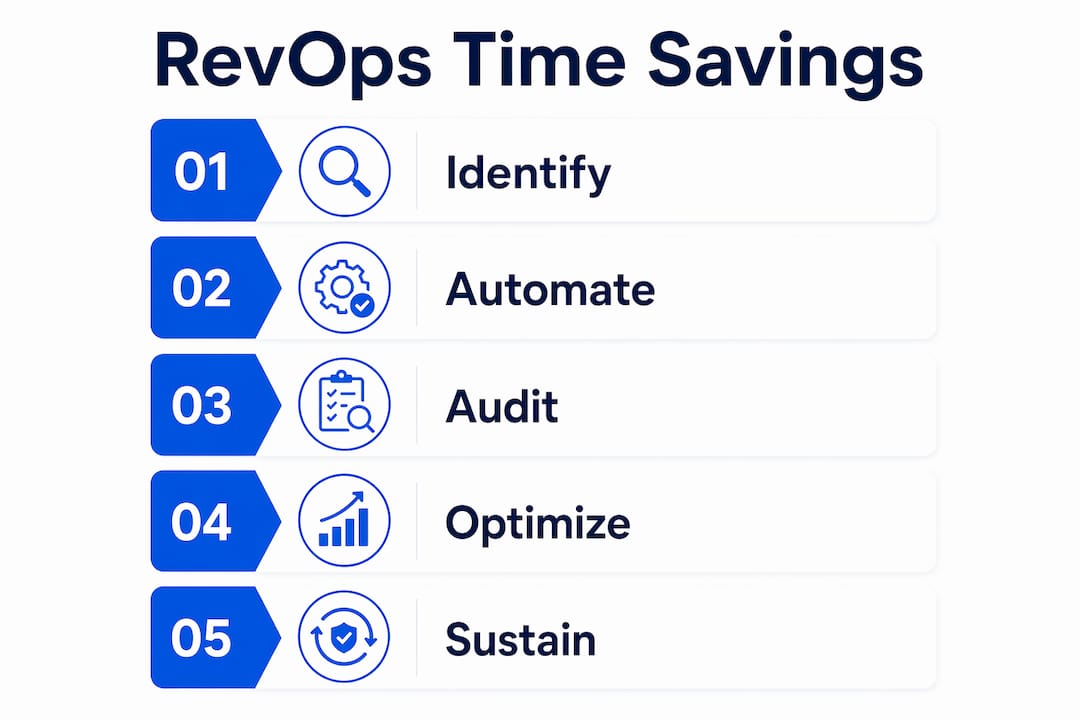
Here’s what drives these numbers in practice:
Pro Tip: Before investing in new RevOps tooling, audit your current sales cycle for the three biggest time drains. In most mid-market B2B teams, lead routing delays, manual CRM updates, and inconsistent handoff criteria account for over 60% of non-selling time. Fix the process first, then automate it.
Real talk: a lot of sales leaders use “RevOps” and “Sales Ops” interchangeably. They’re not the same thing, and confusing them leads to under-investing in what RevOps actually delivers.
Sales Operations focuses on the sales team’s internal mechanics. Think CRM administration, territory planning, quota modeling, and sales forecasting. It’s a critical function, but it operates within the sales silo. RevOps, by contrast, governs the entire revenue lifecycle across marketing, sales, and customer success with shared metrics and joint accountability.
Here’s a direct comparison:
| Dimension | Sales Operations | Revenue Operations (RevOps) |
|---|---|---|
| Scope | Sales team only | Marketing, sales, and customer success |
| Reporting line | VP of Sales | CRO or CEO |
| Primary metrics | Quota attainment, pipeline coverage | ARR, NRR, CAC, revenue cycle velocity |
| Data ownership | CRM data | Unified revenue data across all systems |
| Accountability model | Departmental KPIs | Shared revenue targets |
The reporting line difference matters more than most people realize. RevOps reporting into a CRO or CEO ensures the function maintains cross-functional influence and avoids being captured by any single department’s priorities. When RevOps reports into the VP of Sales, it quietly becomes Sales Ops with a new name.
For sales leaders thinking about adoption, here’s the practical progression:
The Four Pillars of RevOps are people, process, data, and technology. Every proven strategy maps back to at least two of these pillars working together. Here’s what actually moves the needle for sales teams:
Clean, unified data is non-negotiable. Dirty CRM data is the silent killer of sales productivity. Duplicate records, missing fields, and inconsistent lead scoring make every downstream process less reliable. RevOps establishes data governance standards that keep your pipeline data trustworthy. Without this, your forecasts are guesses dressed up as numbers.
End-to-end process mapping changes how sales teams operate. Most sales organizations optimize their own stage of the funnel without understanding what happens before or after. RevOps maps the full customer lifecycle from first marketing touch to renewal, identifying where deals stall, where leads go dark, and where customer success can create expansion opportunities. This visibility alone changes the conversations sales leaders have with their teams.
Automated lead routing and standardized SLAs accelerate pipeline velocity. Centralizing data and automating lead routing improves sales velocity by removing the manual steps that slow down response time. Speed to lead is a proven conversion driver. Every hour a qualified lead sits unassigned is revenue at risk.
Pro Tip: Map your current lead-to-close process on a whiteboard with your marketing and customer success leads in the room. You’ll find at least three handoff points where leads go silent or data gets lost. Those gaps are your first RevOps priorities.
The business case for RevOps is strong, and the numbers are specific enough to build a board-level presentation around. Unified RevOps platforms deliver 5X to 20X ROI within the first year by enabling automated lead routing, data enrichment, and forecasting. For context, typical RevOps platform costs of $80K to $150K yield $1M to $2M in annual value for mid-market B2B firms.
Organizations with RevOps are 1.4 times more likely to exceed revenue targets by 10% or more. That’s a meaningful edge in competitive markets where every percentage point of growth matters.
Here’s how to track RevOps ROI in your own organization:
| Metric | What it measures | Target improvement |
|---|---|---|
| Sales productivity | Revenue per rep per quarter | 15% to 30% increase |
| Sales cycle length | Days from first touch to close | Up to 30% reduction |
| Forecast accuracy | Variance between forecast and actual | 15% to 25% improvement |
| Go-to-market costs | Total cost to acquire and retain revenue | 10% to 30% reduction |
| Net Revenue Retention (NRR) | Revenue retained and expanded from existing customers | Baseline plus expansion |
Strong RevOps capabilities drive a 30% reduction in go-to-market costs and a 10% to 20% increase in sales productivity. When you combine those two levers, the math on RevOps investment becomes straightforward. You’re spending less to acquire revenue while your reps produce more of it.
The biggest mistake sales organizations make with RevOps is treating it as a technology project. Buy the platform, flip the switch, wait for results. It doesn’t work that way. The biggest RevOps pitfall is treating it as merely a technology or reporting initiative rather than an operational governance function.
Here’s what separates successful RevOps implementations from expensive disappointments:
RevOps is the operational system that connects marketing, sales, and customer success into a single revenue engine, and sales teams that adopt it outperform those that don’t on every measurable dimension.
| Point | Details |
|---|---|
| RevOps drives real productivity gains | Sales reps gain 28% to 40% more selling time when administrative tasks are automated through RevOps workflows. |
| RevOps is not Sales Ops | RevOps governs the full revenue lifecycle with shared accountability, while Sales Ops focuses only on the sales team. |
| ROI is measurable and significant | RevOps platforms deliver 5X to 20X ROI within the first year for mid-market B2B organizations. |
| Start with data and process, not tools | Clean data and documented processes are the foundation. Technology without governance produces no lasting results. |
| Early adoption pays off | Implementing RevOps principles before $5M ARR is far cheaper than fixing broken systems at scale. |
I’ve worked with enough sales leaders to know the pattern. The team is hitting quota some months, missing it others. The forecast is consistently off by 15% to 20%. Marketing blames sales for not following up on leads. Sales blames marketing for sending garbage leads. Customer success is operating in a completely separate world. Sound familiar?
The real talk is this: those aren’t people problems. They’re system problems. And RevOps is the system fix.
What I’ve seen work, consistently, is when a sales leader stops trying to solve coordination failures with more meetings and starts solving them with process architecture. When you define shared metrics, automate the handoffs, and give everyone visibility into the same data, the blame game stops. People start solving problems instead of defending territory.
The cultural shift is the hardest part. Asking a VP of Sales to share revenue accountability with a CMO and a VP of Customer Success feels threatening at first. But the leaders who make that shift stop managing a sales team and start leading a revenue organization. That’s a fundamentally different, and more powerful, position to be in.
AI and predictive analytics are accelerating this shift. The next generation of RevOps isn’t just about clean data and automated workflows. It’s about using intent signals, behavioral data, and predictive scoring to tell your reps exactly who to call, when to call them, and what to say. The organizations building that capability now will have a structural advantage that’s very hard to close later.
If you’re a Head of Sales or VP of Sales reading this, the question isn’t whether RevOps matters. The question is how far behind you’re willing to fall before you build it.
— Antony
The strategies in this article work. But knowing what to do and knowing how to execute it inside your specific organization are two different things.

At Saleslabelconsulting, we work directly with RevOps leaders, Heads of Sales, and VPs of Sales to translate RevOps principles into execution. Our sales enablement programs are built around the same frameworks covered here: clean data, standardized processes, automated workflows, and shared accountability. We also offer sales audits that identify exactly where your revenue cycle is leaking. If you’re ready to stop guessing and start building a predictable revenue engine, let’s talk.
RevOps serves as the operational backbone that aligns marketing, sales, and customer success under shared data, processes, and metrics. Its primary role in sales is to remove friction, automate workflows, and create the conditions for consistent, predictable revenue growth.
Sales Ops focuses on the internal mechanics of the sales team, including CRM management, territory planning, and quota modeling. RevOps governs the entire revenue lifecycle across all three go-to-market functions with shared accountability and unified metrics.
Unified RevOps platforms deliver 5X to 20X ROI within the first year for mid-market B2B firms, with typical platform investments of $80K to $150K generating $1M to $2M in annual value.
Earlier than most teams think. Adopting RevOps principles like clean data and documented processes before reaching $5M ARR is significantly cheaper than retrofitting them at scale, where broken systems compound quickly.
Treating RevOps as a technology project rather than an operational governance function is the most common failure. Successful implementation requires shared accountability frameworks, cultural alignment, and embedding RevOps into daily sales workflows, not just reporting dashboards.
Subscribe to our Insights: Expert productivity tips in your inbox
You'll receive 1-3 emails per month. Your data stays private, always.

CRO & Co-Founder with Sales Label Consulting

Watch our Sales Mates Podcast
July 23, 2026 - 17 min read
Read article Read articleJuly 21, 2026 - 9 min read
Read article Read articleJuly 20, 2026 - 8 min read
Read article Read article