
Sales Terminology Explained for Sales Pros and Leaders
TL;DR:
- Sales terminology is a standardized language that aligns teams across all functions, improving forecast accuracy and deal closing. Confusing key terms like lead, prospect, and opportunity inflates pipeline reports, leading to revenue misjudgments. Implementing precise frameworks like MEDDPICC and building a shared glossary enhances sales performance and accelerates onboarding and revenue predictability.
Sales terminology is the standardized vocabulary that sales professionals use to communicate deals, performance, and strategy with precision across every function in a revenue organization. When your team speaks the same language, from SDRs to the VP of Sales to RevOps, forecasts get cleaner, onboarding gets faster, and deals close with fewer surprises. The problem is that most teams never formally define their terms. They assume everyone means the same thing by “lead” or “pipeline,” and that assumption costs real money. This article covers the core sales terms, qualification frameworks, key metrics, and communication practices you need to align your team and build predictable revenue.
Sales vocabulary starts with three terms that get confused more than any others: lead, prospect, and opportunity. Getting these right is not a semantic exercise. Confusing these three terms inflates revenue forecasts and corrupts the data your leadership team uses to make decisions.

| Term | Definition | Example |
|---|---|---|
| Lead | An unqualified contact who has shown some interest or fits a target profile | Someone who downloaded a whitepaper |
| Prospect | A lead who has been researched and confirmed as a potential fit | A VP of Sales at a 200-person SaaS company |
| Opportunity | A prospect actively engaged in a buying conversation with a defined need | A prospect in a discovery call with budget confirmed |
A lead is raw material. A prospect is a lead you’ve validated against your ideal customer profile. An opportunity is a prospect you’ve opened a formal sales conversation with, typically tracked inside your CRM as a deal record. Skipping these distinctions is one of the most common sales mistakes teams make, and it shows up immediately in distorted pipeline reports.
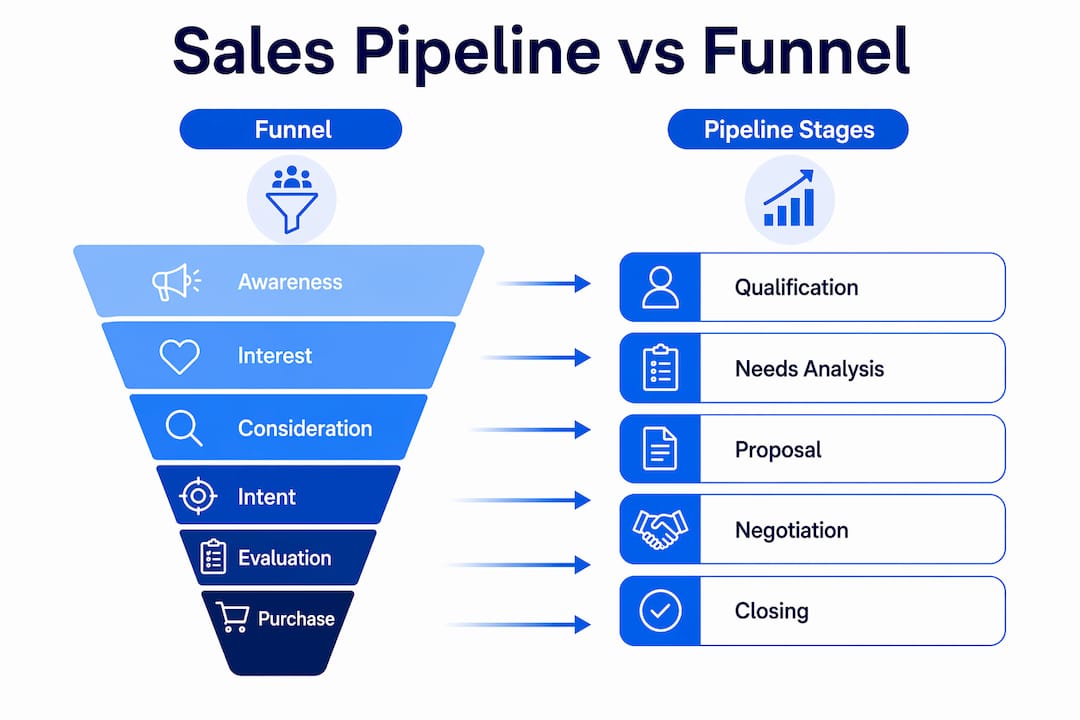
The sales pipeline and sales funnel are related but not the same thing. The funnel describes the buyer’s journey from awareness to purchase, typically from the marketing perspective. The pipeline is the seller’s view of active deals at each stage of the sales process. Modern sales pipelines typically run 5 to 7 stages, from qualification through to closed won, and each stage maps to a specific probability of closing. That probability is what feeds your weighted forecast.
Common sales roles also carry specific definitions. An SDR (Sales Development Representative) focuses on outbound prospecting and qualifying inbound leads. A BDR (Business Development Representative) typically focuses on outbound pipeline creation, though the titles are used interchangeably at many companies. An AE (Account Executive) owns the full sales cycle from discovery to close. Quota is the revenue target assigned to a rep or team for a given period, and commission is the variable compensation paid when that quota is met or exceeded.
Pro Tip: Never use internal sales jargon like “bluebird” or “whale” in front of clients. These terms speed up internal communication but signal insider culture to buyers, which can feel exclusionary and unprofessional.
Qualification frameworks exist for one reason: to give your team a repeatable way to assess whether a deal is real before it consumes your AE’s time and inflates your forecast. Without a framework, reps qualify on gut feel, and gut feel does not scale.
BANT (Budget, Authority, Need, Timeline) was the dominant framework for decades. It’s simple and fast, but it’s also shallow. BANT tells you whether a buyer can buy, not whether they will buy. It misses the internal dynamics that actually kill deals: the lack of a champion, an undefined decision process, or a competitor already embedded in the account.
MEDDPICC is the most widely adopted enterprise qualification framework in B2B SaaS, used by companies like Salesforce and Snowflake. Here’s what each letter covers:
The addition of Paper Process and Champion is what separates MEDDPICC from older frameworks. Enterprise deals die in legal review and in the absence of an internal advocate far more often than they die from budget issues. BANT is considered outdated for modern SaaS sales cycles precisely because it ignores these dynamics.
CHAMP (Challenges, Authority, Money, Prioritization) is a middle-ground framework that flips the order of BANT to lead with pain rather than budget. It’s a reasonable choice for mid-market teams that find MEDDPICC too heavy for their deal complexity.
Pro Tip: Choose your qualification framework based on your average deal size and sales cycle length. MEDDPICC fits enterprise deals above $50K ACV. CHAMP or a simplified MEDDIC works well for mid-market. BANT is only appropriate for high-velocity, transactional sales.
Metrics are where sales terminology gets most dangerous. When your RevOps team and your VP of Sales define ARR differently, your board deck is wrong before you’ve written a word of it.
| Metric | Definition | Why It Matters |
|---|---|---|
| ARR | Annual Recurring Revenue: total contracted recurring revenue normalized to one year | Core health metric for SaaS businesses |
| CLV | Customer Lifetime Value: total revenue expected from a customer over the relationship | Informs CAC tolerance and retention investment |
| CAC | Customer Acquisition Cost: total sales and marketing spend divided by new customers acquired | Measures efficiency of your go-to-market motion |
| Win Rate | Percentage of opportunities that close as won | Signals qualification quality and competitive strength |
| Sales Velocity | Speed at which revenue moves through your pipeline | Combines deal size, win rate, volume, and cycle length |
Pipeline coverage is the ratio of pipeline value to quota. A 3x coverage ratio means you have three dollars of pipeline for every dollar of quota you need to close. Most sales leaders target 3x to 4x coverage to account for deals that slip or die. Weighted pipeline applies a probability percentage to each deal based on its stage, giving you a more realistic revenue forecast than raw pipeline value.
The pipeline velocity formula is: (Number of Opportunities × Win Rate × Average Deal Size) ÷ Sales Cycle Length. This means improving any single input, whether that’s increasing win rate by 5% or shortening your cycle by two weeks, directly accelerates revenue throughput. It’s one of the most practical formulas in sales operations.
Pro Tip: Align metric definitions across sales, finance, and RevOps in a shared glossary before your next planning cycle. A single misaligned ARR definition between sales and finance can produce a six-figure discrepancy in your annual plan.
The real talk here is that most sales teams have two vocabularies: the formal one in their CRM and contracts, and the informal one they actually use in Slack and team meetings. Formal sales terms differ from internal slang, and knowing when to use which is a professional skill that separates strong communicators from average ones.
Using the wrong terminology in front of buyers or cross-functional partners undermines credibility and creates alignment gaps. A marketing leader who hears your AE call a marketing-qualified lead a “prospect” will stop trusting your pipeline data. A CFO who hears “ARR” used to describe one-time revenue will question every number you present.
Here’s how to build a team that uses sales vocabulary precisely:
High-performance sales teams treat their vocabulary as specialized language that signals competence and enables cross-functional alignment. Structure beats heroics here. A well-defined glossary does more for your forecast accuracy than any individual rep’s hustle.
Standard outbound sales cadences run 14 to 21 days with 8 to 12 touchpoints across calls, emails, and LinkedIn. That means your team is making 8 to 12 decisions per prospect about what to say and how to say it. Precise vocabulary in those touchpoints is not optional. It’s the difference between sounding like a professional and sounding like a script.
Mastering sales terminology requires consistent definitions across CRM, training, and cross-functional communication to produce accurate forecasts and faster onboarding.
| Point | Details |
|---|---|
| Define lead, prospect, and opportunity precisely | Confusing these three terms directly inflates forecasts and corrupts pipeline data. |
| Use MEDDPICC for enterprise deals | MEDDPICC covers champion and paper process, the two factors that most often kill large deals. |
| Align metric definitions across teams | ARR, CAC, and win rate must mean the same thing in sales, finance, and RevOps. |
| Build a shared sales glossary | Document every term with a definition and example, and embed it in onboarding from day one. |
| Separate internal jargon from client language | Terms like “bluebird” and “whale” belong in team meetings, not in buyer conversations. |
I’ve worked with dozens of sales teams across B2B SaaS and tech, and the pattern is almost always the same. The team is smart, the product is solid, and the forecast is still wrong every quarter. When we dig in, the root cause is almost never the market or the competition. It’s vocabulary.
Real talk: when your SDR calls every contact a “lead,” your AE calls every lead a “prospect,” and your VP of Sales calls every prospect an “opportunity,” your pipeline is fiction. The numbers look healthy until they don’t, and by then you’ve already missed the quarter.
The choice of qualification framework matters more than most leaders admit. I’ve seen teams adopt MEDDPICC because it sounds sophisticated, then abandon it after 90 days because it wasn’t right for their deal complexity. MEDDPICC is a precision instrument for enterprise sales. Using it on a $5K deal is like using a scalpel to cut bread. Match the framework to the context.
What I’d push every VP of Sales and RevOps leader to do right now is schedule a one-hour glossary audit. Pull up your CRM, your onboarding docs, and your sales playbook. Count how many terms are defined inconsistently across those three sources. The number will surprise you. Updating that glossary is not a training project. It’s a revenue project.
— Antony
If any of this resonates, you’re probably sitting on a terminology problem that’s quietly distorting your pipeline and slowing your onboarding. Saleslabelconsulting works directly with RevOps leaders, Heads of Sales, and VPs of Sales to fix exactly this. We audit your current sales process, align your vocabulary across CRM, playbooks, and training, and implement qualification frameworks that fit your actual deal complexity.
Our sales enablement step-by-step guide gives you a structured path from terminology alignment to predictable revenue. We don’t hand you a generic framework and walk away. We build the system with you, calibrated to your team, your market, and your growth stage. If you want to explore sales enablement best practices that scale, start there.
Sales terminology is the standardized vocabulary used by sales professionals to describe deals, roles, metrics, and processes. Consistent definitions across teams prevent forecast errors and accelerate new hire ramp time.
A lead is an unqualified contact, a prospect is a validated fit for your ideal customer profile, and an opportunity is an active buying conversation tracked in your CRM. Mixing up these terms directly inflates pipeline and corrupts revenue forecasts.
MEDDPICC stands for Metrics, Economic Buyer, Decision Criteria, Decision Process, Paper Process, Identify Pain, Champion, and Competition. It is the preferred qualification framework for enterprise B2B SaaS sales teams.
A standard sales pipeline runs 5 to 7 stages, from qualification through to closed won, with each stage carrying a probability percentage used to calculate weighted pipeline and forecast revenue.
Pipeline velocity measures how fast revenue moves through your pipeline, calculated as (Opportunities × Win Rate × Average Deal Size) ÷ Sales Cycle Length. Improving any single variable in that formula increases revenue throughput directly.
Subscribe to our Insights: Expert productivity tips in your inbox
You'll receive 1-3 emails per month. Your data stays private, always.

CRO & Co-Founder with Sales Label Consulting

Watch our Sales Mates Podcast
July 28, 2026 - 17 min read
Read article Read articleJuly 27, 2026 - 9 min read
Read article Read articleJuly 26, 2026 - 13 min read
Read article Read articleJuly 25, 2026 - 8 min read
Read article Read article