What Is Sales Readiness and Why It Matters
TL;DR:
- Sales readiness is a continuous cycle of skill development, coaching, and application that ensures sales teams perform confidently at every buyer journey stage. It involves shared ownership among enablement, managers, marketing, and RevOps to embed behaviors that drive revenue, not just completing training modules. Effective assessment relies on observable behaviors and real-world performance, supported by AI tools when built on clear standards and managerial reinforcement.
Most sales leaders assume they’ve got sales readiness covered because they run onboarding and send reps through a few product training modules. Real talk: that’s not sales readiness. That’s just the starting line. What is sales readiness, exactly? It’s the ongoing state of preparedness that equips every seller on your team with the right knowledge, skills, tools, and coaching to engage buyers confidently at every stage of the funnel, not just when they’re brand new. The gap between what you think you’re doing and what actually drives consistent revenue performance is where this concept lives.
| Point | Details |
|---|---|
| Readiness is not onboarding | Sales readiness is a continuous cycle of skill development, coaching, and reinforcement, not a one-time event. |
| Enablement vs. readiness | Enablement provides the resources; readiness ensures your reps actually apply those resources in live deals. |
| Cross-functional ownership matters | Marketing, RevOps, managers, and enablement all share responsibility for keeping sellers prepared. |
| Measure behaviors, not completions | Certification scorecards and mock calls are better readiness indicators than module completion rates. |
| Technology amplifies, not replaces | AI tools can scale readiness programs, but only when built on an operationally mature foundation. |
The formal industry term you’ll see in the literature is sales readiness, and it sits inside the broader category of sales performance management. A practical sales readiness definition: it’s a seller’s ability to perform the right sales behaviors, under realistic conditions, at any point in the buyer journey. Ongoing preparedness is the key phrase. Not a certification you earn once. Not a checklist you complete during your first 90 days.
Here’s what what does sales readiness mean in operational terms. Think of it as having six core components working together:
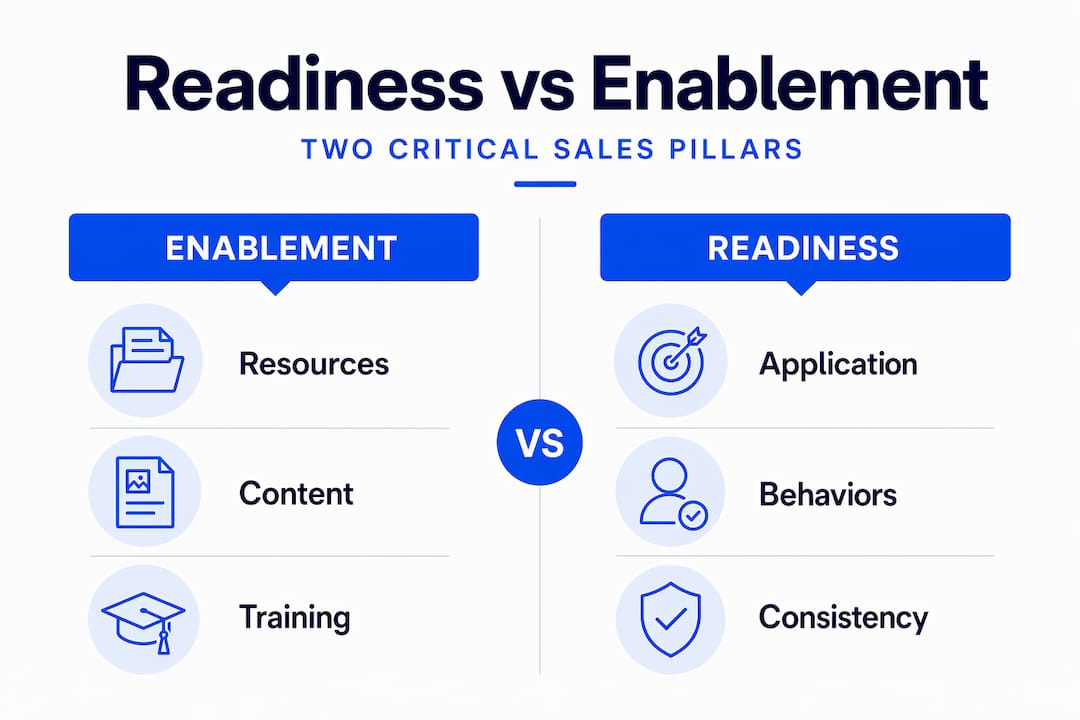
Now here’s the distinction that matters most, especially if you’re working with a sales enablement function. Enablement focuses on providing resources. Readiness is about whether your rep can actually apply them correctly when a CFO asks a hard question in a discovery call. One is about supply. The other is about execution.
| Dimension | Sales enablement | Sales readiness |
|---|---|---|
| Primary focus | Creating and distributing resources | Applying resources in real selling situations |
| Output | Content libraries, playbooks, tools | Confident, consistent seller behavior |
| Ownership | Enablement team | Cross-functional: enablement, managers, RevOps |
| Measurement | Content usage and adoption rates | Deal progression, behavior quality, certifications |
| Timing | Continuous but asynchronous | Integrated into live selling moments |
The practical implication: you can have a world-class enablement program and still have a readiness problem. If your reps aren’t converting what they learn into buyer-facing behavior that moves deals forward, you’re looking at a readiness gap.
Sales readiness isn’t a destination. It’s a cycle. And the reason most programs stall is that leaders treat it like a project with a finish line rather than an operating rhythm. Here’s how a healthy readiness lifecycle runs:
Foundation onboarding. New reps get the baseline: product knowledge, messaging frameworks, CRM fundamentals, and initial role plays. Solid onboarding frameworks compress ramp time and establish the behavioral expectations that readiness programs reinforce later.
Continuous skill development. After onboarding, the work accelerates. Reps practice specific skills tied to pipeline stage challenges, not generic sales theory. This is where effective sales training separates teams that plateau from teams that compound their performance.
Manager-led coaching. This is the multiplier. Manager reinforcement is the key differentiator between training that sticks and training that evaporates within a week. Weekly deal reviews, call debriefs, and live opportunity coaching are non-negotiable.
Marketing messaging updates. When competitors shift positioning or new objections surface in the field, marketing feeds updated messaging into the readiness cycle. Reps need current talk tracks, not six-month-old battle cards.
RevOps data feedback. RevOps closes the loop with cross-functional readiness inputs like pipeline health data, win/loss patterns, and stage conversion rates. That data tells you exactly where readiness gaps are creating revenue leaks.
Reinforcement and recertification. Skills decay fast without practice. Periodic recertification through role plays and scenario assessments keeps readiness sharp as markets and buyer expectations shift.
Pro Tip: Set a monthly readiness rhythm: one skills practice session, one manager scorecard review, and one messaging refresh from marketing. When those three run consistently, the cycle self-sustains without heroics from any single person.
This is where most programs fall apart. If you’re measuring readiness by content completion rates or LMS module scores, you’re measuring the wrong thing. Readiness assessments need to be grounded in observable, realistic behaviors that map to actual sales outcomes.
What does a ready rep actually look like? Here are the behaviors that signal genuine preparedness:
Notice that none of those are “completed three modules on objection handling.” Reps demonstrating readiness can handle buyer objections, deliver relevant value, and move deals forward. That’s the bar.
Here’s a simple framework for structuring readiness assessments:
| Assessment method | What it measures | Cadence |
|---|---|---|
| Mock discovery call | Questioning depth, active listening, problem framing | Quarterly or at stage gate |
| Role play with scoring rubric | Objection handling, value positioning, close technique | Monthly for new skills |
| Deal review with manager | Opportunity strategy, stakeholder mapping, forecast accuracy | Weekly |
| Conversation intelligence review | Talk ratio, question frequency, buyer sentiment | Ongoing, automated |
| Certification scorecard | Overall skill mastery across defined competencies | Semi-annual |
Pro Tip: Build your certification rubric around the specific deal-stage behaviors your top performers demonstrate. When you score reps against what actually wins deals in your market, readiness assessment stops being an HR exercise and starts being a revenue tool.
The importance of sales readiness shows up clearly in this assessment phase. Teams that know exactly what “ready” looks like in behavioral terms can close readiness gaps faster because the goal is concrete, not abstract.
AI is changing what’s possible in sales readiness, but not in the way most vendors will tell you. It’s not about replacing your managers or automating your coaching. It’s about contextual next-best-action recommendations that surface the right practice, content, or coaching prompt exactly when a rep needs it.
Here’s what AI-powered readiness tools actually do well:
The honest caution here: technology amplifies what’s already working. If your readiness program doesn’t have clear behavioral standards, consistent manager involvement, and shared GTM ownership, no AI platform will fix that. The tools are powerful, but they need an operationally sound program underneath them to deliver results.
I’ve seen this pattern repeat across dozens of sales organizations: leadership invests in training, builds out a content library, rolls out an enablement platform, and then wonders why quota attainment barely moves. Here’s what I’ve learned the hard way.

The problem is almost never the training itself. It’s the absence of sustained manager reinforcement after the training ends. Training delivers knowledge. Managers convert that knowledge into behavior through repeated coaching, expectation-setting, and live deal support. Without that reinforcement layer, continuous manager coaching is what actually makes readiness stick.
I’ve also seen teams treat readiness as a checklist instead of a dynamic capability. They build a certification program, run everyone through it once, check the box, and move on. Six months later, reps are falling back on old habits because nothing in the operational environment reinforced the new ones.
The teams that get this right treat readiness as an operating system, not a program. It’s baked into how managers run weekly reviews. It’s part of how marketing delivers new messaging. It’s reflected in how RevOps reports on pipeline health. When readiness has that kind of structural support, it stops depending on individual heroics and starts compounding over time.
The real talk: if your VP of Sales isn’t actively participating in readiness culture, no enablement team can carry it alone. Readiness needs executive air cover to survive the quarterly pressure to just close deals and worry about development later.
— Antony
If this article surfaced gaps you recognize in your own team, you’re not alone. Most sales organizations are operating with a readiness deficit they can’t quite name, which means they’re leaving predictable revenue on the table every quarter.
Saleslabelconsulting works directly with RevOps leaders, VPs of Sales, and Heads of Sales to build readiness programs that connect training to real deal outcomes. Our step-by-step enablement framework is designed to move your team from inconsistent execution to predictable, repeatable performance. We also cover enablement best practices for scaling what works across your entire GTM motion. If you’re ready to stop guessing and start measuring readiness like a revenue function, let’s talk.
Sales readiness is your team’s ability to perform the right sales behaviors at the right time across every stage of the buyer journey. It combines ongoing skill development, coaching, and real-time support rather than one-time onboarding.
Sales enablement focuses on creating and distributing resources like content and tools. Sales readiness focuses on whether reps can actually apply those resources correctly in live customer interactions to advance deals.
Assess readiness through observable behaviors in realistic conditions: mock discovery calls, scored role plays, deal reviews, and conversation intelligence data. Avoid relying solely on content completion metrics, which don’t reflect real-world execution ability.
Well-designed sales readiness programs improve quota attainment, shorten sales cycles, and reduce the variance between top and average performers by giving every rep consistent behavioral standards and coaching support.
Sales readiness requires shared ownership across enablement, sales managers, marketing, and RevOps. Each function contributes unique inputs including coaching, messaging updates, and performance data that collectively keep sellers prepared for live selling situations.
Subscribe to our Insights: Expert productivity tips in your inbox
You'll receive 1-3 emails per month. Your data stays private, always.

CRO & Co-Founder with Sales Label Consulting

Watch our Sales Mates Podcast
July 26, 2026 - 13 min read
Read article Read articleJuly 25, 2026 - 8 min read
Read article Read articleJuly 24, 2026 - 11 min read
Read article Read articleJuly 23, 2026 - 17 min read
Read article Read article