
Master sales trend analysis: 85%+ IT forecast accuracy
Sales leaders in European IT companies know the frustration of inaccurate forecasts. Despite investing in CRM systems and analytics tools, many struggle to achieve reliable predictions. The core issue lies in applying outdated methodologies to complex, nonlinear sales dynamics. This guide explores proven sales trend analysis techniques that drive forecasting accuracy above 85%, covering advanced methodologies, common pitfalls, empirical benchmarks, and practical implementation steps tailored for European IT sales environments.
| Point | Details |
|---|---|
| Data hygiene matters | Clean CRM data is foundational for forecasting accuracy and poor data quality can reduce accuracy by 30 percent or more. |
| Align methods to cycle | Short sale cycles with clean data favor time series while complex enterprise deals benefit from AI driven models that handle multiple variables. |
| Scenario planning helps | Scenario planning uses base, optimistic, pessimistic, and stress forecasts to model different market conditions and support contingency planning. |
| Bias calibration is key | Regular calibration to detect sandbagging and optimism bias improves forecast reliability. |
| Use ensemble approach | Smart leaders blend quantitative models with qualitative judgment to improve accuracy and mitigate bias across different scenarios. |
Sales trend analysis methodologies include time-series analysis, weighted pipeline forecasting, AI and ML models, regression analysis, and qualitative judgment approaches. Each method serves distinct use cases based on sales cycle length, data maturity, and market conditions.
Time-series analysis decomposes historical data into trend, seasonality, and residual components using ARIMA models or moving averages. This approach works best for short sales cycles with stable patterns, delivering 87% to 88% accuracy when data quality is high. European IT companies with transactional sales benefit most from this methodology.
Weighted pipeline forecasting multiplies deal values by stage-specific probabilities. A deal at 60% probability contributes 60% of its value to the forecast. This probability-adjusted pipeline forecasting method provides transparency but relies heavily on accurate stage definitions and honest rep assessments.
AI and ML models including Random Forest, Neural Networks, and Gradient Boosting excel in medium to long sales cycles. These algorithms identify complex patterns invisible to traditional methods, processing variables like engagement frequency, deal velocity, and competitive dynamics simultaneously. They require substantial clean historical data but deliver superior accuracy for enterprise IT sales.
Regression analysis establishes relationships between independent variables like marketing spend or lead source and dependent variables such as closed revenue. This method quantifies specific factor impacts but assumes linear relationships that rarely exist in complex B2B environments.
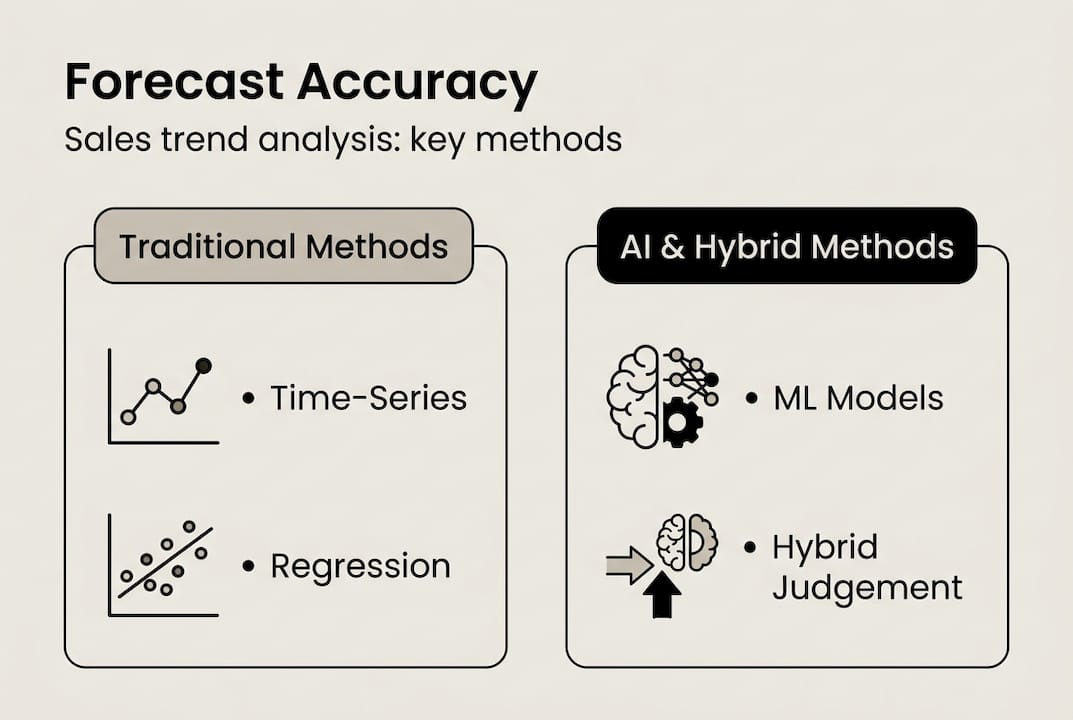
Qualitative judgment leverages sales rep experience and market knowledge. While valuable for incorporating context that data misses, this b2b sales methodology explained approach introduces bias and inconsistency. Smart leaders combine it with quantitative methods rather than relying on it exclusively.
Pro Tip: Match your forecasting method to your sales cycle length and data maturity. Short cycles with clean data favor time-series models, while complex enterprise sales demand AI-driven approaches that handle multiple variables simultaneously.
Clean CRM data forms the foundation of accurate forecasting. Poor data hygiene reduces accuracy by 30% or more, rendering even sophisticated models unreliable. Missing close dates, incorrect stage assignments, and outdated contact information corrupt predictions at their source.

Traditional methods collapse during market volatility and crisis periods. The nonlinear dynamics of European IT sales, where deals accelerate or stall based on budget cycles and regulatory changes, expose the limitations of simple trend extrapolation. What worked in stable conditions fails when market fundamentals shift.
Scenario planning addresses uncertainty by creating base, optimistic, pessimistic, and stress forecasts. Each scenario models different market conditions, helping leaders prepare contingency plans. This approach proves essential when economic indicators send mixed signals or geopolitical events introduce unpredictability.
Bias risks undermine forecast reliability. Sandbagging occurs when reps lowball predictions to ensure they beat targets. Overestimation stems from optimism bias or pressure to show pipeline growth. Regular calibration comparing forecasts to actual outcomes identifies systematic biases, enabling correction through adjusted probability weights or rep-specific factors.
Hybrid AI and human models reduce errors 15% to 30% compared to single-method approaches. Machine learning captures patterns in historical data while human judgment incorporates market intelligence and customer relationship nuances. This combination delivers accuracy impossible with either approach alone.
Spreadsheets carry 88% error rates according to research, while ML models achieve 85% to 88% accuracy versus 50% to 64% for traditional approaches. The gap widens as sales complexity increases. European IT companies managing multi-stakeholder enterprise deals cannot afford spreadsheet-based forecasting.
Common pitfalls include ignoring data quality, selecting methods mismatched to sales cycles, failing to monitor forecast accuracy metrics, and treating forecasting as a monthly ritual rather than continuous process. Leaders who fix classic sales mistakes by addressing these issues systematically improve outcomes quarter over quarter.
Pro Tip: Implement weekly data hygiene reviews where reps update deal stages, close dates, and next steps. This 15-minute ritual prevents data decay and maintains the input quality your forecasting models require.
Top-tier forecasts achieve 85% to 95% accuracy using AI and ML approaches. European IT firms operating in dynamic markets need these advanced models to handle nonlinear sales patterns. Combining multiple methods delivers error reduction and high confidence levels.
Accuracy varies by forecasting horizon. Thirty-day forecasts typically exceed 85% accuracy with proper methodology, while 90-day predictions drop to 75% to 80% as uncertainty compounds. Understanding these benchmarks helps leaders set realistic expectations and adjust planning accordingly.
| Metric | Top Quartile | Acceptable | Poor |
|---|---|---|---|
| 30-day forecast accuracy | 90% to 95% | 80% to 85% | Below 75% |
| 90-day forecast accuracy | 80% to 85% | 70% to 75% | Below 65% |
| MAPE (Mean Absolute Percentage Error) | Under 10% | 10% to 15% | Above 20% |
| Bias (systematic over/under forecasting) | Within 3% | 3% to 7% | Above 10% |
European tech spend grows 5% reaching €1.4 trillion, with optimistic B2B sales outlook for 2026. This growth creates opportunities but demands accurate forecasting to capitalize on market expansion while managing resource allocation efficiently.
Practical implementation follows five critical steps:
Clean your CRM data by removing duplicates, standardizing fields, and enforcing mandatory data entry at each stage transition. Audit historical data quality and correct systemic issues before building models.
Select forecasting methods matched to your sales cycle and data maturity. Short transactional cycles suit time-series analysis, while complex enterprise sales require AI sales workflows that process multiple variables.
Monitor MAPE, sMAPE, and bias metrics weekly. Track accuracy by rep, product line, and region to identify improvement opportunities. Compare forecasts to actual outcomes systematically.
Use rolling weekly forecasts instead of static monthly predictions. This approach incorporates new information continuously, adapting to market changes faster than traditional quarterly planning cycles.
Ensemble multiple methods by averaging predictions from time-series, weighted pipeline, and ML models. This reduces individual method weaknesses and improves overall reliability.
Implementing these sales strategy trends 2026 positions European IT sales leaders to capture market growth while maintaining forecast accuracy. Leaders who optimize sales outreach 2026 align forecasting improvements with execution capabilities for maximum impact.
Pro Tip: Track bias metrics separately from accuracy. A forecast can be consistently wrong in one direction while showing acceptable MAPE. Identifying and correcting systematic bias improves decision quality more than reducing random error.
Relying exclusively on traditional or AI/ML methods creates vulnerabilities in complex IT sales environments. Traditional approaches miss nonlinear patterns, while pure ML models lack contextual market intelligence that experienced sales leaders possess. Hybrid models combining AI and human judgment reduce forecast error 15% to 30% compared to single-method approaches.
| Method | Accuracy Potential | Data Requirements | Flexibility | Primary Risk |
|---|---|---|---|---|
| Time-series analysis | 85% to 88% | Moderate, clean historical data | Low, assumes pattern stability | Fails in volatile markets |
| Weighted pipeline | 70% to 80% | Low, current pipeline data | High, adapts to changes | Vulnerable to rep bias |
| AI/ML models | 85% to 95% | High, extensive clean data | Moderate, needs retraining | Black box, hard to explain |
| Regression analysis | 65% to 75% | Moderate, multiple variables | Low, assumes linearity | Oversimplifies relationships |
| Qualitative judgment | 50% to 70% | None, relies on experience | Very high, incorporates context | Inconsistent, biased |
Machine learning models achieve 85% to 88% accuracy versus spreadsheets at 50% to 64%. This performance gap justifies investment in proper forecasting infrastructure for European IT companies managing significant revenue volumes.
Hybrid approaches combine strengths while mitigating weaknesses. Use ML models for pattern recognition and quantitative predictions, then overlay qualitative adjustments for market events the data cannot capture. Scenario planning adds robustness by modeling multiple futures simultaneously.
Bias correction mechanisms improve hybrid model performance. Compare individual rep forecasts to their historical accuracy, applying correction factors to chronic over or under estimators. This data-driven calibration removes systematic errors while preserving valuable market insights.
Best practices for method selection and integration include:
Leaders exploring how AI is reshaping sales tech discover that successful implementation requires balancing automation with human expertise. The goal is augmented intelligence, not replacement of experienced judgment.
Common pitfalls include overreliance on spreadsheets despite proven error rates, ignoring expert insights when they contradict model outputs, and failing to update models as market conditions evolve. Sales leaders who fix classic sales mistakes by addressing these issues systematically outperform competitors stuck in outdated practices.
Pro Tip: Run parallel forecasts using different methods for three months before committing to a hybrid approach. This testing period reveals which combinations work best for your specific sales environment and builds team confidence in the new methodology.
Accurate forecasting delivers maximum value when paired with robust sales enablement. European IT sales leaders implementing advanced trend analysis need aligned processes, training, and tools to translate predictions into revenue outcomes.

Sales Label Consulting helps you bridge forecasting insights with execution capabilities. Our enablement services ensure your team capitalizes on improved forecast accuracy through systematic process improvements and skill development.
Key benefits include:
Explore our comprehensive guides on sales enablement step by step for implementation roadmaps, sales enablement best practices for proven approaches, and sales enablement trends 2026 for cutting-edge strategies.
Sales trend analysis examines historical sales data to identify patterns, seasonality, and trajectories that inform future predictions. For IT sales, this analysis proves critical because complex enterprise deals follow nonlinear patterns that simple extrapolation misses, requiring sophisticated methods to achieve reliable forecasts.
Traditional methods assume linear relationships and stable patterns that rarely exist in European IT sales. Market volatility, regulatory changes, budget cycles, and competitive dynamics create nonlinear sales behaviors that spreadsheet-based approaches cannot model accurately, leading to systematic forecast errors.
Hybrid models leverage machine learning to identify complex patterns in historical data while incorporating human expertise to adjust for market context and relationship nuances. This combination reduces forecast error 15% to 30% by capturing both quantitative patterns and qualitative insights that neither approach achieves alone.
Accurate forecasting requires complete deal records with correct stage assignments, realistic close dates, accurate deal values, and current contact information. Missing or incorrect data reduces forecast accuracy by 30% or more, making weekly data hygiene reviews essential for maintaining model performance.
Rolling weekly forecasts outperform static monthly predictions by incorporating new information continuously. This cadence balances administrative burden with responsiveness to market changes, enabling faster adaptation while maintaining forecast reliability through consistent methodology application.
Subscribe to our Insights: Expert productivity tips in your inbox
You'll receive 1-3 emails per month. Your data stays private, always.

CRO & Co-Founder with Sales Label Consulting

Watch our Sales Mates Podcast
October 22, 2026 - 9 min read
Read article Read articleOctober 21, 2026 - 9 min read
Read article Read articleOctober 20, 2026 - 9 min read
Read article Read articleOctober 19, 2026 - 10 min read
Read article Read article