
Consultative selling guide for tech sales leaders 2026
Buyers now complete 70–90% of their research before engaging sales, fundamentally changing how tech solutions are sold. Traditional product pitching no longer resonates in complex B2B environments where multiple stakeholders evaluate vendors independently. Consultative selling offers a collaborative, customer-focused approach that aligns solutions with precise business needs, driving higher win rates and sustainable revenue growth for European tech companies navigating increasingly sophisticated buyer journeys.
| Point | Details |
|---|---|
| Consultative selling prioritizes customer needs over product features | This advisory approach builds trust through problem diagnosis and solution co-creation rather than transactional pitching. |
| Tech buyers research extensively before sales contact | 70–90% of buyer research happens independently, requiring sales to add value beyond available information. |
| Structured frameworks drive consultative success | Five-step processes covering discovery, problem framing, solution design, mutual action plans, and value tracking create predictable outcomes. |
| AI enhances but doesn’t replace human judgment | Technology provides personalized insights and behavioral signals while preserving the essential advisor role. |
| Success requires tracking complex deal metrics | Monitor stage conversion rates, stakeholder engagement depth, business case acceptance, and discount reduction for continuous improvement. |
Consultative selling is an advisory methodology where sales professionals act as trusted partners, focusing on diagnosing customer challenges and co-creating tailored solutions rather than pushing predetermined products. Unlike transactional selling, which emphasizes quick closes and feature comparisons, consultative selling can increase deal size and shorten sales cycles by aligning solutions with precise customer needs.
This approach differs fundamentally from traditional methods across several dimensions:
The role of consulting in sales has evolved dramatically as buyers demand expertise that complements their internal research. Sales professionals must bring insights, frameworks, and strategic guidance that prospects cannot easily obtain through independent investigation. This positions sellers as advisors who help navigate complexity rather than vendors pushing products.
Consultative selling works particularly well in tech environments where solutions address multifaceted business challenges requiring cross-functional implementation. By emphasizing problem-solving over product features, sales teams differentiate themselves in crowded markets and build sustainable competitive advantages.
Tech buyers have fundamentally changed how they evaluate and purchase solutions, making consultative selling essential rather than optional. Research shows buyers perform 70–90% of research before engaging sales, dramatically reducing their dependence on sales reps for basic product information and pricing.
This shift creates both challenges and opportunities for tech sales organizations:
Consultative selling addresses these dynamics by focusing on value creation through collaborative problem-solving. When sales teams invest in understanding both explicit challenges (what prospects articulate) and latent needs (underlying issues they may not recognize), they position solutions as strategic investments rather than commodities.
The approach proves especially powerful in IT sales team mastery contexts where technical complexity demands deeper stakeholder engagement. Sales professionals who master consultative techniques navigate multi-threaded deals more effectively, maintaining momentum through lengthy evaluation cycles.
Adopting consultative selling aligns perfectly with sales strategy trends 2026 emphasizing buyer-centric approaches, AI-augmented insights, and outcome-based value propositions. Organizations that embed these capabilities across their sales teams gain predictable revenue growth and higher customer lifetime value.
Successful consultative selling requires fundamental mindset shifts that transform how sales professionals approach customer interactions. Moving from product advocate to trusted advisor demands behavioral changes that many salespeople initially find uncomfortable but ultimately find more rewarding and effective.
Essential principles include:
Active listening becomes the cornerstone skill, requiring sales reps to genuinely absorb what stakeholders share rather than waiting for their turn to talk. Structured discovery using open-ended questions helps uncover explicit and latent customer needs critical for consultative sales success.

Empathy plays an equally vital role, enabling sales professionals to appreciate customer challenges from multiple perspectives. Understanding the CFO’s cost concerns, the CTO’s technical requirements, and the end user’s workflow needs creates comprehensive solutions addressing diverse stakeholder priorities.
Developing these capabilities requires intentional practice and coaching. Sales leaders should model consultative behaviors, celebrate discovery excellence, and create safe environments where reps can experiment with new approaches. IT sales team mastery programs that embed consultative principles through role-playing, deal reviews, and ongoing feedback accelerate adoption across teams.
Pro Tip: Record discovery calls and review them with peers to identify moments where you jumped to solutions prematurely instead of exploring customer context more deeply.
Implementing consultative selling effectively requires a structured framework that sales teams can apply consistently across diverse customer situations. The following five-step process creates predictable outcomes while remaining flexible enough to adapt to different buyer contexts.
Deep discovery: Begin with open-ended questions exploring business objectives, current challenges, attempted solutions, and success metrics. Go beyond surface-level pain points to understand root causes and organizational dynamics.
Collaborative problem framing: Work with stakeholders to define the core challenge in business terms, ensuring alignment across decision-makers. Document agreed-upon problem statements to maintain focus throughout the sales cycle.
Tailored solution development: Design offerings that directly address the defined problem, connecting specific capabilities to measurable business outcomes. Involve technical resources and customer subject matter experts to ensure feasibility.
Mutual action planning: Create joint implementation roadmaps with clear responsibilities, timelines, and success milestones. These plans maintain momentum and demonstrate commitment from both parties.
Value tracking and validation: Establish metrics to measure realized business impact post-implementation, supporting renewal conversations and identifying expansion opportunities.
The table below illustrates how discovery questions map to different stakeholder levels:
| Stakeholder Level | Discovery Focus | Example Questions |
|---|---|---|
| Executive | Strategic objectives, competitive position | What business outcomes would make this initiative successful? |
| Operational | Process efficiency, resource constraints | Where do current workflows create bottlenecks or delays? |
| Technical | Integration requirements, security standards | How does this need to work with existing systems? |
| End User | Daily workflow, usability needs | What would make your job easier or more productive? |
Structured discovery processes using open-ended questions help uncover explicit and latent customer needs critical for consultative sales success. Sales teams should develop question libraries organized by buyer persona and sales stage to ensure comprehensive coverage.
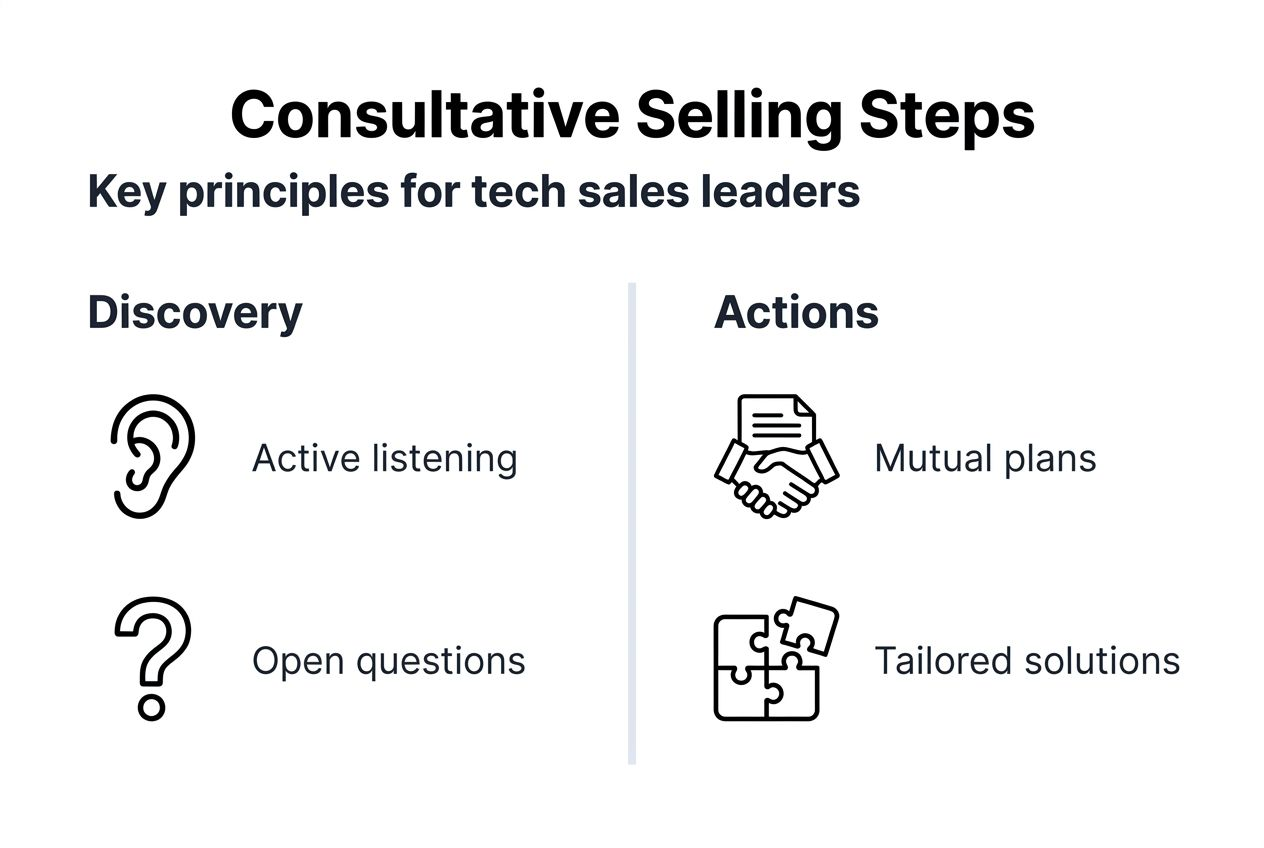
Mutual action plans prove especially valuable in complex tech sales where lengthy implementation cycles can stall deals. By documenting next steps, responsible parties, and completion dates, both sellers and buyers maintain accountability and forward momentum.
Pro Tip: Use mutual action plans as qualification tools. Prospects unwilling to commit to specific next steps may lack genuine buying intent or internal alignment.
Sales leaders can support process adoption through step by step sales training that reinforces consultative techniques with practical exercises. Regular sales process checklist reviews ensure reps apply the framework consistently across their pipelines.
Many sales teams struggle with consultative selling because they misunderstand its core requirements or fall into predictable traps that undermine effectiveness. Recognizing these pitfalls helps leaders coach their teams toward authentic consultative approaches.
Frequent misconceptions include:
The most damaging pitfall involves deals that stall indefinitely because sales reps focus exclusively on discovery without creating urgency or clear next steps. Consultative selling should uncover compelling events and build business cases that drive decision timelines, not extend them unnecessarily.
Another common error occurs when salespeople blur boundaries between advisory conversations and actual implementation work. While demonstrating value through insights is essential, doing tasks that belong in paid engagements trains customers to expect free labor and devalues your offering.
Sales leaders should watch for reps who struggle to transition from discovery to recommendation. Rethinking sales issues often reveals that salespeople lack confidence in their expertise or fear rejection, causing them to remain in comfortable questioning mode rather than taking advisory stances.
Pro Tip: Set time boundaries for discovery phases based on deal size. Knowing when to move from learning to recommending prevents analysis paralysis and maintains sales momentum.
Artificial intelligence is transforming how consultative selling operates in 2026, providing sales teams with unprecedented insights while preserving the essential human elements that drive trust and relationship depth. Smart integration of AI tools enhances consultative effectiveness without replacing the advisor role.
AI supports consultative selling through several key capabilities:
Despite these powerful capabilities, technology cannot replicate the empathy, contextual judgment, and relationship-building that define consultative excellence. Buyers still crave human connection, especially when making complex purchasing decisions involving organizational change and significant investment.
The most successful sales organizations blend AI insights with relationship skills. Reps use technology to prepare for conversations, identify relevant discussion points, and track engagement patterns, then apply human judgment to navigate sensitive topics, build stakeholder consensus, and adapt recommendations based on emotional cues.
How AI reshapes sales tech explores both opportunities and risks in this evolving landscape. Sales leaders must help teams leverage AI in proven sales workflows while maintaining the authentic advisory relationships that differentiate top performers.
Tracking the right metrics helps sales leaders assess consultative selling effectiveness and identify improvement opportunities. Traditional activity metrics like call volume prove less relevant than outcome-focused indicators measuring deal quality and stakeholder engagement.
Priority metrics for consultative selling include:
| Metric Category | Specific Measures | Why It Matters |
|---|---|---|
| Pipeline quality | Stage-to-stage conversion rates | Higher conversions indicate better qualification and stakeholder alignment |
| Deal economics | Average deal size, discount rate | Consultative approaches typically increase deal value and reduce discounting |
| Sales efficiency | Sales cycle length, time in each stage | Effective discovery accelerates decisions despite seeming to slow initial progress |
| Stakeholder engagement | Executive access rate, champion strength | Multi-threaded relationships improve win rates in complex sales |
| Value realization | Business case acceptance, post-sale metrics tracking | Measuring actual outcomes supports renewals and expansions |
Stage-to-stage conversion rates provide especially valuable insights into where consultative approaches succeed or fail. Low conversion from discovery to proposal may indicate poor qualification or inadequate stakeholder alignment during early interactions.
Monitoring discount rates reveals whether sales teams effectively communicate value. Consultative selling should reduce price pressure by clearly connecting solutions to measurable business outcomes, making ROI comparisons more favorable than price negotiations.
Executive access serves as a leading indicator of deal health in enterprise sales. Consultative sellers who engage C-level stakeholders early build stronger business cases and navigate organizational politics more successfully.
Business case acceptance rates measure how well sales teams translate discovery insights into compelling value propositions. Low acceptance suggests gaps between what customers share and what solutions address.
Sales leaders should review these metrics regularly with individual reps and across teams to identify coaching opportunities. Sales enablement metrics frameworks help connect consultative behaviors to revenue outcomes, building organizational commitment to the approach.
Concrete examples illustrate how consultative selling drives measurable business results across diverse tech sectors. These cases demonstrate the approach’s versatility and tangible value when applied effectively.
Key success stories include:
These examples share common patterns: sales teams invested time in understanding customer environments, brought domain expertise that added value beyond product knowledge, and measured success through customer business outcomes rather than just closed deals.
The role of consulting in sales becomes evident in these scenarios. Sales professionals acted as business advisors who happened to have relevant solutions rather than vendors seeking transactions. This positioning created trust, reduced competitive pressure, and opened opportunities for expanded partnerships over time.
Mastering consultative selling across entire sales organizations requires structured enablement programs that embed skills, reinforce behaviors, and align supporting systems. Professional sales enablement accelerates adoption while ensuring consistency in customer experiences.
Effective enablement frameworks combine training on consultative techniques with ongoing coaching, technology integration, and performance tracking. Sales leaders need comprehensive approaches that address skill development, process adoption, and cultural transformation simultaneously. Sales enablement step by step programs create predictable revenue growth by systematically building consultative capabilities.
Sales enablement best practices emphasize role-playing discovery conversations, analyzing successful deals, and creating question libraries tailored to buyer personas. Staying current with sales enablement trends 2026 ensures your approach incorporates AI tools, buyer behavior insights, and competitive positioning strategies that maintain advantages in evolving markets.
Consultative selling prioritizes understanding customer needs through diagnostic discovery and co-creating tailored solutions, while transactional selling focuses on quick product presentations emphasizing features and pricing. Consultative approaches build long-term relationships and reduce price sensitivity by clearly demonstrating business value.
AI provides personalized insights by analyzing buyer behavior signals, conversation patterns, and predictive deal scoring to help sales reps prepare better and prioritize effectively. However, the human advisor’s empathy, contextual judgment, and relationship-building abilities remain essential for navigating complex stakeholder dynamics and building trust.
Avoid treating consultative selling as merely asking questions without providing expert recommendations, giving away free consulting that should be part of paid engagements, and lacking sufficient domain expertise to focus conversations productively. Setting clear boundaries and maintaining deal momentum through mutual action plans prevents these errors.
Key indicators include stage-to-stage conversion rates showing qualification effectiveness, increased average deal size with reduced discount rates, shorter sales cycles despite deeper discovery, stakeholder engagement depth including executive access, and business case acceptance rates demonstrating value clarity. Tracking realized customer outcomes post-sale supports renewals and expansions.
Subscribe to our Insights: Expert productivity tips in your inbox
You'll receive 1-3 emails per month. Your data stays private, always.

CRO & Co-Founder with Sales Label Consulting

Watch our Sales Mates Podcast
September 14, 2026 - 10 min read
Read article Read articleSeptember 13, 2026 - 8 min read
Read article Read articleSeptember 12, 2026 - 10 min read
Read article Read articleSeptember 11, 2026 - 11 min read
Read article Read article