
What Is Sales Forecasting: A Guide for Sales Leaders
TL;DR:
- Sales forecasting is a systematic process that estimates future revenue based on historical data and market signals to support business decisions. Most organizations treat it as a ritual, but successful companies use it as an operational system to improve accuracy and accountability. Poor data quality, undefined pipeline stages, and inadequate governance are the primary barriers to reliable forecasting; fixing these process issues enhances forecast precision.
Sales forecasting is defined as the systematic process of estimating future revenue by analyzing historical data, pipeline activity, and market signals to drive informed business decisions. Most organizations treat it as a reporting ritual. The ones that win treat it as an operating system. Only 43% of sales leaders achieve forecast accuracy within 10% of their goals, which means the majority are flying blind when it comes to quota setting, hiring, and budget allocation. This guide breaks down the core methods, sales forecasting best practices, and a practical implementation path so you can build a process that actually holds up under pressure.

Sales forecasting is the practice of predicting how much revenue your team will generate over a defined period, typically a quarter or fiscal year, using structured data rather than gut instinct. The sales prediction meaning goes beyond a single number. It includes the confidence level behind that number, the assumptions baked into it, and the process used to generate it.
The importance of sales forecasting shows up everywhere in your business. Finance uses your forecast to model cash flow. HR uses it to plan headcount. Marketing uses it to calibrate demand generation spend. When your forecast is off by 20%, every downstream decision built on it is also off. That’s not a modeling problem. Forecast accuracy is an operating system problem, and it requires consistent process and tooling to fix.
Three core benefits make forecasting non-negotiable for growth-stage companies. First, it gives leadership a shared reality to plan against. Second, it surfaces pipeline gaps early enough to act on them. Third, it creates accountability across the revenue team by tying rep activity to projected outcomes. CRM platforms like Salesforce, HubSpot, and Clari are the data backbone for most modern forecasting workflows, pulling pipeline stage data, deal velocity, and historical win rates into a single view.
Choosing the right forecasting method depends on your data maturity, sales cycle length, and business model. Here’s how the three primary approaches compare.
Top-down forecasting starts with total addressable market size or company-level revenue targets and works backward to individual rep quotas. It’s fast to build and useful for early-stage planning, but it disconnects from ground-level pipeline reality. A $10M ARR target divided by 10 reps doesn’t tell you whether the pipeline actually supports that number.
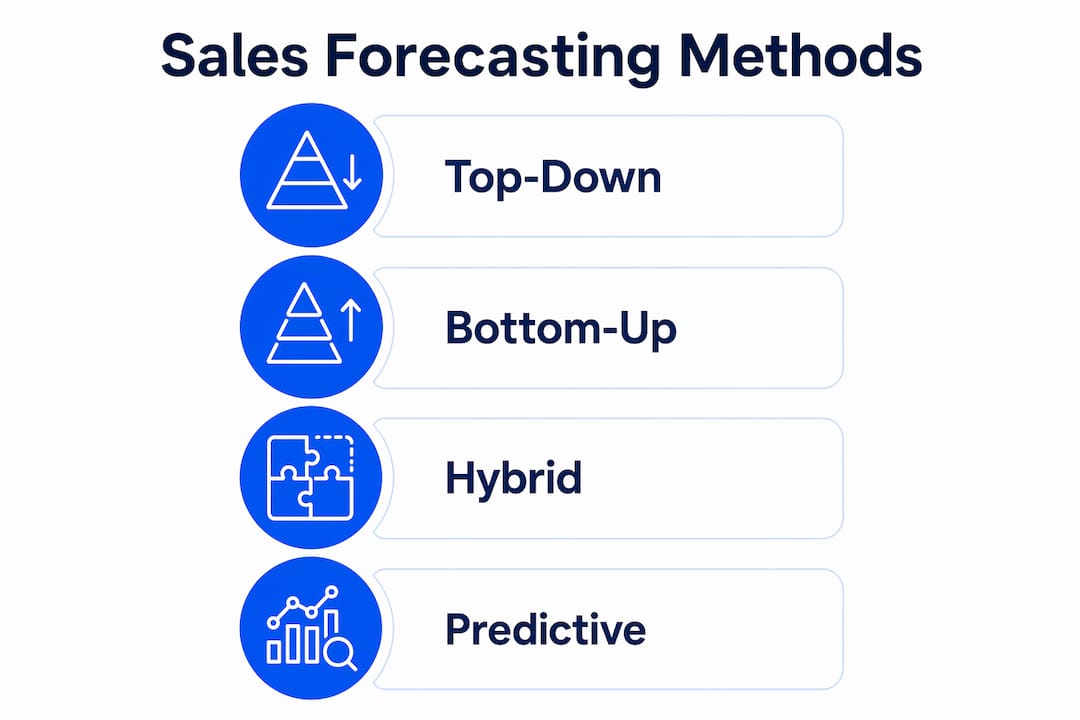
Bottom-up forecasting, also called pipeline forecasting, aggregates deal-level probabilities across all open opportunities. Each deal gets a weighted value based on its pipeline stage, and those values roll up to a total forecast. This method is more accurate when your stage definitions are tight, but it breaks down when reps inflate deal stages to hit activity metrics.
Hybrid forecasting combines stage-weighted pipeline data with historical win rates and market trending. A hybrid approach improves reliability for B2B SaaS companies specifically because it cross-checks rep-level optimism against historical patterns. This is the method Saleslabelconsulting recommends for most mid-market and enterprise sales teams.
| Method | Best for | Strength | Weakness |
|---|---|---|---|
| Top-down | Early-stage planning | Fast, high-level | Disconnected from pipeline reality |
| Bottom-up (pipeline) | Teams with mature CRM data | Deal-level granularity | Vulnerable to rep bias |
| Hybrid | B2B SaaS, mid-market | Balances data and trends | Requires clean historical data |
| AI-driven predictive | High-volume, data-rich teams | Pattern recognition at scale | Needs 12+ months of clean data |
What is predictive sales forecasting? It’s the application of machine learning models to historical CRM data, buyer engagement signals, and external market factors to generate probability-weighted revenue predictions. Tools like Clari, Gong, and Salesforce Einstein fall into this category. The catch: AI-driven tools require 12 months of clean historical data before they produce meaningful accuracy. Skip that foundation and you’re just automating noise.
Real talk: most forecast accuracy problems trace back to process failures, not model failures. Here are the practices that actually move the needle.
Define pipeline stages with written criteria. Pipeline stages need strict entry and exit criteria so that every deal in a given stage represents a vetted opportunity, not a rep’s optimism. “Discovery” should require a confirmed pain statement and a next step on the calendar. Without that, your pipeline is a wish list.
Build on at least six months of historical data. Teams that apply strict stage criteria and six months of data improve forecast accuracy by 15 to 25 percentage points. That’s not a marginal gain. That’s the difference between a forecast your CFO trusts and one they discount by default.
Eliminate rep bias with objective signals. Forecasts based on rep gut feelings are hopes, not forecasts. Replace subjective deal assessments with measurable signals: days in stage, number of stakeholders engaged, email response rates, and proposal sent dates. Gong and Chorus.ai surface these signals automatically from call and email data.
Make forecasting a repeatable system, not a spreadsheet exercise. A documented, repeatable forecasting process combining pipeline data, win rates, defined stages, and governance rhythm produces consistent revenue estimates. One-off spreadsheet models built by a single analyst create single points of failure.
Integrate AI tools only after your data foundation is solid. Explore AI’s role in sales tech carefully before committing to a platform. The tools are powerful, but they amplify whatever data quality you feed them.
Pro Tip: Before adopting any AI forecasting tool, run a data audit on your last 12 months of CRM records. Check for missing close dates, undefined pipeline stages, and deals that sat in the same stage for more than 60 days. Fix those first.
The barriers to accurate forecasting are predictable. So are the solutions.
Poor data quality blocks 39% of sales leaders from generating reliable forecasts. That stat should stop you cold. Nearly four in ten revenue leaders can’t trust their own numbers because the underlying data is incomplete, inconsistent, or outdated. The fix is not a better model. It’s CRM hygiene enforced at the manager level.
Here are the five most common forecasting failures and how to address each one:
Pro Tip: Track your forecast accuracy by rep, segment, and product line for at least two quarters before drawing conclusions. Patterns in where you’re consistently off tell you exactly where your process is broken.
Structure beats heroics. Here’s how to build a forecasting process that doesn’t depend on one analyst or one spreadsheet.
Start by defining your forecasting goals and time horizon. Are you forecasting weekly, monthly, or quarterly? Are you forecasting total revenue, new ARR, or expansion ARR? Clarity here prevents the most common implementation mistake: building a process that answers the wrong question.
Next, document your pipeline stage definitions with precise entry and exit criteria. This is the single highest-leverage step in the entire process. Without it, every downstream calculation is built on sand. Work with your pipeline optimization strategy to align stage definitions with actual buyer behavior, not internal sales activity.
Then establish baseline win rates by segment, product, and rep cohort. Segment-specific win rates matter because a 30% overall win rate might mask a 50% win rate in enterprise and a 15% win rate in SMB. Blending those together produces a forecast that’s wrong for everyone.
From there, choose your forecasting method based on data maturity. New teams with less than six months of CRM data should start with top-down forecasting and migrate to bottom-up as data accumulates. Teams with 12 or more months of clean data can layer in AI-driven tools.
Set up a weekly forecast review cadence with clear ownership. The meeting is for explaining model-to-rep commitment gaps, not for manually updating spreadsheets. Assign a RevOps owner to maintain the model and flag anomalies before they become surprises.
Finally, measure forecast accuracy every cycle and recalibrate. Track mean absolute percentage error (MAPE) by segment and use it to identify where your assumptions are consistently wrong. Forecasting is not a set-and-forget process. It’s a feedback loop.
| Implementation step | Key action |
|---|---|
| Define goals and horizon | Specify forecast period, metric type, and audience |
| Document stage criteria | Write entry and exit rules for every pipeline stage |
| Establish win rates | Segment by product, region, and rep cohort |
| Choose forecasting method | Match method to data maturity level |
| Set governance cadence | Weekly review focused on gap explanation, not data collection |
| Measure and recalibrate | Track MAPE by segment every cycle |
Accurate sales forecasting requires a documented process, clean CRM data, strict pipeline stage criteria, and a consistent governance rhythm before any model or tool can produce reliable results.
| Point | Details |
|---|---|
| Definition matters | Sales forecasting is a structured revenue estimation process, not a gut-check exercise. |
| Method selection | Match your forecasting method to your data maturity: top-down first, then hybrid or AI-driven. |
| Data quality is the foundation | 39% of sales leaders cite poor data as their primary forecasting barrier. Fix data before fixing models. |
| Stage criteria drive accuracy | Teams with strict entry and exit criteria improve accuracy by 15 to 25 percentage points. |
| Governance makes it stick | Weekly forecast reviews focused on gap explanation create accountability and catch errors early. |
Here’s what I’ve learned after working with dozens of sales organizations across SaaS, professional services, and manufacturing: the forecast is almost never the problem. The process that generates it is.
I’ve seen teams spend months evaluating AI forecasting platforms while their CRM had deals sitting in “Proposal Sent” for 180 days with no activity. The tool doesn’t fix that. Discipline does. The shift from gut-based to data-driven forecasting isn’t a technology decision. It’s a cultural one, and it starts with managers enforcing stage criteria in every single deal review.
The other thing I’d push back on is the idea that one forecasting method is universally superior. Top-down forecasting gets dismissed as too simplistic, but for a team in its first year of CRM adoption, it’s the right starting point. Trying to run a hybrid model with six months of messy data produces false precision, which is worse than honest uncertainty.
What actually works is a layered approach: start simple, get your data clean, build your baseline win rates, and then add complexity only when the foundation supports it. The teams I’ve seen hit consistent forecast accuracy within 10% share one trait. They treat forecasting as an organizational capability they invest in over time, not a quarterly fire drill.
If you’re consistently off by more than 15%, don’t buy a new tool. Audit your pipeline stage definitions first. That’s almost always where the answer is hiding.
— Antony
Saleslabelconsulting works directly with RevOps leaders, VPs of Sales, and Heads of Sales to build the foundational systems that make accurate forecasting possible. That means auditing your current pipeline stage definitions, establishing segment-specific win rates, and designing governance rhythms your team will actually follow.
If you’re ready to move from spreadsheet-based guessing to a process your CFO will stand behind, start with our sales enablement framework for predictable revenue. It covers the full stack: pipeline methodology, forecast governance, and capacity planning in a sequence that matches your data maturity. You can also explore our sales enablement best practices for scaling revenue if you’re further along and looking to tighten what you already have.
Sales forecasting is the process of estimating how much revenue your team will generate over a set period using historical data, pipeline activity, and defined win rates. It replaces guesswork with a structured, repeatable system.
The three primary methods are top-down forecasting, bottom-up pipeline forecasting, and hybrid forecasting. Hybrid approaches that combine stage-weighted pipeline data with historical trending produce the most reliable results for B2B sales teams.
Accuracy improves by defining strict pipeline stage entry and exit criteria, collecting at least six months of clean historical data, and replacing rep gut feelings with objective signals like deal velocity and buyer engagement patterns.
Predictive sales forecasting uses machine learning models to analyze historical CRM data and buyer behavior signals to generate probability-weighted revenue predictions. Tools like Clari and Salesforce Einstein require a minimum of 12 months of clean data to produce meaningful results.
87% of companies fail to hit revenue targets partly because of ineffective forecasting processes. The root cause is usually poor data quality, undefined pipeline stages, or a lack of consistent governance rather than the wrong forecasting model.
Subscribe to our Insights: Expert productivity tips in your inbox
You'll receive 1-3 emails per month. Your data stays private, always.

CRO & Co-Founder with Sales Label Consulting

Watch our Sales Mates Podcast
July 28, 2026 - 17 min read
Read article Read articleJuly 27, 2026 - 9 min read
Read article Read articleJuly 26, 2026 - 13 min read
Read article Read articleJuly 25, 2026 - 8 min read
Read article Read article