
How to Qualify B2B Leads for Predictable Sales Success
TL;DR:
- Structured lead qualification reduces costs, improves forecast accuracy, and boosts sales team morale.
- Frameworks like BANT and MEDDICC help tailor qualification to deal complexity and stakeholder involvement.
- Regular review, documentation, and cultural emphasis on disqualification lead to better pipeline health and revenue growth.
Your pipeline looks full. Your team is busy. But the numbers at the end of the quarter tell a different story. Sound familiar? High lead volume with low conversion rates is one of the most common and costly problems B2B sales leaders face across Europe. Chasing poor-fit leads burns rep time, inflates your customer acquisition cost (CAC), and quietly kills team morale. The good news: a structured lead qualification process changes everything. This guide walks you through proven frameworks, actionable steps, and the mindset shifts that turn a bloated, unpredictable pipeline into a focused, revenue-generating machine.
| Point | Details |
|---|---|
| Disqualify quickly | Eliminate poor-fit leads early to save time and reduce acquisition costs. |
| Use proven frameworks | Apply models like MEDDICC or BANT for structured, repeatable results. |
| Track and measure | Regularly monitor metrics to continuously improve your qualification process. |
| Empower your team | Enable sales reps to confidently identify and act on buyer intent signals. |
Let’s get clear on what lead qualification actually means. In B2B sales, qualification is the process of determining whether a prospect has the right fit, intent, and resources to become a paying customer. It’s not just a checkbox. It’s the filter that separates real opportunities from noise.
Without a structured approach, most sales teams face the same three problems:
Structured qualification fixes all three. When your team knows exactly what a good lead looks like, and has a clear process to confirm it, close rates go up, cycle times shrink, and forecasting becomes far more reliable.
The business impacts are real:
“The fastest way to cut your CAC is to stop spending time on leads that were never a fit. Disqualify early on no pain or ICP mismatch, and invest that energy into lead fit signals that actually convert.”
The dual mandate here is simple. Quickly disqualify poor fits before they consume resources. And nurture the high-signal leads with the attention they deserve. This is the foundation of any effective B2B sales methodology worth building on.
Now that you understand the stakes, let’s talk about the tools that make systematic qualification possible. Two frameworks dominate the conversation: BANT and MEDDICC.
BANT (Budget, Authority, Need, Timeline) is a classic. It works well for shorter, simpler sales cycles where the buying process involves fewer stakeholders. Fast, straightforward, easy to train reps on.
MEDDICC (Metrics, Economic Buyer, Decision Criteria, Decision Process, Identify Pain, Champion, Competition) is built for complexity. MEDDICC suits complex enterprise B2B sales with multiple stakeholders, longer cycles, and higher deal values. It forces reps to understand not just the pain, but the internal politics and buying process at the account.
| Framework | Best use case | Deal size | Stakeholders |
|---|---|---|---|
| BANT | SMB, transactional sales | Small to mid | 1 to 2 |
| MEDDICC | Enterprise, complex sales | Mid to large | 3 or more |
| MEDDIC | Mid-market, growing teams | Mid | 2 to 4 |
| CHAMP | Customer-centric cycles | Variable | 2 to 3 |
How do you choose the right one? Here’s a simple approach:
For digital tools, consider CRMs like HubSpot or Salesforce with custom qualification fields, intent data platforms like Bombora, and sales engagement tools that track signal activity. Tie your sales pipeline management process directly to your chosen framework so nothing falls through the cracks.

Pro Tip: Don’t pick a framework because it’s popular. Pick the one that mirrors how your best customers actually buy. If your top deals always involve a champion and a formal procurement process, MEDDICC is your answer.
Great frameworks mean nothing without execution. Here’s how to run a qualification process that actually works day to day.
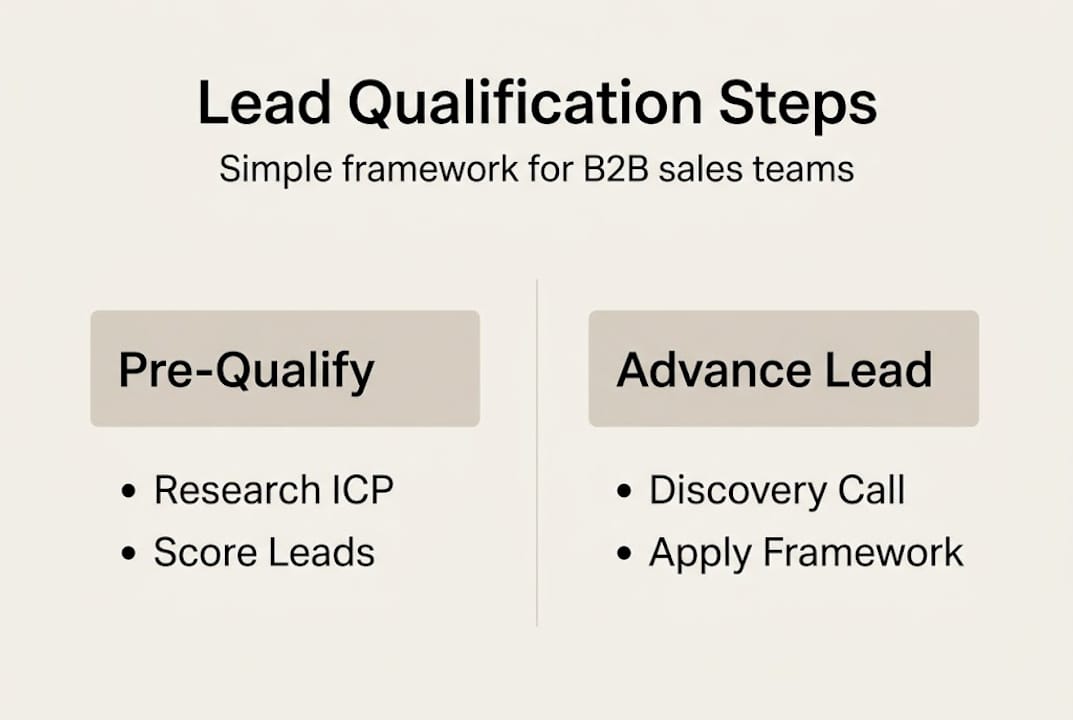
Step 1: Pre-qualification research
Before any outreach, check ICP alignment. Does the company match your target profile on firmographics (industry, size, region) and technographics (tools they use)? Look for intent signals: content downloads, pricing page visits, competitor comparisons.
Step 2: Prioritize your lead list
Not all leads deserve equal attention. Score them based on fit and intent. Use your lead generation checklist to rank leads before reps invest time.
Step 3: Initial outreach and discovery
Your first conversation is a qualification call, not a pitch. Ask open questions: What’s driving this initiative? Who else is involved in this decision? What happens if you don’t solve this in the next six months? Listen more than you talk.
Step 4: Apply your framework
| Qualification stage | Key questions to ask | Signal to look for |
|---|---|---|
| Pain identification | What’s the core problem? | Urgency, specificity |
| Budget confirmation | Is there a budget allocated? | Clear number or range |
| Authority mapping | Who signs the contract? | Access to economic buyer |
| Timeline check | When do you need this live? | Hard deadline or vague |
| Competition scan | Are you evaluating others? | Awareness of alternatives |
Step 5: Score, nurture, or disqualify
After your discovery call, make a clear call. High fit, high intent: move to next stage. Partial fit: nurture with targeted content. No pain or no ICP match: disqualify now. Don’t delay. Every week a bad-fit lead sits in your pipeline is a week of wasted capacity. Managing a long B2B sales cycle is hard enough without carrying dead weight.
Remember, qualification red flags like vague pain, no budget, or no access to decision-makers are signals to act on immediately, not ignore.
Pro Tip: Log the specific reason for every disqualification in your CRM. After 90 days, analyze the patterns. You’ll find targeting gaps that no amount of rep training can fix, only better ICP definition can.
Even experienced sales teams make qualification errors that cost them real revenue. Here’s what to watch for.
Overlooking pain signals early. If a lead can’t articulate a clear business problem in the first conversation, that’s a red flag. Don’t assume the pain will surface later.
Qualifying on company size alone. A Fortune 500 logo is exciting. But if there’s no budget, no champion, and no urgency, it’s a vanity deal. Focus on buyer need, not brand name.
Delaying disqualification. This is the most expensive mistake. Keeping a low-probability lead alive because it “might turn around” clogs your pipeline and distorts your forecast. Disqualify early and move on.
Failing to document no-go reasons. If your team doesn’t log why leads were disqualified, you lose the data needed to improve targeting. This is a systemic failure, not a rep failure.
Letting gut feel override process. Experienced reps have good instincts, but instincts without structure are inconsistent. Process wins over heroics every time.
Here’s how to avoid each of these pitfalls:
“Structure beats heroics. The best B2B sales tactics aren’t about working harder on every lead. They’re about working smarter on the right ones.”
Pro Tip: Run a quarterly post-mortem on lost deals and disqualified leads. You’ll spot patterns in where qualification broke down, whether it was too early, too late, or based on the wrong criteria entirely.
Qualification isn’t a one-time setup. It’s an ongoing discipline. Here’s how to keep it sharp.
Key metrics to track:
Here’s a practical improvement loop:
Teams that apply improving sales qualification practices consistently see measurable gains in win rate and pipeline health within one to two quarters. Pair this with strong lead-to-MQL strategies at the top of funnel and the compounding effect on revenue is significant.
The real talk here: most sales teams review their qualification criteria once a year, if at all. The teams that treat it as a living process, revisiting it quarterly, are the ones that consistently outperform their peers.
Here’s our honest take after working with dozens of B2B sales teams across Europe. Most organizations overcomplicate qualification. They invest in more tools, longer scorecards, and elaborate frameworks, but they never address the root issue: reps don’t feel empowered to say no.
Qualification isn’t just a process. It’s a culture. When reps are rewarded for pipeline volume instead of pipeline quality, they hold onto bad-fit leads because dropping them feels like failure. That’s a leadership problem, not a rep problem.
The best teams we’ve seen do something counterintuitive. They celebrate fast disqualifications. They treat a clean, honest “this isn’t the right fit” as a win, because it protects capacity for deals that can actually close.
A strong revenue-driving methodology gives reps the clarity and confidence to move on quickly. Less second-guessing. Faster pipelines. Healthier forecasts. That’s the real payoff of getting qualification right.
If you’re ready to stop guessing and start qualifying with precision, we can help. At Sales Label Consulting, we work directly with RevOps leaders, Heads of Sales, and VPs of Sales to build qualification systems that drive real results: higher win rates, shorter cycles, and a pipeline that actually reflects your revenue potential.
Our step-by-step sales enablement programs are built around your specific ICP, deal complexity, and team structure. We don’t hand you a generic playbook. We build the system with you. Explore our sales enablement best practices or reach out to Sales Label Consulting to start a conversation about where your qualification process is leaking revenue and how to fix it fast.
MEDDICC suits complex enterprise deals with multiple stakeholders, while BANT is a faster fit for simpler, shorter sales cycles with fewer decision-makers involved.
Leads without a clear articulated pain or ICP alignment are your clearest signal to disqualify early before they consume time and inflate your CAC.
Focus on stage conversion rates, win rates by lead source, CAC by segment, and sales cycle length. Together, these reveal exactly where your qualification process is strong and where it’s leaking.
Review your criteria at least quarterly, or immediately after a significant shift in market conditions, product positioning, or buyer behavior patterns.
Subscribe to our Insights: Expert productivity tips in your inbox
You'll receive 1-3 emails per month. Your data stays private, always.

CRO & Co-Founder with Sales Label Consulting

Watch our Sales Mates Podcast
Available
June 15, 2026 - 11 min read
Read article Read articleFix the System
Not Symptoms