
How to Conduct Sales Gap Analysis for Revenue Growth
TL;DR:
- Sales gap analysis quantifies the difference between current sales performance and revenue targets, identifying specific shortfalls and root causes. It involves measuring pipeline coverage, quota attainment, forecast accuracy, and performance-to-plan gaps, with stage-by-stage conversion analysis pinpointing bottlenecks. Effective execution requires frequent monitoring, clear ownership of actions, and quick organizational response to ensure revenue recovery.
Sales gap analysis is the disciplined process of measuring the distance between your current sales performance and your revenue targets to pinpoint shortfalls and build recovery plans that actually work. In practice, this means quantifying gaps across pipeline coverage, quota attainment, and forecast accuracy, then tracing each gap to a root cause you can fix. Tools like Fullcast for pipeline math and Outreach for variance decomposition have made this process faster and more precise. Done right, a sales gap assessment tells you not just that you’re behind, but where and why, so you can act before the quarter is lost.
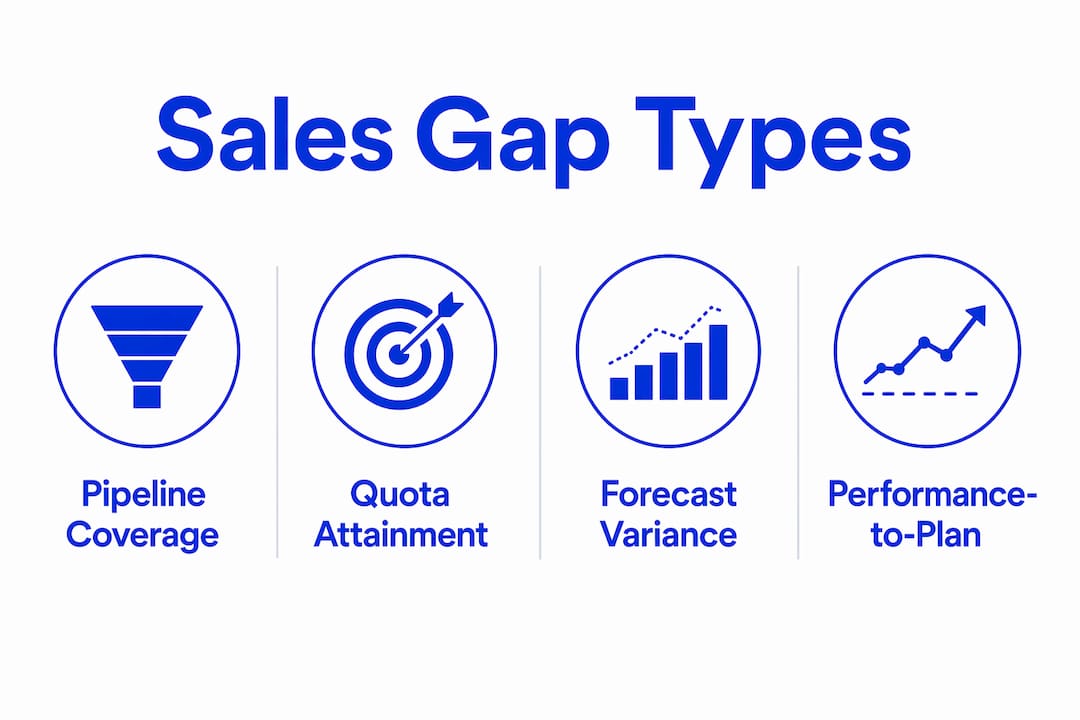
Sales gap analysis, known in RevOps circles as revenue gap analysis, starts with recognizing that not all gaps are the same. Four distinct gap types drive most revenue shortfalls, and each requires a different diagnostic lens.
Pipeline coverage gap is the most common and the most measurable. The formula is straightforward: Required pipeline = Target revenue / Historical win rate. If your target is $10M and your win rate is 25%, you need $40M in pipeline. If your CRM shows $28M, you have a $12M coverage gap. That number is not abstract. It tells you exactly how much new pipeline your team must generate before the quarter closes.
Quota attainment gap lives at the rep level. You calculate it by comparing each rep’s closed revenue against their assigned quota. The danger here is relying on team averages. A team average of 80% attainment can mask three reps at 120% and four reps at 40%. Those four reps represent a skill or execution problem that average numbers hide completely.
Forecast accuracy variance measures how far your committed forecast deviates from actual results. The calculation is simple: (Forecast minus Actuals) / Forecast, expressed as a percentage. Consistent positive variance means your team is sandbagging. Consistent negative variance means deals are slipping or being miscategorized in your CRM.
Performance-to-plan gap compares planned metrics like average deal size, sales cycle length, and activity volume against actual results. If your plan assumed a 45-day cycle and actuals show 68 days, that gap is compressing your pipeline velocity and pushing revenue into future quarters.
| Gap Type | Formula / Metric | Typical Benchmark |
|---|---|---|
| Pipeline coverage | Required pipeline = Target / Win rate | 4x coverage at 25% win rate |
| Quota attainment | Rep closed revenue / Assigned quota | 70%+ attainment across team |
| Forecast accuracy | (Forecast minus Actuals) / Forecast | Within 10% variance |
| Performance-to-plan | Planned metric vs. actual metric | Cycle length, deal size, activity |
Pro Tip: Never report a single team win rate without breaking it down by rep, segment, and deal size. The aggregate number almost always conceals the real problem.
Once you know what kind of gap you have, you need to find where in the funnel it lives. This is where stage-by-stage conversion analysis becomes your most powerful tool for identifying sales performance gaps with precision.
Pipeline conversion rate is the product of conversion rates at every funnel stage from Lead to MQL to SQL to Opportunity to Won. Typical total conversion rates run between 1.5% and 3.5%. That range matters because a small improvement at your weakest stage compounds multiplicatively through every stage below it. Fix a 30% Lead-to-MQL conversion rate to 40%, and you don’t just add 10 percentage points. You lift every downstream number proportionally.
Here’s how to run the analysis:
The Optifai Pipeline CVR Gap Analyzer approach makes this prioritization explicit: address the largest stage gap first because early funnel fixes compound downstream and deliver the highest return on your coaching and enablement investment.
Pro Tip: Cross-reference your stage conversion gaps with lost reason codes in your CRM. If your SQL-to-Opportunity gap is large but lost reasons show “no budget,” the fix is qualification criteria, not sales skills.
Track pipeline coverage weekly, not monthly. Weekly monitoring of leading indicators like pipeline coverage, deal velocity, and conversion rates gives you four to eight weeks of warning before a revenue miss shows up in your actuals. By the time a quarterly review surfaces the problem, your options for recovery are already limited.
This is the workflow Saleslabelconsulting uses when conducting a sales audit for clients. It moves from data preparation through root cause diagnosis to action planning in a sequence that keeps the analysis grounded in numbers you can defend.

Step 1: Gather your baseline data. Pull 90 days of CRM data covering pipeline by stage, closed-won and closed-lost deals, rep-level quota and attainment, average deal size, and sales cycle length. Define your revenue target for the period and calculate your historical win rate by segment.
Step 2: Calculate your pipeline coverage gap. Apply the formula: Required pipeline = Target revenue / Win rate. Compare that number to your current pipeline. A 25% win rate requires roughly 4x pipeline coverage. If you’re sitting at 2.5x, you have a structural shortfall that no amount of deal acceleration will fix without new pipeline generation.
Step 3: Calculate your forecast variance. Pull your last three committed forecasts and compare each to actuals. If variance exceeds 10% consistently, your forecast methodology or CRM hygiene is broken. Fix this before you trust any gap number downstream.
Step 4: Run variance decomposition. Break your revenue variance into four components: volume variance (fewer deals than planned), price variance (smaller deal sizes), mix variance (wrong segment or product mix), and coverage variance (pipeline shortfall). Each component points to a different corrective action.
Step 5: Run a rep cohort analysis. Compare your top 10% performers to your bottom 10%. The gap between those cohorts reveals whether you have a skills problem, a territory problem, or a process problem. Average metrics will never show you this.
Step 6: Build your action plan. A solid gap-to-budget plan includes the quantified gap amount, required closes, pipeline needs, and a clear decision cycle. Assign an owner to every action. Set a deadline. Schedule a monthly gap-to-budget meeting where each owner reports on progress against their specific gap.
Pro Tip: Automate your gap-to-budget calculation in a shared spreadsheet or your CRM dashboard. Manual recalculation every month introduces errors and delays the decisions you need to make.
Most gap analyses fail not because the math is wrong, but because the inputs are stale or the outputs have no owner. Here are the pitfalls that consistently derail sales performance analysis in practice.
Real talk: The most common failure mode we see is a beautifully built gap analysis that sits in a slide deck and gets reviewed once. Structure beats heroics. A scrappy weekly review with clear owners beats a polished quarterly presentation with none.
Pro Tip: Use your sales funnel optimization process to set stage-level conversion benchmarks before you run your gap analysis. Without benchmarks, you’re measuring gaps against nothing.
A sales gap analysis works only when it combines quantitative formulas, weekly leading indicator monitoring, and action plans with named owners and firm deadlines.
| Point | Details |
|---|---|
| Start with the right formula | Required pipeline = Target revenue / Win rate; this single calculation anchors every gap discussion. |
| Monitor weekly, not quarterly | Weekly pipeline coverage tracking gives you four to eight weeks to intervene before a miss becomes structural. |
| Decompose variance by component | Break revenue gaps into volume, price, mix, and coverage variances to identify the specific corrective action needed. |
| Validate with CRM data | Cross-reference stage conversion gaps with lost reasons and stage time to avoid misdiagnosing a data problem as a skills problem. |
| Assign every gap an owner | A gap without an owner and a deadline is a number, not a plan. Accountability is what converts analysis into revenue. |
Here’s my honest take after working through gap analyses with RevOps teams and VP of Sales across multiple tech companies: the math is rarely the hard part. The hard part is getting the organization to act on what the numbers say, fast enough to matter.
The teams that close gaps consistently share one habit. They treat gap analysis as a weekly operating rhythm, not a quarterly report. They don’t wait for the QBR to discover they’re 30% behind on pipeline. They know it in week two of the quarter, and they’ve already adjusted activity targets by week three.
I’ve also seen how dangerous it is to let a single team win rate drive decisions. One client had a 28% team win rate that looked acceptable. When we broke it down by rep and deal size, the top three reps were winning at 45% on enterprise deals, while the rest of the team was at 18% on mid-market. Those are two completely different problems requiring two completely different fixes. The aggregate number was hiding both.
The other thing I’d push you on: gap analysis without sales enablement follow-through is a dead end. You can identify that your SQL-to-Opportunity conversion is 12 points below benchmark. But if you don’t connect that finding to a specific coaching intervention, a revised qualification framework, or a new piece of sales content, the gap stays open. The analysis has to feed directly into your enablement and coaching cadence. That’s where the revenue actually moves.
Early detection via leading indicators is what separates teams that manage their quarters from teams that react to them. Build the weekly cadence. Assign the owners. Connect the gaps to the coaching. That’s the whole game.
— Antony
Running a gap analysis gives you the diagnosis. Closing the gaps requires a system.
At Saleslabelconsulting, we work with RevOps leaders, Heads of Sales, and VPs of Sales to translate gap findings into structured enablement programs that stick. Our Sales Enablement Step by Step resource walks you through exactly how to connect your gap analysis outputs to coaching cadences, content development, and pipeline generation programs that produce predictable results. If you want to go deeper on sales enablement best practices that scale with your team, that’s where we start every engagement. The gap is already identified. Let’s close it.
A sales gap analysis measures the difference between your current sales performance and your revenue targets across metrics like pipeline coverage, quota attainment, and forecast accuracy. It identifies specific shortfalls and their root causes so you can build a recovery plan.
Divide your target revenue by your historical win rate to get your required pipeline, then subtract your actual pipeline from that number. A 25% win rate on a $10M target requires $40M in pipeline; if you have $28M, your gap is $12M.
Weekly monitoring of leading indicators like pipeline coverage and conversion rates is the minimum effective cadence. Monthly deeper reviews translate those signals into updated action plans with quantified gaps, required closes, and assigned owners.
Fullcast supports pipeline coverage math and revenue gap modeling. Outreach provides variance decomposition to diagnose missed forecasts. Optifai offers a Pipeline CVR Gap Analyzer for stage-by-stage conversion bottleneck identification.
The most common failure is producing a gap report with no assigned owners or deadlines. A gap analysis becomes a management tool only when every identified shortfall maps to a specific person, a specific action, and a specific date for resolution.
Subscribe to our Insights: Expert productivity tips in your inbox
You'll receive 1-3 emails per month. Your data stays private, always.

CRO & Co-Founder with Sales Label Consulting

Watch our Sales Mates Podcast
July 27, 2026 - 9 min read
Read article Read articleJuly 26, 2026 - 13 min read
Read article Read articleJuly 25, 2026 - 8 min read
Read article Read articleJuly 24, 2026 - 11 min read
Read article Read article