
What B2B Multi-Touch Attribution Actually Tells You
B2B multi-touch attribution splits revenue credit across every touchpoint a buying committee interacts with, not just the first email or the last demo request. It works best when your CRM and CDP can resolve individual contacts back to a single account record, because without that link you’re measuring people, not the deals they’re part of.
Here’s the practical claim: multi-touch attribution (MTA) earns its keep for tactical, channel-level decisions. Think budget shifts between paid search and webinar spend, or figuring out whether your SDR sequence actually moves deals or just adds noise. It’s a weaker tool for strategic, board-level questions like “should we enter a new segment?” That’s a job for marketing mix modeling, and we’ll get to why the two need each other.
The American Marketing Association has documented this trade-off for years: algorithmic attribution models can isolate a channel’s marginal contribution, but they need enough conversion volume to do it reliably. Sales Label Consulting sees the same pattern across RevOps engagements. Teams adopt MTA expecting a single dashboard of truth, and instead they get a directional signal that’s genuinely useful, once they stop expecting perfection from it.
Three things matter more than the model you pick:
Get those three right, and even a simple model beats no model at all.
B2B multi-touch attribution works when account-level data is clean, the lookback window matches the real sales cycle, and the output is validated against incrementality tests rather than trusted blindly.
| Point | Details |
|---|---|
| Start with rules-based models | Use linear or W-shaped attribution until you’re closing enough deals per quarter for algorithmic models to be statistically reliable. |
| Fix account mapping first | Roll every contact up to a parent account record before trusting any attribution output. |
| Match lookback windows to reality | Pull actual sales cycle length from closed-won deals and set your window accordingly, not the platform default. |
| Stack methods, don’t rely on one | Pair MTA with incrementality testing and, at scale, marketing mix modeling to catch what any single model misses. |
| Validate through audits | A sales process audit from Sales Label Consulting often reveals the CRM hygiene issues distorting attribution before the model itself needs to change. |
Multi-touch attribution assigns fractional credit to every touchpoint in a buyer’s journey rather than handing 100% of the credit to one interaction. Adobe’s overview of the practice frames it as a direct upgrade over single-touch models, which either credit the first thing a prospect ever clicked or the last thing before they converted. Both extremes ignore everything in between, and in B2B, “everything in between” is where the real story lives.
First-touch tells you what got someone’s attention. Last-touch tells you what closed the deal. Neither tells you that the prospect read three blog posts, attended a webinar, ignored two emails, then had a call with sales before finally converting. A single enterprise deal can touch a dozen channels over several months, and if your reporting only credits one of them, you’re systematically undervaluing everything else in the mix.
That gap matters because B2B teams make three kinds of decisions with attribution data:
The touchpoints worth tracking go well beyond ad clicks, making use of proven franchise lead generation strategy tactics essential for building a comprehensive attribution model. Email nurture sequences, webinar attendance, content downloads, sales call notes, product trial activity, and even dark social shares in Slack communities all shape a buying committee’s decision. If your attribution model only sees paid channels, you’re building your budget case on a fraction of the actual journey.
Every attribution model answers the same question differently: how much credit does each touchpoint deserve? The answer ranges from “equal credit for everyone” to “let a machine learning model figure it out.” Here’s how the main options break down and where each one earns its place.
Data-driven models sound like the obvious end state, and eventually they might be, but the Factors is blunt about the prerequisite: these models need substantial conversion volume and clean account-level data to produce statistically meaningful weights. A team closing a few dozen deals a quarter doesn’t have the sample size to make a Shapley model outperform a well-reasoned custom rules-based approach.
Statistic Callout: Research on algorithmic attribution methods notes that Shapley-value approaches require analyzing both converting and non-converting journeys to generate reliable marginal contribution estimates, a data requirement most mid-market B2B teams simply haven’t hit yet.
Rules-based models aren’t a consolation prize while you wait to “graduate” to algorithmic ones. Research on hybrid approaches found that simple weighted combinations of first- and last-touch data can meaningfully improve budget allocation even with limited data volume. If your pipeline volume is thin, a well-built W-shaped model with input from your AEs will beat a statistically underpowered machine learning model every time.
The decision rule is simple: use rules-based models (linear, time-decay, position-based, W-shaped) as your default, and only invest in algorithmic modeling once you’re consistently generating enough closed-won deals per quarter to trust the statistics. Below that threshold, an algorithmic model isn’t more accurate, it’s just more confident about being wrong.
B2B attribution breaks in ways consumer attribution never has to deal with, and the root cause is almost always the same: B2B deals aren’t decided by one person clicking one button. They’re decided by committees, sometimes six to ten stakeholders deep, each interacting with your content at different times through different channels.
If you’re attributing credit at the contact level, you’re missing the actual unit of analysis. A deal doesn’t close because one champion read your pricing page. It closes because the champion, the economic buyer, the technical evaluator, and a procurement stakeholder each engaged with different content over several months. Guidance on B2B attribution modeling recommends mapping every contact-level event up to a parent account record and building the attribution timeline at the account level, not the individual level.
In practice, that means:
Most attribution platforms ship with a default lookback window of 30 to 90 days. That default was built with e-commerce and short sales cycles in mind, and applying it to B2B without changing anything is one of the fastest ways to produce garbage output. If your average enterprise deal takes six months from first touch to signature, a 30-day lookback window will show you almost nothing about the top of your funnel. It’ll credit only the touches that happened right before close, which systematically overweights sales activity and underweights the top-of-funnel content and campaigns that actually generated the opportunity in the first place.
The fix is straightforward in concept, tedious in execution: pull your actual average sales cycle length from closed-won deals in the last four to six quarters, then set your lookback window to match it, not to whatever the platform defaults to. A company selling enterprise software with a 180-day sales cycle needs a 180-day (or longer) lookback window, full stop.
Pro Tip: Before you trust any attribution report, run a quick audit. Pull five closed-won deals, manually trace every touchpoint from CRM activity logs, and compare that timeline to what your attribution tool reported. If the tool missed touches that happened outside its lookback window, you’ve found your problem before it costs you a budget decision.

A meaningful share of B2B influence happens somewhere your tracking pixel can’t see it: a conference conversation, a customer reference call, a Slack recommendation in a peer community, an analyst briefing. None of that shows up in web analytics, and no attribution model can credit a touchpoint it never captured. The practical answer isn’t to ignore these gaps, it’s to log them manually. Sales reps should be recording key offline interactions (a dinner, a reference call, a proof-of-concept demo) directly into the CRM as activities, so they at least enter the account timeline even if they weren’t digitally tracked.
This is also where CDP and CRM hygiene stop being a back-office concern and become a measurement problem. A customer data platform that resolves cookies, device IDs, and email addresses back to a single contact, and then to a single account, is what makes cross-device tracking possible at all. Without it, the same prospect researching on their phone during a commute and closing the deal on a work laptop shows up as two disconnected journeys instead of one continuous story. If your team is still mapping out how these journeys should connect, it’s worth working through a structured approach to customer journey mapping before layering attribution on top of a messy foundation.
Implementation fails most often not because the model was wrong, but because teams skipped the unglamorous groundwork and jumped straight to picking software. Here’s the order that actually works.
Pro Tip: Don’t wait for a perfect data setup before running your first incrementality test. Even a rough version, pausing one channel in one region for a month and comparing pipeline against a similar untouched region, will tell you more about real channel impact than another quarter of refining your attribution model’s weighting.
Every one of these steps assumes your sales process itself is producing clean, consistent data to feed the model. If deal stages, close dates, or source fields are inconsistently logged by reps, no attribution model can fix that at the reporting layer. A sales process audit is often the fastest way to find and fix those upstream data problems before they poison your attribution output.
The right model depends on three things: how much data you’re generating, how long your sales cycle runs, and what kind of decision you’re trying to make. Get honest about where you actually sit on each axis before you commit to a model, because building an algorithmic attribution stack on top of thirty closed deals a quarter is a common and expensive mistake.
For most B2B teams starting out, a linear or W-shaped position-based model is the sensible entry point. It’s transparent, easy to explain in a budget meeting, and doesn’t require a data science hire to maintain. Growth-stage teams with more volume and cleaner data can graduate to custom weighted models informed by sales feedback, and only enterprise teams with high deal volume and mature identity resolution should be running full algorithmic attribution.
None of this happens in isolation from other measurement methods, either. The Pepper Effect playbook on B2B attribution recommends stacking methods rather than picking one and calling it done: use MTA for tactical, channel-level optimization, marketing mix modeling for strategic, budget-level decisions, and incrementality testing to validate that either model is actually reflecting reality rather than correlation.
| Maturity Level | Recommended Model | Method Stack |
|---|---|---|
| Starter (under 50 deals/quarter) | Linear or W-shaped rules-based | MTA plus quarterly win/loss interviews |
| Growth (50 to 100 deals/quarter) | Custom weighted, sales-informed | MTA plus periodic incrementality tests |
| Enterprise (above 100 deals/quarter) | Algorithmic (Shapley or Markov) | MTA plus MMM plus incrementality testing |
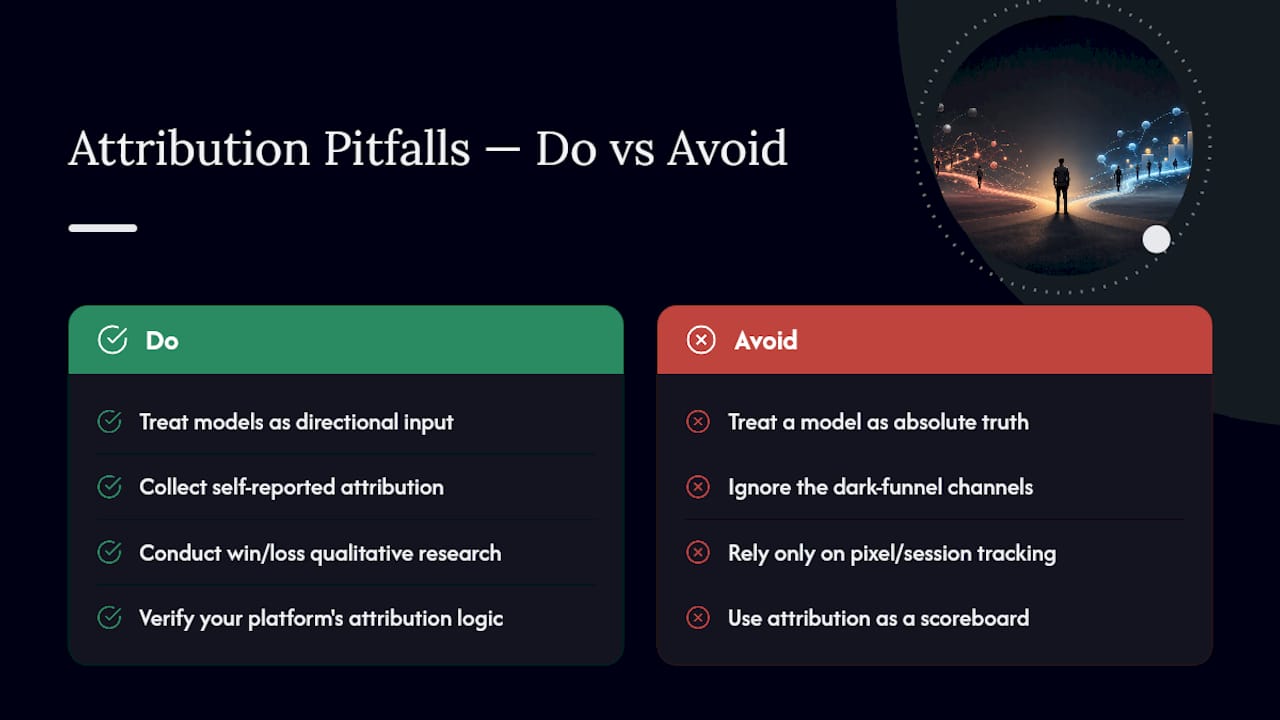
The biggest mistake isn’t picking the wrong model. It’s treating whatever model you picked as an unquestionable source of truth instead of a directional input that needs a reality check.
The dark funnel problem is real and it isn’t going away. Peer community discussions, private Slack recommendations, word-of-mouth referrals, none of it shows up in any attribution platform. The mitigation isn’t a better tool, it’s supplementing MTA with self-reported attribution (a simple “how did you hear about us” field in your demo request form) and qualitative research like win/loss interviews. Practitioner guidance on stacking methods treats this combination as standard practice, not a nice-to-have.
Privacy and tracking changes are steadily reducing how much pixel-level data you can rely on. Browser restrictions and cookie deprecation mean session-level tracking captures less of the journey than it did a few years ago. Server-side tracking and first-party data collection through your CRM help close some of that gap, but the honest answer is that some visibility is permanently gone, and your reporting should reflect that uncertainty rather than paper over it.
Platform defaults quietly distort results. GA4 and similar tools can fall back to last-click behavior under certain conditions without clearly flagging that they’ve done so. If nobody checks, teams end up making budget decisions off data that isn’t running the model they think it’s running. Confirm your platform is actually executing the attribution logic you configured before you trust a single report from it.
The organizational pitfall underneath all of this: attribution output gets treated as a scoreboard instead of a diagnostic tool. A directionally accurate model that your team actually acts on every quarter beats a statistically elegant one that leadership quietly ignores because they don’t trust it.
Sales Label Consulting works with RevOps leaders who’ve usually already bought an attribution tool and are frustrated it isn’t delivering the clarity they were promised. The gap is rarely the software. It’s the account mapping, the lookback window, and the validation loop underneath it.
Before you trust your next attribution report, run through this:
Attribution work only pays off when it changes a real budget or process decision. A model that produces a beautiful dashboard nobody references before the next planning cycle hasn’t done its job, no matter how sophisticated the math behind it.
For teams stuck on the CRM hygiene piece specifically, a full sales process audit often surfaces the data gaps that no attribution model can work around on its own.
The attribution conversation spends too much time debating models and not enough time on the plumbing underneath them. That’s backwards. A Shapley-value model running on messy, unresolved contact data will produce confident-looking output that’s still wrong, and confident wrong numbers are more dangerous than an honest “we don’t fully know yet.”
What the evidence actually supports is unglamorous: get your account-level data clean, set a lookback window that matches reality, and pick a model your team can explain without a statistics degree. Algorithmic attribution is genuinely valuable, but only past a data volume threshold most mid-market B2B teams haven’t reached, and treating it as the finish line skips the work that makes any model trustworthy.
The conventional advice oversells model sophistication and undersells validation. Method stacking, pairing MTA with incrementality tests and even lightweight marketing mix modeling, isn’t a nice-to-have for enterprise teams with big budgets. It’s how you catch a model quietly lying to you. Start there before you start arguing about Markov chains.
— Antony
Attribution data only creates value once it changes what your team actually does, and that’s the gap where most B2B organizations get stuck. Sales Label Consulting works directly inside that gap: sales process audits that clean up the CRM data your attribution model depends on, RevOps advisory that aligns your lookback windows and account mapping with how your deals really move, and sales enablement frameworks that turn attribution insights into changes your reps and marketers can act on the same week.
If your attribution reports keep producing numbers nobody trusts enough to act on, the fix usually isn’t a new tool. It’s a structured audit of the process feeding it. Start with a step-by-step sales enablement engagement built to connect your measurement data to the decisions your sales and marketing teams make every quarter.
Subscribe to our Insights: Expert productivity tips in your inbox
You'll receive 1-3 emails per month. Your data stays private, always.

CRO & Co-Founder with Sales Label Consulting

Watch our Sales Mates Podcast
September 22, 2026 - 11 min read
Read article Read articleSeptember 21, 2026 - 8 min read
Read article Read articleSeptember 20, 2026 - 13 min read
Read article Read articleSeptember 19, 2026 - 13 min read
Read article Read article