
90-Day AI Pilot for RevOps Leaders: Agentic Playbook and Data Sprint
AI for RevOps means three things working together: predictive scoring that flags what matters, generative drafting that produces the outreach and reports, and agentic execution that acts on both without a human clicking every button. The single next move is a focused data-readiness sprint over several weeks, followed by a 30 to 90 day copilot pilot on one workflow. Do that well and you should see reps reclaiming hours weekly, faster lead-to-opportunity movement, and forecasting signals that actually hold up under scrutiny.
TL;DR:
- Successful AI pilots require a clear focus on data quality, covering consistency, recency, completeness, and system integration before deployment.
- The most impactful initial use cases are lead routing, deal-risk scoring, and RFP drafting, due to high impact and ease of implementation.
- AI autonomy should be staged: start with read-only insights, move to copilot approval, and finally to autonomous actions within strict governance boundaries.
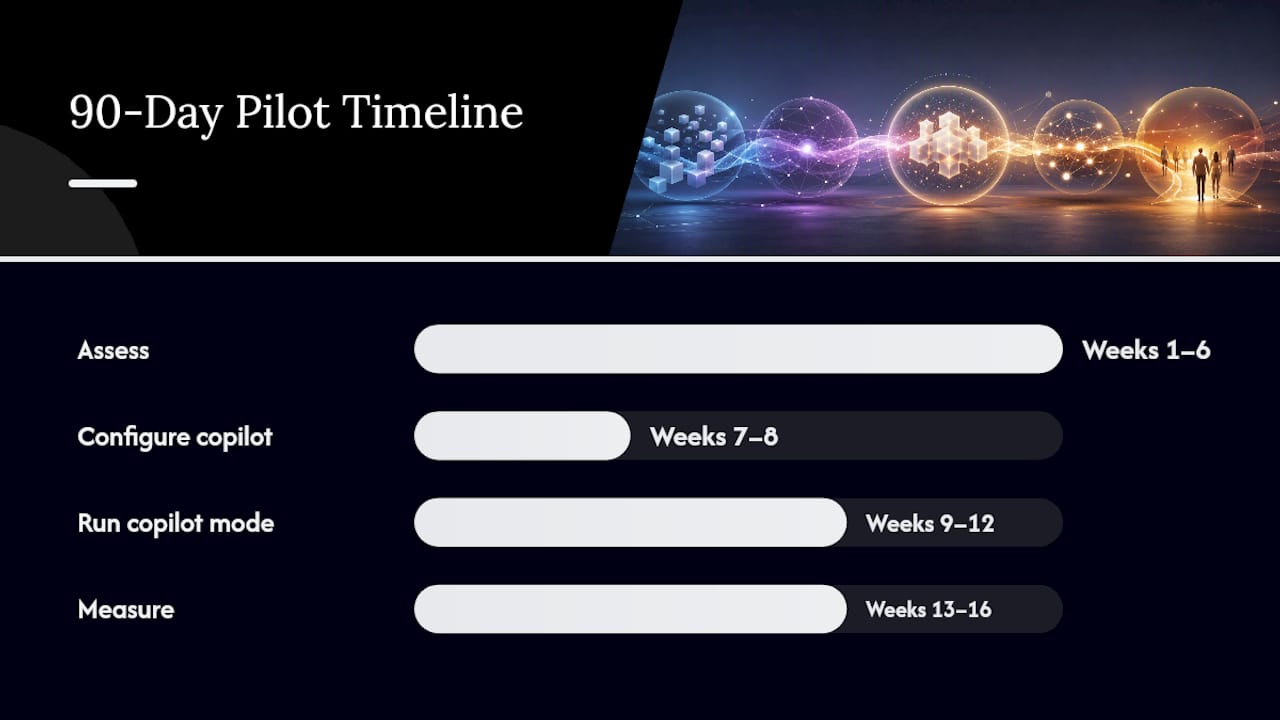
- A 90-day pilot involves six weeks of data readiness, followed by configuration, a two-week copilot phase, and measurement before expanding or adjusting.
- A unified platform with reliable data connectors and strong governance simplifies implementation, but teams can also combine best-of-breed tools with careful integration.
Most vendors blur these three layers together, and that’s exactly why so many pilots stall. Each one solves a different problem, and confusing them leads teams to expect agentic results from a predictive tool.
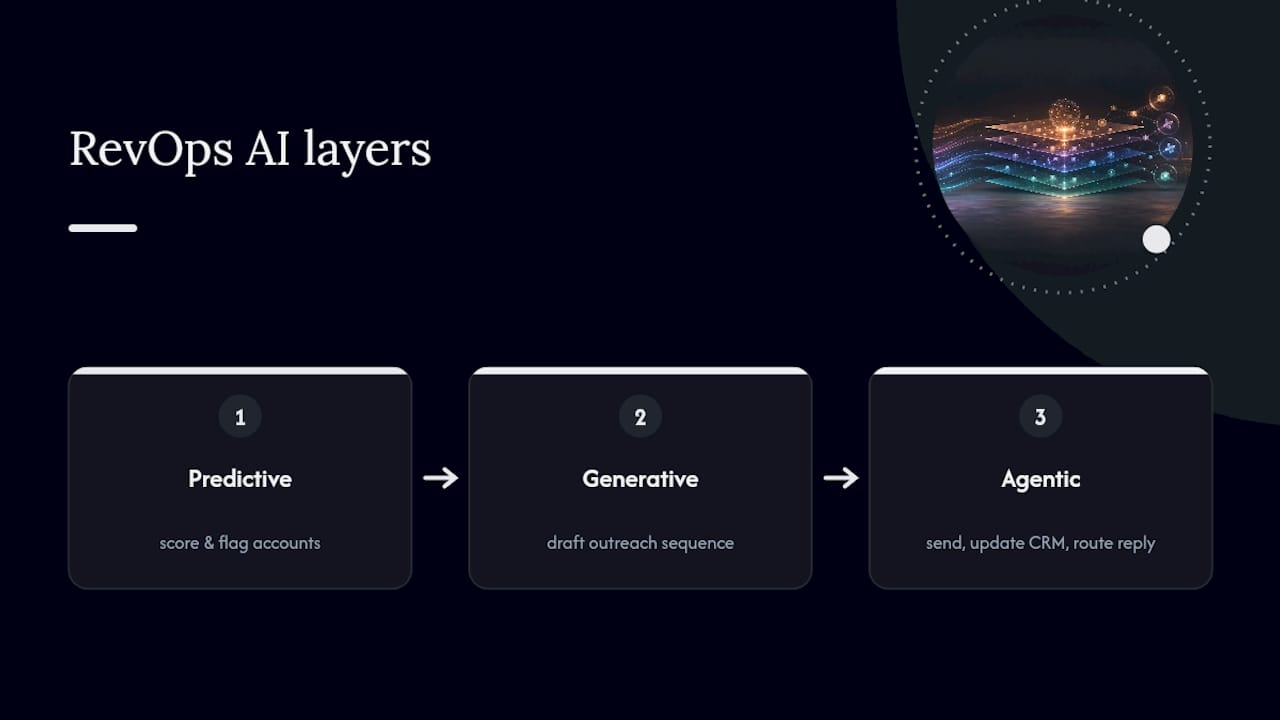
Predictive AI scores and ranks. It looks at historical patterns and tells you which deals are at risk, which leads will convert, and which accounts are about to churn. Think of it as your best analyst working overnight. It’s low risk because it only suggests, never acts.
Generative AI drafts. It writes the follow-up email, summarizes the call, builds the first pass of an RFP response. BCG’s research on AI in RevOps found generative tools can cut RFP turnaround time by a measurable percentage when paired with governed templates and a real review step. That “governed” part matters. Ungoverned generative output creates more cleanup work than it saves.
Agentic AI executes. It qualifies the lead, updates the CRM, schedules the meeting, and moves to the next step without waiting for approval. IBM’s breakdown of AI agents in RevOps points to lead routing, personalized outreach, and pipeline management as where agents already earn their keep.
In practice, these layers stack. A predictive model flags an account showing expansion signals, a generative layer drafts the outreach sequence, and an agent sends it, logs the response, and routes a hot reply to the rep’s queue. That’s the whole point of moving from prediction to execution: the insight doesn’t just sit in a dashboard, it triggers action.
Be conservative with agentic write access early, and experimental with predictive scoring from day one. The risk profiles aren’t close.
Not every use case deserves your first pilot slot. Some take weeks to show value; others take a quarter. Rank by impact and ease, not by whatever your vendor is pushing hardest.
For picking your first pilot, weigh impact against how much data cleanup it demands. Outreach’s practical use-case breakdown consistently ranks lead routing and deal-risk scoring highest on that impact-to-ease ratio, which is why most teams start there rather than with forecasting.
Here’s the uncomfortable truth: most AI-for-RevOps disappointments aren’t AI problems. They’re data problems wearing an AI costume. Rework’s analysis of RevOps data alignment makes the case plainly: fix consistency, completeness, recency, and coverage before you deploy anything, or you’re just automating your existing mess faster.
Consistency means “Enterprise” and “Enterprise Segment” aren’t two different values in your CRM. Completeness means required fields are actually filled, not just marked required. Recency means the data reflects this quarter, not the one before your last reorg. Coverage means every stage of the funnel has enough historical volume for a model to learn from, not just the top of funnel.
Run this quick audit before committing to any pilot:
A revenue architecture audit is exactly this kind of structured pass, done before tools get bought instead of after they underperform.
Pro Tip: Don’t try to fix everything in one sprint. A perfect CRM with the wrong priorities wastes six weeks.
Governance isn’t a compliance checkbox here, it’s what determines whether your pilot survives contact with a bad week. Different agents need different leashes, and treating them all the same is a documented failure mode according to guidance on agent governance across autonomy levels.
Three tiers work for most RevOps teams:
Every tier needs an audit log and a rollback path. If you can’t undo what an agent did, it doesn’t belong in autopilot yet.
Pro Tip: *Track action-accuracy weekly during copilot mode.
Executives don’t want a philosophy of AI adoption. They want a timeline and a number. Here’s a sequence that holds up under a board update.
Set acceptance thresholds before you start, not after you see the numbers.
For the CFO conversation, report three numbers: forecast accuracy lift versus the prior two quarters, time-to-lead reduction, and hours recovered across the team. Those three translate cleanly into budget language, unlike “the AI feels helpful.”
This decision shapes everything downstream, and most teams underestimate how much. A unified platform gives you cleaner data lineage and faster time-to-value because the connectors and identity resolution are already solved. An orchestrated best-of-breed stack gives you flexibility to pick the best tool per function but multiplies your integration and observability burden. Gartner’s guidance on revenue operations consistently points toward a unified data layer as the foundation agentic workflows actually need to function reliably.
Whichever path you choose, run vendors through the same checklist:
Someone on your team needs to own rollback and observability full time. That’s not a part-time responsibility bolted onto someone’s existing role.
The playbook holds together on paper. Executing it under deadline pressure, with your existing tools and a team that’s never run a data audit, is a different exercise. Sales Label Consulting runs this exact sequence with B2B tech clients: a data-readiness assessment first, then a scoped copilot pilot on one workflow, then a measured expansion decision.
[Client case studies and specific engagement outcomes to be added.]
[Author credentials and consultant bios to be added.]
What we bring to this specifically: a revenue architecture audit that catches the consistency and coverage gaps before they sabotage a pilot, plus hands-on pilot design so the copilot stage has real accuracy checkpoints instead of a vague “let’s see how it goes.”
The technology rarely fails. What fails is the manager layer that stops enforcing data hygiene once the novelty wears off, or that lets reps ignore agent suggestions without consequence. AI outputs need to show up in coaching conversations, not just dashboards, or they quietly get ignored.
The other trap is spreading a pilot across five workflows because everyone wants their favorite use case included. Narrow focus with two or three clear metrics beats a broad rollout every time. Pick one workflow, hold the line on data quality, and let the results argue for expansion.
— Antony
Reading the playbook is the easy part. Running a 6 to 8 week data-readiness sprint while still hitting quota, managing a forecast call, and keeping five other fires contained is where most teams stall out before the pilot even starts. Sales Label Consulting is built for exactly that gap: a done-with-you engagement that runs the data audit, scopes the copilot pilot, and sets your accuracy checkpoints so you’re not building this playbook from scratch while also running your day job.
Our sales enablement framework is designed to sit underneath exactly this kind of AI rollout, so your reps have the process and coaching structure to actually adopt what the agents surface instead of ignoring another dashboard. Teams weighing AI investment against agency productivity gains might also find this analysis of AI-driven agency ROI useful context on what realistic returns look like.
If your team is ready to move past theory, book a scoping call and we’ll map your first 90-day pilot together, starting with the data-readiness assessment that makes or breaks everything after it.
Subscribe to our Insights: Expert productivity tips in your inbox
You'll receive 1-3 emails per month. Your data stays private, always.

CRO & Co-Founder with Sales Label Consulting

Watch our Sales Mates Podcast
September 22, 2026 - 11 min read
Read article Read articleSeptember 21, 2026 - 8 min read
Read article Read articleSeptember 20, 2026 - 13 min read
Read article Read articleSeptember 19, 2026 - 13 min read
Read article Read article