
Discovery Call Framework: A Playbook for Sales Teams
Run this five-move sequence on your next call: Open, Diagnose, Quantify, Map, Commit. Open by naming the goal of the call in one sentence and asking permission to dig. Diagnose the real problem behind the stated one. Quantify what it’s costing them in dollars, hours, or risk. Map who else touches the decision. Commit to a dated next step before you hang up.
Here’s the opener, word for word: “Before we dive in, my goal today is to understand what’s driving this project and whether we’re actually a fit. Sound good if I ask a few pointed questions?” And here’s the close: “Based on what you’ve shared, it sounds like the next logical step is [specific action]. Does [specific date] work to get [specific stakeholder] in the room?”
A discovery call framework only earns its name if it produces three things by the time you hang up:
Miss any one of those three and you haven’t run discovery. You’ve had a nice conversation.
A discovery call succeeds only when it produces a qualified problem, a quantified impact, and a dated next step before the call ends.
| Point | Details |
|---|---|
| Use the five-move micro-framework | Open, Diagnose, Quantify, Map, Commit, run in that order on every call. |
| Pick a framework by deal size | Use SPIN or the 5-Question Stack for smaller deals, MEDDIC/MEDDPICC for enterprise. |
| Target 11 to 14 questions | Enough depth to diagnose without tipping into interrogation. |
| Track three metrics starting now | Next-step conversion rate, rep talk ratio, and average questions per call. |
| Get expert help scaling the framework | Sales Label Consulting builds team-wide scorecards and coaching systems around your discovery process. |
A discovery call framework is a repeatable sequence of questions and transitions designed to diagnose a prospect’s problem, not to pitch a solution. That distinction gets blurred constantly, and it’s the single biggest reason discovery calls underperform. The moment a rep starts describing features before understanding the actual pain, the call stops being discovery and turns into a premature demo.
Real discovery surfaces evidence, not just information. A good call should let you check off three success criteria before you hang up:
Discovery sits underneath most qualification systems you’ve heard of, whether that’s SPICED, MEDDIC, or BANT. Here’s the part people miss: those are scoring frameworks, built to evaluate a deal after the fact. They tell you whether a deal is healthy. They don’t tell you what to say at minute six of the call when the prospect just mentioned a vague budget concern. A discovery call is diagnostic work, and it needs its own on-call question architecture, distinct from the scorecard you fill in afterward. Confusing the two is why so many reps read MEDDIC criteria out loud like a survey and wonder why prospects go quiet.
The calls that fall apart in the first ninety seconds almost always trace back to weak prep, not weak questions. A five-minute research pass before the call changes the entire tone of the conversation because you walk in already sounding informed instead of generic.
Before any discovery call, populate these fields in your CRM or pre-call brief:
Use public signals to build that hypothesis fast. A company that just posted three open sales engineering roles is probably scaling outbound and hitting a technical bottleneck. A LinkedIn post complaining about pipeline visibility tells you exactly what to ask about first. Turn that signal into one hypothesis and two prioritized questions you’ll lead with, and you’ll sound like you’ve done homework because you have.
Pro Tip: Send a short agenda 24 hours before the call. A one-paragraph email listing what you’ll cover and what you hope they’ll bring measurably reduces no-shows and primes the prospect to arrive with real numbers instead of vague impressions.
Add three things to the calendar invite itself: a clear agenda line, an estimated time check (“30 minutes, ending on a next step”), and any materials you’re promising to bring, like a case study or pricing overview. It sounds small. It’s the difference between a call that feels like an appointment and one that feels like an interruption.
A question architecture is the live sequence of what you ask and in what order, built so each answer earns the right to probe deeper. That’s different from a scoring checklist you fill in after the call. The most common mistake teams make is treating MEDDIC or BANT as a script, reading through criteria in order regardless of what the prospect just said. Real discovery adapts in real time.
Here’s how the major frameworks stack up against each other:
| Framework | Best for deal size | Typical call length | Stakeholder count | Primary job on the call |
|---|---|---|---|---|
| SPIN | Transactional to mid-market | 20-30 minutes | One to two | Surface implications of an unaddressed problem |
| SPICED | Mid-market B2B SaaS | 25-30 minutes | Two to four | Balance pain exploration with decision mapping |
| MEDDIC / MEDDPICC | Enterprise, multi-stakeholder | 30-45 minutes | Four or more | Document economic buyer, metrics, and decision criteria |
| 5-Question Discovery Stack | Any deal size, especially early-stage | 15-30 minutes | One to three | Layer symptom, cost, trigger, and future state sequentially |
| Minimum-viable discovery flow | Fast-cycle transactional deals | 10-15 minutes | One | Confirm fit and urgency quickly, route or advance |
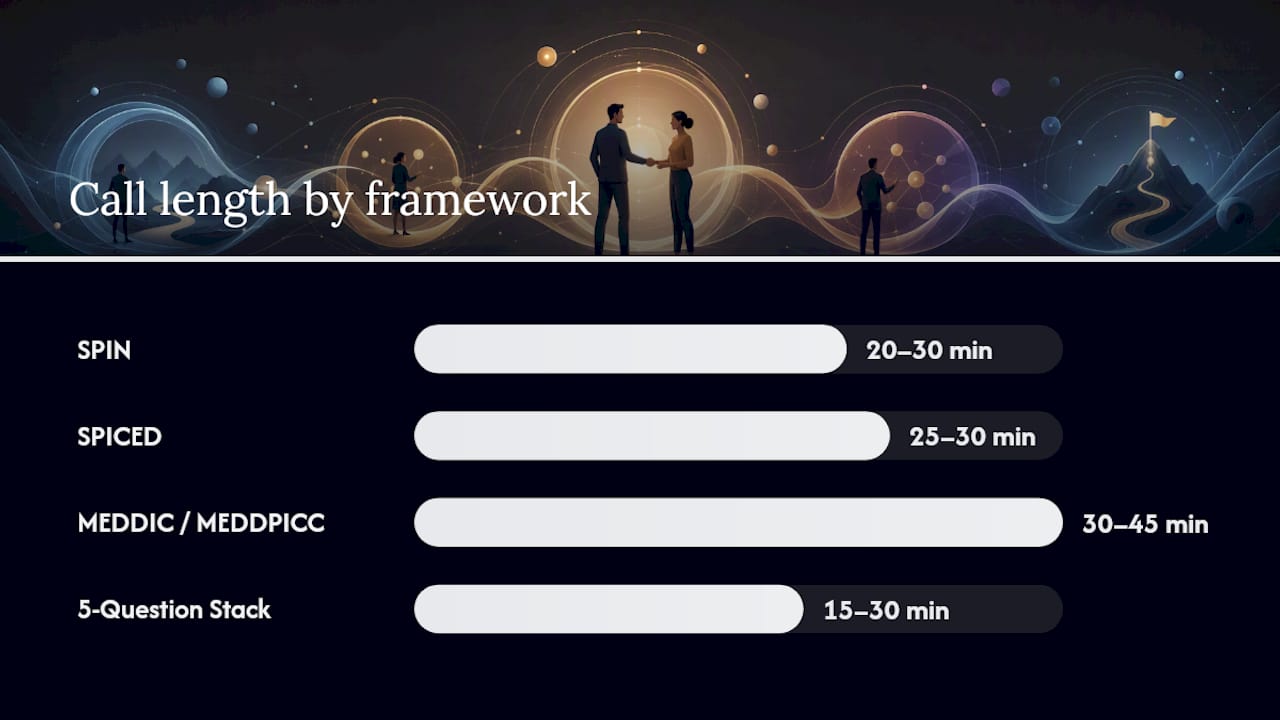
SPIN (Situation, Problem, Implication, Need-payoff) is the oldest of the group and still the intellectual backbone of most modern frameworks. Neil Rackham’s research on thousands of sales calls found that top performers spend disproportionate time on implication and need-payoff questions, not situation questions. Use it when the prospect hasn’t fully articulated their own pain yet. Sample questions: “What happens if this bottleneck isn’t fixed by next quarter?” and “If you solved this, what would that free your team up to do?”
SPICED (Situation, Pain, Impact, Critical Event, Decision) works well for mid-market B2B SaaS deals where you need speed without skipping the decision map. It’s built for a 25 to 30 minute call with 8 to 12 targeted questions, which is enough depth without dragging into interrogation territory. Sample questions: “What’s the critical event that made this a priority now?” and “Walk me through how a decision like this typically gets made here.”
MEDDIC/MEDDPICC earns its keep on enterprise deals with four or more stakeholders, where missing the economic buyer or decision criteria kills deals in procurement, not in the room. Sample questions: “Who signs off on a purchase like this?” and “What metrics would this need to move for your team to call it a win?”
The 5-Question Discovery Stack orders questions so each layer, symptom, cost, trigger, stakeholder, and future state, earns the next. It maps cleanly into MEDDIC scoring afterward, which makes it a strong default when you’re not sure which framework fits. Sample questions: “What’s the actual symptom you’re seeing day to day?” and “What triggered you to start looking at this now instead of six months ago?”
A minimum-viable discovery flow is for fast-cycle transactional deals where a 45-minute framework is overkill. Ask one situation question, one pain question, one urgency question, then route or advance.
Organize your question bank by layer, not by framework name. That way you can pull from any category regardless of which structure you’re running.
Symptom and context questions (get the prospect describing the visible problem):
Cost and impact questions (quantify what the problem is actually costing them):
Trigger and urgency questions (find the compelling event driving action now):
Stakeholder questions (map the buying committee before you lose the deal in procurement):
Future state and success definition questions (get them to describe the win in their own words):
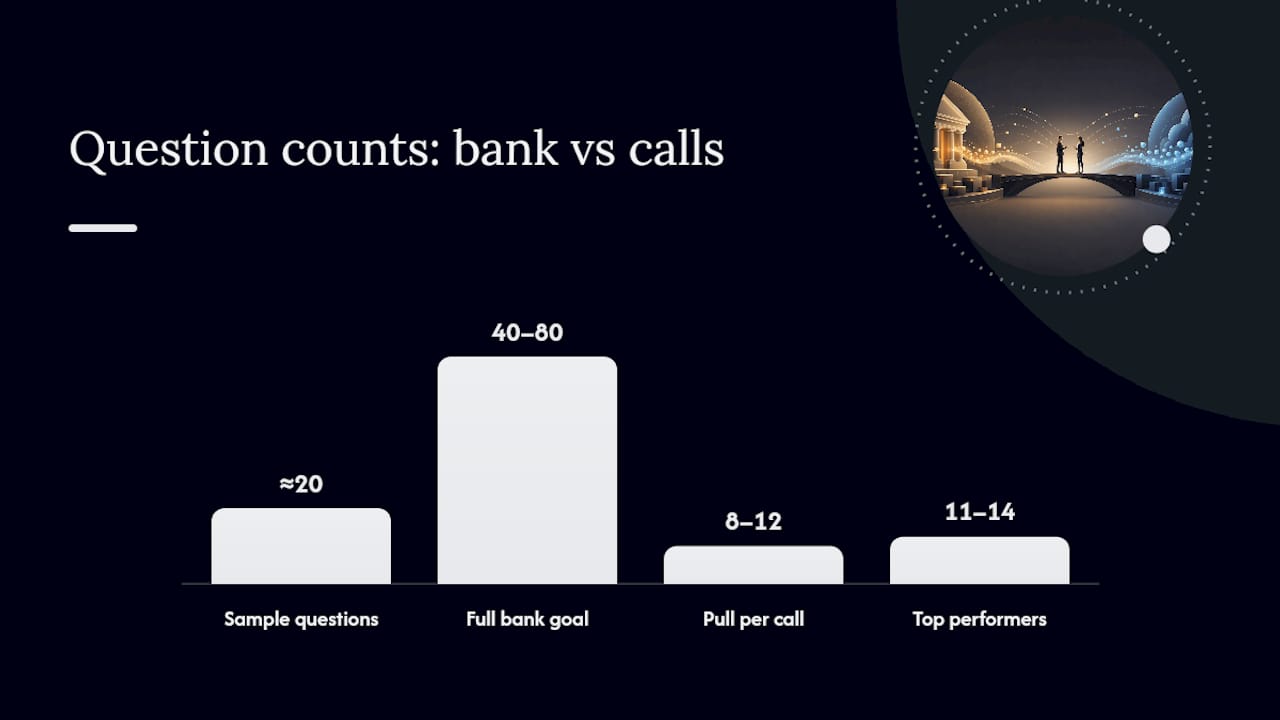
That’s roughly 20 sample questions across five layers. Build your own bank out toward 40 to 80 total questions organized this way, then pull 8 to 12 per call depending on framework and deal size. Top performers ask roughly 11 to 14 targeted questions per call while keeping the conversation feeling natural, not scripted. Open-ended phrasing matters here too. Open-ended questions invite fuller answers you can actually probe, while closed questions kill the thread after one word.
Short script (15 to 20 minutes, screening call):
Full script (30 to 45 minutes, following the complete micro-framework):
If you want the categorized version of this bank as a standalone checklist you can hand to a new rep, build it into your team’s onboarding material and keep it updated as you learn which questions actually convert.
Qualification has to happen on the call, not in a follow-up email. If you hang up without a dated next step, the deal stalls, because vague “I’ll circle back” energy rarely survives contact with the prospect’s actual week.
Five dimensions determine whether a deal is ready to advance:
The decision rule is simple: if you have clear signal on at least three of those five, propose a dated next step with a named participant. If you’re missing budget and authority both, route the prospect to a lighter-touch nurture path instead of forcing a proposal meeting nobody with power will attend.
Here’s a simple on-call scorecard structure you can fill in live:
| Field | What to capture |
|---|---|
| Problem statement | One sentence, in the prospect’s own words |
| Quantified impact | Dollar, hour, or risk figure they stated |
| Stakeholders identified | Names and roles, even if partial |
| Timeline / trigger | Specific date or event driving urgency |
| Confidence score | 1 to 5, how ready this deal is to advance |
Watch for red flags that should slow you down regardless of how friendly the call feels: the prospect can’t name a single other stakeholder, they dodge every cost question, or they describe the timeline as “whenever, no rush.” None of those alone kill a deal, but two or more together mean you’re talking to someone without real buying power.
When the signal is strong, close with something like this: “Based on what you’ve told me about [specific pain] and [quantified cost], it sounds like the right next step is a working session with [stakeholder name] on [specific date]. I’ll send the invite now, does 2pm Thursday work?” Book it live. Don’t leave it to a follow-up email.
Diagnostic questioning and interrogation can look identical on paper and feel completely different on the call. The difference isn’t the question list, it’s whether each answer earns the right to the next probe. Trainers describe this shift as moving from a static checklist to a repeatable question architecture that adapts in real time.
Interrogation sounds like reading down a list regardless of what the prospect just said. Diagnostic questioning sounds like genuinely reacting to their last sentence before deciding what to ask next. If a prospect says “we’ve tried three tools and none of them stuck,” an interrogator moves to the next scripted question. A diagnostic listener stops and asks, “What specifically didn’t stick?”
Three techniques separate good discovery from mediocre discovery:
Try this roleplay prompt in your next team practice session: one rep plays a prospect who mentions a problem in one vague sentence and nothing else unless probed. The other rep has to get to a quantified cost and a named stakeholder using only follow-up questions, no assumptions.
A quick transcript snippet showing the pivot: “We’re kind of managing it manually right now.” “What does managing it manually look like day to day?” “Honestly, someone’s pulling reports every Friday and cross-checking by hand.” “How long does that take them?” “Probably a full afternoon.” That’s three questions from vague to quantified.
Pro Tip: At Sales Label Consulting, we tell every team we work with: never end a discovery call without mapping at least one stakeholder you hadn’t previously identified. If the prospect only ever mentions themselves, you haven’t found the real buying committee yet, and that deal will stall in procurement later.
Teams looking to build this muscle without live prospects on the line sometimes use roleplay tools like callflow.dev’s AI mock call practice to rehearse the pause and re-voicing techniques before putting them in front of real deals.
Discovery-stage objections aren’t rejections. They’re usually a request for more context, and treating them as a wall to push through instead of a signal to diagnose is how reps lose the thread of the call entirely.
Four objections show up constantly, and each one has a diagnostic intent hiding underneath it:
| Objection | Response pattern | Follow-up question |
|---|---|---|
| “We don’t have budget for this.” | “Totally fair, most teams don’t have a line item until they see the cost of not solving it.” | “What would this problem need to cost you before budget got found?” |
| “We don’t really have time to explore this right now.” | “Makes sense, that’s usually a sign the current problem hasn’t hit a breaking point yet.” | “What would need to happen for this to become urgent?” |
| “We’re already using [a tool] for this.” | “Good, that tells me you’ve already validated the problem is real.” | “What’s working well with it, and what’s still falling through the cracks?” |
| “I’d need to check with my team first.” | “Of course, who else should be part of this conversation?” | “Would it help to get them on a call together instead of relaying secondhand?” |
The pattern across all four: acknowledge without conceding, then ask a question that keeps the conversation diagnostic instead of defensive. Never argue with an objection. Get curious about it instead.
Know when to stop pushing. If a prospect gives the same objection twice after you’ve probed it, that’s your signal to ask for a micro-commitment instead of a full next step: “Would it make sense if I sent over a short case study relevant to what you described, and we reconnect in two weeks?” That keeps the door open without forcing a decision nobody’s ready to make.
Price and procurement objections specifically respond well to reframing around cost of inaction rather than defending the number: “Before we talk price, can I ask what this problem is currently costing you in [hours/dollars/lost deals]? That’ll help us figure out if this is even the right conversation to be having.”
Five metrics tell you whether your discovery framework is actually converting, and most teams only track one of them.
Run a simple two-week experiment to improve any of these. Pick one variable, question order, opener wording, or where in the call you introduce cost questions, and A/B test it across your team for two weeks. Compare next-step conversion rate between the control group and the variant group, then keep whichever performs better as your new default.
Every call should feed a scorecard with these minimum fields: problem statement, quantified impact, stakeholders named, confidence score, and next-step date. That data feeds directly into pipeline hygiene and gives sales managers something concrete to coach against instead of vague feedback like “be more consultative.” Low confidence scores clustered around one rep, or one question layer getting skipped repeatedly, tell you exactly where to focus the next coaching session and where the master question bank needs an update.
The trap most sales leaders fall into isn’t building a discovery framework. It’s assuming that once it exists, it runs itself. It doesn’t. A framework on a slide deck and a framework actually happening on live calls are two different things, and the gap between them widens fast as headcount grows.
Here’s what we’ve seen work when scaling discovery quality across a growing team: structured pre-call briefs that force every rep to write a one-sentence hypothesis before dialing, paired with a one-page scorecard that gets filled in during the call, not reconstructed from memory afterward. That combination alone changed pipeline visibility more than any new question script we’ve ever introduced, because managers stopped guessing which deals were real and started reading it off the scorecard.
The governance piece is where most teams underinvest. Revenue operations should be spot-checking a sample of recorded calls every two weeks, not to police reps, but to catch framework drift before it becomes a pattern. If three reps independently start skipping the stakeholder-mapping question because it feels awkward, that’s not a coaching problem with three people. That’s a framework problem, and it needs a fix at the script level, not three separate one-on-ones.
Audit checkpoints matter more than most teams admit. If you’re not periodically reviewing whether your discovery calls are actually producing dated next steps at the rate your pipeline math assumes, you’re forecasting off a framework you’ve never verified. That’s the exact gap a proper sales process audit is built to close, and it’s usually where we find the biggest, most fixable leaks in a client’s pipeline.
A framework works on one call. Getting a whole team to run it the same way, every time, with clean data feeding your pipeline, is a different problem entirely, and it’s the one Sales Label Consulting solves.
We help RevOps leaders and Heads of Sales at B2B tech companies fix three things a single framework document never solves on its own:
If your team’s discovery calls are inconsistent, or you’re not sure your current framework is producing the dated next steps your pipeline math assumes, our sales enablement program starts with mapping exactly where your current process breaks down. Book a conversation and we’ll show you what’s fixable in the first 30 days.
What is the best discovery call framework for B2B sales?
There’s no single best framework across every deal. SPICED works well for mid-market B2B SaaS calls in the 25 to 30 minute range, MEDDIC/MEDDPICC fits enterprise deals with multiple stakeholders, and the 5-Question Discovery Stack is a strong default when you’re unsure which one to run.
How long should a discovery call last?
Most effective discovery calls run 25 to 45 minutes depending on deal complexity. A screening call can be as short as 15 minutes, while enterprise discovery involving multiple stakeholders often needs the full 45 minutes to map the decision process properly.
How many questions should I ask on a discovery call?
Aim for roughly 11 to 14 targeted questions. Fewer than that and you risk missing key qualification signals; more than that and the call starts to feel like an interrogation instead of a conversation.
What’s the difference between discovery and qualification?
Discovery is the live conversation where you diagnose the problem and gather evidence. Qualification is the decision, made during or immediately after that conversation, about whether the deal is worth advancing based on budget, authority, timeline, and impact.
How do I stop discovery calls from turning into a demo too early?
Set the agenda explicitly at the start of the call: “My goal today is to understand your situation, not to walk you through a product.” If a prospect asks for a feature preview mid-call, acknowledge it and redirect: “Happy to show that, let me make sure I understand the full picture first so I show you the right thing.”
What should I do if the prospect won’t share budget information?
Don’t push for an exact number. Ask about the cost of the problem instead: “What would you estimate this issue costs your team monthly?” That question often surfaces a budget range indirectly, without putting the prospect on the defensive.
How soon after the call should I send a follow-up email?
Within the same business day, ideally within an hour. Confirm the next step, restate the problem and quantified impact in the prospect’s own words, and include the calendar invite if you haven’t already sent it live on the call.
Several sources shaped the frameworks and figures in this playbook, and each one is worth a closer read if you want to go deeper on a specific piece.
Subscribe to our Insights: Expert productivity tips in your inbox
You'll receive 1-3 emails per month. Your data stays private, always.

CRO & Co-Founder with Sales Label Consulting

Watch our Sales Mates Podcast
August 18, 2026 - 9 min read
Read article Read articleAugust 16, 2026 - 13 min read
Read article Read articleAugust 15, 2026 - 9 min read
Read article Read articleAugust 14, 2026 - 9 min read
Read article Read article