
Role of Presales in Revenue: A Guide for Sales Leaders
TL;DR:
- Presales enhances revenue by confirming technical feasibility, filtering misqualified prospects, and accelerating sales cycles. It owns the technical win, improves qualification, and reduces post-sale churn, making it a critical revenue function for most B2B deals. Effective measurement, aligned KPIs, and organizational models ensure presales contributes predictably to growth and ROI.
Presales directly increases closed revenue by owning the technical win, improving qualification, and compressing the sales cycle. Three mechanisms do most of the heavy lifting: first, a technical win confirms feasibility and fit before commercial negotiation begins, removing the single biggest reason deals stall late; second, structured discovery filters out misaligned prospects early, so your AEs spend time on deals that can actually close; third, faster technical validation cuts evaluation time, which shortens cycle length and pulls revenue forward on the forecast.
Executive summary bullets you can drop into a brief:
Presales sits between marketing’s lead generation and sales’ deal closure. Its job is to convert qualified prospects into buyers through consultative discovery, tailored demonstrations, and solution validation. The primary outputs are two things: a qualified opportunity with confirmed technical fit, and a buyer who trusts the solution will work in their environment.
The distinction from sales is cleaner than most org charts suggest. Sales owns the commercial win: price, terms, timing, and the signature. Presales owns the technical win: feasibility, fit, security, and architecture. Strong organizations treat these as complementary, not competitive. When they operate as a single pipeline unit with shared deal accountability, quota misses drop. When they operate as silos, deals die in legal or get killed by a late-stage technical objection that should have been resolved in week two.
Common presales job titles and what they actually own:
| Title | Core accountability |
|---|---|
| Sales Engineer (SE) | Technical discovery, demos, PoC delivery, RFP responses |
| Solutions Consultant | Business-value mapping, workflow design, stakeholder alignment |
| Presales Architect | Deep technical design, security review, integration validation |
| Solutions Architect | Enterprise-level architecture, multi-system fit, scalability scoping |
One clarification worth making: in some licensing agreements, “pre-sales revenue” refers to upfront, non-refundable payments by publishers before a product ships. That’s a contract-law term, not the presales function this article covers.
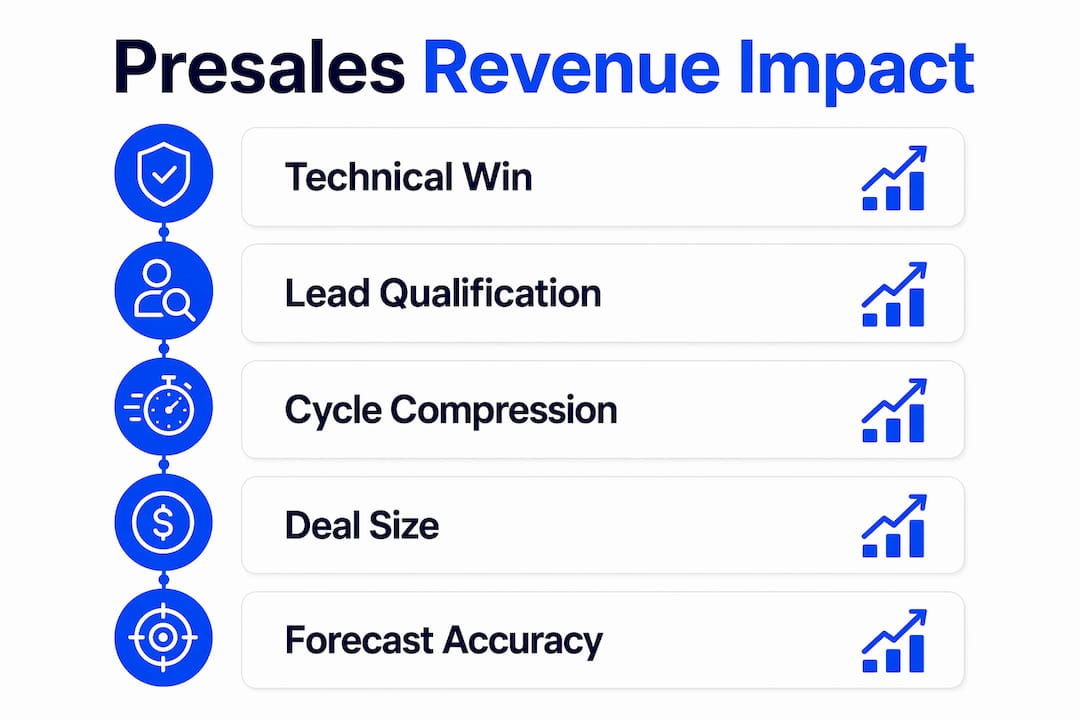
This is where the business case lives. Each mechanism below is a direct pathway from presales activity to closed dollars.
Technical win. A buyer’s technical team signs off that the solution works in their environment. Without this, commercial negotiation is theater. With it, procurement moves fast because the internal champion has air cover. An enterprise SaaS deal stalling at security review is almost always a presales gap, not a pricing problem.
Qualification and lead filtration. Presales discovery surfaces misfit early. An AE who runs a 90-day cycle on a prospect that was never going to buy is a capacity problem, not a motivation problem. Structured presales discovery catches the red flags in week one. A strong presales process improves lead qualification and reduces the risk of misaligned deals consuming sales and engineering time.
Sales cycle compression. When technical questions get answered in parallel with commercial conversations rather than sequentially after them, evaluation time drops. Faster evaluations mean revenue lands in an earlier quarter. For tactics that accelerate this specifically, cycle compression strategies are worth reviewing alongside your presales SLA design.
Deal size and attach rate. Presales discovery often surfaces adjacent use cases the AE didn’t know existed. A solutions consultant who maps the buyer’s full workflow can legitimately expand scope, add modules, or increase seat counts before the proposal goes out. That’s not upselling; it’s accurate scoping.
Reduced post-sale churn. Deals scoped correctly in presales don’t generate “this isn’t what we bought” calls six months later. Better scoping means smoother implementation, faster time-to-value, and higher renewal rates. Churn prevention is deferred revenue protection, and it belongs on the presales ROI ledger.
Pro Tip: To find which mechanism matters most for your business, pull your last 20 lost deals and tag each with the primary failure mode: late technical objection, misqualified prospect, slow evaluation, or post-sale churn. The most common tag tells you where to invest first in presales.
The day-to-day work of a presales team covers six core activities:
When to use each engagement type:
For a practical look at how these activities connect to sales process optimization in B2B tech, the workflow mapping there applies directly to presales sequencing.

The metrics that matter depend on what your CEO or CFO is focused on right now. Presales KPIs should map to corporate objectives: use revenue-achievement KPIs when growth is the priority, and efficiency KPIs when budgets are constrained. When presales leaders align their metrics to those objectives, they get treated as business partners rather than cost centers.
Revenue-achievement KPIs (growth focus):
Efficiency KPIs (cost-control focus):
To measure SE impact accurately, segment your deals into buckets by size and SE involvement. The comparison between buckets removes the subjective argument about whether presales “really” made a difference.
Pro Tip: Your CRM is only useful here if SE engagement is logged as a deal field, not buried in activity notes. Add a binary “SE engaged: yes/no” checkbox and a “technical win date” field to every opportunity. Without those two data points, you’re arguing about presales ROI from gut feel, not numbers.
For a broader view of how these fit into a sales KPI dashboard, the definitions there map directly to what belongs in a presales reporting layer.
Stat to know: ~70% of B2B deals now require presales support. If your CRM doesn’t track SE involvement, you’re flying blind on more than two-thirds of your pipeline.
There’s no universal answer here, but there is a right answer for your stage. The three models each make a different bet.

Centralized presales
All SEs report to a single presales leader and are allocated to deals on request. Pros: consistent quality, easier to manage utilization, lower cost at small team sizes. Cons: slower response time, SEs lack deep product-line context, AEs feel like they’re waiting in a queue. Works best for early-stage companies with a single product and a small sales team.
Embedded presales
SEs are assigned to specific sales pods or territories and operate as part of the AE’s team. Pros: deep relationship, faster response, better product knowledge for that segment. Cons: utilization is harder to manage, SEs can get pulled into non-revenue work, and scaling requires hiring in lockstep with sales. Works best for scale-ups with distinct market segments or product lines.
Hybrid presales
A small central team handles strategic or complex deals; embedded SEs cover standard evaluations. This is the model most enterprises run. Pros: balances efficiency and responsiveness. Cons: requires clear escalation criteria and strong RevOps governance to avoid confusion about who owns what.
Recommended model by stage:
A real trade-off to watch: a centralized model at a 50-person sales team saved headcount cost but added three days to average evaluation start time. That delay pushed two deals past a quarter-end close date. The cost of the delay exceeded the savings from not hiring an embedded SE. Structure beats heroics, but the wrong structure still costs you.
For context on how startup CTO priorities intersect with technical validation and go-to-market decisions, that framing is useful when you’re designing your first presales function.
Getting the org model right is necessary but not sufficient. The operational layer is where most presales functions leak revenue.
Align on a shared definition of “technical win.” If sales and presales don’t agree on what constitutes a technical win, your forecast is fiction. Write it down: what criteria must be met, who signs off, and where it gets logged in the CRM.
Set SLAs for SE engagement. Define when an SE gets assigned (deal size threshold, stage gate, or both), what qualifies a handoff from marketing to presales, and what the expected response time is for each deal tier. Without SLAs, SEs get pulled to whoever shouts loudest.
Build a demo library and automate intro demos. Senior SEs should not be running first-call product overviews. Use tools like Reprise, Navattic, or Consensus to deliver automated or self-serve intro demos. Reserve SE time for technical deep-dives and PoCs where their expertise actually changes the outcome.
Run a joint forecast rhythm. Presales and sales should review the pipeline together weekly, not separately. The SE’s view of technical risk is different from the AE’s view of commercial momentum. Both inputs belong in the forecast call.
Create a presales playbook per product line. Discovery question sets, common objections, security questionnaire templates, and PoC success criteria should be documented and versioned. This cuts ramp time for new SEs and keeps quality consistent across the team.
Pro Tip: The fastest way to improve presales effectiveness is to run a deal-bucket analysis on your last two quarters. Split deals into four buckets: large/SE-involved, large/no-SE, small/SE-involved, small/no-SE. Compare win rates across buckets. The gap between large/SE-involved and large/no-SE is your presales revenue argument, quantified.
For a structured approach to pipeline optimization that incorporates these SLA and forecast practices, the framework there applies directly.
This is the calculation you bring to a CFO. It’s not complicated, but most teams never build it.
Step-by-step template:
Worked example:
Sensitivity bullets:
Template variables to copy into your spreadsheet: W₀, W₁, D, ADS, presales cost. Swap in your numbers. The formula doesn’t change.
A sales audit is often the fastest way to pull the W₀ and W₁ figures if your CRM doesn’t currently track SE involvement by deal.
Most presales functions underperform for the same handful of reasons. Here’s what to watch for.
Treating presales as a demo factory. When SEs spend the majority of their time on intro demos, they’re not doing the work that actually changes win rates. Intro demos are the leading cause of SE burnout and rank low on revenue impact relative to PoCs and security reviews. Remedy: automate intro demos; set a hard rule that SEs only engage after a discovery call confirms technical complexity.
Misaligned incentives. If SEs are measured only on activity (demos delivered, RFPs completed) and not on win rate or ARR influence, they optimize for volume, not impact. Remedy: add a win-rate KPI and an ARR-influence target to SE compensation or performance reviews.
No data on SE engagement. You can’t prove presales ROI if you don’t know which deals had SE involvement. This is the most common gap we see. Remedy: add SE engagement as a required CRM field at the opportunity level before the next quarter starts.
Over-allocating SEs to low-probability deals. SEs get pulled into deals that are poorly qualified because AEs want technical support everywhere. Remedy: enforce a deal-size or stage-gate threshold for SE assignment; use the deal-bucket analysis from the best practices section to set the threshold objectively.
Attrition risk. Senior SEs are expensive to replace and carry institutional knowledge about your product’s technical edge cases. High burnout from demo overload is the primary driver of SE attrition. Track SE utilization monthly. If billable SE hours on revenue-generating work drop below 60% of capacity, you have a structural problem, not a motivation problem.
Presales directly drives revenue through five mechanisms: technical win, qualification, cycle compression, deal size expansion, and churn prevention. The ROI case is quantifiable, and the measurement framework is straightforward once SE engagement is tracked in the CRM.
| Point | Details |
|---|---|
| Technical win is the core mechanism | Presales owns the technical win; without it, commercial negotiation stalls and late-stage deals collapse. |
| Many B2B deals need presales | Approximately 70% of B2B deals now require SE involvement, making presales a revenue function, not a support cost. |
| ROI is measurable and strong | A worked example with realistic inputs shows a strong return on presales investment from win-rate lift alone. |
| KPIs must match CEO/CFO priorities | Use revenue-achievement KPIs in growth mode; shift to efficiency KPIs when budgets tighten. |
| Saleslabelconsulting accelerates this | Saleslabelconsulting’s sales audits and enablement engagements help leaders build the data infrastructure and playbooks to prove and grow presales ROI. |
Here’s what I see consistently: revenue leaders invest in presales headcount, then measure it the wrong way and conclude it isn’t working. They track demo volume. They track RFP completion rate. They don’t track win rate by SE involvement, and they don’t run a deal-bucket analysis. So the ROI argument never gets made, the CFO sees presales as overhead, and the function gets cut or starved of resources right when it should be scaling.
The real talk is this: presales is not a support function. It’s a revenue function with a specific job, a measurable output, and a clear ROI model. The organizations that treat it that way, with shared KPIs between sales and presales, SLAs that protect SE capacity, and a CRM that captures technical win data, consistently outperform those that don’t. The alignment between presales KPIs and corporate objectives is what shifts the conversation from “how much does presales cost?” to “how much revenue does presales generate?”
One pattern worth naming: the companies that get the most from presales aren’t always the ones with the most SEs. They’re the ones where the presales leader sits in the forecast call, where technical win is a defined stage in the CRM, and where the SE team has a playbook instead of a blank calendar. Structure beats heroics every time.
If your presales function is generating activity but not moving your win rate or ARR, the gap is usually structural, not a people problem. Saleslabelconsulting works with B2B tech revenue leaders to build the systems that make presales a measurable revenue driver: sales audits that surface where SE capacity is leaking, sales enablement frameworks that give your presales team the playbooks and demo assets they need to run faster evaluations, and ROI modeling that gives you a defensible number for your next CFO conversation.
Three things clients get from a Saleslabelconsulting engagement:
Ready to quantify what your presales function is actually worth? Book a sales audit and we’ll run the deal-bucket analysis with you in the first session.
Subscribe to our Insights: Expert productivity tips in your inbox
You'll receive 1-3 emails per month. Your data stays private, always.

CRO & Co-Founder with Sales Label Consulting

Watch our Sales Mates Podcast
July 30, 2026 - 14 min read
Read article Read articleJuly 29, 2026 - 14 min read
Read article Read articleJuly 28, 2026 - 17 min read
Read article Read articleJuly 27, 2026 - 9 min read
Read article Read article