
Role of Sales Enablement Manager: 2026 Impact Guide
TL;DR:
- A sales enablement manager equips sales teams with content, training, and tools to improve win rates. They build processes like onboarding, content development, and live support while tracking outcome metrics for continuous improvement. Effective enablement integrates resources into the sales workflow and focuses on ongoing diagnostics rather than one-time programs.
A sales enablement manager is defined as the dedicated professional who equips sales reps with the right content, training, and tools to win more deals consistently. This role sits at the intersection of sales, marketing, and product, coordinating resources so reps spend less time searching and more time selling. Organizations with a dedicated enablement function see 15–20% higher win rates compared to those without one. That gap is not accidental. It reflects the compounding effect of systematic content delivery, structured onboarding, and continuous coaching that the role of sales enablement manager makes possible. Saleslabelconsulting works with RevOps leaders, Heads of Sales, and VPs of Sales who want that kind of predictable, measurable lift.
The sales enablement manager owns the infrastructure that makes reps effective, not just trained. The role covers content creation, program design, cross-functional coordination, and live execution support. Think of it as “The Architect” of your sales motion: someone who builds the systems so the team doesn’t have to rely on heroics.
The core sales enablement responsibilities break down into five areas:
Pro Tip: Map every content asset to a specific deal stage. If a rep can’t find the right battlecard in under 60 seconds during a live call, it’s not enabling anyone.
The sales team onboarding frameworks that deliver the fastest ramp time share one trait: they’re built around role-specific paths, not one-size-fits-all curricula.

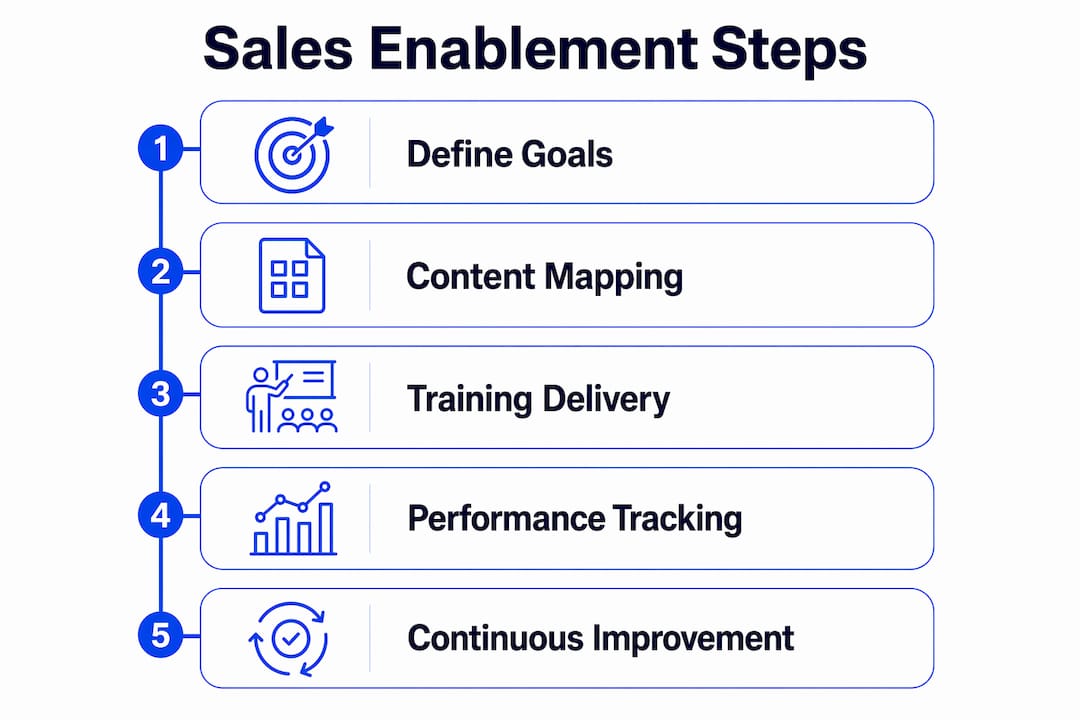
Measurement is where most enablement programs fall apart. Activity metrics like training attendance are vanity metrics. They tell you people showed up. They don’t tell you whether deals closed. The real measure of enablement impact lives in outcome data.
The table below shows the difference between vanity metrics and outcome metrics that actually reflect enablement success:
| Metric type | Example | What it tells you |
|---|---|---|
| Vanity metric | Training attendance rate | Reps completed a session, not whether behavior changed |
| Outcome metric | New hire ramp time | Whether onboarding actually accelerates productivity |
| Outcome metric | Competitive win rate change | Whether battlecards and coaching are working in real deals |
| Outcome metric | Content engagement rate | Whether reps use assets during active sales cycles |
| Usage target | Playbook views per day | Whether live execution tools are embedded in daily workflow |
Specific targets give you something to manage against. Reducing ramp time from 6 to 4 months or increasing win rates by 10% in a quarter are the kinds of outcomes that justify the role and the investment behind it. Content usage targets are equally concrete: 80% or more of reps should engage with enablement content weekly, with playbook adoption reaching at least 3 views per day for live sales execution. If you’re below those thresholds, you have a distribution problem, not a content problem.
Pro Tip: Run a monthly “deal autopsy” with your sales manager. Pull three lost deals and three won deals. Compare which content was used and when. That single exercise will tell you more than a quarterly training report.
Linking metrics to sales effectiveness measurement practices gives enablement managers the data they need to refine programs continuously rather than rebuild them from scratch every year.
The best enablement managers treat their function as an ongoing diagnostic discipline, not a one-time project. Here’s what that looks like in practice.
Diagnose before you build. Identify exactly where deals stall. Is it discovery? Demo? Negotiation? Build your content and coaching interventions around those specific failure points. Generic programs produce generic results.
Deliver content in context. Contextual content delivery integrated into CRM workflows outperforms static content libraries substantially. A rep who gets the right battlecard surfaced automatically inside their CRM during a competitive deal is far more likely to use it than one who has to search a shared drive.
Prioritize in-call support. High-impact enablement uses in-call support tools that guide reps during live buyer conversations, not just after the call ends. Post-call coaching is necessary. It’s not sufficient. The highest-value moment is the conversation itself.
Customize training by role and skill gap. An AE closing enterprise deals needs different coaching than an SDR running cold outreach. Role-based paths keep training relevant and reduce the “this doesn’t apply to me” dropout rate.
Invest in frontline manager development. First-line sales managers are critical enablement levers. Coaching their coaching skills delivers the highest ROI of any enablement activity. When managers reinforce enablement in their 1:1s and deal reviews, adoption multiplies across the whole team.
The types of sales enablement that scale best share one trait: they’re embedded in the daily workflow, not bolted on as a separate training event.
The right tech stack makes the difference between enablement that lives in a shared folder and enablement that actually changes rep behavior. Here’s what the modern enablement infrastructure looks like:
The goal of the tech stack is not to add more tools. It’s to remove the friction between a rep’s need and the resource that meets it.
A sales enablement manager drives measurable revenue impact by delivering the right content, training, and tools at the right moment in the sales cycle, not by building programs in isolation.
| Point | Details |
|---|---|
| Define outcomes, not activities | Measure ramp time reduction and win rate changes, not training attendance. |
| Embed content in workflow | Deliver assets inside CRM at the deal stage where reps need them most. |
| Support reps live, not just after | In-call guidance tools outperform post-call coaching for changing rep behavior. |
| Develop frontline managers | Coaching manager coaching skills multiplies enablement impact across the whole team. |
| Treat enablement as diagnostic | Identify specific deal-stage failure points and build targeted interventions there. |
Real talk: most enablement programs fail not because of bad content, but because of bad timing. I’ve seen teams build beautiful playbooks that live in a SharePoint folder nobody opens during a live call. The content exists. The problem is that it’s not there when the rep needs it, which is mid-conversation with a skeptical buyer.
The shift I push for is from “content librarian” to “live support architect.” That means thinking about where in the sales motion a rep is most likely to struggle and putting the right resource exactly there. Not in a training session two weeks before. Not in a post-call debrief. Right there, in the moment.
The other thing I see underestimated is the frontline manager’s role. Enablement managers often focus entirely on the rep layer. But if the sales manager isn’t reinforcing the playbook in their weekly 1:1s and deal reviews, adoption drops fast. The highest-leverage move an enablement manager can make is often spending half a day coaching the managers, not the reps.
The importance of sales enablement is not in question anymore. What’s still evolving is the understanding that enablement is a continuous diagnostic function, not a content production team. The best enablement managers I know spend more time analyzing lost deals than building new decks. Structure beats heroics, and data beats intuition.
— Antony
Saleslabelconsulting works directly with RevOps leaders, Heads of Sales, and VPs of Sales who need enablement programs that produce predictable results, not just polished training decks.
Our consulting covers the full enablement cycle: diagnosing where your deals stall, building role-based training paths, embedding content inside your CRM workflow, and developing the frontline managers who multiply your investment. If your ramp time is too long or your win rates aren’t moving, the sales enablement step-by-step program gives you a structured path from diagnosis to measurable revenue impact. You can also explore our enablement best practices consulting for teams focused on scaling revenue with less guesswork and more repeatable process.
A sales enablement manager develops sales content, designs training programs, coordinates with marketing and product teams, and tracks content usage and win rate metrics. The daily focus shifts between building assets, coaching programs, and analyzing what’s working in active deals.
The core skills of a sales enablement manager include cross-functional communication, data analysis, instructional design, and CRM proficiency. The ability to diagnose deal-stage weaknesses and translate them into targeted training or content is what separates high-impact enablement managers from average ones.
Measure enablement success through outcome metrics: new hire ramp time, competitive win rate changes, and content engagement rates. Outcome-focused metrics outperform activity metrics like training attendance because they connect enablement directly to revenue.
Sales enablement gives reps the right content and coaching at the right moment in the sales cycle, which directly reduces ramp time and increases win rates. Organizations with a dedicated enablement function consistently outperform those that rely on ad hoc training and informal content sharing.
Sales training is a component of enablement, typically a scheduled learning event. Sales enablement is the broader, ongoing discipline of equipping reps with content, tools, coaching, and live support across the entire sales motion, not just during formal training sessions.
Subscribe to our Insights: Expert productivity tips in your inbox
You'll receive 1-3 emails per month. Your data stays private, always.

CRO & Co-Founder with Sales Label Consulting

Watch our Sales Mates Podcast
October 23, 2026 - 10 min read
Read article Read articleOctober 22, 2026 - 9 min read
Read article Read articleOctober 21, 2026 - 9 min read
Read article Read articleOctober 20, 2026 - 9 min read
Read article Read article