
The Role of Collaboration in Sales: 2026 Guide
TL;DR:
- Effective sales collaboration combines team selling, cross-functional alignment, and AI-augmented workflows to increase deal success and buyer confidence. Implementing clear roles, leadership support, shared data, and AI integration is essential for sustainable results. Most teams struggle not with tools but with building trust and structures that enable genuine coordination.
Collaboration in sales is defined as the coordinated effort of multiple team members, departments, and AI-enabled tools working toward shared revenue goals. The role of collaboration in sales goes far beyond splitting tasks. It determines whether your team closes complex enterprise deals or loses them to a competitor who showed up with a more unified front. In 2026, the data is unambiguous: teams that sell together win together, and the performance gap between collaborative and isolated selling is widening fast. This guide breaks down the forms, benefits, and practical mechanics of sales collaboration so you can act on it today.
Sales collaboration, often called collaborative selling in the industry, takes three distinct forms. Understanding which one applies to your deal type is the first step toward using it well.
Team selling is the practice of deploying multiple internal experts, including account executives, solution engineers, and customer success managers, to engage a single prospect or buying committee. Team selling increases the likelihood of closing enterprise deals by 258% by mobilizing multiple internal expertise points. That number reflects a structural advantage: complex buying committees need cross-functional validation, and one rep simply cannot provide it alone.
Cross-functional alignment connects sales with marketing, customer success, and product teams around shared metrics and pipeline data. When these departments operate in silos, reps get contradictory messaging, stale content, and no visibility into post-sale outcomes. When they align, the buyer gets a consistent experience from first touch through renewal.
AI-augmented workflows represent the newest and fastest-growing form of collaboration. These are not standalone AI tools bolted onto a CRM. They are redesigned seller workflows where AI orchestrates execution across roles in real time, surfacing the right content, coaching cue, or next best action at the exact moment a rep needs it.
Here is a quick breakdown of where each form delivers the most value:
Pro Tip: Don’t deploy team selling on every deal. Reserve it for opportunities above a defined ARR threshold or complexity level. Overusing it burns internal resources and confuses buyers on smaller deals.
The benefits of collaboration in sales are measurable, not theoretical. Let’s look at what the 2026 research actually says.

AI-augmented sales teams close 31% more deals, with shorter deal cycles and faster rep ramp time, by changing how reps work inside integrated collaborative workflows. This comes from a 14-month study of 400 B2B sales organizations comparing AI-augmented teams against traditional CRM-only teams. The key finding is not just the deal volume. It’s the ramp time reduction, which means new reps reach quota faster when they work inside a collaborative, AI-supported system rather than figuring things out alone.
The numbers on cross-functional content collaboration are equally striking. Collaboration on enablement content across sales, marketing, and service increases commercial growth likelihood by 2.4x when that content reaches reps in real time during sales conversations. That 2.4x multiplier only activates when the content is live and contextual, not sitting in a shared drive that nobody opens.
| Collaboration type | Performance impact | Source |
|---|---|---|
| Team selling | 258% higher deal close likelihood | ZoomInfo Pipeline 2026 |
| AI-augmented workflows | 31% more deals closed | Rework/Gartner 2026 |
| Real-time enablement content | 2.4x commercial growth likelihood | Backdrop/Gartner 2026 |
| AI next best actions | 2.6x commercial growth likelihood | Gartner/Morningstar 2026 |
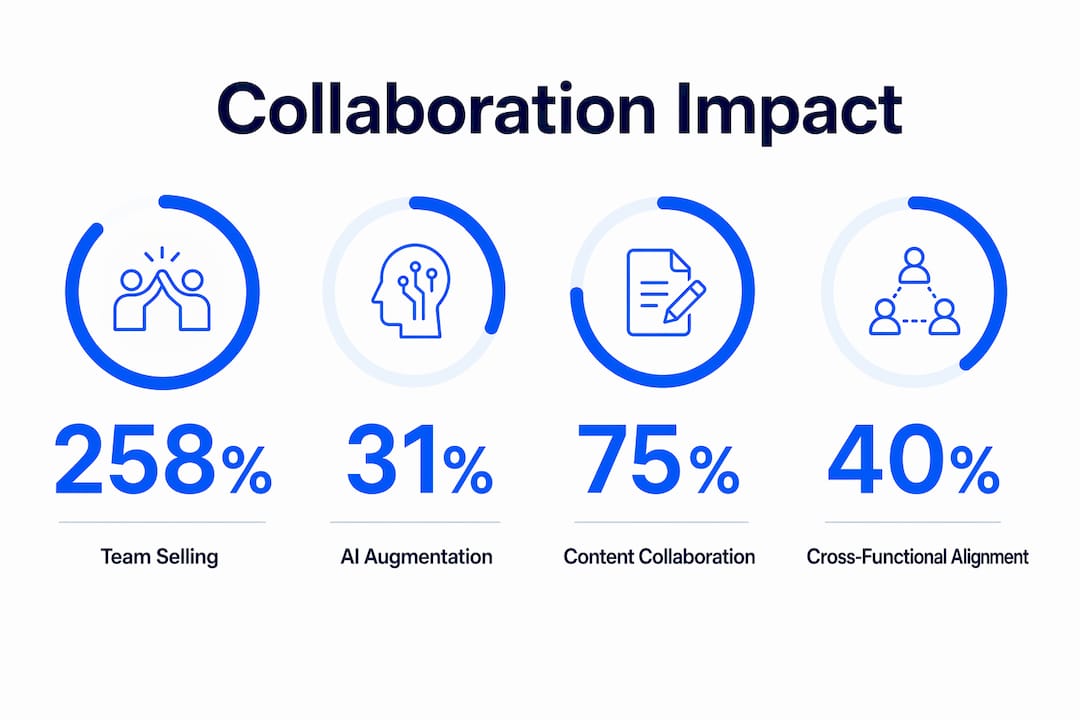
There is also a buyer psychology dimension that rarely gets discussed. Team selling demonstrates internal harmony to complex buying committees, increasing buyer confidence by showcasing coordinated expertise beyond a single rep. When a CFO, a VP of Engineering, and a procurement lead all see a unified, well-coordinated team across from them, their perceived risk drops. That psychological shift is a real deal accelerant.
Structure beats heroics. You can have the most talented reps in the market, but without the right leadership behaviors and technology infrastructure, collaboration collapses into good intentions.
Executive buy-in, leadership modeling, and clear communication are non-negotiable for sustaining cross-functional collaboration and shared revenue goals. Salesforce’s RevOps best practices make this explicit: when leaders don’t model collaborative behavior, teams revert to siloed incentives and individual scorecards. The Head of Sales or VP of Sales who rewards only individual quota attainment will get exactly that, and nothing more.
On the technology side, the single most important requirement is a unified source of truth. When sales, marketing, and customer success each operate from different data sets, metric mismatches get amplified by AI rather than resolved. Governance on shared metrics and workflow mapping is what separates teams that benefit from AI collaboration tools from teams that just add more noise to an already chaotic pipeline.
Practical leadership and technology practices that work:
Pro Tip: Before buying any new sales collaboration tool, audit whether your team actually uses the CRM you already have. A Salesforce instance with 60% adoption won’t get better by adding another platform on top of it.
Implementation is where most teams stall. The concept is clear. The execution gets messy. Here is a practical sequence that works.
Assess deal complexity first. Not every deal needs a team. Define a clear threshold, such as deal size, number of stakeholders, or technical requirements, that triggers team selling. This prevents resource waste and keeps the process scalable.
Assign roles before the first call. Role clarity is fundamental to collaborative selling success. The account executive owns the client relationship. Solution engineers contribute technical depth. Customer success provides proof of value. Everyone knows their lane before the buyer meeting starts.
Map your AI tools to workflow moments. AI-driven sales enablement achieves real performance improvement when embedded in CRM workflows with manager coaching integration, not as standalone tools. Map each AI capability to a specific workflow moment: pre-call prep, live conversation guidance, post-call follow-up, or pipeline review.
Build a shared knowledge base. Create a living repository of win stories, objection responses, and competitive intel that every team member can access and contribute to. Tools like Notion, Confluence, or Salesforce Knowledge work well here.
Run weekly cross-functional syncs. A 30-minute weekly sync between sales and marketing on pipeline status and content gaps does more for teamwork impact on sales than any offsite ever will. Keep it short, structured, and focused on blockers.
| Approach | Best for | Risk if skipped |
|---|---|---|
| Role assignment before calls | Enterprise team selling | Confused buyer experience |
| AI embedded in CRM | Rep ramp and deal velocity | Tool adoption failure |
| Shared knowledge base | Consistent messaging at scale | Repeated mistakes, lost context |
| Cross-functional syncs | Pipeline accuracy and content relevance | Siloed decisions, stale messaging |
Effective communication in sales teams also means knowing when to escalate internally. If a deal stalls because a prospect needs executive validation, the AE should have a clear, fast path to get a VP or CRO on a call. That escalation path is a collaboration design decision, not a spontaneous act of heroism.
Collaborative selling works because it combines coordinated expertise, AI-enabled workflows, and cross-functional alignment to close more deals faster and with greater buyer confidence.
| Point | Details |
|---|---|
| Team selling multiplies close rates | Deploying multiple internal experts increases enterprise deal close likelihood by 258%. |
| AI workflows accelerate performance | AI-augmented teams close 31% more deals with shorter ramp times when AI is embedded in CRM. |
| Leadership drives collaboration culture | Executive modeling and shared incentives are required to sustain cross-functional sales cooperation. |
| Role clarity prevents buyer confusion | Assigning clear roles before every team selling engagement protects the buyer experience. |
| Real-time content is the multiplier | Enablement content delivered live during sales conversations increases commercial growth by 2.4x. |
Here’s the real talk: most sales teams don’t have a collaboration problem. They have a trust problem dressed up as a process problem.
I’ve worked with RevOps leaders and Heads of Sales who invested in Salesforce, Clari, Gong, and every collaboration tool on the market, and still watched their teams operate like a collection of solo acts. The tools weren’t the issue. The issue was that reps didn’t trust that helping a colleague close a deal would benefit them. The incentive structure rewarded individual heroics, so that’s what they got.
The teams I’ve seen genuinely crack collaborative selling share one trait: their leaders go first. The VP of Sales joins a deal call not to take over, but to model what coordinated selling looks like. The Head of Sales shares their own pipeline in the QBR, not just the team’s. That kind of transparency gives everyone permission to collaborate without feeling exposed.
On AI, I’d push back on the idea that AI reshapes sales automatically. It reshapes sales for teams that have already done the hard work of aligning their workflows and data. If your CRM data is a mess and your marketing and sales teams are still arguing about lead definitions, AI will amplify those contradictions, not fix them. Get the governance right first, then layer in the technology.
The teams winning in 2026 aren’t the ones with the most tools. They’re the ones where structure beats heroics, every single time.
— Antony
At Saleslabelconsulting, we work directly with RevOps leaders, Heads of Sales, and VPs of Sales who are done with unpredictable pipelines and siloed teams. Our Sales Enablement consulting practice is built around one goal: giving your team the structure, content, and workflows to sell as a coordinated unit, not a collection of individual contributors.
If you’re ready to move from good intentions to a repeatable, collaborative sales motion, our sales enablement roadmap gives you the step-by-step framework to get there. We also cover advanced enablement tactics for teams that are scaling and need to operationalize collaboration across a growing revenue organization. Let’s build something that runs without heroics.
Collaboration in sales is the coordinated effort of multiple team members, departments, and AI tools working toward shared revenue goals. It directly increases deal close rates, shortens sales cycles, and improves buyer confidence.
Team selling deploys multiple internal experts against a single buying committee, increasing enterprise deal close likelihood by 258% according to ZoomInfo. It works by matching the complexity of the buyer’s organization with equivalent internal depth.
AI tools embedded directly in CRM platforms like Salesforce or HubSpot outperform standalone tools because they change how reps work inside existing workflows. The Rework/Gartner study found AI-augmented teams close 31% more deals when AI is integrated, not bolted on.
When sales, marketing, and customer success share the same pipeline data and metrics, reps get relevant content and consistent messaging at every stage. Misaligned teams amplify contradictions through AI tools rather than resolving them, which hurts both deal velocity and buyer experience.
Assign clear roles before every team selling engagement. The account executive owns the relationship, specialists contribute expertise, and everyone operates from a shared brief. Role orchestration ensures the buyer hears one unified message, not competing voices.
Subscribe to our Insights: Expert productivity tips in your inbox
You'll receive 1-3 emails per month. Your data stays private, always.

CRO & Co-Founder with Sales Label Consulting

Watch our Sales Mates Podcast
September 21, 2026 - 8 min read
Read article Read articleSeptember 20, 2026 - 13 min read
Read article Read articleSeptember 19, 2026 - 13 min read
Read article Read articleSeptember 18, 2026 - 10 min read
Read article Read article