
Sales capacity planning: A strategic guide for B2B sales
TL;DR:
- Most sales leaders treat capacity planning as simple headcount math, which leads to failed revenue plans.
- Effective sales capacity planning is a strategic, data-driven process that aligns team structure with realistic revenue targets.
- Regularly updating models, considering ramp time, attrition, and pipeline timing, ensures accurate resource allocation and predictable growth.
Most sales leaders treat sales capacity planning as a headcount equation. Count the reps, multiply by quota, call it done. But that thinking is exactly why so many revenue plans fall apart in Q2. Real capacity planning is a strategic, data-driven process that connects your revenue targets to the actual structure, skills, ramp timelines, and territory design of your team. If you’re running a B2B tech sales org and your hiring plan feels disconnected from your pipeline reality, this guide will fix that.
Sales capacity planning is not a spreadsheet exercise you do once a year during budgeting season. It’s a living process. At its core, sales capacity planning is the strategic process of sizing and structuring the sales force with the right number of reps, with the right skills, in the right territories, to realistically achieve revenue targets using a data-driven model.
That word “realistically” does a lot of heavy lifting. Most revenue plans are built top-down: the board sets an ARR target, finance divides it by average deal size, and someone concludes you need twelve more reps. That process ignores ramp time, attrition, selling capacity per rep, and territory saturation. The result is a plan that looks clean on paper and breaks in practice.
“Sales capacity planning focuses on how you size and structure the revenue-generating team to hit sales targets, unlike workforce planning which views company-wide headcount.”
That distinction matters. Workforce planning is an HR function. Sales capacity planning is a revenue function. It belongs in your RevOps and GTM conversations, not just in a headcount request form.
The process integrates your sales team structure insights, quota assignments, ramp schedules, attrition forecasts, and territory coverage into one coherent model. When done right, it bridges the gap between your ambitions and your execution. It tells you not just how many reps you need, but when you need to hire them, where they should be focused, and what performance you can realistically expect from each cohort.
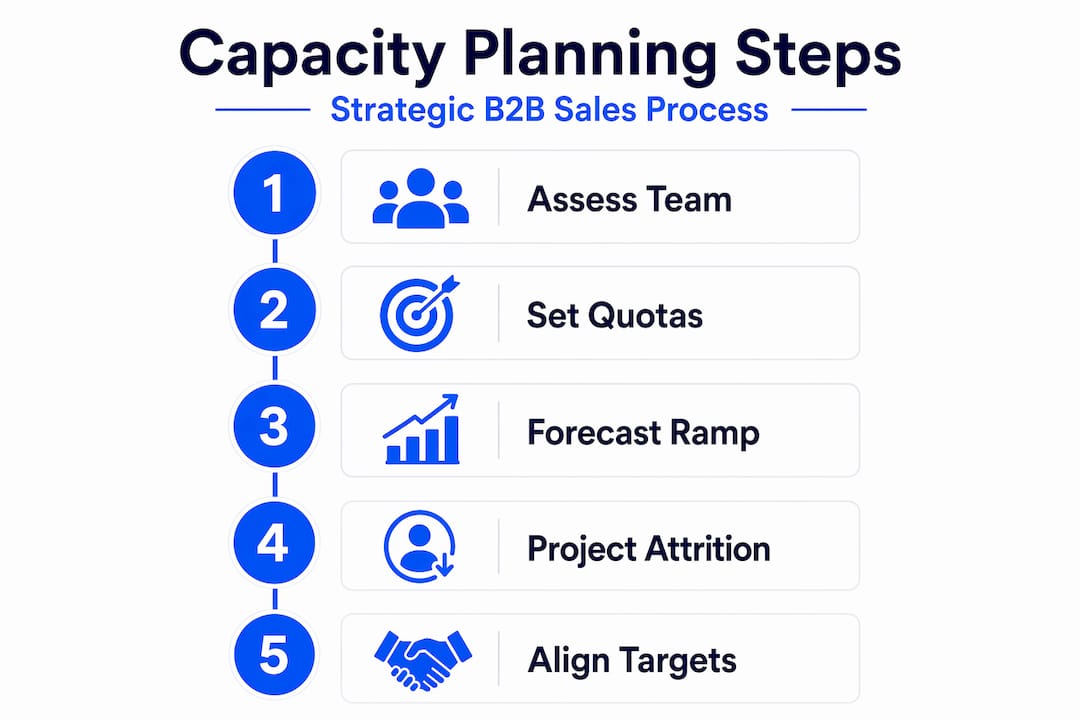
Garbage in, garbage out. Your capacity model is only as good as the inputs you feed it. Metrics critical for capacity planning include quota attainment, ramp time, sales cycle length, attrition, productivity per rep, average deal size, close ratio, and ramped percentage. Let’s break down why each one matters.
The metrics that drive your model:
Pro Tip: Track your sales onboarding frameworks carefully. Cutting ramp time from five months to three is mathematically equivalent to adding a new rep without hiring anyone. It’s one of the highest-leverage moves in capacity planning.
Understanding how AI advantages in B2B sales can surface these metrics faster is also worth exploring, especially for teams still building their data infrastructure. Consistent tracking against a sales performance metrics checklist keeps your inputs honest and your model reliable.
Once you have clean data, you can build a model that tells you something true. The core formula is straightforward:
Sales Capacity = Number of Reps × (Quarterly Quota × Average Quota Attainment)

But that’s theoretical capacity. The number you should actually plan around is effective capacity, which factors in ramped percentage, attrition, and real selling time. Core formula adjusted for effective capacity accounts for Ramped %, attrition, and real productivity.
Here’s how theoretical and effective capacity compare in practice:
| Factor | Theoretical capacity | Effective capacity |
|---|---|---|
| Rep count | 20 reps | 20 reps |
| Quarterly quota | $200K per rep | $200K per rep |
| Quota attainment | 100% assumed | 78% actual average |
| Ramped percentage | 100% assumed | 65% fully ramped |
| Attrition adjustment | Not included | 15% annual turnover factored in |
| Resulting output | $4M | ~$2.03M |
That gap between $4M and $2M is not a rounding error. It’s the difference between hitting your number and explaining to the board why you missed.
Capacity bounds define upper and lower limits of team capability, aligning daily activity with long-term goals, audited across performance and team structure. Think of them as your planning guardrails. Your upper bound assumes everything goes right: low attrition, fast ramp, high attainment. Your lower bound models realistic stress: higher churn, longer ramp, deals that slip. Your actual plan should live somewhere in between, closer to realistic than optimistic.
Pro Tip: Apply phased ramp models and adjust productivity assumptions for actual selling time. A typical enterprise AE spends only 30 to 35% of their time actually selling. Administrative load, internal meetings, and CRM hygiene eat the rest. Build that into your model, not as an excuse, but as a fact.
Our sales capacity frameworks section has ready-to-use templates if you want to start modeling without building from scratch.
This is where planning turns into action. Your model tells you there’s a capacity gap. Now what?
The goal isn’t just to fill seats. It’s to fill the right seats at the right time with a clear path to productivity. That’s what building high-performance sales teams actually looks like in practice.
Here’s our real talk on why most capacity plans fail.
The number one mistake we see? Treating capacity planning as isolated headcount math without linking territory design, quotas, ramp timelines, and CRM execution causes failure in execution. You can have the most elegant model on paper. If it’s not connected to how territories are designed, how quotas are assigned, and how reps are actually executing in your CRM, it’s fiction.
The second big failure is ramp modeling that uses a single average. “Our ramp time is four months” sounds clean. But ramp time for an enterprise rep selling into new verticals is very different from a mid-market rep in a mature territory. Normalizing ramp to a consistent “time zero” and segmenting ramp curves by vertical and product gives you far more accurate capacity estimates. That level of nuance separates the plans that actually hold up from the ones that quietly get abandoned by March.
The third pitfall is ignoring pipeline timing. Your capacity model might show you have enough reps to hit $8M this quarter. But if the deals in your pipeline have an average close date that runs 30 days past quarter-end, you have a timing problem, not a headcount problem. Capacity planning should sanity-check pipeline timing, ensuring deals modeled can realistically close in the planning period.
The best capacity plans we’ve seen at Sales Label Consulting combine three things: scenario modeling that pairs hiring with productivity improvements, ramp curves segmented by role and territory type, and tight integration between the capacity model and actual CRM execution data. Structure beats heroics, every time.
You now have a solid foundation for building sales capacity plans that hold up under real-world conditions. But knowing the framework and executing it with precision across your org are two different challenges.
At Sales Label Consulting, our sales enablement approach is built specifically for B2B tech teams that need more than theory. We align your capacity planning with execution tactics that drive predictable ARR, including territory design, rep onboarding acceleration, and quota-setting grounded in your actual data. Our teams apply sales enablement best practices proven across fast-growing tech organizations. Whether you’re building your first formal capacity model or fixing one that keeps missing targets, we help you translate planning into revenue. Start with territory management optimization and see how fast clean structure changes outcomes.
Workforce planning looks across the entire company; sales capacity planning focuses specifically on sizing and structuring the revenue-generating sales team to meet revenue targets. They serve different functions and require different inputs.
Ramp time is the most critical assumption driver; without it, models won’t reflect reality and hiring decisions will be mistimed, leaving gaps in capacity exactly when you need coverage most.
Capacity plans should be reviewed quarterly because quarterly refresh keeps targets and staffing capacity aligned as reality diverges from initial planning assumptions. Annual planning alone is not enough in fast-moving B2B markets.
Yes. Capacity planning guides concrete hiring timing by connecting recruitment lag and onboarding ramp to specific revenue targets, so you hire the right number of people at the right time rather than reacting when gaps appear.
Subscribe to our Insights: Expert productivity tips in your inbox
You'll receive 1-3 emails per month. Your data stays private, always.

CRO & Co-Founder with Sales Label Consulting

Watch our Sales Mates Podcast
September 21, 2026 - 8 min read
Read article Read articleSeptember 20, 2026 - 13 min read
Read article Read articleSeptember 19, 2026 - 13 min read
Read article Read articleSeptember 18, 2026 - 10 min read
Read article Read article