
What a VP of Sales really owns and drives growth
TL;DR:
- Most executives mistakenly expect a VP of Sales to be a deal-closing hero, but the role is about building scalable sales systems for predictable revenue. Successful VPs focus on strategy, cross-functional alignment, and team development, not just individual wins, with early progress seen through pipeline discipline and forecast accuracy. Choosing the right leadership title and mindset, along with systematic hiring and coaching, is essential for sustainable growth in tech sales organizations.
Most executives hire a VP of Sales expecting a deal-closing machine. Then six months pass, numbers stagnate, and everyone wonders what went wrong. Here’s the hard truth: the VP of Sales role isn’t about personal heroics on the phone. It’s about building, systematizing, and scaling the entire sales engine so that revenue becomes predictable, not accidental. If your tech company is stuck in a cycle of inconsistent pipeline and team underperformance, the answer usually isn’t more hustle. It’s the right sales leadership, scoped correctly from day one.
| Point | Details |
|---|---|
| VP of Sales scope | Effective VPs of Sales architect and lead the entire sales engine—not just close deals. |
| Time-to-impact | Expect concrete improvements in revenue metrics and process within one sales cycle. |
| Framework mastery | Top VPs use and blend sales qualification methodologies to ensure forecast reliability. |
| Bridging performance gaps | Great sales leaders close the gap between top and average reps through consistency and enablement. |
| Role clarity matters | Clarifying VP, CRO, and hybrid roles prevents misalignment and accelerates revenue growth. |
Let’s clear up the confusion right away. A VP of Sales is not a glorified account executive. They’re not there to swoop in and close your biggest deals personally, even though they can. Their real job is to architect and run the machine that produces those deals, at scale, repeatably.
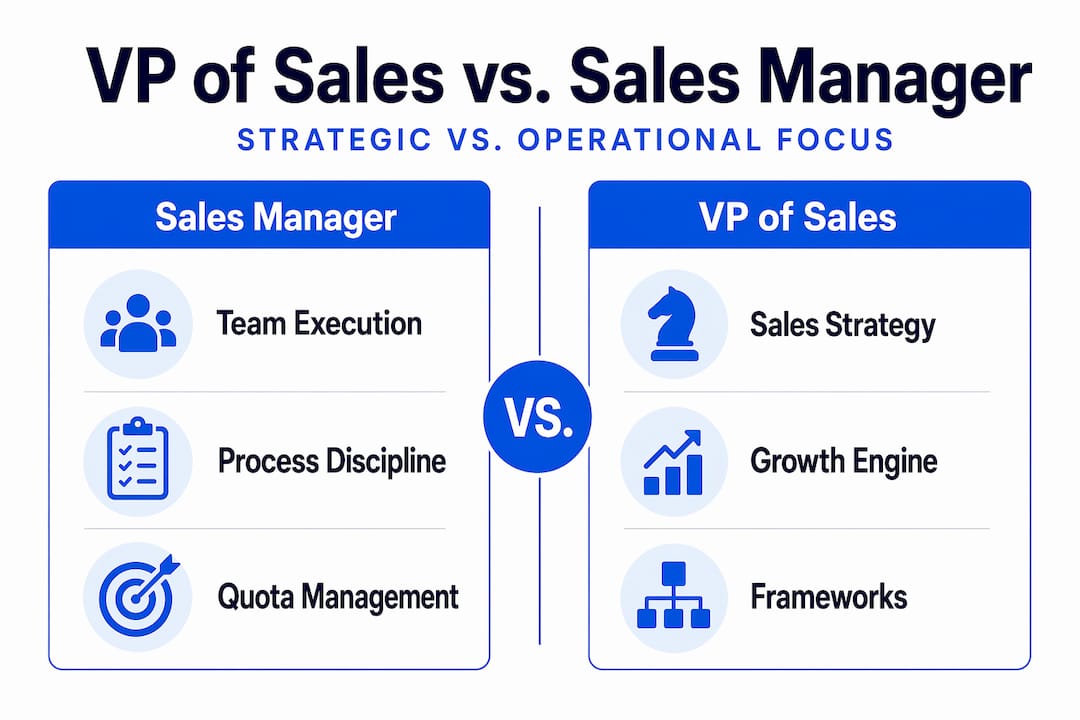
A VP of Sales job description typically includes sales strategy execution for a defined region or segment, building and scaling the sales team, owning go-to-market execution, and driving revenue growth through predictable, repeatable sales processes. That’s a fundamentally different skill set from being a great individual seller.
Core VP of Sales responsibilities:
When you consult in sales leadership roles across European tech companies, one pattern shows up constantly: founders underestimate how much of the VP’s value lies in cross-functional alignment. When marketing and sales are misaligned on what qualifies as a lead, pipeline looks full but closes stay slow. The VP of Sales is the one who fixes that friction.
Comparing the roles: VP of Sales vs. Sales Manager vs. CRO
| Dimension | Sales Manager | VP of Sales | CRO |
|---|---|---|---|
| Primary focus | Team execution | Strategy + team | Revenue-wide alignment |
| Quota carry | Often individual | Team quota | No individual quota |
| Cross-functional scope | Limited | Marketing + CS alignment | Full GTM ownership |
| Hiring authority | Limited | Full team | Leadership hires |
| Forecast ownership | Team-level | Org-level | Company-level |
Choosing the right leadership tier matters enormously. When evaluating leadership potential vs experience, the best VP candidates show a track record of building systems and teams, not just personal numbers. That distinction often gets overlooked during hiring.
Pro Tip: Ask your VP of Sales candidates to walk you through a sales process they designed from scratch. If they can’t describe one clearly, they may not be the builder your company needs right now.
Understanding the job is only half the equation. Now, let’s get specific on how VP of Sales success is measured and how to spot a mis-hire fast.

Many founders make the mistake of assessing their VP of Sales solely on personal deal wins during the first quarter. That’s not the right signal. According to VP of Sales impact benchmarks, VP of Sales impact is judged on quota attainment and forecast accuracy for the sales org as a whole, often with no individual quota carry, along with the operating cadence that makes the funnel measurable and actionable.
That operating cadence includes pipeline reviews, rep coaching sessions, deal desk processes, and forecast calls. If those structures aren’t in place within the first 60 days, that’s a yellow flag. If they’re missing after 90 days, it’s a red one.
What to look for in a new VP’s early impact:
One sobering stat from the field: many sellers miss quota even when targets are reduced, and the performance gap between top and average reps shows up directly in sales velocity differences. That delta is the VP of Sales’ problem to close. Not by replacing everyone, but by understanding what top performers do differently and replicating it across the team.
Benchmark performance indicators at 90 days:
| Metric | Weak start | Strong start |
|---|---|---|
| Forecast accuracy | Below 70% | Above 80% |
| Pipeline coverage ratio | Under 2.5x | 3x or higher |
| Rep coaching cadence | Ad hoc | Weekly, structured |
| New rep ramp time | No change | Improving trend |
| CRM data hygiene | Inconsistent | Defined standards enforced |
A solid VP of Sales who accelerates sales onboarding and brings process discipline will show progress on these metrics before you see a major revenue jump. Trust the leading indicators. They’re telling you what’s coming.
When building sales strategy examples that actually hold up under pressure, the VP of Sales is the one translating high-level goals into weekly executable plays for the team.
Pro Tip: Build a 30/60/90 day scorecard with your new VP before day one. Agree on leading indicators together. This removes ambiguity and creates mutual accountability from the start.
With measurement in mind, let’s look at the key tools VPs use to ensure consistent execution: frameworks that drive high-quality, repeatable deals.
Sales qualification frameworks are not just academic exercises. They are the operational backbone of a scalable pipeline. MEDDIC in B2B tech is one of the most widely adopted enterprise qualification frameworks because it ties directly to forecast discipline. Every letter matters: Metrics, Economic Buyer, Decision Criteria, Decision Process, Identify Pain, and Champion.
When your reps use MEDDIC consistently, you stop chasing deals that were never real. Pipeline becomes honest. Forecasts become reliable. That’s not a small thing. That’s the difference between a board meeting that builds confidence and one that erodes it.
Comparing common sales qualification frameworks:
Real talk: Most high-performing tech sales orgs don’t pick one framework and rigidly apply it. They build a hybrid. MEDDIC for enterprise pipeline hygiene, Challenger for the pitch and positioning, Sandler for early disqualification. Your VP of Sales should know which framework fits which scenario and teach that judgment to the team.
You can explore how top-performing orgs structure and use sales frameworks across different stages of company maturity. The key insight is this: the framework is only as good as the VP’s ability to coach it, not just mandate it.
Now that frameworks are clear, let’s address a persistent challenge: how to help every rep, not just the best ones, hit ambitious targets.
Here’s a hard number that should get your attention: sellers consistently miss quota across companies of all sizes, and the performance gaps between top and average reps reflect real differences in sales efficiency and velocity. The best reps close more, faster, and with better margin. The average rep closes less, slower, and at more discounted prices. That gap compounds over time and quietly eats your ARR.
The VP of Sales’ job is to compress that gap. Not by burning out your top performers or lowering the bar, but by systematically replicating what works.
Practical levers to close the performance gap:
When you build a high-performance sales team, you’re not just recruiting talent. You’re creating an environment where average performers have a clear, coached path to becoming good ones.
The goal of scaling your sales teams efficiently isn’t to double headcount. It’s to double output per rep first. When that ratio improves, you earn the right to grow the team.
Pro Tip: Map your reps on a performance grid quarterly: contribution vs. trajectory. Some strong contributors are plateauing; some developing reps are accelerating fast. Your VP should be investing coaching hours accordingly. When building cohesive teams, fit matters as much as skill.
To close out the core content, let’s make sure you select and scope the right leadership for where your company is heading.
This is where a lot of mid-sized European tech companies make an expensive mistake. They either hire a VP of Sales when they actually need a CRO, or they create a CRO role before they have the revenue architecture to support it. Both errors burn money and slow momentum.
The state of revenue leadership in 2026 makes the scope distinction clear: VP of Sales is sales-team focused, while a CRO typically expands scope across marketing, sales, and customer success as an integrated revenue engine. That’s a fundamentally different operating model.
Role scope comparison:
| Role | Scope | When to hire |
|---|---|---|
| VP of Sales | Sales org, quota, process, and GTM execution | Series A to B, one primary sales motion |
| CRO | Full revenue: sales, marketing, CS, and RevOps | Series B and beyond, multiple motions or channels |
| Head of Sales | Player-coach, often individual quota plus team | Pre-product-market-fit, early team |
Questions to clarify before your next leadership hire:
The answers shape the role. Nail the scoping before you post the job. When thinking about your sales team structure and how it feeds into RevOps success, clarity on leadership boundaries makes everything else work better. For more on scoping executive role boundaries, the key is matching scope to stage.
Stepping back, here’s what our experience and what the data shows about why VP of Sales hires too often disappoint.
The most common mistake is confusing a great deal closer with a great sales leader. These are not the same person. Not even close. We see it constantly: a company promotes or hires someone with an impressive individual quota history, and then is baffled when the team doesn’t improve. Individual excellence and organizational leverage are completely different skills.
The VP of Sales you need is an optimizer and a builder. They should be screened for their ability to drive team-wide behavioral change, not their ability to win a specific account. Ask them how they diagnosed a broken sales process. Ask them how they turned around an underperforming rep. Ask them how they implemented a new qualification framework without the team revolting.
Here’s what we know from working inside tech companies across Europe: the vast majority of VP of Sales failures trace back to three root causes. First, weak onboarding into the role, where neither side invested time in aligning on priorities and success metrics. Second, lack of a coaching infrastructure, where the VP couldn’t cascade skills because no structured system existed. Third, absent or broken RevOps support, where CRM data and reporting were too unreliable to manage by.
None of those are “hustle” problems. They’re systems problems. The B2B sales tech trends in 2026 point clearly in one direction: structure beats heroics. The companies growing predictably are the ones where the VP of Sales has built a machine, not just won some deals personally.
Screen for the builder. Coach the builder. Give the builder the infrastructure to build. That’s the formula.
If the insights in this article resonated, the next step is turning them into action inside your organization.
At Sales Label Consulting, we work directly with VPs of Sales, Heads of Sales, and revenue-focused founders at European tech companies to build what actually works: structured sales enablement best practices that lift team performance, not just individual results. Our proven sales audit steps give you a clear picture of where your revenue engine leaks and exactly how to fix it. We also help you get your sales team structure strategies aligned with your GTM motion so leadership roles and reporting lines actually support growth. Real insights. Practical fixes. No generic playbooks.
Founders should expect measurable progress in pipeline metrics within 90 days, including forecast accuracy and process improvements, before major revenue lifts appear.
Typically, no. VP of Sales performance is measured on team quota attainment, forecast accuracy, and the operating cadence of the sales org as a whole.
Enterprise VPs of Sales frequently use MEDDIC for pipeline discipline, but mature orgs typically blend it with frameworks like Challenger or SPIN based on deal type and market stage.
A VP of Sales owns the sales team and GTM execution, while a CRO expands scope across sales, marketing, and customer success as an integrated revenue function.
Hiring a deal-closer instead of a process architect. The best VP of Sales candidates demonstrate the ability to build systems and elevate team performance, not just close personal opportunities.
Subscribe to our Insights: Expert productivity tips in your inbox
You'll receive 1-3 emails per month. Your data stays private, always.

CRO & Co-Founder with Sales Label Consulting

Watch our Sales Mates Podcast
October 23, 2026 - 10 min read
Read article Read articleOctober 22, 2026 - 9 min read
Read article Read articleOctober 21, 2026 - 9 min read
Read article Read articleOctober 20, 2026 - 9 min read
Read article Read article