
How feedback transforms sales team performance
TL;DR:
- Support and coaching are stronger predictors of sales quota attainment than activity volume alone, according to recent research. Effective feedback must be timely, specific, and actionable to foster continuous improvement and retention, especially when embedded into daily routines. Building a culture of trust and two-way communication enhances the impact of feedback, leading to predictable revenue growth.
Most sales leaders assume that if reps aren’t hitting quota, they need to make more calls, send more emails, and fill the pipeline with more activity. More volume equals more results, right? Not quite. According to the 2026 State of BDR report by 6sense, support and coaching are the defining factors for BDR quota attainment, while sheer volume falls short as a reliable predictor. This article breaks down why feedback beats activity, what makes it land well, how to embed it into your sales workflow, and how to measure whether it’s actually working.
| Point | Details |
|---|---|
| Feedback outperforms volume | Support and coaching are the top predictors of sales success, not raw activity numbers. |
| Make feedback actionable | Effective feedback is timely, relevant, and tied to specific behaviors or outcomes. |
| Integrate feedback routines | Embedding structured feedback into workflows boosts long-term performance. |
| Measure feedback impact | Use KPIs like quota attainment and retention to track coaching effectiveness. |
For years, the playbook was simple: track calls, measure emails sent, monitor meetings booked. Hit the numbers, hit quota. Sales activity metrics became the backbone of most pipeline management conversations. If a rep was struggling, the instinctive answer was to dial up the volume. Sound familiar?
Here’s the real talk. High activity without quality improvement is just expensive noise. You get burnout, high churn, and the same conversion problems at a bigger scale.
The 2026 State of BDR report flips this thinking on its head. Support and coaching, not activity volume, emerge as the strongest predictors of whether a BDR will actually attain quota. That’s a meaningful signal for every Head of Sales and VP of Sales managing a team in a competitive tech environment.
“Structure beats heroics. A rep doing 200 activities a week with poor messaging and no coaching will lose to a rep doing 80 activities with sharp skills and consistent feedback every single time.”
Why does coaching matter so much? Because it creates compound improvement. A rep who gets specific, actionable feedback after every discovery call improves their conversion rate incrementally. Over a quarter, those small gains stack up into a measurable lift in pipeline capacity and ARR contribution. You can explore coaching techniques for tech teams that connect directly to pipeline outcomes if you want to see how this plays out in practice.
Feedback also improves retention. When reps feel supported, challenged, and coached toward growth, they stay. The cost of replacing a mid-market sales rep in a tech company is brutal. Feedback isn’t soft HR stuff. It’s a revenue protection strategy.

Once we recognize the importance of feedback, it’s vital to understand what makes it effective or ineffective in practice. Not all feedback is created equal. In fact, bad feedback is often worse than no feedback at all. It breeds defensiveness, confusion, and disengagement.
Effective feedback in a sales team coaching context shares three non-negotiable characteristics:
One framework we’ve seen work consistently well is the SBI model: Situation, Behavior, Impact. You describe the specific situation, name the precise behavior observed, and explain the impact that behavior had. It keeps feedback grounded and removes personality from the equation.
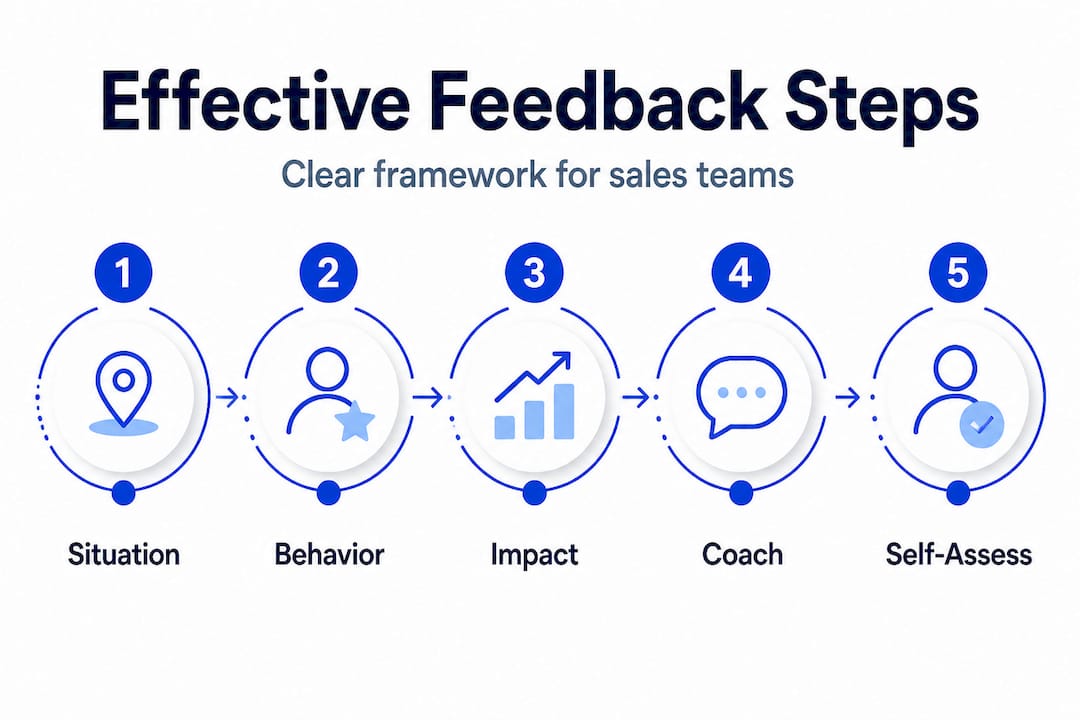
Here’s a quick comparison to illustrate the difference between generic feedback and coaching-style feedback:
| Feedback type | Example | Outcome |
|---|---|---|
| Generic | “You need to build better rapport.” | Confusion, frustration, no change |
| Coaching-style (SBI) | “In yesterday’s demo (S), you jumped to features before confirming the buyer’s priority (B), which led to a disengaged prospect (I). Try asking a confirming question first.” | Clear direction, actionable, builds skill |
The difference isn’t subtle. Coaching-style feedback grounded in step-by-step sales training frameworks gives reps a mental model they can apply immediately and repeatedly. Generic feedback just generates noise.
Common pitfalls to avoid:
Pro Tip: Before delivering feedback, ask the rep to self-assess. “How do you think that call went? What would you do differently?” This reduces defensiveness dramatically and builds the rep’s ability to self-coach over time, which is the real goal.
Coaching and support that follow these principles consistently correlate with improved quota attainment across sales organizations of all sizes.
Equipped with the elements of impactful feedback, let’s focus on integrating these practices into daily operations for sustainable improvement. The biggest mistake we see is treating feedback as an event rather than a rhythm. One quarterly performance review does not a coaching culture make.
Here’s a practical integration approach built around the natural touchpoints in a typical sales week:
Improving your sales meetings structure is often the fastest way to create natural feedback touchpoints without adding extra time burdens to your team.
Here’s a sample weekly feedback workflow you can adapt:
| Day | Activity | Feedback touchpoint |
|---|---|---|
| Monday | Team standup | Share one win and one learning from last week |
| Tuesday | Call blitz | Spot-coach one rep post-call (5 min max) |
| Wednesday | 1:1 with reps | 15 min dedicated to skills and coaching |
| Thursday | Deal review | Pipeline feedback tied to specific behaviors |
| Friday | Async recap | Share a brief note on team wins and themes |
Pro Tip: Use your CRM and call recording tools not just for pipeline tracking, but as a feedback database. Tag calls by skill area (discovery, objection handling, closing) and review trends monthly. This lets you give data-driven, personalized feedback rather than relying on memory or gut feel. Structured coaching built around real data is the defining factor separating average teams from quota-crushing ones.
The right tools matter here. Platforms like Gong, Chorus, or even native CRM notes can support documentation and tracking. The goal is to make feedback visible, recurring, and tied to real behaviors, not just intentions.
With feedback practices in place, leaders need to measure their effect. Here’s how to ensure your approach is driving results, not just best intentions.
The challenge is that feedback quality is inherently qualitative, but its impact shows up in hard numbers. You need to connect the dots between the coaching you’re delivering and the business outcomes you’re tracking. Coaching and support consistently correlate more strongly with quota attainment than activity volume alone, so the metrics you track should reflect this.
Key metrics most influenced by feedback quality:
Check your sales strategy examples to see how leading tech teams connect coaching interventions directly to pipeline conversion improvements.
When you see metrics plateau, don’t just add more feedback. Diagnose the root cause. Is the feedback not specific enough? Is it being delivered too infrequently? Is there a trust issue between manager and rep that’s blocking learning? Sometimes the fix is technical. Sometimes it’s cultural. Either way, you need the data to see where the bottleneck is.
Here’s our honest take after working with dozens of tech sales teams across Europe. Most organizations implement feedback as a process checkbox rather than a cultural shift. They roll out a feedback framework, train managers for a half-day, and expect transformation. Six months later, the 1:1 templates are gathering digital dust and nothing has fundamentally changed.
Real talk: feedback only works when it’s trusted. And trust takes time, consistency, and vulnerability to build.
The most common mistake we see? Feedback flows downward and never upward. Managers give feedback to reps, but reps never give feedback to managers. This creates a power dynamic that kills psychological safety. When reps don’t feel safe enough to say “your briefings are unclear” or “I don’t understand what ‘good’ looks like in your eyes,” you’ve lost half the learning loop.
The second big mistake is volume over quality. Teams with 12-point feedback forms after every call are doing it wrong. A rep who gets one genuinely specific, thoughtful piece of feedback per week will outperform a rep who gets a dozen vague comments delivered through a templated form. Less is more. Go deep on one thing at a time.
We’ve also seen the opposite problem: teams that avoid critical feedback entirely to protect good vibes. This is particularly common in European tech companies with flat hierarchies and strong culture around autonomy. The result is reps who feel liked but not coached, comfortable but not growing. That’s a slow leak in your pipeline capacity.
The fix starts at the top. If leadership demonstrates vulnerability by asking for feedback on their own performance, teams follow. We’ve helped transform underperforming teams simply by changing the feedback flow from top-down-only to a genuine two-way exchange. The cultural shift accelerates everything else.
One more thing. Stop waiting for the right moment. Feedback delivered imperfectly and immediately is worth ten times more than feedback delivered perfectly three weeks later. Don’t overthink the framework. Just say the specific, honest thing with care and respect. That’s where the real growth lives.
Feedback isn’t a nice-to-have. It’s one of the highest-leverage tools in your sales enablement stack, and it costs almost nothing to implement when done with discipline and intent.
At Sales Label Consulting, we help RevOps leaders, Heads of Sales, and VPs of Sales at mid-sized European tech companies build feedback-driven sales cultures that produce predictable results. Whether you need to audit your current sales process, build a structured enablement program, or redesign how coaching flows through your team, we’ve done it before and we know what works. Start with our step-by-step sales enablement guide to map your current gaps. Or dig into our sales audit guide to understand where your team is leaving revenue on the table. If you want a broader foundation, our sales enablement best practices resource is a strong place to start.
The most effective feedback is timely, specific, and actionable, ideally delivered through coaching that ties directly to real sales scenarios. According to the 2026 BDR report, coaching-style support consistently outperforms activity volume as a predictor of quota attainment.
Optimal results come from ongoing, embedded feedback, typically at least weekly in 1:1s and in-the-moment coaching after calls or meetings. Structured coaching delivered consistently across the week drives quota attainment far more reliably than periodic performance reviews.
Look for improvement in quota attainment rates, faster ramp-up times, higher retention, and increased pipeline conversion rates. Research confirms that coaching correlates more strongly with quota attainment than activity volume alone, making these the right indicators to track.
Normalize feedback by building it into the team’s regular routine and investing in two-way conversations that prioritize trust over compliance. When feedback flows both upward and downward, resistance drops fast because it no longer feels like evaluation.
Subscribe to our Insights: Expert productivity tips in your inbox
You'll receive 1-3 emails per month. Your data stays private, always.

CRO & Co-Founder with Sales Label Consulting

Watch our Sales Mates Podcast
September 22, 2026 - 11 min read
Read article Read articleSeptember 21, 2026 - 8 min read
Read article Read articleSeptember 20, 2026 - 13 min read
Read article Read articleSeptember 19, 2026 - 13 min read
Read article Read article