
Optimize sales territory management workflow: 30% more revenue
Uneven territory distribution is one of the most expensive problems in mid-sized tech sales organizations, and most teams don’t even realize it’s happening. Reps in oversaturated regions burn out chasing marginal accounts while high-potential markets sit untouched. Deals slip through the cracks, quota attainment suffers, and your best people start looking for the exit. The good news? A structured, repeatable territory management workflow fixes this. This guide walks you through the prerequisites, the step-by-step process, the pitfalls to avoid, and how to measure whether it’s actually working.
| Point | Details |
|---|---|
| Well-defined workflow boosts sales | Structured territory management can drive clear productivity and revenue gains. |
| Technology and data enable success | Up-to-date CRM systems and reliable data are essential prerequisites. |
| Regular reviews drive results | Quarterly territory audits help maintain efficiency and capitalize on market changes. |
| Metrics ensure continuous improvement | Tracking revenue, coverage, and win rates lets leaders optimize over time. |
“Territory management isn’t an admin task. It’s a revenue strategy. Get it wrong and you’re leaving money on the table every single quarter.”
Real talk: most sales leaders underestimate how much revenue leaks from poor territory design. When accounts are misaligned with reps, you get coverage gaps, duplicated effort, and frustrated customers who feel ignored. The downstream effects hit harder than you’d expect.
Here’s what poor territory management actually costs you:
The flip side is equally compelling. Structured territory management drives up to 30% higher sales productivity, according to Harvard Business Review. That’s not a marginal gain. That’s the difference between hitting plan and blowing past it.
For teams focused on improving sales operations, territory design is often the highest-leverage fix available. It touches every rep, every account, and every dollar in your pipeline.
Before you redesign anything, you need to check three foundational areas. Skip this step and your new workflow will collapse under the weight of bad data and misaligned stakeholders.
| Prerequisite | Why it matters | Signs it’s missing |
|---|---|---|
| Data quality | Clean account and contact data drives accurate segmentation | Duplicate records, outdated firmographics, missing industry tags |
| CRM capability | Automation and reporting depend on a configured CRM | Manual territory tracking in spreadsheets, no assignment rules |
| Stakeholder alignment | Sales, marketing, and finance must agree on territory logic | Conflicting account ownership, budget disputes, finger-pointing |
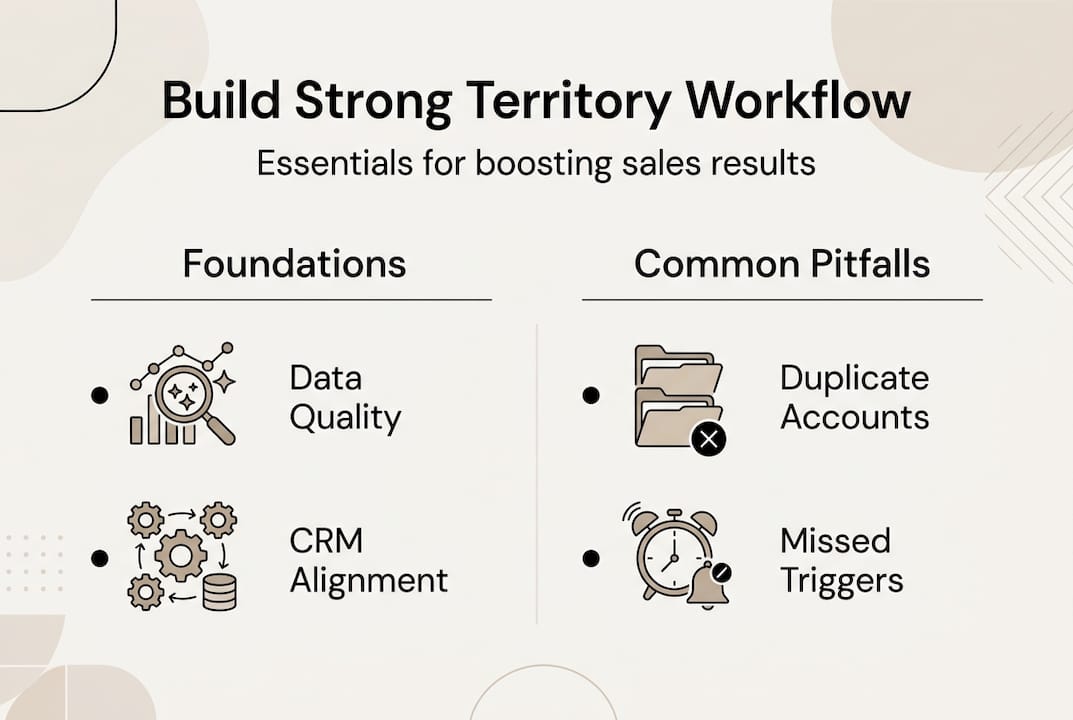
CRM alignment with sales data is foundational to any territory improvement effort, as McKinsey’s research consistently shows. Without it, you’re building on sand.
Before you start, make sure you’re also addressing fixing classic sales mistakes that often hide inside territory problems. And if you’re scaling, optimizing your sales team structure should happen in parallel.
Pro Tip: Set up CRM workflow triggers that flag territory reassignment when an account changes industry, size, or region. This keeps your data and assignments in sync automatically, without a quarterly scramble.
Here’s the process we use with clients. It’s not complicated, but it requires discipline at every stage.
Analyze current performance and define goals. Pull revenue, win rate, and coverage data by territory. Identify where you’re over-indexed and where you’re leaving money behind. Set specific targets for each territory before you touch anything else.
Segment territories by geography, industry, or account value. Segmenting sales accounts by value and potential supports targeted resource allocation, according to Forrester. Don’t default to geography alone. Layer in industry vertical and ARR potential for sharper segmentation.
Assign reps using coverage and skill criteria. Match rep strengths to territory characteristics. A rep who excels at enterprise deals shouldn’t be working a high-volume SMB patch. Fit matters as much as headcount.
Roll out in CRM and communicate clearly. Update assignment rules, ownership records, and reporting dashboards. Then communicate the changes to your team with context, not just a Slack message. Reps need to understand the why.
Track performance and review regularly. Set a cadence. Monthly check-ins on leading indicators, quarterly reviews of territory health. Don’t wait for annual planning to catch problems.
Here’s how the classic approach compares to a modern workflow:
| Stage | Classic workflow | Modern workflow |
|---|---|---|
| Segmentation | Geography only | Geography plus industry plus account value |
| Assignment | Headcount-based | Skill and coverage-based |
| Rollout | Annual, top-down | Phased, with pilot testing |
| Review cadence | Yearly | Monthly and quarterly |
| Data source | Spreadsheets | CRM with automation |
For teams working on managing sales teams through growth phases, this structured approach prevents the chaos that comes with rapid hiring. And if you want to see how this connects to broader sales strategy examples, the territory layer is always foundational.

Pro Tip: Always pilot territory changes with one region before full rollout. You’ll catch data issues, rep resistance, and CRM configuration gaps before they become company-wide problems.
“Continuous reviews separate top performers from the rest. The teams that win aren’t smarter. They’re more disciplined about looking at what’s actually happening.”
Even well-designed workflows break down in execution. Here are the mistakes we see most often:
Addressing classic sales mistakes early in your workflow design prevents these issues from compounding over time. Structure beats heroics every time.
You’ve built the workflow. Now you need to know if it’s working. Measurement isn’t optional here. It’s the mechanism that turns a one-time fix into a continuous improvement engine.
Track these key indicators consistently, as the Sales Management Association recommends: revenue, win rate, and territory coverage guide ongoing improvements.
Here’s your core metrics list:
Run a formal territory audit every quarter. Compare actual performance against targets, validate your CRM data, and adjust assignments where needed. For teams investing in sales process improvements, this audit rhythm is what separates reactive firefighting from proactive growth management.
The goal isn’t perfection on day one. It’s a system that gets smarter every quarter.
Territory management optimization sounds straightforward on paper. In practice, it requires aligning data, technology, people, and strategy simultaneously. That’s where most teams stall.

At Sales Label Consulting, we work directly with RevOps leaders, Heads of Sales, and VPs of Sales at mid-sized European tech firms to build territory workflows that actually hold up under pressure. Our approach to enablement for predictable revenue connects territory design to your broader GTM motion, so changes stick and results compound. We also bring enablement best practices that help your reps execute within the new structure from day one. If you’re ready to stop guessing and start growing, let’s talk.
Start by analyzing current performance data and setting clear sales goals for each territory. As Forrester’s research confirms, analyzing current performance is the critical first step before any redesign.
Review sales territories at least once per quarter, and adjust as needed for market or team changes. Periodic reviews prevent missed opportunities and keep your workflow aligned with real market conditions.
Focus on revenue by territory, account coverage, win rates, and sales cycle length to gauge effectiveness. The Sales Management Association identifies these as the key indicators that guide ongoing territory improvements.
Look for uneven workloads, high rep turnover, and uncovered key accounts as signals of workflow issues. Signs like uneven workloads and missed accounts reveal structural gaps that compound over time if left unaddressed.
Subscribe to our Insights: Expert productivity tips in your inbox
You'll receive 1-3 emails per month. Your data stays private, always.

CRO & Co-Founder with Sales Label Consulting

Watch our Sales Mates Podcast
October 22, 2026 - 9 min read
Read article Read articleOctober 21, 2026 - 9 min read
Read article Read articleOctober 20, 2026 - 9 min read
Read article Read articleOctober 19, 2026 - 10 min read
Read article Read article