
The Role of Digital Transformation in Sales in 2026
TL;DR:
- Digital transformation in sales involves integrating AI, CRM, and automation into workflows to boost deal velocity and revenue. Success depends on redesigning processes, full-stack adoption, and effective change management, not just tool deployment. Fully embracing AI-driven strategies by 2027 will become essential for competitive growth and sales excellence.
Digital transformation in sales is defined as the systematic integration of AI, CRM platforms, and automation directly into sales workflows to increase deal velocity, personalize buyer interactions, and drive predictable revenue growth. The role of digital transformation in sales has moved well past optional upgrade territory. According to recent data, AI-augmented teams close 31% more deals than traditional teams, not by adding headcount, but by restructuring how work gets done. Tools like Salesforce, HubSpot, and Gong are no longer differentiators. They are the baseline. The real question for sales leaders today is whether their teams are using these tools to redesign workflows or just to digitize old habits.
The impact of digital tools on sales productivity is measurable and specific. AI saves sellers nearly 5 hours per week, according to a 2026 Gartner survey. That number sounds great until you realize that 72% of organizations fail to reinvest that time into high-value activities, which means the productivity gain evaporates before it ever hits the pipeline.

The teams that actually capture the benefit are the ones that redesign the workflow first, then layer in the technology. Think of it this way: if your reps were spending 40% of their week on research and data entry, giving them an AI tool that cuts that in half only helps if you redirect the freed time toward discovery calls, deal reviews, and relationship building. Sales teams that make this reinvestment are 2.2x more likely to exceed growth goals and 3.1x more likely to improve lead-to-opportunity conversion.
Here is what the highest-performing digital sales strategies have in common:
Pro Tip: Don’t buy a new tool and call it transformation. Map your current workflow, identify the three biggest time drains, and find technology that eliminates those specific friction points. That sequencing is what separates teams that see ROI from teams that accumulate unused software licenses.
Real talk: most digital transformation initiatives in sales stall not because the technology is bad, but because the human side is underestimated. The technostress paradox is a documented phenomenon where salespeople experience measurable hindrance stress during AI adoption phases. Performance can actually dip before it improves. If your leadership team is not prepared for that curve, they will pull the plug on a tool that would have delivered results with six more weeks of adoption support.
The most common adoption failures follow a predictable pattern:
“The organizations that win with digital transformation treat it as a change management project first and a technology project second. The tools are the easy part. The people are the work.”
Overcoming these challenges requires structured onboarding, manager training, and a clear narrative about what the technology is for. You can read more about how AI reshapes sales tech and where the real pitfalls are before you commit to a rollout plan.
Not all digital sales strategies produce equal results. The ones that generate double-digit revenue growth share a specific architecture, and McKinsey’s 2026 B2B research makes it explicit: hyper-personalization, AI operationalization, and sales-led governance form an integrated commercial engine. Pull out any one of those three and the system underperforms.
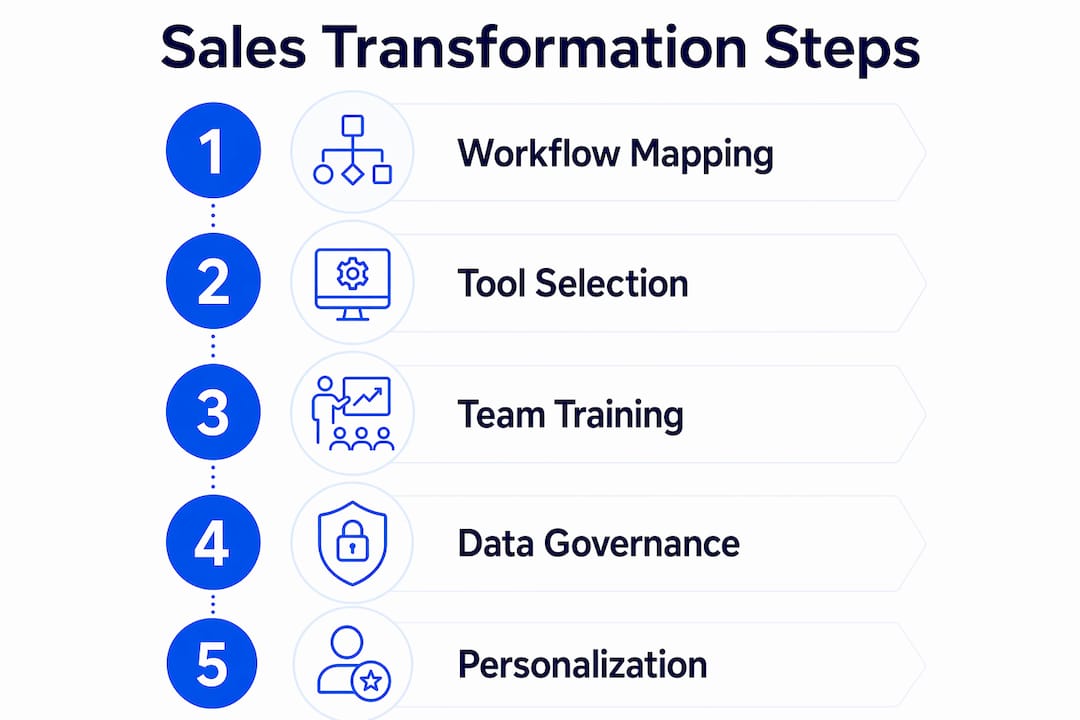
Here is how those three elements compare in practice:
| Strategy element | What it looks like in execution | Revenue impact |
|---|---|---|
| Hyper-personalization | AI generates buyer-specific content, pricing, and outreach sequences at scale | Higher conversion and retention |
| AI operationalization | Deal scoring, next-best-action prompts, and conversation intelligence embedded in CRM | 2.6x more likely to achieve commercial growth |
| Sales-led governance | RevOps owns the data model; sales leadership owns accountability for adoption and outcomes | Sustained ROI vs. one-time gains |
The omnichannel dimension matters just as much. Omnichannel strategies combining digital and human touchpoints yield 30% higher customer lifetime value than single-channel approaches. That means your LinkedIn outreach, email sequences, SDR calls, and AE discovery conversations need to feel like one coherent buyer experience, not three separate campaigns running in parallel.
Pro Tip: Before you invest in AI personalization tools, audit your data quality inside your CRM. AI personalization is only as good as the contact and account data feeding it. Garbage in, generic out.
The governance piece is where most organizations leave money on the table. Buying Salesforce Einstein or Microsoft Copilot for Sales without assigning a RevOps owner to manage the data model, monitor adoption, and iterate on the configuration is like buying a race car and leaving it in the parking lot. The technology requires human stewardship to deliver results. You can explore how to use data to transform your sales strategy for a practical framework on building that governance layer.
The trajectory is clear and the timeline is short. By 2027, 95% of sellers’ research workflows will begin with AI, compared to less than 20% in 2024. That is not a gradual shift. That is a near-complete replacement of how reps start their day, within three years.
What does that mean for how you build and manage a sales team right now? A few things worth paying attention to:
The sales technology trends for 2026 point toward AI-driven recommendations becoming the standard operating model for B2B sales teams, not a competitive advantage. Organizations that treat digital capabilities as optional are not just behind. They are setting a ceiling where the floor used to be.
Digital transformation in sales delivers measurable results only when organizations redesign workflows around AI and commit to full-stack adoption, governance, and manager enablement.
| Point | Details |
|---|---|
| Workflow redesign over tool acquisition | AI delivers ROI when workflows are restructured first, not when tools are added to old processes. |
| Reinvest the time savings | Teams that redirect AI-freed hours into high-value activities are 2.2x more likely to exceed growth goals. |
| Manage the adoption curve | Technostress is real and temporary. Structured onboarding and manager training determine whether teams push through it. |
| Build the full commercial architecture | Hyper-personalization, AI operationalization, and sales-led governance must work together to drive double-digit growth. |
| Prepare for the AI-first research shift | By 2027, 95% of seller research will start with AI. Hiring, training, and tooling decisions need to reflect that now. |
I’ve worked with enough sales organizations to know that the biggest gap is not between companies that have AI tools and companies that don’t. The gap is between companies that treat digital transformation as a structural project and companies that treat it as a procurement event.
Here’s what I mean. A VP of Sales buys a conversation intelligence platform, rolls it out to the team, and expects the numbers to move. Six months later, nothing has changed. The tool is technically deployed. Reps are logging calls. But no one redesigned the coaching process around the new data. No one told managers what to look for. No one connected the insights to deal reviews or rep development plans. The technology did its job. The organization didn’t do its job.
The other thing I’d push back on is the idea that digital transformation is primarily about efficiency. Yes, saving 4.8 hours per week per rep matters. But the more important shift is qualitative. When AI handles research and personalization at scale, your reps get to show up to conversations as actual consultants rather than information delivery systems. That changes the buyer relationship in ways that don’t show up cleanly in a dashboard but absolutely show up in renewal rates and expansion revenue.
Structure beats heroics. A well-designed AI-augmented workflow with average reps will outperform a team of stars running on instinct and spreadsheets. Build the system first. Then hire into it.
— Antony
Knowing the strategy is one thing. Building it inside a real sales organization, with real reps, real CRM debt, and real change resistance, is a different challenge entirely. Saleslabelconsulting works directly with RevOps leaders, Heads of Sales, and VPs of Sales to audit existing workflows, identify where digital tools are underperforming, and build the adoption and governance structures that turn technology investment into predictable revenue.

If you’re ready to move from digital transformation theory to a working system, start with our sales enablement framework built specifically for B2B sales organizations that need results without the guesswork. You can also run a sales audit to identify exactly where your current process is leaving revenue on the table before committing to any new technology.
Digital transformation in sales is the integration of AI, CRM systems, and automation into sales workflows to improve deal velocity, personalization, and revenue predictability. It requires workflow redesign, not just tool adoption, to deliver measurable results.
AI-augmented sales teams close 31% more deals than traditional teams by restructuring workflows so AI handles research and scoring while reps focus on high-value conversations. The key is full-stack deployment combined with deliberate reinvestment of the time saved.
Technostress, low adoption of standalone tools, and lack of manager enablement are the three most common failure points. Organizations that treat transformation as a change management project, not just a technology rollout, consistently outperform those that don’t.
Omnichannel sales strategies that combine digital and human touchpoints deliver 30% higher customer lifetime value than single-channel approaches. Digital transformation enables omnichannel execution by connecting CRM data, outreach sequences, and conversation intelligence into one buyer experience.
AI-enabled next-best-action guidance, embedded CRM intelligence, and hyper-personalization at scale are the top priorities. Organizations providing AI-enabled next-best-action guidance are 2.6x more likely to achieve commercial growth compared to those relying on traditional sales methods.
Subscribe to our Insights: Expert productivity tips in your inbox
You'll receive 1-3 emails per month. Your data stays private, always.

CRO & Co-Founder with Sales Label Consulting

Watch our Sales Mates Podcast
July 26, 2026 - 13 min read
Read article Read articleJuly 25, 2026 - 8 min read
Read article Read articleJuly 24, 2026 - 11 min read
Read article Read articleJuly 23, 2026 - 17 min read
Read article Read article