
Lead nurturing workflow: boost sales and engagement fast
TL;DR:
- Effective lead nurturing workflows increase sales-ready leads by 50% at lower costs.
- Automated, behavior-triggered sequences improve conversion rates and shorten sales cycles.
- Proper alignment, data quality, and personalization are crucial for workflow success.
Most sales leaders in mid-sized European companies have seen it happen: a prospect downloads a white paper, gets one follow-up email, and then disappears. Nobody picks it up. The lead dies quietly in the CRM. That’s not a pipeline problem. That’s a process problem. Companies excelling at lead nurturing generate 50% more sales-ready leads at 33% lower cost per lead. Read that again. The opportunity cost of sporadic outreach is enormous. This guide walks you through exactly how to build, launch, and optimize a lead nurturing workflow that produces real results for European B2B sales teams.
| Point | Details |
|---|---|
| Define clear triggers | Automated workflows work best when started by relevant actions like form submissions or content views. |
| Segment and personalize | Tailoring messaging to personas and buyer stages dramatically improves engagement and conversion rates. |
| Align sales and marketing | Teams that agree on qualification and handoff rules close more deals and avoid lost opportunities. |
| Automate but monitor | Automation multiplies qualified leads, but regular reviews and testing prevent errors or lead drop-off. |
| Prioritize compliance | Following GDPR and data privacy rules is critical for European companies deploying nurturing workflows. |
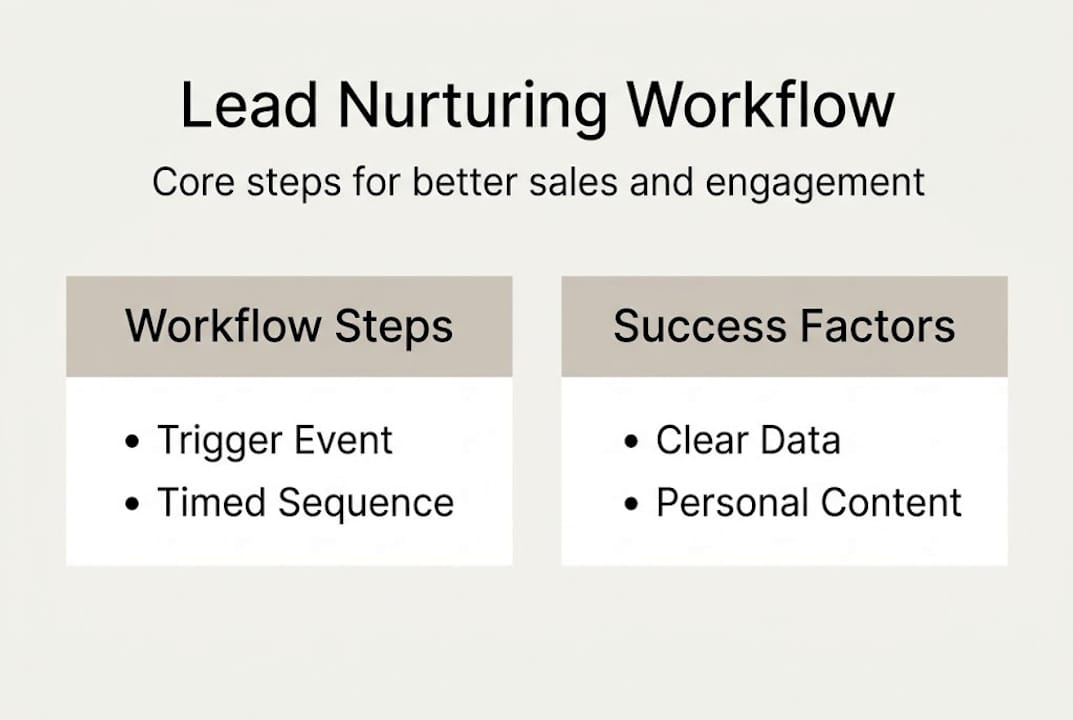
A lead nurturing workflow is an automated sequence of touchpoints designed to move a prospect from initial interest to sales readiness. It’s not a newsletter. It’s not a one-off drip campaign. It’s a structured, behavior-triggered system built around where your prospect is in the buying journey.
The mechanics are straightforward. Automated sequences are triggered by events like form submissions, using delays, conditional branching, and personalized emails to guide leads through defined stages. A prospect downloads a guide, triggers a workflow, gets a relevant follow-up two days later, and then receives a case study if they clicked the first email. If they didn’t click, they get a different angle. The system adapts.
Workflow vs. one-off campaigns: what’s the difference?
| Factor | Lead nurturing workflow | One-off campaign |
|---|---|---|
| Trigger | Behavior-based | Time-based |
| Personalization | Dynamic by persona/stage | Static |
| Channels | Multi-channel | Usually single |
| Handoff | Scored, automated | Manual |
| Outcome | Predictable pipeline | Unpredictable |
The channels most commonly used in European B2B markets are email, LinkedIn, and retargeting ads. Email carries the heaviest load, but pairing it with social touchpoints significantly improves engagement rates. According to EU lead nurturing stats, automation adoption among mid-sized European firms runs well above 70%.
Why does this matter for your bottom line? Nurtured leads produce 20% more sales opportunities and convert 23% faster than non-nurtured leads. Faster conversion means shorter cycles. More opportunities means higher pipeline capacity. Those two outcomes alone justify the investment in building a proper workflow. Understanding your lead qualification process beforehand makes the whole system sharper. And if you’re still unclear on where leads sit in your funnel, brushing up on managing sales pipeline stages will help.
Here’s where most teams stumble. They jump into building sequences before they have the foundational pieces in place. Don’t do that. Getting the prerequisites right saves you weeks of rework.
Tools you need in your stack:
| Tool category | Examples | Purpose |
|---|---|---|
| CRM | HubSpot, Salesforce, Pipedrive | Central lead data source |
| Marketing automation | Marketo, ActiveCampaign | Sequence execution |
| Lead scoring | Built-in or custom | Sales handoff triggers |
| Email platform | Mailchimp, Brevo | Delivery and tracking |
Before you configure a single step, you need clean data. That means mapped personas, defined lifecycle stages, and GDPR-compliant opt-in records. Europe has strict rules, and compliance isn’t optional. Check your consent records and make sure your suppression lists are current.
Segmentation is equally critical. If you’re sending the same sequence to a CFO in Munich and a junior marketing manager in Warsaw, you’re wasting everyone’s time. Map out your core personas, define what content is relevant at each stage, and build your sequences around those distinctions.
Pre-launch checklist:
Marketing automation for lead nurturing yields a 451% increase in qualified leads when structured correctly. That number only holds if your inputs are solid. Business process automation experts consistently point out that garbage in means garbage out. Explore your lead nurturing automation tools options before committing to a stack, and ground your segmentation in solid lead data research practices.

Pro Tip: Start with two personas maximum. Build one workflow for each, run them for 30 days, then expand. Complexity added too early kills adoption.
Okay, you’ve got your tools, your data, and your personas. Now let’s build.
Step 1: Define your entry trigger. What behavior starts the workflow? A form submission, a demo request, a content download, or a specific page visit. Be exact. Vague triggers create messy pipelines.
Step 2: Map the sequence. Lay out every step before you configure anything. Sketch it on paper or in a tool like Miro. Define delays between steps (typically 2 to 4 days for B2B), branching conditions, and exit points.
Step 3: Build persona-driven content for each step. Every email, every ad, every message should feel like it was written specifically for that person at that moment. Multi-channel flows with segmentation by persona and lifecycle stage are what separate high-performing workflows from average ones.
Step 4: Set up lead scoring and handoff rules. When a lead reaches a defined score threshold, it automatically moves to sales. No manual review, no waiting. Automated sequences with conditional branching handle this cleanly when configured correctly. Tying this into your lead scoring in nurturing model ensures sales gets leads that are actually ready.
Step 5: Launch with a test group. Run dummy leads through the full workflow before going live. Check every email renders correctly, every delay fires on time, and every branch condition routes accurately.
Mid-sized European firms running structured nurturing workflows report an 18.5% average conversion rate from lead to opportunity. That’s a benchmark worth knowing.
Common mistakes at this stage: over-automating without a human touchpoint, using generic subject lines, and skipping the test run. Also, make sure your sales funnel optimization logic aligns with what your workflow is doing. Misalignment between funnel stages and workflow steps is a silent killer.
Pro Tip: Always test workflows with dummy leads first. Even experienced teams catch broken links and misfiring delays this way.
You’ve launched. Now what? Most teams set it and forget it. That’s the fastest way to see results decline within 60 days.
Common issues and fixes:
Ongoing optimization priorities:
Personalization via dynamic content boosts open rates and CTRs meaningfully. Don’t just use first names. Customize content blocks based on industry, persona, and lifecycle stage. That level of relevance is what drives the MQL to SQL progression.
For longer European sales cycles running 3 to 6 months, phased nurturing intensity works better than one long uniform sequence. Run a high-touch phase in months one and two, then shift to a lower cadence maintenance phase. This mirrors how real buying decisions unfold. Pair this with optimizing sales outreach tactics and smarter personalizing email sequences practices.
Pro Tip: Track MQL to SQL conversion rates weekly, not just email click metrics. Email engagement tells you what people find interesting. SQL conversion tells you what’s actually driving revenue.
Real talk: automation is not the secret sauce. We’ve worked with European sales teams running beautifully engineered workflows that produced terrible results. Why? Because the data behind them was weak and sales and marketing weren’t aligned on what a qualified lead even looked like.
The real differentiator is process clarity. When marketing and sales agree on definitions, scoring thresholds, and SLA handoffs, the workflow becomes a revenue machine. Without that alignment, you’re just sending emails into a void and calling it nurturing.
Another thing we see too often: leaders obsessing over open rates and clicks while ignoring sales-accepted lead rates. If your lead qualification insight tells you leads are engaging but not converting, the problem isn’t volume. It’s relevance and context. Leads aren’t buying because they don’t see a clear connection between your content and their actual pain points. Fix the message before you optimize the machine.
Structure beats heroics every time. A simple, well-aligned workflow outperforms a complex, disconnected one.
Building a lead nurturing workflow from scratch is one thing. Making it perform consistently at scale is another. That’s where most teams hit a wall, and it’s exactly where we come in.
At Sales Label Consulting, we help European sales leaders operationalize high-performing nurturing systems through hands-on step-by-step sales enablement frameworks and proven sales enablement best practices. Whether you’re starting from zero or fixing a workflow that’s underperforming, our team brings real-world B2B experience to the table. If you’re ready to turn your lead nurturing into a predictable revenue engine, let’s talk.
In European B2B settings, effective workflows typically run 21 to 28 days, but may extend to 3 to 6 months for longer sales cycles. European benchmarks show a 28-day cycle produces strong engagement with an 18.5% average conversion rate.
Email remains the core channel for B2B lead nurturing, but pairing it with retargeting and social touchpoints boosts conversions. Multi-channel approaches with persona-based segmentation consistently outperform single-channel sequences.
When applied to structured workflows, marketing automation can generate a 451% increase in qualified leads. The key is having clean data and well-defined scoring criteria in place before turning on automation.
Avoid over-automation without human touchpoints, poor sales-marketing alignment, and failing to personalize content by stage. SLA misalignment between sales and marketing is one of the most common and costly causes of early handoff failures.
Subscribe to our Insights: Expert productivity tips in your inbox
You'll receive 1-3 emails per month. Your data stays private, always.

CRO & Co-Founder with Sales Label Consulting

Watch our Sales Mates Podcast
Available
June 15, 2026 - 11 min read
Read article Read articleJune 13, 2026 - 8 min read
Read article Read articleJune 12, 2026 - 8 min read
Read article Read articleFix the System
Not Symptoms