
How to Create Sales Playbooks That Cut Ramp Time
TL;DR:
- A sales playbook is a living guide that captures proven deal patterns to reduce ramp time and improve sales consistency. It should be built from real deal data, updated quarterly, and integrated into daily workflows to drive trust and adoption among sales teams. Properly maintained, it acts as a core revenue operating system that accelerates onboarding and closes more deals.
A sales playbook is the operational document that codifies your team’s proven deal patterns into a repeatable, executable guide every rep can follow. The industry term is “sales playbook,” but many teams treat it as a static onboarding binder. That’s the wrong approach. A well-built playbook reduces ramp time by 66%, cutting new Account Executive onboarding from 90 days down to 30. This guide covers how to create sales playbooks that actually get used, from the core components and build process to maintenance cadence and team adoption.
A sales playbook is not a theory document. It’s a codification of what actually worked in real deals with real buyers. The moment you treat it as a reference manual rather than a living operating system, it starts losing value. Sales leaders who understand this distinction build playbooks that reps open before calls, not after they’ve already lost the deal.

The most common mistake is building a playbook too early. Creating playbooks before closing sufficient deals leads to reliance on untested theory rather than proven tactics. You end up with a document full of assumptions that no rep trusts. The result is a PDF that lives in a shared drive and gets opened twice a year.
The right mental model: your playbook is the operating system for your revenue team. It should be referenced in pipeline reviews, used in coaching sessions, and updated whenever the market shifts. That’s the standard Saleslabelconsulting applies when working with sales leaders on sales enablement programs.
B2B SaaS playbooks work best with 7–9 core sections, each focused on a specific stage of the sales process. Each section should run 1–3 pages. Longer sections lose reps. Here’s what those sections cover and why each one matters:
| Component | Purpose |
|---|---|
| Ideal Customer Profile (ICP) | Defines who to target so reps don’t waste time on poor-fit accounts |
| Qualification criteria | Gives reps a clear framework (like MEDDIC or BANT) to score opportunities |
| Discovery questions | Provides tested questions that surface real pain and buying intent |
| Demo flow | Outlines the sequence and narrative for product demonstrations |
| Objection handling | Documents proven responses to the top 5–10 objections your team faces |
| Pricing and packaging | Clarifies deal structures, discount thresholds, and approval paths |
| Contract terms | Sets expectations on standard terms, red lines, and escalation paths |
| Competitive positioning | Equips reps to respond when buyers mention alternatives |
| Success metrics | Defines what a win looks like for the buyer and for your team |
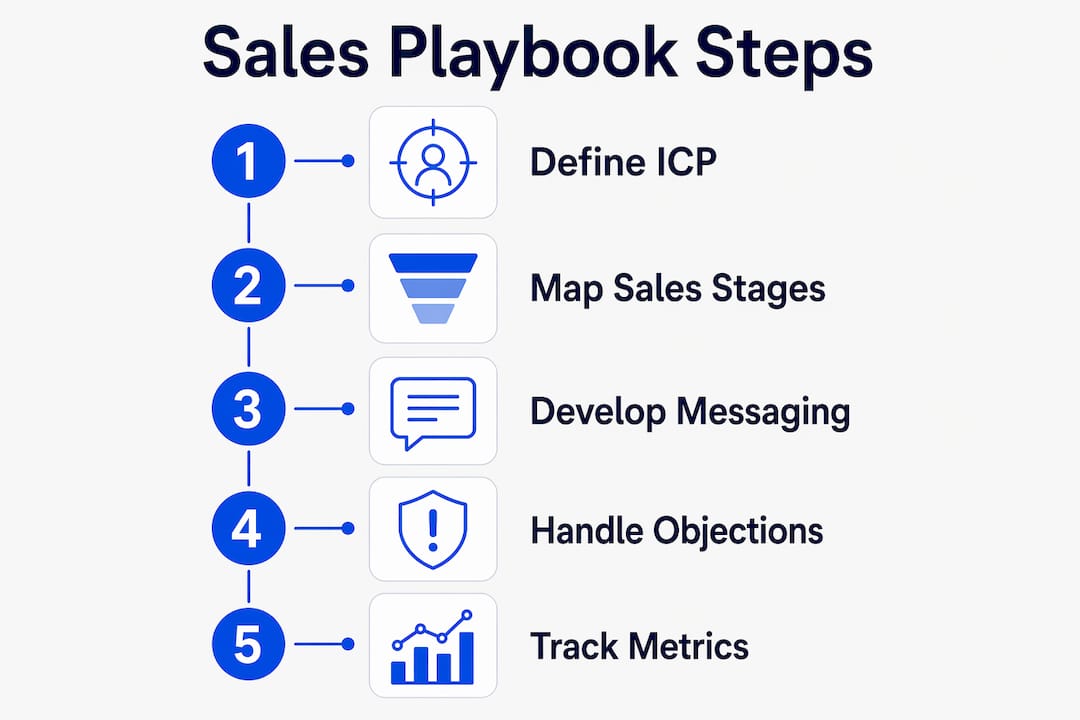
Every section should pull from real closed deals, not from what you wish reps would say. If your discovery questions have never been tested in a live call, they don’t belong in the playbook yet.
Pro Tip: Link each objection in your objection-handling section to the specific deal stage where it typically appears. Reps will use it far more when it’s contextual rather than a generic list.
The build process matters as much as the content. Here’s the sequence that produces a playbook reps actually trust:
Close 10–20 deals first. Founders should close 10–20 deals across 2–3 ICP variations before writing a single word. Pattern recognition requires a sample size. Two deals is anecdote. Twenty deals is data.
Interview your top performers. Analyzing 6 months of closed-won deals and walking through them with your best reps reveals the tactics that actually move buyers. Ask them: “What did you say when the buyer pushed back on price?” Record the answer verbatim.
Pull CRM data for deal stage analysis. Look at where deals stall, where they accelerate, and what activities correlate with closed-won outcomes. This data shapes your qualification criteria and demo flow sections.
Document the discovery framework. Write out the exact questions your top reps use, in the order they use them. Don’t generalize. “Tell me about your current process” is weaker than “Walk me through the last time this problem cost you a deal.”
Draft objection responses from real calls. Pull objections from call recordings or CRM notes. Write responses that mirror how your best reps actually talk, not how a sales trainer thinks they should talk.
Align with your sales methodology. Whether your team uses MEDDIC, Challenger, or a custom framework, the playbook should reinforce it. Check out B2B sales methodology alignment for guidance on connecting methodology to playbook structure.
Pilot with 3–5 reps for two weeks. Piloting the first draft with 3–5 reps over 2 weeks surfaces gaps you won’t catch in a review meeting. Ask reps what they skipped and why. That feedback is gold.
Iterate before the full launch. Fix the gaps the pilot reveals. Then release to the full team with a short training session, not a 60-slide deck.
Pro Tip: Record a 10-minute walkthrough video of the playbook when you launch it. Reps absorb context from a human voice faster than from reading alone.
A playbook that isn’t updated becomes a liability. Frozen playbooks become obsolete within 12 months as markets shift, products evolve, and buyer objections change. The maintenance process is where most teams fail.
Here are the practices that keep a playbook relevant:
The most common pitfall is treating the playbook as a one-time project. Structure beats heroics. A well-maintained playbook compounds in value every quarter. A neglected one costs you ramp time and deal consistency.
Pro Tip: Add a “last updated” timestamp to each section. Reps lose trust in playbooks that look stale. A visible date signals that someone is actively maintaining it.
Design is not decoration. The way you format and deliver the playbook determines whether reps open it or ignore it. Early-stage organizations find 10–20 page playbooks more effective for adoption, while mature firms may extend to 50–80 pages. Start short. You can always add depth.
Here’s what drives adoption:
For teams building their first playbook, the startup sales playbook guide from Saleslabelconsulting walks through structure and timing in detail. For a broader view of how AI tools are changing playbook delivery, the AI-assisted playbook framework from Crono is worth reviewing.
A sales playbook built from real deal patterns, maintained quarterly, and integrated into daily sales workflows is the single most effective tool for reducing ramp time and driving consistent revenue.
| Point | Details |
|---|---|
| Build from real deals | Create your playbook only after closing 10–20 deals across multiple ICP variations. |
| Include 7–9 core sections | Cover ICP, qualification, discovery, demo flow, objections, pricing, and contracts. |
| Pilot before full launch | Test with 3–5 reps over two weeks to find gaps before team-wide rollout. |
| Update every quarter | Assign section owners and review content quarterly to prevent obsolescence. |
| Integrate into CRM | Embed the playbook in the tools reps already use to drive real-time adoption. |
I’ve worked with sales leaders who spent three months building a 60-page playbook before closing their first 10 deals. Every section was polished. None of it was tested. The reps ignored it within a month because it didn’t match what they were actually hearing from buyers.
The playbook that works is the one built backward from closed deals. It’s scrappy at first. It has rough edges. But it reflects reality, and reps trust it because they recognize the objections, the discovery questions, and the deal structures from their own experience.
The other trap I see constantly: playbooks that live only in onboarding. A new hire reads it in week one, then never opens it again. That’s a waste of a powerful tool. The teams I’ve seen scale fastest use the playbook in every pipeline review. Managers ask, “What does the playbook say about this objection?” That one habit changes everything.
Forecast accuracy improves when reps follow a consistent process. Ramp time drops when new hires have a tested guide rather than shadowing whoever is available. The playbook is not a document. It’s the codified intelligence of your best deals, made available to every rep on your team.
Build it from patterns. Keep it short. Update it relentlessly. Reference it in every coaching conversation. That’s the difference between a playbook that collects dust and one that drives ARR.
— Antony
Sales leaders who want predictable revenue need more than a template. They need a process grounded in their actual deal data, their ICP, and their team’s real objections.
Saleslabelconsulting works directly with RevOps leaders, Heads of Sales, and VPs of Sales to build, audit, and maintain sales playbooks that reduce ramp time and increase forecast accuracy. The work starts with a sales enablement audit that surfaces what’s working in your current process and what’s costing you deals. From there, the team builds a playbook structure grounded in your closed-won data. If you want a playbook your reps will actually use, explore the sales enablement best practices Saleslabelconsulting applies across B2B tech organizations.
A sales playbook is an operational document that codifies your team’s proven sales process, including ICP criteria, discovery questions, objection responses, and deal structures, into a repeatable guide for every rep.
Early-stage organizations see the best adoption with playbooks in the 10–20 page range. More mature organizations may extend to 50–80 pages as their process complexity grows.
The right time is after closing 10–20 deals across two or three ICP variations. Building before that point produces theory-based content that reps won’t trust.
Successful playbooks are reviewed and updated at least quarterly. Assign a named owner to each section so updates happen on schedule rather than only when something breaks.
Embed it in your CRM, keep it under 20 pages for early-stage teams, use real scripts from actual deals, and reference it explicitly in pipeline reviews and coaching sessions.
Subscribe to our Insights: Expert productivity tips in your inbox
You'll receive 1-3 emails per month. Your data stays private, always.

CRO & Co-Founder with Sales Label Consulting

Watch our Sales Mates Podcast
July 27, 2026 - 9 min read
Read article Read articleJuly 26, 2026 - 13 min read
Read article Read articleJuly 25, 2026 - 8 min read
Read article Read articleJuly 24, 2026 - 11 min read
Read article Read article