
B2B sales tech trends 2026: 77% more revenue per rep
TL;DR:
- AI-embedded sales teams that utilize agentic AI generate 77% more revenue per rep than those without it.
- Consolidating sales tech stacks into fewer, AI-native platforms improves efficiency, data accuracy, and rep productivity.
- Effective AI-driven sales rely on clean data, strong governance, and signal-led workflows for better targeting and outcomes.
AI-embedded sales teams now generate 77% more revenue per rep than those without it. That’s not a rounding error. That’s a structural performance gap that compounds every quarter you wait. Yet most B2B sales leaders are still treating AI as a feature to evaluate rather than an operational layer to deploy. The 2026 sales tech landscape has shifted faster than most organizations have adapted, and the gap between early adopters and everyone else is widening. This article breaks down the four trends reshaping how B2B sales teams operate, hit quota, and grow revenue, with concrete benchmarks and practical takeaways you can act on now.
| Point | Details |
|---|---|
| Agentic AI transforms workflows | AI is now operationalizing every sales stage, driving smarter decisions and higher productivity. |
| Tech stack consolidation boosts results | Moving from fragmented tools to 4-6 integrated platforms saves hours and increases accuracy. |
| Autonomous CRM enables signal-led selling | Predictive systems and real-time data help sales teams act proactively and close deals faster. |
| Data governance prevents costly errors | Solid data management is essential for reliable AI outcomes and quota performance. |
| Profitability trumps productivity | Leaner, AI-powered teams focused on revenue influence outperform larger, less adaptive sales groups. |
For the past few years, AI in sales meant a chatbot here, a scoring model there. Useful, but not transformational. That era is over. Agentic AI shifts from experimentation to full operationalization, augmenting every stage of the sales process, from prospecting to close.
What does that actually look like? Agentic AI doesn’t just assist. It orchestrates. It reads live pipeline signals, scores leads dynamically based on real-time behavior, triggers next-best-action recommendations for reps, and even delivers automated coaching after calls. Think of it as a tireless sales manager embedded in your CRM, one that never misses a signal.
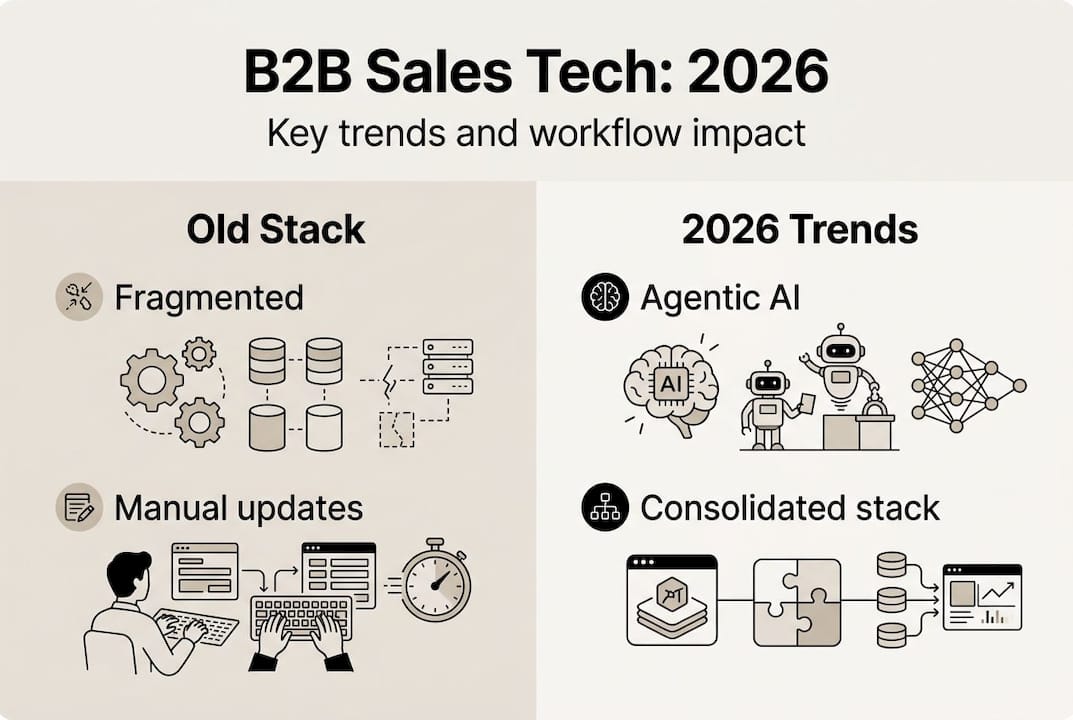
Here’s where it gets interesting. According to Highspot’s sales technology analysis, agentic systems are now capable of managing multi-step workflows without constant human input. That means your reps spend less time on admin and more time selling. The AI reshaping sales tech shift isn’t theoretical anymore. It’s operational.
Key capabilities Agentic AI brings to your sales floor:
But here’s the real talk: Agentic AI is only as good as the data feeding it. If your CRM is full of duplicates, stale contacts, and inconsistent field entries, the AI will confidently recommend the wrong actions. Garbage in, garbage out, just at machine speed.
“The teams winning with Agentic AI aren’t the ones with the most tools. They’re the ones with the cleanest data and the clearest governance policies.”
Human oversight still matters, especially for high-stakes decisions like enterprise deal strategy or contract negotiation. Use AI sales workflows to handle volume and repetition. Keep humans in the loop for judgment calls. That balance is what separates teams that scale from teams that stall.
Pro Tip: Before deploying any Agentic AI tool, run a data quality audit on your CRM. Fix field consistency, remove duplicates, and standardize contact records. You’ll see dramatically better AI output within weeks. Check out our AI impact podcast for a candid conversation on what this looks like in practice.
Here’s a number that should make you pause: sales reps on fragmented tech stacks lose 7 hours per week to tool-switching, duplicate data entry, and broken workflows. That’s nearly a full workday, every single week, per rep. Multiply that across a 50-person team and you’re looking at 350 hours of lost selling time weekly.

The trend in 2026 is clear. High-performing B2B sales teams are consolidating from 8 to 12 disconnected tools down to 4 to 6 tightly integrated, AI-native platforms. The goal isn’t fewer tools for the sake of simplicity. It’s fewer tools that actually talk to each other, share data in real time, and reduce the cognitive load on your reps.
Here’s how the two approaches compare:
| Capability | Legacy fragmented stack | Consolidated AI-native stack |
|---|---|---|
| Tool count | 8 to 12 | 4 to 6 |
| Data sync | Manual or delayed | Real-time, automated |
| Reporting | Siloed, inconsistent | Unified, accurate |
| Rep time on admin | High (7+ hrs/week) | Low (1 to 2 hrs/week) |
| AI integration | Bolted on, limited | Native, deeply embedded |
| Error rate | Higher, due to gaps | Lower, with fewer handoffs |
The sales performance benchmarks from Outreach confirm this pattern. Teams using unified GTM platforms report faster execution cycles, more accurate forecasting, and measurably better rep productivity. That’s not a coincidence.
What should a consolidated stack include? At minimum:
If you’re optimizing tech sales teams, start by auditing every tool your reps touch in a given week. Ask: does this tool share data automatically with everything else? If the answer is no, it’s a candidate for replacement or consolidation. Our guide on sales process optimization walks through exactly how to do this audit without disrupting your team mid-quarter.
Cold outreach is dying. Not because buyers are harder to reach, but because they’re harder to impress with generic sequences. Autonomous CRM evolves to predictive, dynamic systems that anticipate customer needs and surface the right action before your rep even thinks to ask.
Signal-led selling is the methodology that makes this possible. Instead of blasting a list with a templated sequence, signal-led teams monitor real-time intent data: which companies are researching your category, which contacts just changed jobs, which accounts just expanded their tech budget. Then they act on those signals with precision.
Here’s what that shift looks like in practice:
This isn’t science fiction. It’s happening now, and the AI governance risks are real if you don’t have proper oversight in place. Poor data governance leads to irrelevant AI recommendations, which erode buyer trust fast.
Two trends worth watching closely:
20% of B2B sellers are already negotiating with AI agents on the buyer side. And 75% of B2B companies are increasing influencer marketing budgets as a demand signal channel.
Those numbers mean your optimizing sales outreach strategy needs to account for non-human buyers and multi-channel signal capture. The teams building signal-led workflows now will have a significant head start when these trends hit mainstream in the next 12 to 18 months.
Everything we’ve covered so far, Agentic AI, consolidated stacks, signal-led CRMs, collapses without solid data underneath it. This is the part most sales leaders underinvest in because it’s not glamorous. But it’s the difference between AI that helps and AI that hurts.
The numbers are sobering. 71% of sales teams start the year without clearly defined quotas, and 77% face commission errors due to poor data integrity. That means most teams are running AI on top of a foundation that’s already broken.
And the stakes are rising. Ungoverned generative AI in commercial applications is projected to cost B2B firms over $10 billion in losses. That’s not a theoretical risk. It’s a balance sheet problem.
Common data pitfalls that undermine AI selling:
The fix isn’t complicated, but it requires discipline. Regular data audits, clear field governance policies, and a human-in-the-loop review process for AI-generated content are non-negotiables. Our sales coaching for tech resources include frameworks for building these habits into your team’s rhythm without adding bureaucracy.
You can also benchmark your ICP targeting accuracy against revenue benchmark data from Fullcast, which analyzed $78 billion in revenue data to identify what separates top-performing teams from the rest.
Pro Tip: Assign a data steward role within your RevOps function. This person owns CRM hygiene, monitors field completion rates weekly, and flags AI recommendation quality. One person, properly empowered, can prevent millions in avoidable errors.
Here’s our honest take after working with dozens of B2B sales organizations: most leaders are optimizing for the wrong thing. They chase productivity metrics, tool counts, and integration checklists. But the real shift in 2026 is from productivity to profitability.
Leaner teams with high AI utilization consistently outperform larger, slower organizations on quota attainment and margin. A 20-person team with clean data, tight governance, and embedded AI can outrun a 60-person team running on fragmented tools and gut instinct. We’ve seen it firsthand.
The leaders who get this right are tracking contact rates, deal margins, and revenue influence per rep, not just activity volume. They’re also investing in buyer-centric AI content, meaning personalized, signal-triggered outreach that feels human, not automated. Ignoring governance and buyer-facing personalization leaves your team exposed to AI hallucinations and eroded buyer trust.
Stack consolidation is a means to an end, not the destination. The destination is a leaner, smarter, more profitable sales motion. Keep that in mind as you evaluate your sales strategy trends for the year ahead. Structure beats heroics, and governance beats volume.
The trends covered in this article aren’t future-state. They’re happening now, and the teams acting on them are pulling ahead fast. If you’re ready to move from insight to execution, Sales Label Consulting can help you build the frameworks that make it stick.
We specialize in predictable sales enablement for B2B organizations navigating exactly these challenges. Whether you need a full sales audit, a demand generation overhaul, or a practical AI adoption roadmap, our team brings the entrepreneurial tech experience to get it done without the guesswork. Explore our sales enablement best practices and stay ahead with our sales enablement trends 2026 guide.
Agentic AI operationalizes dynamic decision-making across the entire sales workflow, while traditional automation simply executes preset rules without adapting to new signals or context.
Signal-led selling uses real-time intent and behavioral data to trigger targeted outreach, replacing generic cold sequences with precision engagement that converts at a higher rate.
Most high-performing teams consolidate to 4 to 6 integrated platforms, eliminating the productivity drag caused by tool-switching and disconnected data across larger stacks.
Poor CRM hygiene and ungoverned AI outputs are the top culprits, with 71% of teams starting without set quotas and 77% experiencing commission errors that erode rep trust and revenue accuracy.
Yes. Leaner AI-powered teams consistently outperform larger organizations on quota attainment and revenue growth, proving that quality of execution beats headcount every time.
Subscribe to our Insights: Expert productivity tips in your inbox
You'll receive 1-3 emails per month. Your data stays private, always.

CRO & Co-Founder with Sales Label Consulting

Watch our Sales Mates Podcast
October 12, 2026 - 11 min read
Read article Read articleOctober 11, 2026 - 7 min read
Read article Read articleOctober 10, 2026 - 8 min read
Read article Read articleOctober 9, 2026 - 7 min read
Read article Read article