
Account-Based Selling Guide for B2B Teams in 2026
TL;DR:
- Account-based selling is a targeted B2B sales approach focusing on high-value accounts with multiple stakeholders.
- Success depends on rapid execution, accurate stakeholder mapping, multi-channel outreach, and shared metrics.
Account-based selling (ABS) is a focused B2B sales approach that engages multiple stakeholders within high-value accounts through coordinated, personalized outreach. Unlike traditional lead-based models, ABS treats each target account as its own market. Modern B2B buying committees often involve 10 or more members, which means your reps must engage 4 to 8 buyers in parallel to move a deal forward. This account-based selling guide covers how to build your target list, map buying committees, orchestrate multi-channel outreach, and measure what actually matters for predictable pipeline growth.
Account-based selling is defined as a targeted sales approach that shifts focus from chasing individual leads to penetrating curated, high-value accounts. The industry term is ABS, and it sits at the intersection of account-based marketing strategy and outbound sales execution. The core shift is operational: your team stops reacting to inbound signals and starts proactively building relationships inside specific accounts based on fit, timing, and buying triggers.

This matters because broad lead-chasing produces inconsistent pipeline. ABS produces predictable revenue because every rep knows exactly which accounts to work, which stakeholders to engage, and what message to deliver. Structure beats heroics every time.
Your target account list is the foundation of every ABS program. Get it wrong and every downstream effort wastes time and budget. Get it right and your reps work with focus and confidence.
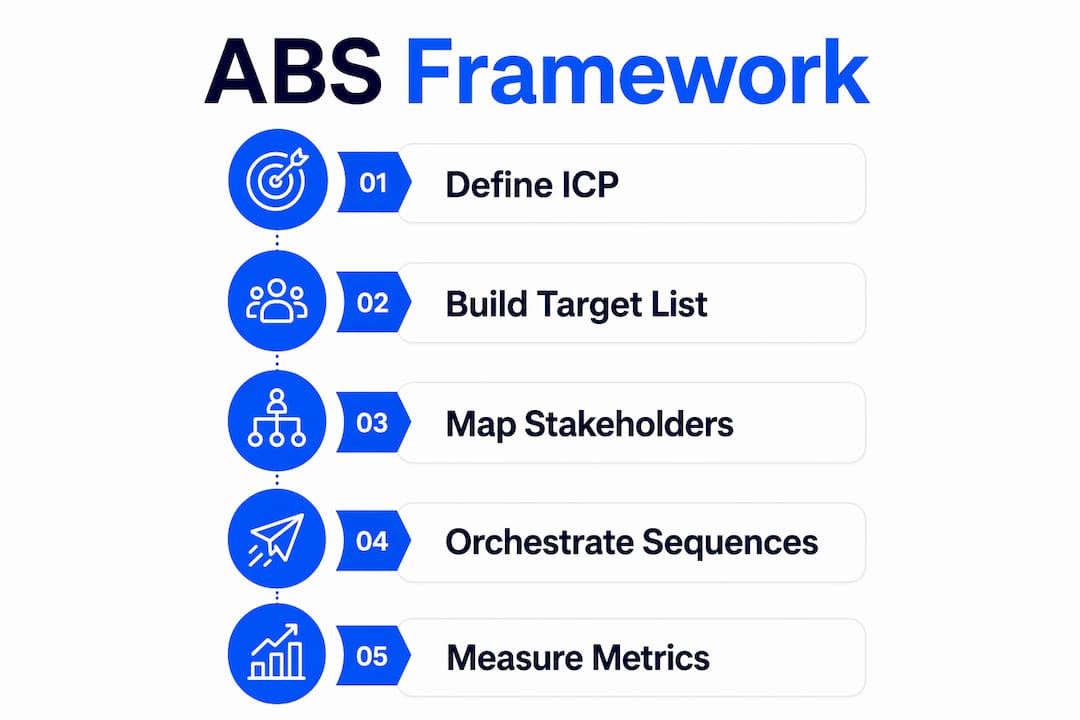
Start with a tight Ideal Customer Profile (ICP). Define it using firmographics: industry vertical, company size, annual revenue range, technology stack, and geography. Then layer in buyer personas for the roles you typically sell to, such as VP of Sales, Head of RevOps, or CTO.
Next, filter by buying triggers. Leadership changes, funding rounds, and regulatory deadlines are the strongest signals that an account is ready to buy. An account that just hired a new VP of Sales is far more likely to invest in sales enablement than one with stable leadership and no budget cycle pressure.
Then apply these prioritization criteria:
Segment your final list into three tiers. Tier 1 covers 5 to 25 accounts with deep personalization and executive sponsorship. Tier 2 covers 25 to 200 accounts with moderate personalization. Tier 3 covers 200 to 1,000 or more accounts with programmatic outreach.
Pro Tip: Run your shortlist through your CRM’s win/loss data before finalizing. Accounts that match your top 10 closed-won deals by firmographic profile convert at a significantly higher rate than accounts selected by gut feel alone.
Mapping a buying committee means identifying every person who can say yes, no, or slow down your deal. For most enterprise B2B sales, that means four core personas:
Once you’ve named each stakeholder, verify their contact data. Failing to verify email deliverability before outreach wastes entire sales cycles. A rep who spends two weeks nurturing a contact with a broken email address has lost two weeks of pipeline time.
Coordinate multi-threaded outreach from day one. Don’t wait until you’ve built a relationship with one stakeholder before approaching others. Parallel engagement across 4 to 8 contacts inside the same account increases your odds of finding a champion and shortens the sales cycle.
Pro Tip: Build a simple stakeholder map in a shared doc or CRM record for each Tier 1 account. List each persona, their confirmed email, their LinkedIn profile, and their likely objection. Update it after every touchpoint. This single habit separates disciplined ABS teams from everyone else.
Personalize your messaging by persona, not by account alone. The economic buyer cares about ARR impact and risk. The technical evaluator cares about integration complexity. Sending the same message to both is a fast way to lose both.
Coordinated multi-channel outreach drives higher engagement rates than single-channel sequences. Email, LinkedIn, paid ads, events, content drops, and direct mail all reinforce the same message from different angles. The goal is to make your account feel like you understand their world, not like you’re blasting them with generic pitches.
Structure your sequences around value drops. Week one: send a relevant insight or benchmark report. Week two: connect on LinkedIn with a personalized note referencing the insight. Week three: follow up by email with a case study that mirrors their situation. Week four: call or send a direct mail piece for Tier 1 accounts.
| Tier | Account range | Budget per account | Personalization level |
|---|---|---|---|
| Tier 1 (1:1) | 5–25 accounts | $5,000–$50,000 | Custom content, executive sponsorship |
| Tier 2 (1:few) | 25–200 accounts | Moderate investment | Persona-level messaging |
| Tier 3 (1:many) | 200–1,000+ accounts | $50–$500 | Programmatic, automated outreach |
Tier 1 requires executive sponsorship and custom content built specifically for the account. Tier 3 uses programmatic outreach at scale, costing $50 to $500 per account. The budget difference reflects the deal size potential at each tier.
Sales and marketing alignment is non-negotiable here. Both teams must agree on messaging, content assets, and channel ownership before the first outreach goes out. Misaligned messaging across channels signals disorganization to the buyer and kills credibility fast.
ABS performance is measured at the account level, not the lead level. Tracking MQLs in an ABS program is a common mistake. It tells you nothing about account penetration or buying committee engagement.
The 90-day benchmarks for a healthy ABS program are clear: 30–60% account engagement rate, 35–55% multi-thread engagement rate, and 12–22% account-to-opportunity conversion rate. These numbers tell you whether your program is working before pipeline shows up in your CRM.
Account engagement rate measures how many of your target accounts have responded to at least one touchpoint. Multi-thread rate measures how many accounts have two or more active stakeholder conversations. Account-to-opportunity conversion measures how many engaged accounts become formal pipeline opportunities.
Pro Tip: Set a 90-day review cadence for your ABS program. Pull these three metrics by tier, not in aggregate. Tier 1 should hit the top of each range. If Tier 1 accounts are underperforming, the problem is usually stakeholder mapping or messaging, not channel selection.
Pipeline-weighted annual contract value is your north star metric. It combines deal size with probability to give you a realistic view of what your ABS program will actually deliver to revenue. Track it weekly for Tier 1 accounts and monthly for Tier 2.
Most ABS programs fail not because the strategy is wrong but because execution breaks down. The most common failure mode is what practitioners call the “ABM deck trap”: teams spend months building strategy decks, aligning on ICP criteria, and designing content frameworks, then never actually execute.
Real talk: ABS is not a planning exercise. It’s a discipline. The teams that win are the ones that ship imperfect outreach on week one and improve from data, not the ones that wait for perfect messaging before sending a single email.
Shared metrics and biweekly sales-marketing syncs are the structural fix for misalignment. When both teams report on the same pipeline-influenced number, finger-pointing stops and collaboration starts. Without a shared scoreboard, each team optimizes for its own metrics and the account experience suffers.
Clean contact data is the other execution killer. Dirty data means wasted outreach, missed stakeholders, and reps who lose confidence in the program. Audit your contact records for every Tier 1 account before the program launches. Verify emails, confirm titles, and check LinkedIn profiles for recent role changes.
The operational shift from lead chasing to focused account penetration is the hardest part of ABS adoption. It requires reps to slow down, do more research per account, and trust that fewer, better-targeted conversations produce more revenue than a high-volume spray-and-pray approach. That trust comes from data. Show your reps the conversion rate difference between ABS accounts and non-ABS accounts after 90 days, and the mindset shift happens fast.
Account-based selling produces predictable B2B revenue when you combine a tight ICP, verified stakeholder maps, multi-channel sequencing, and shared pipeline metrics across sales and marketing.
| Point | Details |
|---|---|
| Build a tiered account list | Segment accounts into Tier 1, 2, and 3 based on deal size and personalization capacity. |
| Map every buying committee | Identify economic buyers, champions, and technical evaluators before outreach begins. |
| Verify contact data first | Confirm email deliverability for every stakeholder to avoid wasted sales cycles. |
| Track account-level metrics | Measure engagement rate, multi-thread rate, and account-to-opportunity conversion, not MQLs. |
| Align sales and marketing | Run biweekly syncs and share pipeline-influenced metrics to keep both teams accountable. |
I’ve seen this pattern more times than I can count. A VP of Sales gets excited about account-based selling, the team builds a beautiful ICP framework, marketing produces a content calendar, and then… nothing ships for 60 days. By the time the first outreach goes out, the buying triggers that made those accounts attractive have passed.
The uncomfortable truth is that ABS rewards execution speed over planning perfection. The teams I’ve worked with that hit their 90-day benchmarks all had one thing in common: they launched with a rough account list and improved it weekly. They didn’t wait for a perfect CRM integration or a fully built content library. They used what they had and iterated fast.
The other thing I’ve learned is that relationship-driven account selection beats algorithmic scoring for Tier 1 accounts. Your reps know which accounts they have warm relationships in. Start there. A warm introduction to an economic buyer beats a cold sequence to a perfectly scored account every time.
If you’re a Head of Sales or VP of Sales reading this, your job in an ABS program is to remove blockers, not build decks. Set the metrics, run the syncs, and let your reps execute. The B2B sales methodology that wins in 2026 is the one that ships first and optimizes second.
— Antony
Knowing the framework is one thing. Building the operational infrastructure to run it consistently is another challenge entirely.
Saleslabelconsulting works directly with RevOps leaders, Heads of Sales, and VPs of Sales to design and execute account-based selling programs that produce measurable pipeline within 90 days. From ICP definition and stakeholder mapping to multi-channel sequencing and metric frameworks, the work is hands-on and built around your specific accounts. If you’re ready to move from planning to execution, the sales enablement programs at Saleslabelconsulting give you the structure, playbooks, and accountability to make ABS work at scale. You can also run a sales audit first to identify exactly where your current process is leaking revenue before you build the ABS layer on top.
Account-based selling is a targeted B2B sales approach where reps focus outreach on a curated list of high-value accounts rather than chasing individual leads. It requires engaging multiple stakeholders within each account through coordinated, personalized outreach.
Effective ABS programs engage 4 to 8 stakeholders in parallel within buying committees that often include 10 or more members. Engaging fewer than four contacts per account significantly reduces your odds of finding a champion.
The 90-day benchmarks for a healthy ABS program are a 30–60% account engagement rate, a 35–55% multi-thread engagement rate, and a 12–22% account-to-opportunity conversion rate.
ABS is a sales-led execution model focused on outbound outreach and pipeline creation. Account-based marketing strategy is the marketing-led counterpart that supports ABS with content, ads, and demand generation. The two work together but are owned by different functions.
Most ABS programs fail because teams over-plan and under-execute. The fix is shared pipeline metrics between sales and marketing, biweekly alignment syncs, and launching outreach before the program is perfect rather than waiting for ideal conditions.
Subscribe to our Insights: Expert productivity tips in your inbox
You'll receive 1-3 emails per month. Your data stays private, always.

CRO & Co-Founder with Sales Label Consulting

Watch our Sales Mates Podcast
July 25, 2026 - 8 min read
Read article Read articleJuly 24, 2026 - 11 min read
Read article Read articleJuly 23, 2026 - 17 min read
Read article Read article