
Product-Led Sales: The Playbook for SaaS Revenue Teams
Product-led sales is a hybrid go-to-market model where the product itself qualifies prospects through real usage, and sales reps step in only when the data says the timing is right. Done correctly, it shortens deal cycles and lifts expansion revenue, because reps stop cold-calling strangers and start talking to people who already use and like the product. This playbook walks through the mechanics, the metrics, and the 90-day path to get there.
TL;DR:
- Focus on selecting high-signal, time-bound triggers like seat additions or integration connections, and prioritize organizational adoption over individual activity.
- Ensure a robust data pipeline that captures account-level events, moves data into CRM, and delivers rapid alerts within four hours to prevent loss of buyer context.
- Launch with founder-led outreach based on real product usage, then hire dedicated AEs once PQLs reliably convert, rewarding them on expansion revenue instead of new logos.
- Track key metrics such as PQL-to-opportunity rate, response time, and expansion ARR from day one, and continuously reweight triggers based on monthly conversion performance.
- Avoid common pitfalls like hiring before PQL volume grows and poor data routing, and align product, marketing, and sales on shared success definitions to maintain effective coordination.
Product-led sales, or PLS, is what happens when you attach a targeted sales layer on top of a self-serve product. The product does the early qualifying work. Real usage, not a form fill, decides who a rep talks to and when. That’s the whole model in one sentence: product qualifies, sales converts and expands.
This is different from pure product-led growth (PLG), where the product carries the entire journey from signup to payment with no human intervention at all. It’s also different from sales-led growth (SLG), where reps prospect cold, run discovery calls, and push deals through a pipeline built on intent signals like website visits or content downloads instead of actual product usage. McKinsey frames PLS as the practical middle ground, combining PLG’s bottom-up adoption with sales-led expansion to unlock growth that neither pure model reaches alone.
Here’s how the three models split on the things that actually matter to a revenue leader:
PLS makes sense when your product has a usable free tier or trial, multiple users can act inside one account, and there’s a natural expansion path (more seats, more usage, higher-tier features). If your product is single-user and low-touch by design, forcing a sales layer on top usually just adds cost without adding conversion.
The commercial case for PLS comes down to one shift: sales stops spending its budget on strangers and starts spending it on qualified attention. That changes your cost of acquisition math directly, because reps working PQLs close faster than reps working cold outbound, and they close bigger, since the buyer has already proven they get value from the product before a human ever reaches out.
Pro Tip: Track cost per PQL conversion separately from cost per outbound conversion for the first two quarters. The gap will tell you exactly how much budget to reallocate.
A few concrete outcomes tend to show up once PLS is instrumented properly, including shorter sales cycles, improved win rates on expansion deals, lower blended customer acquisition costs due to more efficient rep time use, and enhanced retention because sales conversations are based on actual usage rather than generic pitches.
None of this is free. You need clean event tracking, a way to move that data into your CRM, and reps trained to read usage signals instead of running a generic script. Mixpanel’s research on this shift is blunt about the risk: without integrating usage data into the sales workflow, reps burn out chasing noise and miss the conversions that actually matter. The investment is real. So is the payoff, but only if you build the instrumentation before you hire the reps, not after.
A product-qualified lead, or PQL, is a user or account whose in-product behavior indicates they’re ready for a sales conversation, whether that’s an upgrade, an expansion, or a first paid conversion. The mistake most teams make is trying to build a perfect scoring model on day one. Practitioner playbooks consistently recommend starting with one strong, time-bound trigger and iterating from there, rather than launching with a ten-variable model nobody trusts.
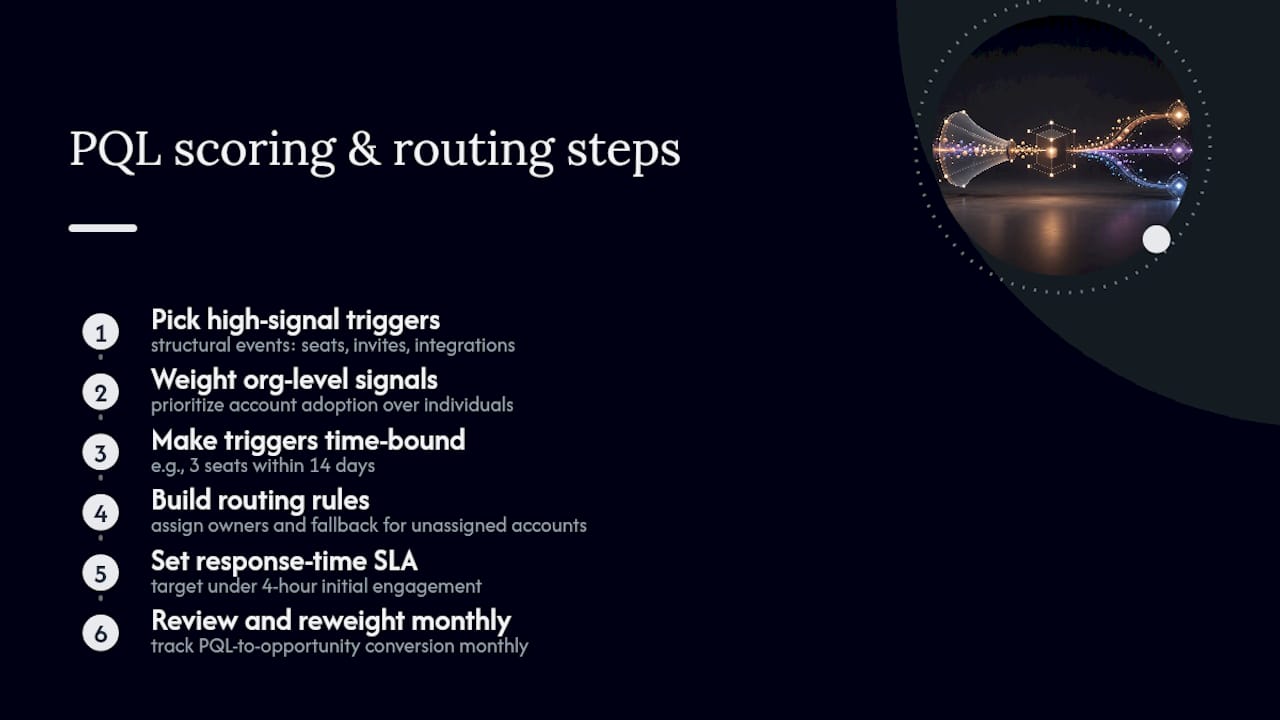
1. Pick your highest-signal triggers first. The strongest PQL indicators tend to be structural, not incidental: seats added within a short window, an admin user inviting teammates, a native integration connected, or a usage limit hit on a paid feature. A single user logging in daily is a weak signal on its own; an account adding three seats in fourteen days is a strong one.
2. Weight org-level signals over individual ones. A team of five hitting a plan limit together matters more than one power user maxing out their own account. Weight signals that indicate organizational adoption higher than signals that indicate individual enthusiasm, since organizational adoption is what actually predicts expansion revenue.
3. Make every trigger time-bound. “3 seats added within 14 days” is scoreable and actionable. “Growing usage over time” is not. Vague triggers create noisy PQL queues that reps learn to ignore within a month.
4. Build routing rules with ownership fallbacks. Decide who gets alerted when a PQL fires, and build in a fallback so an account with no assigned rep doesn’t sit untouched. Skipping this step is one of the fastest ways to duplicate outreach and damage the self-serve experience you worked to build.
5. Set a response-time SLA and hold reps to it. Response time is arguably the single biggest lever in the entire PLS model. Sub-four-hour engagement on a fresh PQL materially increases conversion, because the buyer’s context and intent are still fresh.
6. Review and reweight monthly. Pull your PQL-to-opportunity conversion rate by trigger type every month for the first two quarters. Triggers that convert poorly get deprioritized or dropped; triggers that convert well get more weight and, eventually, get automated deeper into your alerting.
Validation is not a one-time exercise. Treat your PQL model the way you’d treat a lead-scoring model in any mature revenue org: something you revisit on a cadence, not something you set once and trust forever.
None of the PQL scoring above works without a data pipeline that actually gets usage signals in front of a rep before the moment passes. This is the part of PLS that most teams underestimate, and it’s the part that most commonly breaks the whole motion.
Start with event tracking at the account level, not just the user level. You need to know not just that someone logged in, but that an account collectively hit a threshold: seats, integrations, feature usage, storage limits. Tools like Amplitude and Mixpanel are the standard here, and both vendors publish their own PLS instrumentation guidance because the underlying event architecture is nearly identical across SaaS products.
Once events are captured, they need to move somewhere reps can actually see them. That typically means:
Practitioner guidance is consistent on why the alerting layer matters as much as the scoring: without CRM integration and fast routing, PQLs go stale before a rep ever sees them. A PQL that sits in a queue for two days is functionally the same as no PQL at all, because the buyer’s context has moved on. If your organization is still routing product signals manually through spreadsheets or Slack screenshots, that’s the first thing to fix, and it’s exactly the kind of wiring problem a 90-day RevOps engagement is built to solve.
Most PLS motions start smaller than revenue leaders expect, and that’s by design. The sequence matters more than the org chart.
Start with founder-led or operator-led outreach. Before you hire a single sales rep, whoever runs the business should be personally reaching out to accounts that trip your first PQL trigger. This isn’t a permanent arrangement. It’s how you learn what messaging actually converts, because a founder talking to ten PQLs a week will find the right pitch faster than any rep working off a script someone else wrote.
Hire founding AEs once the pattern repeats. Once you can point to a trigger that reliably converts, and you have more PQLs than one person can handle, hire an AE whose entire job is working that queue. Not cold outbound. Not net-new logo hunting. PQL conversion and expansion.
Pro Tip: Compensate founding PLS reps on PQL-to-closed-won and expansion ARR, not raw new logos. If you pay them like outbound reps, they’ll quietly revert to outbound behavior within a quarter.
Scale headcount based on PQL volume, not on a hiring plan built in a spreadsheet. If one rep can’t work through the PQL queue in a normal week, that’s your signal to hire the next one. Hiring ahead of volume just creates reps who backfill their day with outbound work, which quietly turns your PLS motion back into a traditional SLG motion with extra steps. Sales Label Consulting’s sales team structure guidance covers this sequencing in more depth if you’re building the org chart from scratch.
You don’t need a full platform migration to start a PLS motion. You need four weeks of instrumentation, four weeks of learning, and four weeks of formalizing what worked.
Weeks 1 through 4: instrument and pick one trigger. Get account-level event tracking working for the handful of behaviors you already suspect matter, seat additions, admin invites, integration connections. Choose exactly one trigger to launch with. Wire a basic alert, even a Slack message, so someone sees it the moment it fires.
Weeks 5 through 8: run the outreach yourself. Whoever owns revenue at your company should personally work the PQL queue generated by that one trigger. Track what messaging gets a reply, what gets ignored, and how long from trigger to conversation actually takes. This is also when you validate whether your trigger is a real signal or just noise, since choosing one strong trigger to learn messaging fast is exactly what separates a working PLS motion from a stalled one.
Weeks 9 through 12: hire, formalize, and set SLAs. Once the pattern repeats reliably, hire your first founding AE and hand them the playbook you just built by hand. Formalize the response-time SLA (aim for sub-four-hour engagement), build the CRM fields to track PQL scores properly, and set up weekly reporting on PQL-to-opportunity conversion.
Ongoing: run a weekly signal review. Every week, pull the PQL queue and look at what converted, what stalled, and what got ignored. Reweight your scoring model monthly based on that data. This loop never really ends. Companies that stop iterating on trigger quality after the first quarter tend to watch conversion rates quietly decay as buyer behavior shifts.
Forrester’s readiness framework is worth reviewing before you start week one, since it lays out the cross-functional alignment PLS actually requires before you invest in headcount or tooling. Skipping that alignment check is how companies end up with a PLS motion on paper and a traditional cold-calling team in practice.
Four numbers tell you almost everything about whether your PLS motion is healthy. Track them from day one, even when volume is small enough to count on your fingers.
| Metric | What it measures | Why it matters |
|---|---|---|
| PQL-to-opportunity rate | Share of scored PQLs that turn into a real sales opportunity | Reveals whether your trigger definitions actually predict buying intent |
| PQL-to-closed-won rate | Share of PQL opportunities that convert to revenue | Shows whether your reps are converting qualified interest into closed deals |
| PQL response time | Time between trigger firing and first rep outreach | The single biggest lever in the model; sub-four-hour response tends to convert materially better |
| Expansion ARR from PQLs | Revenue growth from existing accounts flagged by usage signals | Confirms whether PLS is driving the expansion economics it’s supposed to |
Segment every one of these by source. Compare PQL-driven conversion against MQL-driven conversion and pure self-serve conversion separately, never blended. Blending the numbers hides exactly the thing you’re trying to measure, which is whether product signals outperform marketing signals as a qualification method. Salesforce’s guidance on measuring PLS success recommends this same segmented approach for exactly that reason.
Review PQL-to-opportunity weekly while you’re still learning your trigger. Review expansion ARR monthly, since that number moves more slowly and reacts to seasonal renewal cycles. If PQL-to-opportunity is trending down while volume is trending up, that’s usually a sign your trigger definition has gone stale, not that your reps have gotten worse at their jobs.
Most PLS failures trace back to one of four mistakes, and every one of them is avoidable if you catch it early.
PLS collapses fast when product, marketing, and sales are each optimizing for a different number. Product usually wants activation and retention. Marketing wants top-of-funnel volume. Sales wants closed revenue. None of those goals is wrong, but none of them alone tells you whether the PLS motion is healthy.
The fix is a shared definition of what qualifies as success at each stage, agreed on jointly, not handed down from one team to the others. That means product agrees to expose the usage events sales actually needs, marketing agrees to route self-serve signups into the same data pipeline instead of a separate nurture track, and sales agrees to work PQLs on the SLA the whole group set together. Forrester’s readiness framework treats this cross-functional agreement as a prerequisite, not a nice-to-have, and companies that skip it tend to discover the gap only after reps start bypassing product signals entirely and reverting to their old habits.
A practical starting point: put one person from each team in a recurring monthly review of PQL performance. Product explains what changed in the product that quarter. Marketing explains what changed in acquisition mix. Sales explains what’s converting and what’s stalling. That single meeting, held consistently, catches misalignment months before it shows up in a missed revenue number.
The fastest way to generate more qualified PQLs isn’t better sales outreach. It’s a better first-run experience, since a user who never reaches the “aha” moment in your product will never trip a meaningful usage trigger.

Map the specific actions that correlate with retention and expansion, then build onboarding flows that get new users to those actions as fast as possible. If inviting a teammate is your strongest PQL trigger, your onboarding should nudge every new user toward inviting a teammate in their first session, not their third week. In-app checklists, contextual tooltips, and milestone-based emails all work here, but only if they’re built around the specific behaviors your scoring model already treats as high-signal.
Engagement doesn’t stop at onboarding. Accounts that go quiet after an initial burst of activity are a warning sign worth its own alert, separate from your PQL triggers. A re-engagement nudge, whether that’s a lifecycle email or a proactive check-in from customer success, can revive an account before it churns silently. The connection back to PLS is direct: every engagement tactic that gets more users to a genuine usage milestone is also generating more raw material for your PQL model to work with.
A PQL is not a cold lead, and treating it like one wastes the entire advantage. of the model. The buyer has already used the product. Your outreach should prove you know that, in the first line.
Reference the specific trigger that flagged the account. If a team added three seats in two weeks, open with something about scaling usage across a team, not a generic “checking in” message. Mixpanel’s framing of this shift is worth internalizing: the rep’s job has moved from pitching a stranger to facilitating success for someone already active in the product. That reframing changes the entire tone of the outreach, from a pitch to a genuine check-in about whether the account needs help getting more value.
Keep the ask small and specific. Offer a fifteen-minute call about the specific limit they hit or the specific feature they’re underusing, not a generic demo of the whole product. And respect the response-time SLA religiously. A PQL outreach sent within four hours of the trigger reads as attentive. The same message sent three days later reads as an afterthought, even if the words are identical.
Not every PQL deserves the same outreach, and treating a five-person startup account the same way you treat a two-hundred-seat enterprise account wastes the specificity that makes PLS work in the first place.
Segment by account size, industry, and trigger type before a rep ever sends a message. A large account hitting a usage limit likely needs a conversation about enterprise features and procurement timelines. A small account hitting the same limit probably just needs a quick upgrade nudge, possibly without a human involved at all. Building this segmentation into your routing rules, rather than leaving it to rep judgment, keeps outreach consistent as volume grows.
Personalization in PLS works best when it’s grounded in the actual trigger data, not generic firmographic guesses. A message referencing the exact feature an account is bumping against will always outperform a message that just references company size or industry vertical. The segmentation and the personalization are really the same discipline: use the data you already have instead of falling back on assumptions.
Your pricing model determines how many PQLs you generate and how clean your triggers are, which makes it one of the most underrated levers in the entire PLS motion.
Usage-based and per-seat pricing models tend to generate the cleanest PQL signals, because hitting a plan limit or adding a seat is a direct, unambiguous action tied to willingness to pay. Flat-rate pricing with no natural expansion path generates far weaker signals, since there’s no plan limit for usage to bump against and no organic reason for a rep to reach out. If your pricing model has no room for a usage-based upgrade path, you’ll likely need to lean more heavily on feature-gating triggers instead, like a locked integration or an advanced reporting feature.
Free trials versus freemium tiers also change the shape of your PQL funnel. A time-boxed trial creates a natural urgency trigger (days remaining) that a freemium model doesn’t have, but freemium tends to generate a larger pool of long-term usage data to score against. Neither is strictly better. The right choice depends on whether your product delivers its core value quickly (trial-friendly) or needs sustained use to show its worth (freemium-friendly), and that choice should be made deliberately, not inherited from whatever the last pricing page happened to look like.
Most of the advice circulating about PLS treats it as a marketing rebrand of inbound sales, and that’s the wrong frame entirely. The conventional wisdom focuses too heavily on tooling, buy this platform, wire that integration, and not nearly enough on trigger design. A perfectly wired data stack feeding a bad PQL definition just produces fast, confident noise.
The judgment the evidence actually supports is this: PQL design and response time are the two levers that determine whether PLS works, and everything else, org structure, tooling, compensation, exists to serve those two things. Companies that get this backward hire a full sales team before they’ve validated a single trigger, then spend two quarters wondering why conversion rates look worse than their old outbound numbers.
What I’d prioritize first, if I were running this at a SaaS company today: pick one trigger, run the outreach personally for a month, and only then build the team and the stack around what actually converted. Everything else is sequencing detail.
— Antony
Sales Label Consulting is the practical alternative to guessing your way through a PLS rollout with borrowed frameworks from a vendor blog. We work directly with RevOps leaders, Heads of Sales, and VPs of Sales at B2B tech companies to design PQL scoring models, wire product analytics into your CRM, and build the response-time SLAs that make the whole motion convert.
A typical engagement starts with a sales audit to find where your current process leaks PQLs, followed by an enablement build to formalize the playbook your team will actually use. The deliverable isn’t a slide deck. It’s a working system: scored triggers, routed alerts, and a rep team compensated on the outcomes that matter. If you’re trying to figure out where your own PLS motion is leaking revenue, start with our sales enablement engagement and book a working session to map your first 90 days.
Subscribe to our Insights: Expert productivity tips in your inbox
You'll receive 1-3 emails per month. Your data stays private, always.

CRO & Co-Founder with Sales Label Consulting

Watch our Sales Mates Podcast
October 23, 2026 - 10 min read
Read article Read articleOctober 22, 2026 - 9 min read
Read article Read articleOctober 21, 2026 - 9 min read
Read article Read articleOctober 20, 2026 - 9 min read
Read article Read article