
Quote-to-Cash Process: A Step-by-Step Guide for RevOps
The quote-to-cash process (Q2C) is the full chain of events from the moment a rep builds a price quote to the moment cash from that deal lands in the bank and gets recognized as revenue. It’s broader than order-to-cash (O2C), which only covers what happens after a contract is signed. The single best measure of a healthy Q2C system is a mathematically billable quote, meaning every discount, pricing rule, and usage term is captured as structured data that flows straight into billing and ERP without anyone retyping numbers from a PDF.
You’ll know your Q2C is working in the first 90 days if you can track:
Pro Tip: If finance still has to “translate” a signed contract into your billing system by hand, you don’t have a Q2C process. You have a relay race with a blindfolded runner in the middle.
A quote-to-cash process only succeeds when every quote is mathematically billable and flows to invoicing without manual rekeying at any handoff.
| Point | Details |
|---|---|
| Q2C differs from O2C | Q2C covers quoting and contracting; O2C starts after signature and covers fulfillment through collections. |
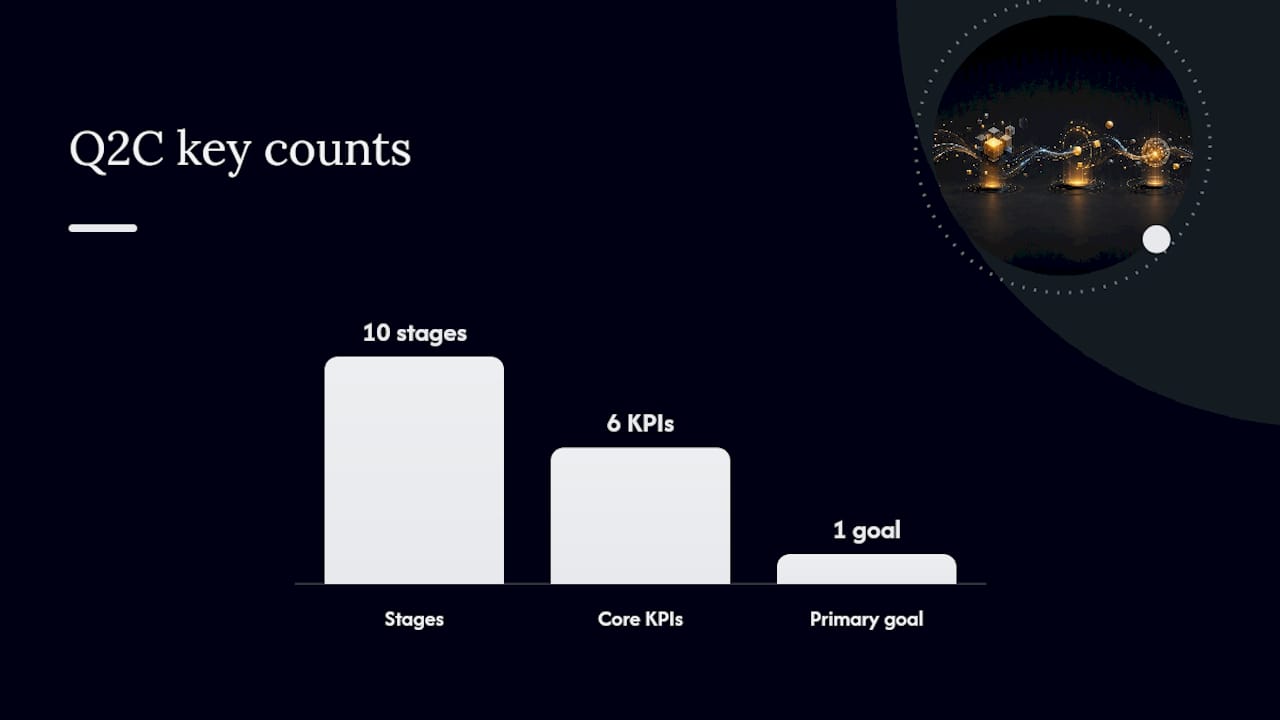
| Ten stages, one goal | Configuration through renewals must connect without manual data re-entry at any handoff point. |
| Upstream fixes pay off most | Fixing quoting and contracting problems often cuts DSO more than automating collections alone. |
| Track six core KPIs | Time-to-quote, invoice accuracy, and DSO show whether Q2C is actually improving. |
| Get expert diagnosis first | Saleslabelconsulting audits your Q2C stack to prioritize fixes before recommending new software. |
A complete quote to cash workflow runs through eight to ten connected stages, and each one has a rep, a system, or a finance team member who owns it. Salesforce frames this as a chain from configuration through revenue recognition, and skipping the integration between any two links is where most revenue leakage starts.
The handoff points between stages three and five, and again between six and eight, are where most companies bleed money. A quote that lives in a slide deck instead of a CRM record forces someone to rebuild it during contracting. A fulfillment event that doesn’t trigger billing automatically means invoices go out late, or not at all. Conga’s breakdown of the process makes the same point: disconnected systems create errors at exactly these junctions, and every manual step is a chance for someone to fat finger a number that finance won’t catch until the quarter closes.
Most Q2C failures cluster around a handful of repeat offenders, and you can usually spot them without a forensic audit.
Practitioner analyses suggest companies that map and fix these upstream problems can substantially cut DSO and reduce costs by a significant margin, and the bigger gains usually come from fixing quoting and contracting, not from buying a fancier collections tool.
Here’s the quick triage test: if the problem shows up before the contract is signed, it’s a Q2C issue. If it shows up after signature, in fulfillment, billing, or collections, it’s an O2C problem living inside your broader Q2C system.
Q2C isn’t one piece of software. It’s a set of systems that each own a piece of the lifecycle, and the whole thing only works if they talk to each other in real time.
The best practice across all of these is a single source of truth for pricing data, API based handoffs instead of file exports, and event driven billing triggers so an invoice fires the moment fulfillment confirms delivery. NetSuite’s own guidance is blunt about this: point solutions stitched together with manual exports lose data fidelity every time a record gets rekeyed.
Pro Tip: Draw your stack as a simple flow chart: CPQ feeds CLM, CLM feeds ERP, ERP feeds payments. Any arrow that requires a human to copy and paste data is a candidate for automation, full stop.
Run this checklist before you assume you need new software. Half the time, the fix is process, not platform.
Sample tests worth running: a data reconciliation test comparing CRM, CLM, and ERP records for the same deal, and a straightforward quote-to-invoice trace on your last quarter’s biggest accounts. Quick fixes often surface fast: locking discount fields in CPQ, or setting an automatic billing trigger on contract execution, can unlock cash within a single billing cycle.
Track these six, and you’ll know whether your Q2C is getting better or just getting more automated theater:
Pull these from your CRM, CLM, and ERP exports rather than estimating them from memory. Firms that fix upstream quoting problems before touching collections tools tend to see the DSO gains land faster than firms that automate invoicing alone.
Quick wins, like locking discount approvals or automating an invoice trigger, take under three months. Mid-size integration projects connecting CPQ to ERP run three to six months. Full enterprise overhauls with custom billing and multi-entity revenue recognition can run six to eighteen months.

The biggest cost drivers aren’t licenses. They’re integration complexity, custom billing models, contract volume, data migration, and how much change management your sales team actually needs. A simple ROI model: if automating billing triggers cuts DSO by even a few days on a large receivables balance, the freed-up cash often pays back the project cost before the first renewal cycle hits.
Score any vendor or consultant against six criteria: primary function (CPQ, CLM, billing, ERP, or payments), best-fit profile for your size and deal complexity, integration and API depth with your existing CRM, realistic time-to-implement, pricing model, and built-in revenue recognition support.
Ask vendors these questions directly: What happens to our data if we switch platforms later? What’s the real implementation timeline, not the sales deck timeline? Which integrations are native versus custom-built? Does revenue recognition handle usage-based and subscription terms out of the box?
The most common oversight isn’t picking the wrong software. It’s overhauling Q2C without first fixing who owns pricing governance. Give one team clear authority over discount rules before you automate anything, or you’ll just automate the chaos faster.
Pro Tip: Fix the pricing approval bottleneck before you touch the tech stack. It stops more revenue leakage than any integration project.
Saleslabelconsulting gets you a diagnosed, prioritized Q2C roadmap in weeks, not the six-month “discovery phase” a big systems integrator will sell you before touching a single workflow.
A Saleslabelconsulting engagement starts with a sales process audit that traces real deals through your CRM, CPQ, and billing systems to find exactly where revenue is leaking, whether that’s unauthorized discounts, rekeying errors, or a contracting bottleneck nobody’s owned in years. From there, we build a prioritized roadmap that separates quick wins you can ship in weeks from bigger integration work worth a longer engagement, and we help you evaluate vendors like Salesforce CPQ, Conga, NetSuite, or Paddle against your actual deal complexity, not a generic feature checklist. You get a plan built for your revenue engine, plus oversight through implementation so the fixes actually stick. Start with a sales process audit and get a roadmap you can act on immediately.
Subscribe to our Insights: Expert productivity tips in your inbox
You'll receive 1-3 emails per month. Your data stays private, always.

CRO & Co-Founder with Sales Label Consulting

Watch our Sales Mates Podcast
August 24, 2026 - 8 min read
Read article Read articleAugust 23, 2026 - 11 min read
Read article Read articleAugust 21, 2026 - 7 min read
Read article Read articleAugust 20, 2026 - 9 min read
Read article Read article