
GTM Audit: A Revenue Leader’s Guide for B2B Tech

GTM Audit: A Revenue Leader’s Guide for B2B Tech

Contents

A go-to-market (GTM) audit is a structured diagnostic of your entire revenue engine — people, process, technology, data, and pipeline — designed to surface where growth is leaking and what to fix first. Commission one when any of these three conditions are true:

  • Repeated missed targets: Your team is working hard, but quota attainment is inconsistent quarter after quarter.
  • Pipeline that looks full but underdelivers: Coverage ratios look healthy on paper, yet deals stall, slip, or close at lower ASPs than forecasted.
  • Pre-scale inflection or leadership change: You’re about to hire, raise, or hand off the revenue function and need a clean baseline.

If one of those fits, run an internal quick scan this week. If two or three fit, commission an external audit now.


Key Takeaways

A GTM audit is the fastest way to identify which part of your revenue engine is leaking — and to get a prioritized, 30-day plan to fix it before you hire, raise, or scale.

Point Details
Commission when targets slip Run an external audit when you miss targets repeatedly, pipeline underdelivers, or a scale event is approaching.
Insist on a scored framework A health score by GTM category lets you prioritize fixes by revenue impact, not by whoever shouts loudest.
Expect a 30-day turnaround A focused audit delivers a scored report and 90-day plan in four weeks; quick wins surface in week one.
Track 30/90/180 milestones Measure lead response, pipeline coverage, and forecast accuracy at 30 days; ARR per FTE at 180 days.
Saleslabelconsulting Delivers a full GTM audit with CEO discussion, scored assessment, and a prioritized 90-day plan for B2B tech firms.

Table of Contents

What does a GTM audit actually cover?

A thorough GTM assessment touches every lever that connects market demand to closed revenue. Here’s what belongs in scope, and why each area matters:

  • ICP and segmentation: Wrong targeting wastes outbound effort before a single call is made. Common audit findings include outbound campaigns aimed at accounts that were never a real fit.
  • Positioning and messaging: Generic messaging kills conversion at the top of the funnel. Audits check whether your value proposition is differentiated and resonates with the buyer’s actual pain.
  • Pricing and packaging: Misaligned pricing creates friction late in the sales cycle and compresses margins silently.
  • Sales motion and process: Audits map your actual sales process against how buyers buy today, validating exit criteria and qualification frameworks at each stage.
  • Pipeline health and forecasting: Stage-by-stage conversion rates, deal velocity, and forecast accuracy are scored against benchmarks.
  • Demand generation and channels: Which channels produce pipeline that closes — and which consume budget without attribution to revenue?
  • Tech stack and CRM/data hygiene: Poor CRM data hygiene is one of the most common findings. Audits check data completeness, duplicate records, and whether your stack is actually used.
  • RevOps and reporting: Are your dashboards measuring what drives revenue, or just activity?
  • Enablement and coaching: Content, playbooks, and coaching cadences are reviewed for alignment to the actual sales motion.
  • Team structure and compensation: Roles, territories, and incentive structures are checked for misalignment that suppresses performance.

Pro Tip: Attribution gaps tend to carry the highest leverage of any single finding. When you can’t link ad spend to closed revenue, you can’t scale what works — fixing attribution often frees significant budget immediately.


What does a strong GTM audit deliver?

The primary outcomes are concrete and measurable. A well-run GTM implementation review identifies revenue leaks by name, prioritizes fixes by impact, and gives you a 90-day plan you can execute without waiting for a strategy offsite.

Specific KPIs you should expect to move:

  • Stage-by-stage conversion rates (where deals are dying and why)
  • Speed-to-lead (slow lead response, often averaging 24–42 hours in B2B, is a recoverable quick win)
  • Pipeline coverage ratio (are you carrying 3x or more of quota in qualified pipeline?)
  • Win rate by segment (are you winning where your ICP is tightest?)
  • Forecast accuracy (within 10–15% of actual close)
  • ARR per FTE (the efficiency metric that matters most at scale)

A scored GTM assessment rolls individual category scores into an overall health score, so leadership can see revenue impact and implementation complexity side-by-side — which accelerates decision-making significantly.

Audit Finding Targeted KPI Expected Direction
ICP mismatch in outbound Win rate by segment Increase
Slow lead response time Speed-to-lead Decrease (hours)
Attribution gap in demand gen Cost per closed deal Decrease
CRM data hygiene issues Forecast accuracy Increase
Misaligned compensation ARR per FTE Increase

Deliverables from a full audit typically include a scored GTM health report, a prioritized 90-day growth plan, a KPI dashboard, and updated playbook recommendations. The sales audit explained framework from Saleslabelconsulting covers all of these in a structured five-step engagement.


How does the audit process work, step by step?

A 30-day audit cadence is the standard for a focused GTM review. Here’s how it breaks down:

  1. Week 1 — Scope, data collection, and quick wins. Define objectives with CEO/CRO sign-off. Pull CRM exports, pipeline data, campaign performance, and call recordings. Flag any immediate quick wins (e.g., a broken lead routing rule or a missing follow-up sequence).
  2. Week 2 — Diagnostic analysis and stakeholder interviews. Score each GTM category. Interview Sales leadership, RevOps/CRM owner, Marketing, and Finance. Map the actual sales process against documented process.
  3. Week 3 — Scored assessment and gap analysis. Consolidate scores into an overall GTM health score. Identify structural gaps versus process gaps versus data gaps. Validate findings with leadership.
  4. Week 4 — Prioritized 90-day plan delivery. Present the scored report with a tiered action plan: Foundations (Days 1–30), Activation (Days 30–60), Optimization (Days 60–90).
  5. Post-audit — Implementation support. The plan is only valuable if it gets executed. Agree on a governance model: who owns each workstream, what the review cadence looks like, and whether ongoing advisory support is included.

Before the audit kicks off, make sure your marketing analytics and website data are clean and accessible. Preparing these inputs ahead of time improves audit accuracy and reduces the time the implementation team spends on data cleanup rather than diagnosis.
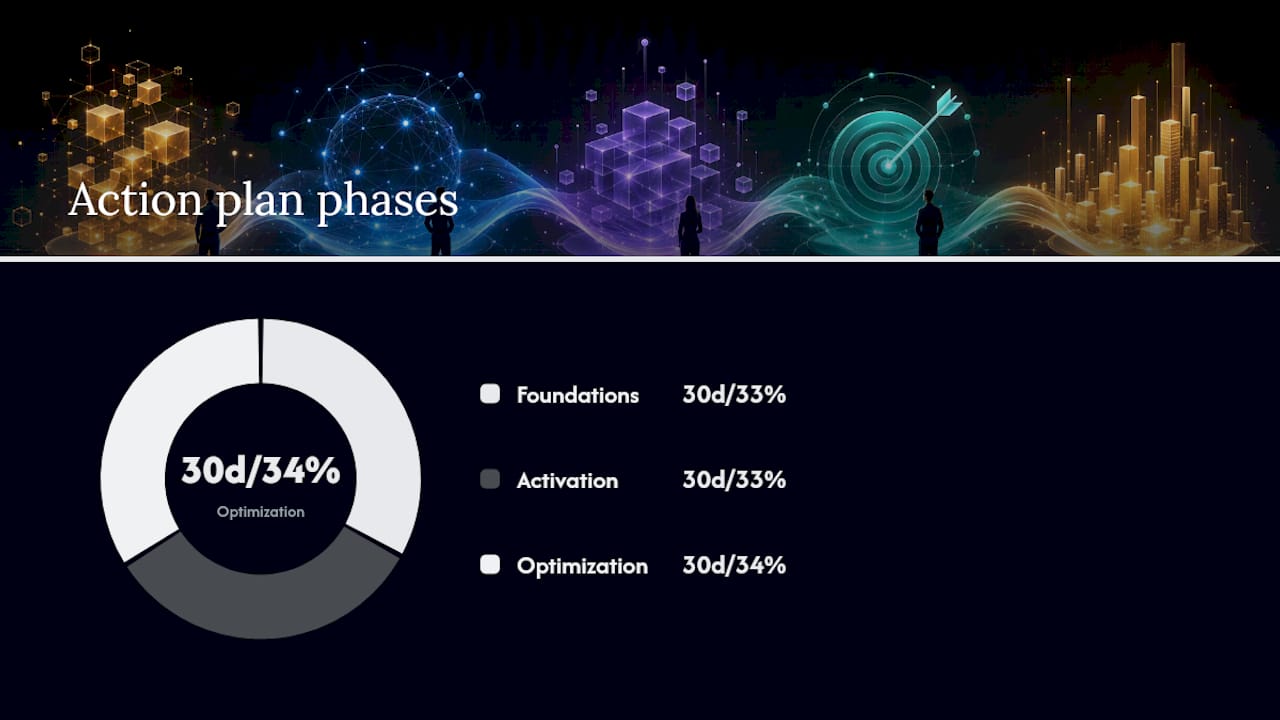

How does the audit process work, step by step? — overview diagram

What does a GTM audit cost in the U.S.?

Engagement models vary by scope and depth. Here’s how the market typically breaks down for B2B tech and IT firms:

  • Quick diagnostic (self-serve or light consulting): Free to $5,000. Covers a structured questionnaire, basic pipeline review, and a short findings summary. Good for an internal baseline before commissioning a full audit.
  • Short consulting audit (2–4 weeks): $8,000–$25,000. Covers core GTM categories, stakeholder interviews, a scored report, and a prioritized action plan. The most common entry point for Series A–B companies.
  • Full-scope GTM audit with implementation support (4–8+ weeks): $25,000–$75,000+. Includes all categories, deeper data analysis, playbook updates, and hands-on implementation support. Appropriate for companies at $5M+ ARR preparing to scale or restructure.
  • Ongoing retainer/advisory: $5,000–$15,000/month. Continuous GTM performance evaluation, quarterly reviews, and implementation accountability.

Main cost drivers: number of stakeholder interviews, depth of CRM and data analysis, whether implementation support is included, and the provider’s RevOps experience in your specific segment.

When evaluating proposals, check for: what’s explicitly included in scope, who owns the data after the engagement, what post-audit support looks like, and whether KPIs are tied to revenue outcomes rather than deliverable counts.


How do you choose the right GTM audit provider?

Evaluation criteria that actually matter:

  • Measurable methodology with a scored framework (not just a slide deck of observations)
  • Demonstrated RevOps experience in B2B tech or IT, not just general sales consulting
  • Sample deliverables you can review before signing
  • Client references from companies at a similar stage and segment
  • Clear KPI wiring: the provider should name the metrics they expect to move and by how much

Ten questions to ask any vendor:

  1. What’s your specific methodology for scoring GTM health?
  2. What data access do you need, and how do you handle CRM exports?
  3. Can you share a sample deliverable from a comparable engagement?
  4. What’s your timeline, and what are the milestones?
  5. Who on your team will actually do the work?
  6. What does post-audit implementation support look like?
  7. How is your pricing structured — fixed fee, time-and-materials, or retainer?
  8. What benchmarks do you use to score each GTM category?
  9. How do you prioritize recommendations when everything feels urgent?
  10. What does success look like at 90 days, and how do we measure it?

Red flags to walk away from: no access to raw CRM data, vague deliverables (“a strategic roadmap”), no prioritized plan, KPIs tied to activity rather than revenue, and over-reliance on tool outputs without human diagnostic work.

Pro Tip: A good audit avoids the reflex to hire or buy. Before recommending headcount, a credible provider checks seller-to-pipeline ratios and quantifies whether the bottleneck is capacity, process, or data — because hiring into a broken process just scales the problem.


Your RFP-ready GTM audit checklist

Use this checklist to scope an engagement or build an internal audit plan. The sales audit checklist from Saleslabelconsulting provides additional RFP-ready language for IT and B2B tech firms.

Audit activities to include in scope:

  • CRM data export and hygiene review (completeness, duplicates, stage definitions)
  • Deal-level pipeline analysis (velocity, conversion by stage, slippage patterns)
  • Call and demo recording sample review (5–10 calls minimum)
  • Campaign performance and attribution analysis
  • ICP definition and account scoring review
  • Pricing and packaging review against competitive context
  • Enablement content audit (playbooks, decks, objection handling)
  • Compensation and incentive structure review
  • Tech stack utilization review (what’s licensed vs. what’s used)
  • Org structure and role clarity review
Activity Deliverable Format Timing Owner
CRM data export and hygiene Scored data quality report Week 1 RevOps
Pipeline stage analysis Conversion waterfall chart Week 2 RevOps + Sales Lead
Stakeholder interviews Interview summary memo Week 2–3 Consultant
GTM category scoring Scored health report Week 3 Consultant
90-day prioritized plan Action plan document Week 4 Consultant + CEO

How to commission an audit and track success at 30/90/180 days

Internal prep steps before the kickoff:

  1. Brief your RevOps lead, Head of Sales, and CFO on scope and expected time commitment.
  2. Pull 12 months of CRM data, pipeline history, and campaign performance reports.
  3. Schedule stakeholder interviews in the first week of the engagement.
  4. Grant data access to the consulting team with clear security parameters.
  5. Assign an internal project owner who has authority to unblock data requests.

Metrics to track by milestone:

  • 30 days (quick wins): Lead response time reduced, broken routing rules fixed, CRM data completeness improved, at least one attribution gap closed.
  • 90 days (activation): Stage conversion rates moving in the right direction, pipeline coverage ratio at or above 3x, forecast accuracy within 15% of actual.
  • 180 days (revenue uplift): Win rate improvement in core ICP segments, ARR per FTE trending up, demand generation spend reallocated to channels with proven attribution.

Preparing your website analytics and tracking data before the audit starts shortens the diagnostic phase and gives the consulting team cleaner inputs from day one.


What most GTM audits get wrong

Real talk: most GTM audits fail not because the diagnosis is wrong, but because the output is a slide deck nobody acts on. The finding becomes a conversation piece at the next board meeting, and six months later the same revenue leaks are still open.

The audits that actually move ARR share one trait — they’re built around a prioritized, time-bound plan with named owners, not a list of observations. A scored health report is only useful if it tells you which three things to fix first and who’s accountable for each one. Without that, you’ve paid for a diagnosis and skipped the treatment.

The other pattern worth naming: leaders often commission an audit when they suspect a people problem, and the audit reveals a process or data problem. A credible GTM assessment checks seller-to-pipeline ratios and CRM data quality before recommending any headcount change. Hiring into a broken process scales the problem, not the revenue.


Saleslabelconsulting delivers a GTM audit built for B2B tech revenue leaders

If your pipeline is underperforming and you need a clear answer — not a 60-slide deck — Saleslabelconsulting runs a focused GTM audit that delivers a scored health report and a prioritized 90-day plan within 30 days. No fluff, no vague “strategic recommendations.” You get a CEO-level discussion of findings, a structural analysis of your revenue system, and a concrete action plan with named owners.
Saleslabelconsulting

Engagement options: a quick diagnostic to establish a baseline, a short 2–4 week audit for early-stage teams, a full-scope audit with implementation support for companies at $5M+ ARR, or an ongoing advisory retainer. Every engagement includes the sales enablement step-by-step framework so audit findings connect directly to execution. Review the full services overview or go straight to the audit engagement page to book a scoping call.


Sources

  • Why Audit a Website: Uncover SEO Issues & Boost Performance

Subscribe to our Insights: Expert productivity tips in your inbox

    You'll receive 1-3 emails per month. Your data stays private, always.

    Oleksii Sinichenko
    Oleksii Sinichenko

    CRO & Co-Founder with Sales Label Consulting

    Sales expert

    Watch our Sales Mates Podcast

    Related articles

    Fix the System
    Not Symptoms

    Diagnose
    Your
    Revenue
    System

      Be advised that by submitting this form, you agree to have read and accepted our Privacy Policy