
Predictable Revenue Generation Steps for Tech Sales Leaders
TL;DR:
- Predictable revenue depends on a structured process with four core pillars and a disciplined 90-day cycle.
- Focusing on two or three growth strategies at a time prevents resource dilution and enhances measurable results.
Predictable revenue generation is defined as a repeatable, measurable sales process that aligns execution with strategic goals to produce consistent, forecastable growth. For sales leaders in technology companies, this means moving beyond gut instinct and heroic individual deals. The four core pillars of a predictable revenue engine are strategic territory and quota planning, AI-powered forecasting, real-time performance management, and transparent commissions. Structure beats heroics every time. When these pillars work together, your team stops reacting to the market and starts driving it.
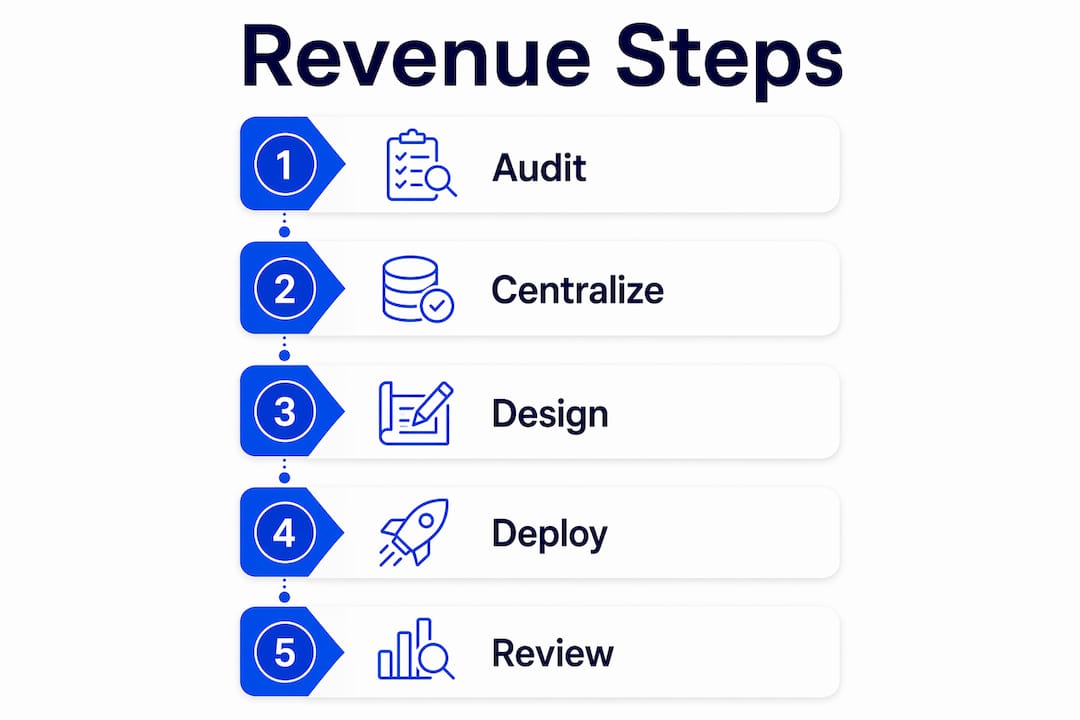
Before you run, you need to walk. The predictable revenue generation steps that actually stick begin with a clear-eyed audit of where you are today, not where you wish you were.
Start with a sales and revenue process audit. Map every stage of your current pipeline: lead source, qualification criteria, handoff points between marketing and sales, and close rates by segment. You’re looking for gaps, not wins. A sales process audit surfaces the exact friction points that kill forecast accuracy before you even open a spreadsheet.

Establish a single source of truth. Consolidating sales systems into one unified data environment improves both transparency and forecast reliability. That means clear data ownership, defined update frequency, and validation rules that everyone follows. Without this, your forecasts are built on sand.
Align your teams on shared definitions. Sales, marketing, and RevOps must agree on what counts as a qualified lead, what “committed” means in the pipeline, and how ARR is calculated. Misaligned terminology is one of the most common and most expensive audit pitfalls. Run a 30-minute terminology alignment session before you touch any tooling.
The essential data fields you need to track from day one include:
Pro Tip: Don’t try to clean all your CRM data at once. Pick the five fields that directly feed your forecast model and get those right first. Perfect data hygiene across 200 fields is a fantasy. Accurate data on the fields that matter is a competitive advantage.
Once your foundation is solid, you execute in phases. The standard framework runs on a 90-day quarterly cycle, moving from design to execution to review. Here’s how to sequence it:
Design territory and quota plans from data. Pull 12 months of historical performance by rep, segment, and geography. Assign territories based on market potential, not seniority or politics. Quota should reflect realistic attainment, not a CFO’s wish list. Reps who believe their quota is fair close more deals. That’s not a soft point. It’s a retention and performance fact.
Deploy AI-powered forecasting. AI forecasting tools analyze deal signals and historical pipeline patterns to shift your focus from lagging indicators to leading ones. The target is forecast accuracy within 10% of actual results. That level of precision lets you make confident headcount, marketing spend, and capacity decisions without waiting for the quarter to close.
Build real-time performance dashboards. Every rep and manager needs visibility into their own numbers, updated daily. Real-time performance management removes the “I didn’t know I was behind” excuse and gives managers the data to coach proactively rather than reactively. Dashboards should show pipeline coverage, conversion rates, and deal velocity at minimum.
Automate commission structures. Manual commission calculations create errors, disputes, and distrust. Automate the calculation and make the logic visible to every rep. When people can see exactly how their behavior connects to their paycheck, they change their behavior. That’s the whole point of a commission plan.
Run 90-day sprint reviews. At the end of each quarter, score each pillar: Did territory design hold up? Did forecasting hit within range? Did dashboards drive the right conversations? Did commissions reward the right behaviors? Adjust one variable at a time so you know what’s actually working.
Prioritize your growth levers deliberately. Moving all four growth levers simultaneously, which are volume, conversion rate, deal size, and retention, dilutes your effort and produces mediocre results across the board. Pick two or three for each 90-day sprint and go deep.
Pro Tip: In your first 90-day cycle, don’t touch commissions until territory and forecasting are stable. Changing comp plans while the data foundation is still shifting creates chaos. Sequence matters.
Knowing the steps is one thing. Choosing the right revenue plays to run alongside them is another. The real talk here is that most tech companies try to do too much at once.
B2B revenue generation works best when you focus on three or four parallel plays rather than spreading resources across every possible channel. Customer expansion alone can contribute up to 70% of potential growth in some models. That number should make you rethink how much attention you’re giving your existing accounts versus chasing net new logos.
The right strategy also depends on your company’s stage. Early-stage tech firms generate qualified pipeline fastest through founder-led outbound prospecting, often within two to four weeks. Heavy investment in content marketing or channel partnerships at that stage is a distraction. Growth-stage companies can layer in intent-based marketing and account-based outreach. Scale-stage companies need all channels firing with clear attribution models.
Here’s a practical comparison of common B2B revenue strategies:
| Strategy | Best stage | Time to first impact | Primary use case |
|---|---|---|---|
| Founder-led outbound | Early | 2–4 weeks | Qualified meeting generation |
| AI-driven outbound prospecting | Growth, Scale | 4–8 weeks | Pipeline volume at scale |
| Intent-based marketing | Growth, Scale | 6–10 weeks | High-fit inbound demand |
| Customer expansion (upsell/cross-sell) | All stages | 2–6 weeks | ARR growth from existing base |
| Channel and partner programs | Scale | 3–6 months | Market coverage expansion |
The risk of spreading too thin is real. When you run five strategies with half-committed resources, none of them generate enough signal to optimize. You end up with inconclusive data and a frustrated team. Pick your plays based on stage, capacity, and where your best customers actually came from. For a broader view of how these plays connect to your overall growth engine, the RevOps growth guide from Saleslabelconsulting covers the full picture.
Pro Tip: Review your revenue stream mix at least once per quarter. What worked in Q1 may not be the right play in Q3 as market conditions shift.
Even well-designed revenue processes break down. Here’s where most tech sales teams hit the wall and what to do about it.
Forecasting inaccuracy caused by bad data. The fix is not a better forecasting tool. The fix is data discipline upstream. Revenue predictability depends on tracking customer lifetime value, conversion rates, acquisition costs, and sales productivity as a connected system. If any one of those inputs is unreliable, the forecast breaks. Assign a data owner for each critical field and review data quality weekly, not quarterly.
Resistance to territory or quota changes. Reps push back on changes when they feel the process was arbitrary. The solution is transparency. Show the data behind every territory boundary and quota number. When reps can see that their number was built from actual market potential and historical attainment, resistance drops significantly. Use a short “quota rationale” document for every rep at the start of each cycle.
Commission conflicts and disputes. Disputes happen when the rules are ambiguous or when the calculation is a black box. Automation removes the black box. Clear written rules remove the ambiguity. Both are non-negotiable for a high-trust sales culture.
Pro Tip: When a rep’s performance drops, check their pipeline age before you check their activity metrics. Stale pipeline is almost always the root cause, and it’s fixable faster than you think.
Predictable revenue generation requires four interdependent pillars, a disciplined 90-day execution cycle, and a deliberate focus on two or three growth levers at a time.
| Point | Details |
|---|---|
| Audit before you build | Map your current pipeline and data quality before changing any process or tool. |
| Four pillars drive predictability | Territory planning, AI forecasting, performance dashboards, and automated commissions must work together. |
| Focus beats breadth | Run two or three revenue plays per quarter rather than spreading effort across every channel. |
| Stage determines strategy | Early-stage teams win fastest with founder-led outbound; growth and scale stages need layered plays. |
| Leading metrics prevent surprises | Track pipeline coverage, conversion rates, and deal velocity weekly to catch problems early. |
The most common mistake I see sales leaders make is treating predictable revenue as a technology problem. They buy a new CRM, add an AI forecasting layer, and expect the numbers to stabilize. They don’t. Technology amplifies the process you already have. If the process is broken, the tech just makes the mess more visible faster.
The leaders who actually achieve consistent revenue growth do two things differently. First, they get leadership alignment before they touch the process. If the CRO, VP of Sales, and Head of RevOps aren’t speaking the same language about what “predictable” means, every initiative stalls at the first sign of friction. Second, they build for the long term while shipping short-term wins. A 90-day sprint is not a shortcut. It’s a deliberate choice to prove the model works before scaling it.
The other thing I’d push back on is the idea that AI replaces human judgment in forecasting. It doesn’t. AI surfaces patterns that humans miss. But the decision about which deals to accelerate, which reps need coaching, and which territories need redesigning still requires a human who understands the context. The interdependent components of revenue generation mean that a failure in one area, whether that’s pricing, retention, or go-to-market execution, reduces the efficiency of the entire engine. No algorithm catches that. A good sales leader does.
Annual planning cycles are increasingly ineffective as a standalone practice. Real-time revenue management is the new standard because markets move faster than a once-a-year plan can accommodate. Build the habit of monthly reviews and quarterly resets. That cadence is what separates teams that hit their number from teams that explain why they didn’t.
— Antony
Saleslabelconsulting works directly with RevOps leaders, Heads of Sales, and VPs of Sales in technology companies to implement the exact processes described here. The work covers sales enablement, sales audits, and demand generation, each designed to produce measurable, repeatable results rather than one-time fixes.
If you’re ready to move from reactive growth to a structured revenue engine, the sales enablement program at Saleslabelconsulting walks you through every step with hands-on support. You can also explore sales enablement best practices to see how other tech companies have applied these frameworks at scale. The process works. The question is how fast you want to get there.
The core steps are: audit your current process, establish a single data source, design territory and quota plans, deploy AI forecasting, build real-time dashboards, and automate commissions. These run on a 90-day quarterly cycle for maximum impact.
AI forecasting tools that analyze deal signals and historical pipeline patterns typically achieve accuracy within 10% of actual results. That level of precision supports confident decisions on headcount and spend before the quarter closes.
Focus on three or four parallel revenue plays at most. Spreading resources across more channels dilutes effort and produces inconclusive data. Stage matters: early-stage teams win fastest with founder-led outbound, while growth-stage companies layer in intent-based marketing.
Customer lifetime value, conversion rates, customer acquisition cost, and sales productivity are the four metrics most directly tied to pipeline predictability. Track them weekly, not monthly, to catch problems before they hit the forecast.
Most fail because teams try to fix all revenue levers at once. Focusing on two or three growth levers per 90-day sprint prevents resource dilution and produces measurable, repeatable improvements.
Subscribe to our Insights: Expert productivity tips in your inbox
You'll receive 1-3 emails per month. Your data stays private, always.

CRO & Co-Founder with Sales Label Consulting

Watch our Sales Mates Podcast
September 20, 2026 - 13 min read
Read article Read articleSeptember 19, 2026 - 13 min read
Read article Read articleSeptember 18, 2026 - 10 min read
Read article Read articleSeptember 17, 2026 - 16 min read
Read article Read article