
What Is Account Based Selling: 2026 B2B Guide
TL;DR:
- Account-based selling focuses on targeting high-value accounts with personalized outreach to multiple stakeholders. Success depends on cross-team alignment, data quality, and coordinated multi-channel campaigns, leading to larger deals and faster sales cycles. Organizational friction and poor data management commonly hinder scaling, but structured processes enhance results significantly.
Account-based selling (ABS) is defined as a focused B2B sales strategy where teams prioritize a curated list of high-value target accounts and engage multiple stakeholders within each account through personalized outreach, rather than chasing raw lead volume. The industry also refers to this as account focused sales or, when marketing is fully integrated, account-based marketing (ABM). ABS treats each prospective account as its own market. You build a Target Account List (TAL) using firmographic data, technographic signals, and buying intent platforms like Bombora and G2, then coordinate Sales, Marketing, and Customer Success around that list to drive qualified pipeline and revenue from the accounts that actually matter.
ABS runs through five core stages: Account Selection, Awareness, Consideration, Decision, and Advocacy. Each stage has a clear owner, a defined set of tactics, and measurable exit criteria. Here is how it plays out in practice.
Multi-channel coordination is where most teams leave money on the table. Coordinated campaigns within a 14-day window combining LinkedIn ads, display retargeting, personalized emails, and SDR calls increase response rates by 200–300% compared to single-channel outreach. That is the surround effect in action.
Pro Tip: Before any outreach goes out, run your contact list through an email verification tool like NeverBounce or ZeroBounce. Poor-quality firmographic data inflates your account list and burns SDR cycles on contacts who will never respond. Clean data is not a nice-to-have. It is the foundation.
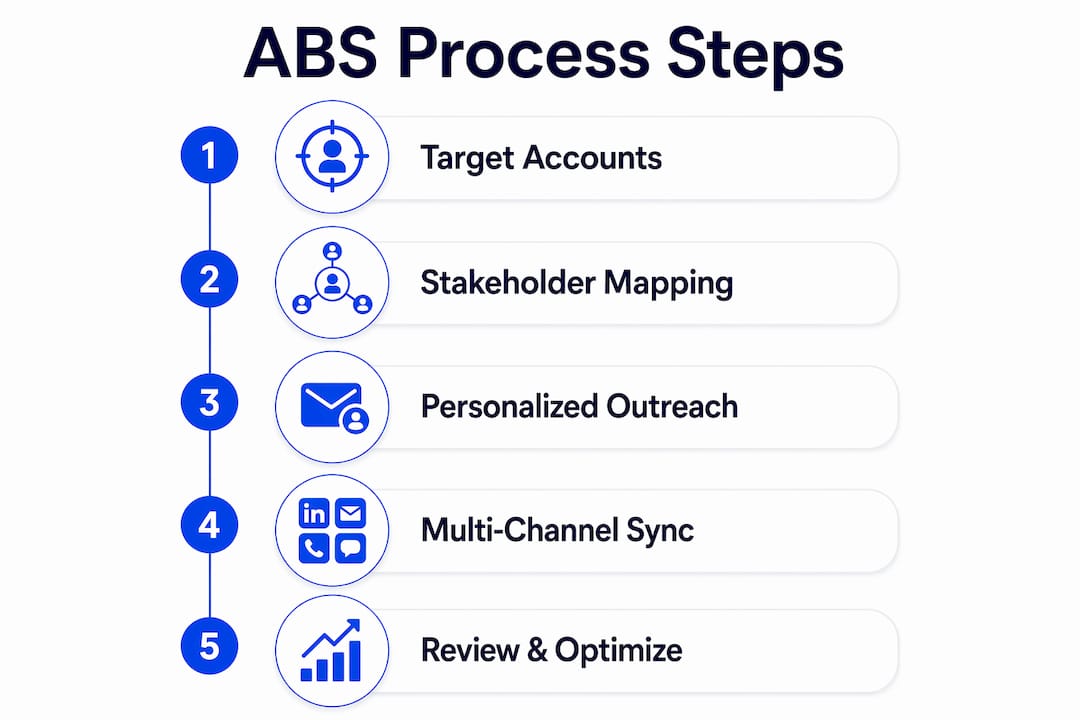
ABS shifts your success metrics from lead volume to qualified pipeline and revenue from target accounts. That shift changes everything about how your team operates, measures performance, and allocates resources.
Here is what you actually gain:
“ABS is not solely a sales or marketing initiative. Effective execution demands unified cross-departmental collaboration and shared account intelligence.” — HubSpot Sales Blog
That quote captures the real talk here. If your VP of Sales owns ABS but Marketing is still running separate campaigns, you do not have an ABS program. You have a naming exercise.
Pro Tip: Segment your accounts into tiers before you build any campaigns. Matching ABS tier to revenue motion is the single biggest lever for program efficiency. Use 1:1 for large strategic accounts, 1:few for clusters of similar mid-market accounts, and 1:many for new segment penetration.
Account-based marketing (ABM) is the go-to-market philosophy that B2B buying happens at the account level, not the lead level. ABS is the sales execution layer that operates within that philosophy. They are not the same thing, but they are not separate programs either.
Here is a direct comparison:
| Dimension | Account-Based Selling (ABS) | Account-Based Marketing (ABM) |
|---|---|---|
| Primary owner | Sales (SDRs, AEs) | Marketing |
| Core objective | Outreach, pipeline creation, deal progression | Awareness, engagement, demand generation |
| Key inputs | TAL, persona maps, intent signals | TAL, content assets, ad campaigns |
| Success metric | Pipeline from target accounts, closed revenue | Account engagement score, MQAs |
| Shared elements | Target Account List, personalization, intent data | Target Account List, personalization, intent data |
The shared elements column is where alignment lives. Both ABS and ABM run off the same TAL. Both personalize at the account and persona level. The difference is who executes and what they measure. When Sales and Marketing operate from separate lists or separate definitions of a target account, the program fails. Cross-departmental alignment is not a soft skill here. It is an operational requirement.
ABM strategies and ABS tactics reinforce each other when the handoff is clean. Marketing warms the account. Sales enters with context. Customer Success expands with intelligence. That is the full loop.
Knowing how to implement ABM and ABS correctly separates teams that see results in 90 days from teams that spend six months building spreadsheets and calling it a program. Here are the practices that actually move the needle.
Map your buying committee before you build a single sequence. Failure to map individual stakeholders within accounts leads directly to missed opportunities. Economic buyers, technical evaluators, champions, and blockers each need different messaging and different entry points. If your SDR is only talking to one contact per account, you are not doing ABS.

Align teams early and keep them aligned. Misalignment between Sales, Marketing, and Customer Success is the leading cause of ABS strategy failure. Set a shared definition of a target account. Agree on what “engaged” means. Review the TAL together on a monthly cadence, not quarterly.
Use intent data dynamically. Accounts should enter and exit your TAL based on live buying signals, not a static list you built in January. Bombora topic surges, G2 product page visits, and job posting signals all indicate when an account is in-market. Static lists decay fast.
Match program type to business reality. No single targeting pattern fits all business sizes or revenue motions. A 20-person sales team running 1:1 programs on 500 accounts will burn out. A 200-person team running only 1:many will leave enterprise revenue on the table. Be honest about your capacity.
Pro Tip: Coordinate your channel timing tightly. Multi-channel campaigns within a 14-day window create the surround effect that buying committees actually notice. Run LinkedIn ads, retargeting, personalized email, and SDR calls in the same two-week sprint. Spread them out and the effect disappears.
You can also review common ABS implementation mistakes to avoid the errors that slow most teams down before they ever see results.
Account-based selling succeeds when Sales, Marketing, and Customer Success operate from the same target account list, the same intent data, and the same definition of a qualified account.
| Point | Details |
|---|---|
| ABS definition | ABS targets curated high-value accounts with personalized, multi-stakeholder outreach instead of chasing lead volume. |
| Five-stage workflow | Move accounts through Selection, Awareness, Consideration, Decision, and Advocacy with clear owners at each stage. |
| Tier your accounts | Use 1:1 for $500k+ ACV deals, 1:few for mid-market clusters, and 1:many for new segment penetration. |
| Data quality is non-negotiable | Verify firmographic data and email deliverability before outreach to protect SDR cycles and conversion rates. |
| Alignment drives results | ABS fails without shared account intelligence across Sales, Marketing, and Customer Success. |
Real talk: I have seen more ABS programs fail from organizational friction than from bad strategy. The playbook is not complicated. The execution is.
The most common pattern I observe is this: Sales builds a target account list, Marketing keeps running their own campaigns, and Customer Success is never looped in until renewal. Everyone calls it ABS. Nobody is actually doing it. The result is a pipeline that looks good in a slide deck and underperforms in the CRM.
The shift that changes outcomes is treating ABS as a revenue operations discipline, not a sales tactic. When RevOps owns the TAL governance, when Marketing’s budget is tied to account engagement scores rather than MQL volume, and when Customer Success feeds expansion signals back into the active account list, the program starts compounding. That compounding is what separates a team growing 20% year-over-year from one growing 80%.
Data quality is the other thing I push hard on. I have watched SDR teams spend entire quarters working lists that were 40% outdated. Firmographic data decays faster than most teams realize. Companies get acquired, contacts change roles, tech stacks shift. If you are not enriching and verifying your TAL on a rolling basis, you are not running ABS. You are running a very expensive spray-and-pray with a better name.
The future of ABS is AI-driven intent data and automated TAL management. Platforms are already surfacing predictive buying signals that human analysts would miss. Teams that build the operational discipline now will absorb those tools faster and compound their advantage further.
Structure beats heroics. Build the system, align the teams, and the results follow.
— Antony
Understanding account-based selling is step one. Operationalizing it across Sales, Marketing, and Customer Success is where most teams need a clear framework and experienced guidance.
Saleslabelconsulting works directly with RevOps leaders, Heads of Sales, and VPs of Sales to build ABS programs that generate predictable pipeline from the accounts that actually move your ARR. From TAL design to cross-team alignment to intent data integration, we cover the full execution layer. If you are ready to move from theory to a working program, start with our sales enablement framework built specifically for B2B teams targeting high-value accounts. You can also explore scalable outreach workflows that support the multi-channel coordination ABS requires.
Account-based selling is a B2B sales strategy where teams focus outreach on a curated list of high-value target accounts rather than pursuing every inbound lead. Each account is treated as its own market, with personalized messaging directed at multiple stakeholders.
Traditional outbound sales prioritizes lead volume and broad prospecting. ABS prioritizes pipeline quality by targeting specific accounts using firmographic, technographic, and intent data to engage the full buying committee.
Account tier determines list size. Strategic Tier 1 accounts represent 5–10% of total targets, Core Tier 2 accounts make up 20–25%, and Expansion Tier 3 fills the remaining 65–75%.
ABS teams commonly use intent data platforms like Bombora and G2, CRM systems like Salesforce or HubSpot, email verification tools like NeverBounce, and LinkedIn Sales Navigator for stakeholder mapping and multi-channel outreach coordination.
Most well-structured ABS programs show measurable pipeline impact within 60–90 days of launch, provided the TAL is clean, buying committees are mapped, and Sales and Marketing are running coordinated campaigns from day one.
Subscribe to our Insights: Expert productivity tips in your inbox
You'll receive 1-3 emails per month. Your data stays private, always.

CRO & Co-Founder with Sales Label Consulting

Watch our Sales Mates Podcast
October 19, 2026 - 10 min read
Read article Read articleOctober 18, 2026 - 10 min read
Read article Read articleOctober 17, 2026 - 7 min read
Read article Read articleOctober 16, 2026 - 8 min read
Read article Read article